
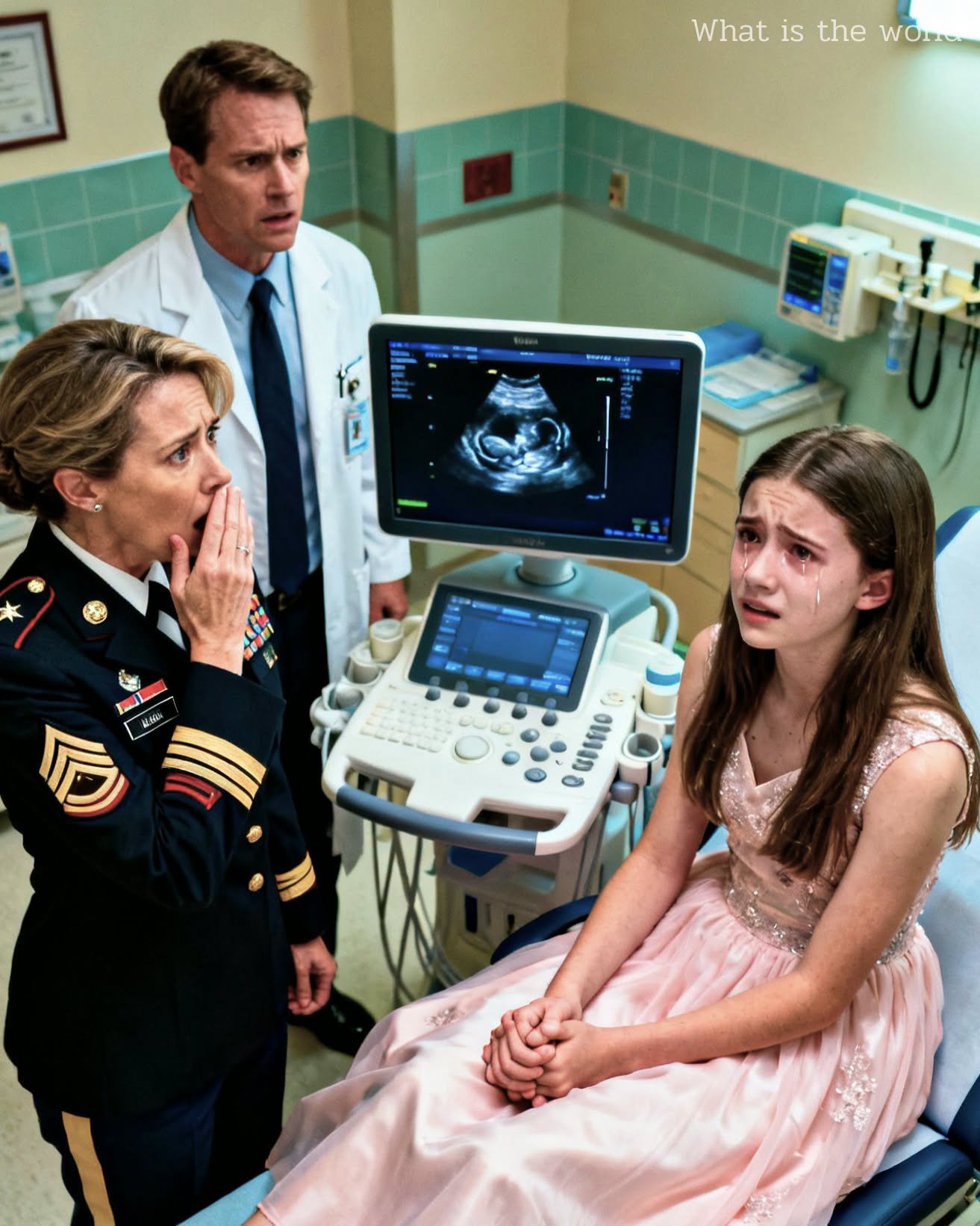
The doctor’s hand froze against Madison’s abdomen.
Until that moment, Dr. Elena Ruiz had spoken in the calm, measured voice of someone accustomed to frightened parents. She had asked Madison when the pain began, whether it changed after meals, whether she had experienced fever, vomiting, or changes in her menstrual cycle. She had explained every movement before gently pressing along the right side of Madison’s stomach.
Then she reached the lower left side.
Madison inhaled sharply.
Her fingers closed around mine with surprising strength.
Dr. Ruiz stopped.
“Does it hurt more there?” she asked.
Madison nodded, her face turning pale.
The doctor pressed again, more carefully this time. A crease appeared between her eyebrows.
“What is it?” I asked.
Dr. Ruiz did not answer immediately. She withdrew her hand, pulled the blanket back over Madison, and looked toward the nurse standing beside the computer.
“Please order a pelvic ultrasound,” she said. “Urgent.”
The nurse’s expression changed too.
“And contact gynecology.”
My mouth went dry.
“Gynecology?”
Dr. Ruiz turned back to us. Her voice remained gentle, but something guarded had entered it.
“I can feel a significant area of fullness in Madison’s lower abdomen. There are several possible explanations, and an ultrasound will give us a much clearer picture.”
“What kind of explanations?”
“It could be a cyst. It could be inflammation. It could be something involving one of the ovaries.” She paused. “Right now, I don’t want to speculate.”
Madison stared at her.
“Am I going to need surgery?”
“We don’t know yet.”
The doctor’s answer was honest, which frightened me more than false reassurance would have.
I moved closer to the bed and slipped my arm around Madison’s shoulders.
“You’re in the right place,” I whispered.
She nodded, but her eyes had filled with tears.
The nurse began typing rapidly.
Dr. Ruiz asked Madison several more questions, this time about symptoms I had not thought to connect. Had her clothes begun fitting differently? Had she felt full after eating only a little? Had the pain ever spread into her back? Had she experienced pressure when using the bathroom?
Madison answered yes to almost all of them.
Each answer felt like another door closing behind us.
“How long has this been happening?” Dr. Ruiz asked.
Madison looked at me before replying.
“The pain started about six weeks ago.”
I turned toward her.
“Six weeks?”
She lowered her eyes.
“At first it wasn’t that bad.”
“You told me it had been a few weeks.”
“I didn’t want you and Dad to fight.”
The words landed softly, but they carried the weight of an accusation.
Dr. Ruiz glanced at me, then back at Madison.
“Has anyone examined you before today?”
“No.”
“Have you taken anything for the pain?”
“Sometimes ibuprofen.”
“Did it help?”
“Not really.”
Dr. Ruiz pulled a stool beside the bed.
“Madison, I need you to hear something clearly. None of this is your fault. You did the right thing by telling someone, and you are doing the right thing by being here.”
Madison pressed her lips together.
I could see how hard she was trying not to cry again.
The doctor stood.
“We’re going to move quickly. That doesn’t necessarily mean the worst. It means I don’t want you waiting any longer than you already have.”
After she left, the room seemed unnaturally quiet.
Machines hummed beyond the curtain. A cart rattled down the hallway. Somewhere nearby, a child complained about wanting to go home.
Madison looked at the clock.
“Dad thinks I’m at school.”
“I know.”
“What are you going to tell him?”
“The truth.”
“When?”
I looked at my phone. Three missed calls from the office. Two messages from my husband.
The first asked whether I had remembered to pay the electricity bill.
The second said he would be home late because a client meeting had been moved.
I turned the screen facedown.
“When we know what we’re dealing with.”
Madison watched me carefully.
“He’s going to be mad.”
“I’m not worried about him being mad.”
That was not entirely true.
For seventeen years, I had built my daily life around preventing my husband’s displeasure. I checked grocery receipts before coming home. I postponed replacing worn shoes. I turned the thermostat lower in winter and higher in summer. I had learned to present ordinary household needs like proposals before a committee.
Mark never called it control.
He called it responsibility.
And because the bills were paid, the mortgage was current, and our home looked peaceful from the outside, I had allowed myself to call it responsibility too.
But sitting beside Madison in that hospital room, I finally understood the cost of keeping that peace.
My daughter had learned to suffer quietly.
A transport aide arrived with a wheelchair.
Madison frowned.
“I can walk.”
“Hospital policy,” the aide said kindly.
Madison started to argue, but when she slid off the bed, her knees nearly gave way. I caught her elbow.
She looked embarrassed.
“No one here is judging you,” I said.
The ultrasound department was two floors below. The aide pushed Madison through long corridors painted in muted blues and grays. Fluorescent lights reflected against the polished floor. Nurses passed us carrying folders and paper cups of coffee, their expressions focused but not hurried.
I walked beside the wheelchair, keeping one hand on Madison’s shoulder.
In the examination room, the technician introduced herself as Priya. She was young, perhaps in her early thirties, with a soothing voice and dark hair twisted into a loose knot.
“I’m going to take some images,” she explained. “It may be uncomfortable because you’re already in pain, but tell me if you need me to stop.”
Madison lay back.
The room darkened.
A screen flickered to life.
Priya spread warm gel across Madison’s abdomen and moved the wand slowly from one side to the other.
At first, I tried to read her expression.
Then I tried to understand the blurred shapes on the monitor.
Neither told me anything.
Priya clicked measurements onto the screen. She captured one image, then another. Her movements became more deliberate as she focused on the left side.
Madison stared at the ceiling.
I watched Priya’s eyes.
“Do you see something?” I asked.
“The radiologist will review the images with the doctor.”
It was the answer medical professionals gave when they had seen something but were not allowed to explain it.
“How large is it?” I asked.
Priya’s hand paused.
She looked at me.
“I’m going to get the radiologist.”
She left the room.
Madison turned her head toward me.
“So there is something.”
I pulled a chair closer.
“There may be.”
“How bad?”
“I don’t know.”
“Mom.”
“I don’t know,” I repeated, and my voice broke.
She reached for my hand.
For one strange moment, she was the one comforting me.
A radiologist entered several minutes later and repeated part of the scan. He introduced himself as Dr. Patel, but his attention remained on the screen.
He asked Priya to adjust the image.
Then he leaned closer.
“Can you show me the blood flow again?”
Priya tapped several keys. Red and blue colors appeared over a gray shape.
Dr. Patel’s jaw tightened.
“When did she last eat?” he asked.
“Last night,” I said. “She skipped breakfast.”
He nodded.
“Good.”
“Why is that good?”
He looked at Madison and then at me.
“There is a large complex mass near the left ovary. It appears to be causing the ovary to twist, which may be reducing its blood supply.”
Madison went completely still.
“What does that mean?” she whispered.
“It means the surgical team needs to evaluate you immediately.”
My hand tightened around hers.
“Is it cancer?”
Dr. Patel’s expression softened.
“An ultrasound cannot answer that question. Many masses in teenagers are benign. Right now, the urgent concern is the twisting.”
“Can they fix it?” Madison asked.
“That is what the surgeons will try to do.”
The next hour passed in pieces.
A nurse drew blood.
Another started an IV.
A resident asked us the same questions Dr. Ruiz had already asked.
Someone brought forms.
Someone else explained that Madison could not eat or drink.
A gynecologic surgeon named Dr. Camille Bennett arrived wearing navy scrubs beneath a white coat. She had silver threaded through her short hair and a manner that was direct without being cold.
She pulled up a chair and placed a tablet on her lap.
“The imaging shows a mass approximately twelve centimeters across,” she said.
I stared at her.
“Twelve centimeters?”
She held her hands apart to show us.
It was roughly the size of a grapefruit.
I looked at Madison’s narrow frame and felt dizzy.
“How could something that large be inside her?”
“These masses can grow without causing obvious symptoms at first. The body adapts, particularly in young people. By the time pressure or pain becomes persistent, they can already be substantial.”
Madison swallowed.
“You said my ovary twisted.”
“We believe it has. That condition is called ovarian torsion. When the ovary twists, its blood supply can be restricted. If that continues too long, the tissue can be damaged.”
“How long is too long?” I asked.
“There is no exact clock. Sometimes the twisting is intermittent. The ovary may twist and partially untwist. That could explain why Madison’s pain has come and gone.”
“And if it’s damaged?”
Dr. Bennett looked directly at Madison.
“Our first goal will be to untwist it and preserve it. But if the tissue is no longer healthy, we may have to remove the affected ovary.”
Madison’s face crumpled.
“Will I still be able to have children?”
The question startled me.
She was fifteen. She still left cereal bowls in the sink and forgot where she put her phone. Yet there she was, confronting the possibility of losing a future she had barely begun to imagine.
“In most cases, one healthy ovary is enough for normal hormones and fertility,” Dr. Bennett said. “But we are not at that point yet. We will do everything safely possible to protect both.”
“What about the mass?” I asked.
“We will remove it and send tissue to pathology. The imaging has features that require careful evaluation, but I want to emphasize that ovarian masses in adolescents are often noncancerous.”
Often.
The word was supposed to comfort me.
It did not.
Dr. Bennett explained the procedure, the risks, the possibility of converting from a minimally invasive operation to a larger incision if the mass could not be removed safely. She spoke slowly, allowing us time to absorb each sentence.
Then she looked at me.
“We need consent from a parent or legal guardian.”
My phone vibrated in my pocket.
Mark.
Madison saw his name flash on the screen.
Neither of us moved.
“Do we have to call him?” she asked quietly.
Dr. Bennett studied our faces.
“Are there custody restrictions or legal issues I need to know about?”
“No,” I said. “We’re married. We both have full parental rights.”
“Then one parent’s consent is sufficient for emergency care.”
I took the forms.
My hand trembled as I signed.
The decision felt bigger than authorizing surgery. It felt like stepping out of a life I had inhabited for nearly two decades.
There would be no taking it back.
When the surgeon left, Madison watched me silence my phone.
“You’re really not telling him?”
“I will.”
“When?”
“Before the operation.”
She looked toward the door.
“He’ll try to stop it.”
“He can’t.”
“He’ll say we should wait for another opinion.”
“We don’t have time to wait.”
“He’ll say the hospital is trying to scare us into spending money.”
I felt something inside me settle.
Not anger.
Clarity.
“Then he can say it to me.”
I stepped into the hallway and called him.
He answered on the second ring.
“Finally. Where are you?”
“At the hospital.”
There was a pause.
“What happened?”
“I picked Madison up from school this morning.”
“You did what?”
“She has a large mass near her ovary. It has caused the ovary to twist. She needs emergency surgery.”
Silence.
For several seconds, all I could hear was the faint sound of traffic through his car speakers.
Then he said, “Are you sure?”
I closed my eyes.
“Yes, Mark.”
“Did you get a second opinion?”
“Two physicians reviewed the imaging.”
“But hospitals rush people into procedures all the time.”
“She could lose the ovary.”
“You don’t know that.”
“The surgeon does.”
His breathing changed.
“How much is this going to cost?”
The question should not have surprised me.
It still did.
“I don’t know.”
“Sarah, you can’t sign us up for an unlimited hospital bill without discussing it with me.”
“Our daughter is in pain.”
“I understand that, but we need to be rational.”
“Rational?”
“Ask whether she can be discharged and scheduled somewhere in-network.”
For a moment, I could not speak.
Behind the closed door, Madison sat alone in a hospital bed, waiting to learn whether part of her body could be saved.
My husband was asking about networks.
“She is going into surgery today.”
“You already agreed to it?”
“Yes.”
His voice hardened.
“You had no right to make that decision without me.”
“I am her mother.”
“I’m her father.”
“Then act like one.”
The words came out quietly.
He did not respond.
I had never spoken to him that way before.
My heart pounded, but I continued.
“You dismissed her for weeks. You made her believe she was lying about her own pain. You made me question what I could see with my own eyes. I will not let you delay this too.”
“That’s not fair.”
“No. What happened to Madison isn’t fair.”
“I didn’t know it was serious.”
“You didn’t want to know.”
Another silence stretched between us.
Then he asked, “Which hospital?”
I told him.
“I’m coming.”
He ended the call.
When I returned to Madison’s room, she searched my face.
“What did he say?”
“He’s on his way.”
She looked frightened.
I sat beside her.
“He is not changing the plan.”
“You promise?”
“I promise.”
A nurse arrived to prepare Madison for surgery. She gave her a gown, placed a bracelet around her wrist, and asked her to remove her small silver necklace.
Madison held it out to me.
The necklace had a tiny camera charm, a gift from my sister on Madison’s thirteenth birthday.
“Keep it safe,” she said.
“I will.”
I closed my fingers around it.
As the nurse adjusted the IV, Madison whispered, “What if I wake up different?”
“You will wake up as yourself.”
“What if they take the ovary?”
“You will still be yourself.”
“What if the mass is something bad?”
I wanted to tell her it would not be.
I wanted to promise that the doctors would remove it, close the incisions, and send us home to the life we had before.
But that life no longer existed.
“I don’t know what the pathology will show,” I said. “But whatever it is, we will face it together. And from now on, when you say something hurts, I will believe you the first time.”
A tear slid into her hair.
“I should have told you sooner.”
“No.” I leaned down and kissed her forehead. “You told us. We failed to listen.”
The door opened before she could answer.
Mark stood in the hallway.
His tie was gone. The top button of his shirt was open, and his face was flushed from rushing through the hospital. He looked first at Madison, then at the IV line, then at me.
“What exactly did they find?”
Madison’s fingers tightened around the blanket.
I stood.
“Not here.”
“I want to talk to the surgeon.”
“You can.”
“Before anything happens.”
“The consent is signed.”
His eyes flashed.
“Sarah.”
A nurse stepped between us with practiced calm.
“Mr. Carter, your daughter is being prepared for an urgent procedure. We need the room to remain quiet.”
He looked past her toward Madison.
“Do you understand what they’re doing?”
Madison nodded.
“Did your mother explain the risks?”
“The doctor did.”
Mark stepped closer to the bed.
“You know we can ask them to wait.”
“No,” Madison said.
Her voice was barely audible, but the room went still.
Mark blinked.
“What?”
“I don’t want to wait.”
“I’m only saying we should make sure—”
“I’ve been telling you for weeks.”
The color left his face.
Madison’s chin trembled, but she held his gaze.
“You kept saying I was exaggerating. You said I wanted to miss school. You said I was being dramatic.”
“I didn’t realize—”
“You didn’t listen.”
Mark opened his mouth.
Nothing came out.
The nurse touched the side rail of the bed.
“We need to move now.”
As they began wheeling Madison toward the operating area, she reached for me.
I walked beside her until we reached the double doors.
“This is as far as you can go,” the nurse said.
Madison looked at me.
“Don’t leave.”
“I’ll be here when you wake up.”
She turned toward Mark.
For one painful second, I thought she might say something to him.
Instead, she looked away.
The doors closed behind her.
Mark and I stood side by side in the corridor.
Neither of us spoke.
The waiting room was nearly empty. A muted television displayed a cooking program no one was watching. Rain had begun tapping against the windows, turning the Chicago skyline into gray, indistinct shapes.
Mark sat across from me, elbows on his knees.
I held Madison’s necklace in my palm.
After several minutes, he said, “I didn’t think she was lying.”
I looked at him.
“You said she was looking for excuses.”
“I thought she was stressed.”
“You said she was trying to get out of school.”
“I was wrong.”
“That doesn’t undo it.”
He rubbed both hands over his face.
“I know.”
It was the first time I could remember hearing him say those words without immediately defending himself.
But I was too tired to be relieved.
“Why are you so afraid of spending money?” I asked.
He looked up.
“This is not the time.”
“It is exactly the time.”
“You know what my father was like.”
“I know he lost his job when you were twelve. I know your family struggled.”
“You don’t know all of it.”
“Then tell me.”
He looked toward the operating-room doors.
“My mother got sick.”
I waited.
“She found a lump. She ignored it for months because we didn’t have insurance. When she finally went to the doctor, the bills started arriving before the test results did. My father borrowed money from everyone. He took out loans. He sold the car.”
I had heard pieces of this before, but never in detail.
“She recovered,” I said.
“For a while.”
His voice had become distant.
“The cancer came back when I was sixteen. My father spent everything trying to save her. After she died, he lost the house.”
I felt some of my anger shift, but it did not disappear.
“I’m sorry.”
“He used to say the doctors took our mother and then took everything else.”
“That was his grief talking.”
“I know that now.”
“Do you?”
His jaw tightened.
“I didn’t want this family destroyed by medical debt.”
“So you decided illness wasn’t real unless it could be proved without a doctor.”
“That’s not what I decided.”
“It’s what you did.”
He looked down.
Outside, the rain fell harder.
“I thought if I stayed calm, the problem would stay small,” he said.
I closed my fingers around the necklace.
“Problems don’t stay small because we refuse to look at them.”
He nodded slowly.
“No.”
The doors opened, and Dr. Bennett entered the waiting room.
We both stood.
“The operation is finished,” she said.
My knees weakened with relief.
“Is she okay?”
“She is stable and in recovery.”
“And the ovary?”
Dr. Bennett’s expression was careful.
“The ovary had twisted twice around its blood supply. Once we untwisted it, the color began improving, which is encouraging. We were able to preserve it.”
I covered my mouth.
Mark exhaled sharply beside me.
“The mass was attached to the ovary,” Dr. Bennett continued. “We removed it while preserving as much healthy tissue as possible.”
“Did it look cancerous?” Mark asked.
“We cannot determine that by appearance alone. The mass was complex, and there were areas that concern us enough to send samples for expedited analysis.”
“How long will that take?” I asked.
“We may receive preliminary findings tomorrow. Full pathology can take several days.”
“Could it be benign?”
“Yes.”
“Could it be malignant?”
“Yes.”
The word seemed to alter the air around us.
Dr. Bennett continued before either of us could speak.
“There is something else. We found a small amount of fluid in the abdomen and took a sample. That is standard when a mass has uncertain features.”
Mark reached for the back of a chair.
“What happens now?”
“Madison will remain overnight. We will monitor her pain, blood counts, and the ovary’s recovery. An oncology specialist may speak with you tomorrow, depending on the preliminary report.”
“Oncology?” I repeated.
“It does not mean she has cancer. It means we are preparing responsibly for every possibility.”
Dr. Bennett gave us a few more details, then left to check on Madison.
Mark sank into his chair.
I remained standing.
A few hours earlier, I had believed the worst moment would be learning that our daughter needed surgery.
Now I understood that fear simply changed shape.
Madison woke near evening.
She was groggy and pale, her voice little more than a whisper. When she saw me beside the bed, she smiled faintly.
“You stayed.”
“Of course I stayed.”
“Did they save it?”
“Yes.”
Her eyes closed with relief.
Mark stood near the window, uncertain whether to approach.
After a moment, Madison noticed him.
“Hi,” he said.
“Hi.”
“I’m glad you’re okay.”
She looked toward me.
“She’s not okay yet,” I said.
Mark flinched.
Madison shifted beneath the blanket.
“Dad?”
He stepped closer.
“I’m here.”
“You have to stop deciding what other people feel.”
His face changed.
“I know.”
“No, I mean it.”
“I know,” he repeated. “I was wrong.”
Madison studied him, perhaps waiting for the explanation that usually followed.
None came.
“I’m sorry,” he said. “You told me you were hurting, and I made you feel like you couldn’t trust yourself. I don’t expect you to forgive me tonight. But I am sorry.”
Madison’s eyes filled.
She turned her face toward the window.
Mark backed away, giving her space.
It was not reconciliation.
But it was the first honest thing he had offered.
Later, after Madison fell asleep, a case manager visited us. She explained the hospital’s financial assistance program, payment plans, and protections available while insurance reviewed the emergency admission.
Mark listened without interrupting.
When she finished, he said, “Do whatever needs to be done.”
I looked at him.
He did not meet my eyes.
Near midnight, he left to get clothes and feed the dog.
I remained in the chair beside Madison’s bed.
The hospital grew quieter. Lights dimmed in the corridor. Nurses spoke in low voices at the station.
Madison slept fitfully, waking whenever the pain medication began wearing off. Each time, I pressed the call button and held her hand until she settled again.
At two in the morning, my sister, Rebecca, returned my message.
I stepped into the hallway.
“Is she all right?” Rebecca asked.
“She made it through surgery.”
“Oh, Sarah.”
The tenderness in her voice nearly broke me.
“They found a mass. We don’t know what it is yet.”
“I’m coming tomorrow.”
“You don’t have to.”
“I’m coming.”
I leaned against the wall.
“There’s something else.”
“What?”
“I think I’m leaving Mark.”
The words felt both terrifying and inevitable.
Rebecca was silent for a moment.
“Are you sure?”
“No,” I admitted. “But I transferred the money from my inheritance into an account in my name last week.”
“You already did it?”
“I kept waiting for the right time to tell him.”
The inheritance had come from my grandmother, a modest sum Mark had wanted to apply entirely to the mortgage. I had agreed at first. Then, after finding Madison crying on the porch, I had made a different decision.
I had opened a separate account.
Not because I was planning revenge.
Because some part of me understood that protecting Madison might require more than one trip to the hospital.
“What made you do it?” Rebecca asked.
“I realized I couldn’t promise Madison I would protect her if every choice still depended on whether Mark approved.”
Rebecca released a slow breath.
“Do you have somewhere to go?”
“I don’t know yet.”
“You have me.”
I closed my eyes.
“Thank you.”
When I returned to the room, Madison was awake.
“How much did you hear?” I asked.
“Enough.”
I sat beside her.
She looked at the ceiling.
“Are you really leaving Dad?”
“I don’t know what will happen.”
“But you’re thinking about it.”
“Yes.”
“Because of me?”
“No.”
She turned toward me.
“This is not your fault,” I said. “What happened today forced me to see things I should have faced years ago.”
“He apologized.”
“I heard him.”
“Maybe he meant it.”
“I think he did.”
“Then why leave?”
The question held no accusation, only confusion.
I searched for an answer that was honest without placing the weight of our marriage on her shoulders.
“An apology can be real,” I said, “and still not repair everything immediately. Your father may change. I hope he does. But I need to make decisions based on what is safe and healthy now, not only on what I hope might happen later.”
Madison was quiet.
“Do you still love him?”
“Yes.”
That was the most painful truth of all.
Love had not disappeared.
It had simply stopped being enough to excuse the damage.
The following morning, Mark returned carrying my overnight bag, Madison’s phone charger, and a paper cup of coffee prepared exactly the way I liked it.
He placed everything on the counter.
“I spoke to my manager,” he said. “I took the week off.”
Madison glanced at him.
“You never take time off.”
“I should have.”
He sat near the door rather than beside her bed.
No one mentioned the separate account.
No one mentioned leaving.
For three hours, we waited for the preliminary pathology report.
A pediatric oncologist introduced herself shortly after noon. Dr. Anika Shah was warm but serious. She explained that some ovarian tumors in adolescents arise from germ cells—the cells involved in forming eggs—and that many of those tumors respond well to treatment, even when malignant.
Madison asked careful questions.
Would she lose her hair?
Would she miss school?
Could she still play soccer?
Dr. Shah did not pretend to know what treatment Madison would need before the pathology returned.
“We will make one decision at a time,” she said. “Today, your job is to recover from surgery.”
At one thirty, Dr. Bennett entered with a folder.
Dr. Shah came in behind her.
I knew before either of them spoke that the results were not entirely reassuring.
“The preliminary analysis shows that the mass is a germ cell tumor,” Dr. Bennett said.
Madison’s fingers curled around the blanket.
“Is it cancer?”
“The initial findings are mixed,” Dr. Shah answered. “Most of the tissue appears consistent with a mature teratoma, which is generally benign.”
I released a breath I had not realized I was holding.
“But,” she continued, “one small area contains immature cells. We need the full pathology to determine whether those cells are limited and low-grade or whether further treatment will be necessary.”
“So we still don’t know,” Mark said.
“Not completely.”
“What are the chances she needs chemotherapy?” I asked.
“It would be irresponsible to give you a percentage before the final grading and staging information,” Dr. Shah said. “There are reasons to be hopeful. The tumor was removed intact, and the imaging did not show obvious spread.”
Madison stared at the blanket.
“What happens if the immature part is bad?”
“We would discuss treatment options. Many of these tumors are highly treatable.”
Dr. Bennett opened the folder.
“There is another finding we need to clarify.”
My stomach tightened again.
“One of Madison’s blood tests showed an unusual elevation in a tumor marker called alpha-fetoprotein. That can occur with certain ovarian tumors, but the level does not match what we saw in the preliminary tissue sample.”
“What does that mean?” I asked.
“It may mean the final pathology will identify another component that was not obvious in the first sections. Or the test may need to be repeated. There are also rare non-tumor explanations.”
Mark leaned forward.
“What kind of explanations?”
“Liver conditions, laboratory interference, and certain genetic factors.”
Dr. Shah placed a second page on the table.
“We repeated the test this morning. The level remains elevated.”
Madison looked between the doctors.
“Is that worse?”
“It means we need more information,” Dr. Shah said.
The doctors recommended additional imaging and a review by a specialist pathologist. They also asked permission to run genetic testing on the tumor and compare certain markers with Madison’s blood.
I signed the forms.
This time, Mark did not object.
By late afternoon, Madison was cleared to walk slowly down the hallway. She moved cautiously, one hand holding her IV pole and the other gripping my arm.
Mark followed several steps behind.
At the end of the corridor, sunlight had finally broken through the clouds. It spilled across the floor in a pale golden rectangle.
Madison stopped inside it.
“For a minute,” she said, “I thought I might not see outside again.”
I turned toward her.
“Why?”
“Because everyone’s faces changed.”
She looked back at Mark.
“Adults think kids don’t notice things.”
Mark lowered his eyes.
“We notice everything,” she said.
That evening, Rebecca arrived with fresh clothes, books, and a small framed photograph of Madison standing on a soccer field at age eleven, her face streaked with mud and her arms raised in triumph.
Madison laughed when she saw it.
“I looked ridiculous.”
“You looked unstoppable,” Rebecca said.
For the first time since entering the hospital, Madison’s smile reached her eyes.
Mark stood awkwardly near the window.
Rebecca gave him a cool nod.
He returned it.
There would be time for difficult conversations later.
For now, we gathered around Madison’s bed and ate sandwiches from the cafeteria while she complained about the hospital gelatin. For fifteen minutes, we almost felt like an ordinary family.
Then Dr. Shah returned.
She carried no folder this time.
Only Madison’s chart and an expression I could not read.
“I received a call from the laboratory,” she said.
My sandwich turned to stone in my stomach.
“Is it the final pathology?” I asked.
“Not yet. This concerns the genetic comparison we requested.”
Mark stood.
“What did they find?”
Dr. Shah closed the door behind her.
“The laboratory identified a discrepancy. Before I explain, I need to ask a few questions about Madison’s medical history.”
She looked at me.
“Was Madison conceived naturally?”
The question seemed unrelated to everything else.
“Yes.”
“Were fertility treatments involved?”
“No.”
“Has she ever received a bone marrow transplant or stem cell treatment?”
“No.”
Dr. Shah turned to Mark.
“Have you or Mrs. Carter ever been told you carry a rare genetic condition?”
Mark shook his head.
“No.”
Rebecca had gone completely still beside the bed.
I noticed it before anyone else did.
Her hand tightened around the strap of her purse.
Dr. Shah continued.
“The tumor contains two distinct genetic profiles. One matches Madison. The other does not.”
I stared at her.
“How is that possible?”
“There are several explanations. Some teratomas contain unusual tissue patterns, and laboratory contamination must always be ruled out. But the second profile is consistent across multiple samples.”
Madison’s voice was small.
“Does it belong to someone else?”
Dr. Shah hesitated.
“In a biological sense, possibly.”
No one spoke.
I looked toward Rebecca.
Her face had lost all color.
“Rebecca?” I said.
She backed into the chair.
Mark turned toward her.
“What do you know?”
“I don’t know anything,” she replied too quickly.
Dr. Shah watched us carefully.
“We may be dealing with a rare condition called chimerism,” she said. “It can occur when two embryos combine very early in development, leaving a person with two sets of DNA.”
Madison frowned.
“So I had a twin?”
“Possibly an embryo that never developed separately.”
The room seemed to tilt.
Dr. Shah continued speaking, but I heard only fragments.
Additional testing.
Parental samples.
Confirmation.
Rare but documented.
Then Rebecca began to cry.
Not quiet tears.
A sudden, broken sound escaped her, and she covered her mouth with both hands.
I stared at my sister.
“Rebecca.”
She shook her head.
“I thought it didn’t matter.”
“What didn’t matter?”
Mark stepped closer.
“What are you talking about?”
Rebecca looked at Madison, and something in her expression filled me with a fear deeper than anything I had felt during the surgery.
“I need to tell you what happened the night you were born,” she whispered.
The room went silent.
Then she looked directly at me.
“And Sarah, before I do, you need to understand that Madison was not the only baby in that hospital room.”
The doctor’s hand stopped against the lower right side of Madison’s abdomen.
Until that moment, Dr. Priya Shah had spoken in the calm, measured voice of someone who had learned how to keep frightened families from imagining the worst. She had asked Madison about the pain, her appetite, her menstrual cycle, her sleep, and whether anything made the nausea better or worse.
Then her expression changed.
It wasn’t dramatic. She didn’t gasp or step backward. But the warmth disappeared from her eyes, replaced by an alertness so sudden that every instinct inside me rose at once.
“Madison,” she said gently, “I need you to stay very still.”
My daughter’s fingers tightened around mine.
“What is it?” I asked.
Dr. Shah pressed carefully again, then looked toward the nurse standing beside the examination table.
“Can you ask radiology to prepare for an urgent abdominal and pelvic ultrasound?”
The nurse nodded and left immediately.
“Doctor?” My voice sounded distant, as though it belonged to someone standing across the room. “What did you feel?”
Dr. Shah pulled the blanket back over Madison’s legs and lowered herself onto the rolling stool.
“There is a fullness in her lower abdomen that should not be there.”
Madison turned her face toward me.
“A fullness?”
“It may be something completely treatable,” Dr. Shah said. “There are several possible explanations, and I don’t want to frighten either of you by guessing. But we need imaging now.”
The room seemed to shrink around us.
“Is it her appendix?” I asked.
“Her symptoms have lasted longer than we would usually expect with acute appendicitis. I’m also concerned about how pale she is and how quickly she has lost weight.”
Madison swallowed.
“Am I going to need surgery?”
“We don’t know yet.”
The answer was honest, and somehow that frightened me more than reassurance would have.
Dr. Shah ordered blood tests while we waited. Madison tried not to watch as the nurse drew several tubes, but I felt her tremble when the needle entered her arm.
“I’m sorry,” she whispered.
I stared at her. “For what?”
“For making this a big thing.”
My heart cracked open.
“You did not make this happen.”
“Dad’s going to be mad.”
The words came out so quietly that the nurse paused.
I leaned closer until Madison had no choice but to look at me.
“Your father’s feelings are not your responsibility. Your health is not an inconvenience. Your pain is not something you have to prove.”
Her eyes filled.
The nurse placed a piece of gauze over Madison’s arm and spoke with a softness I would remember for years.
“You came to the right place, sweetheart.”
Less than ten minutes later, an orderly arrived with a wheelchair.
As we moved through the hospital corridors, fluorescent lights passed over us one after another. Madison sat hunched beneath a thin blanket, her backpack resting on her lap. A small silver camera charm hung from one of the zippers, catching the light each time the chair turned.
That charm had been a gift from her father.
For one confusing second, I remembered him laughing as he fastened it to her bag on her thirteenth birthday. He had told her she saw beauty in places other people overlooked.
How could the same man who understood that part of her have ignored the pain directly in front of him?
The ultrasound room was dim and cool. A technician spread warm gel across Madison’s abdomen and moved the probe slowly over her skin.
At first, the only sounds were the hum of the machine and the soft tapping of keys.
The technician’s face revealed nothing.
I watched the monitor, pretending the gray shapes meant something to me. Madison watched the technician.
After several minutes, the technician stopped.
“I need to get the radiologist.”
“Is something wrong?” Madison asked.
“The radiologist will explain the images.”
She left before either of us could ask anything else.
Madison turned toward me.
“Mom.”
“I’m here.”
“What if it’s cancer?”
The word struck the room like a bell.
I wanted to tell her no. I wanted to promise that nothing terrible could happen because she was only fifteen and because I loved her and because mothers should be able to bargain with the universe.
Instead, I squeezed her hand.
“We don’t know what it is yet. Whatever it is, we are going to face the facts one step at a time. You won’t face any of it alone.”
The door opened.
Dr. Shah entered with a radiologist and a woman who introduced herself as Dr. Elena Morales, a pediatric gynecologic surgeon. The appearance of a surgeon answered one question before anyone spoke.
Dr. Morales pulled a chair close to the table.
“Madison, the ultrasound shows a large cyst arising from your left ovary.”
My daughter blinked.
“A cyst?”
“Yes. It is a fluid-filled growth. Many ovarian cysts are harmless and disappear by themselves. Yours is different because of its size.”
“How big?” I asked.
Dr. Morales glanced briefly at Dr. Shah.
“Approximately seventeen centimeters.”
I tried to imagine it and couldn’t.
“Is that why she’s been in pain?”
“Almost certainly. It is pressing against nearby organs, which can cause nausea, loss of appetite, fatigue, abdominal pain, and the feeling of becoming full after eating only a small amount.”
Madison’s face went pale.
“Is it cancer?”
“We cannot say with absolute certainty until we complete more tests,” Dr. Morales replied. “But several features on the ultrasound suggest it may be benign.”
“May be?”
“We need an MRI and specialized blood work. We also need to monitor you closely because a cyst this size can cause the ovary to twist. That would cut off its blood supply and become an emergency.”
My fingers went cold.
“How close was she to that happening?”
“There is no way to know.”
Dr. Shah met my eyes.
“But bringing her in today was the right decision.”
Today.
Not next week. Not after another month. Today.
The word landed inside me with equal parts relief and fury.
Madison stared at the ceiling.
“Will I still be able to have children?”
Dr. Morales did not rush to answer.
“Our goal will be to remove the cyst while preserving healthy ovarian tissue. At your age, protecting future fertility is one of our highest priorities.”
Madison nodded, but tears slid silently into her hair.
I bent over her and pressed my cheek against her forehead.
“You’re going to get through this.”
She whispered, “Dad didn’t believe me.”
There was nothing I could say that would make that hurt disappear.
My phone began vibrating inside my purse.
Once.
Then again.
Then continuously.
I already knew who it was.
When I finally looked, there were six missed calls from my husband and three messages.
Where are you?
The school says you picked Madison up.
Call me immediately.
I stepped into the hallway while Dr. Morales explained the MRI procedure to Madison.
My husband answered before the first ring finished.
“What is going on?”
His voice carried the clipped impatience of someone who believed he had been excluded from a decision that belonged to him.
“We’re at the hospital.”
Silence.
“Why?”
“They found a seventeen-centimeter ovarian cyst.”
The silence that followed was different.
“What did you say?”
I repeated it.
His breathing changed.
“Is she all right?”
“She’s frightened. They’re running tests. She may need surgery.”
“I’m coming.”
“Daniel—”
“I said I’m coming.”
The call ended.
I stood motionless beside a vending machine, staring at my reflection in the dark glass.
For years, Daniel had made our family’s decisions sound like equations. Necessary or unnecessary. Affordable or wasteful. Rational or emotional. Somehow, his categories always placed him on the side of reason and me on the side of panic.
But the secret decision I had made that morning was no longer a thought I could put away.
Before picking Madison up, I had packed a small overnight bag and placed it in the trunk. Inside were clothes for both of us, copies of our insurance cards, Madison’s birth certificate, and an envelope containing the money I had quietly saved from my freelance bookkeeping work.
I had also called my sister.
If Daniel tried to bring Madison home without treatment, we were not going with him.
I hadn’t known whether that meant one night away or the end of my marriage.
I only knew I would never again teach my daughter that peace inside a house mattered more than truth inside her own body.
By the time Daniel arrived, Madison had been taken for the MRI.
He came down the corridor without his jacket, his tie loosened and one sleeve partly unbuttoned. I had never seen him look disorganized before. Even in emergencies, Daniel usually seemed pressed and polished, as if control were a uniform he refused to remove.
“Where is she?”
“In imaging.”
He looked through the small window in the door as though he might somehow see her through three walls.
“Why didn’t you call me before taking her?”
I almost laughed.
Not because anything was funny, but because the question revealed how completely he still misunderstood what had happened.
“I asked you for weeks.”
“You asked me to take her to a doctor. You didn’t say you were going to pull her out of school and take her to a hospital.”
“The school nurse said she needed immediate evaluation.”
“She said as soon as possible.”
“That was immediate enough for me.”
He rubbed both hands over his face.
“We should have discussed it.”
“We did discuss it. You dismissed it.”
“I didn’t know there was a mass.”
“Neither did I.”
His hands dropped.
“That’s the point, Daniel. We didn’t know because you kept deciding there was nothing to find.”
A family passed at the end of the corridor. A little boy carried a balloon shaped like a yellow star. His father held the string while his mother guided an IV pole beside him.
Daniel watched them disappear around the corner.
“I thought she was exaggerating.”
“She knew that.”
He looked at me.
“What?”
“She stopped telling us how much pain she was in because she knew you wouldn’t believe her.”
His face tightened.
“She said that?”
“Yes.”
“I never told her I didn’t believe her.”
“You didn’t have to use those exact words.”
He sat heavily in one of the plastic chairs.
For a moment, I saw not the man who had overruled us, but someone who had suddenly discovered that all his certainty had been built on a terrible mistake.
Then he said, “We can’t afford a huge hospital bill.”
Something inside me became very still.
“Our daughter is in an MRI machine, terrified that she may have cancer, and you are talking about money.”
“I am thinking about everything.”
“No. You are hiding behind the one thing you know how to control.”
His eyes flashed.
“That isn’t fair.”
“What would have been fair? Believing her the first time? Taking her to an appointment three weeks ago? Letting a doctor decide whether she was sick instead of deciding for them?”
He looked away.
I lowered my voice.
“I packed a bag this morning.”
He turned back slowly.
“What bag?”
“For Madison and me.”
Understanding moved across his face.
“You were going to leave?”
“I was prepared to.”
“Because I didn’t think she needed the emergency room?”
“Because she was learning that her pain only mattered when you approved of it.”
He stood, but there was no anger in the movement. Only shock.
“Sarah.”
“I love you. But I will not sacrifice her trust in herself to protect your need to be right.”
The imaging-room doors opened before he could answer.
Madison emerged in the wheelchair.
When she saw her father, her shoulders stiffened.
Daniel took one step toward her, then stopped.
“Hey, Mads.”
She looked down at her hands.
His voice broke on her nickname.
That frightened me almost as much as the doctor’s expression had.
Daniel knelt in front of the wheelchair.
“I heard what they found.”
Madison nodded.
“I should have listened to you.”
She said nothing.
He glanced at me, but I gave him no rescue.
“I was wrong,” he continued. “Not just wrong about what was causing the pain. I was wrong to make you feel like you had to convince me you were hurting.”
Madison’s eyes lifted.
“Are you mad Mom brought me?”
“No.”
He hesitated.
“I’m grateful she did.”
She searched his face as if testing whether the answer could be trusted.
“Even if it costs a lot?”
The question nearly brought him apart.
He lowered his head for one second, then looked directly at her.
“There is no bill more important than you.”
Madison’s mouth trembled.
Daniel reached for her hand but stopped before touching it.
“May I?”
After a long pause, she turned her palm upward.
He held it with both of his.
Dr. Morales returned an hour later with the MRI results.
The cyst appeared contained, with no obvious signs that it had spread beyond the ovary. Madison’s tumor-marker blood tests were still pending, but the surgeon recommended operating the following morning because of the cyst’s size and the risk of torsion.
“She’ll stay overnight,” Dr. Morales explained. “We’ll keep her comfortable and monitor her closely.”
“Can both of us stay?” Daniel asked.
“One parent can sleep in the room. The other can remain during visiting hours and return early tomorrow.”
Daniel looked at me.
“You stay.”
There was no argument in his voice.
Madison was admitted to a pediatric room on the seventh floor. By evening, the Chicago skyline had softened into gold beyond her window. Lake Michigan reflected the fading light like a sheet of metal.
Normally, Madison would have reached for her camera.
Instead, she lay against the pillows with a hospital bracelet around her wrist and an IV taped to her hand.
Daniel stood near the window, answering work messages. Each time his phone chimed, he silenced it without replying.
At seven, a nurse brought Madison a cup of broth and gelatin. She took two spoonfuls before pushing the tray away.
“Sorry.”
The nurse smiled. “You don’t have to apologize for not being hungry.”
I saw Madison glance at her father.
Daniel crossed the room and lifted the tray.
“You want me to move this?”
She nodded.
“No problem.”
Such a small exchange should not have felt remarkable.
But it did.
After the nurse left, Dr. Shah returned carrying a tablet and a folder.
“The blood tests are encouraging,” she said. “Madison is anemic and mildly dehydrated, which explains some of the dizziness and exhaustion. Her tumor markers do not strongly suggest malignancy.”
I exhaled for what felt like the first time all day.
“So it’s benign?” Daniel asked.
“We still need pathology after surgery to know for certain. But these results are reassuring.”
Madison closed her eyes.
I kissed her temple.
Dr. Shah remained beside the bed.
“There is one other thing I’d like to discuss.”
The tension returned instantly.
“What?” I asked.
“The MRI showed that the cyst has likely been growing for several months, perhaps longer. Madison’s body adapted gradually, which may be why the symptoms were easy to misinterpret at first.”
Daniel’s face tightened at the word misinterpret.
“But there was something else,” Dr. Shah continued. “Her left kidney is positioned lower than usual. It is functioning normally, but the location may have given the cyst more room to grow before the swelling became obvious.”
“Is that dangerous?” Madison asked.
“Not by itself. Many people live their entire lives with anatomical differences and never know. But it helped explain why such a large cyst was not noticed sooner.”
Daniel moved closer to the bed.
“Could this run in families?”
“The kidney position can sometimes be congenital, but it does not necessarily mean there is a hereditary disorder.”
Daniel stared at the MRI image on the tablet.
His face had gone pale again.
“What is it?” I asked.
He didn’t answer.
“Daniel?”
He sat down.
“My sister had that.”
I had known Daniel for twenty-one years. I knew he had grown up outside Milwaukee. I knew his father repaired heating systems and his mother worked at a grocery store. I knew he had one older sister, Rebecca, who died when Daniel was twelve.
But he rarely spoke about her.
“Had what?” I asked.
“A low kidney. They found it when she got sick.”
His eyes remained fixed on the tablet.
“She had stomach pain for months.”
The room became silent.
Madison watched him carefully.
“What happened to her?” she asked.
Daniel’s jaw tightened.
“My father thought she was trying to get out of school.”
He spoke so softly that I almost didn’t hear him.
“He said doctors always found a reason to charge money. He kept saying she was dramatic. My mother wanted to take her in, but he controlled the car, the bank account, everything.”
My skin prickled.
Daniel had told me Rebecca died from an infection. Nothing more.
“One night she collapsed,” he continued. “They took her to the hospital. She had a serious kidney infection. It had spread.”
Madison’s fingers curled into the blanket.
“She died?”
Daniel nodded.
“She was seventeen.”
The sunset beyond the window disappeared behind the buildings, leaving only a thin band of orange at the horizon.
I stared at my husband.
“You never told me.”
“I don’t tell anyone.”
“Why?”
His laugh was barely a sound.
“Because my father blamed himself afterward. He spent the rest of his life terrified of hospitals, bills, debt—everything. He saved every receipt. He checked every light switch. He acted like one unexpected expense could destroy us.”
Daniel rubbed his palms together.
“And I promised myself I would never become him.”
No one spoke.
The irony was too painful to name.
He had spent his life running from his father’s fear and had followed it in a perfect circle.
“I thought being careful made me different,” he said. “I thought if I stayed calm and didn’t panic, I was protecting everyone.”
His eyes filled as he looked at Madison.
“I did exactly what he did.”
Madison studied him for a long moment.
Then she asked, “Did you think about your sister when I said my stomach hurt?”
“Yes.”
The honesty surprised all of us.
“Every time,” he whispered. “That’s why I kept telling myself it was nothing.”
Not greed.
Not indifference.
Fear.
It did not erase what he had done, but it changed the shape of it. Daniel had not refused to see Madison’s pain because it meant nothing to him. He had refused because it opened a door to the worst memory of his childhood, and he had spent decades holding that door shut.
Dr. Shah quietly excused herself.
Daniel moved beside the bed.
“I need help,” he said. “Real help. Because loving you should have made me listen, and instead I let my fear speak louder than you did.”
Madison looked toward me.
I wanted to tell her what to say. I wanted to protect her even from the burden of deciding whether to forgive him.
But this moment belonged to her.
“You really hurt me,” she said.
“I know.”
“I thought maybe I was weak.”
“You aren’t.”
“I thought maybe I was making it worse in my head.”
“You weren’t.”
“I don’t know if I trust you yet.”
Daniel nodded, tears slipping down his face.
“You don’t have to. I’ll earn it if you give me the chance.”
She did not hug him.
She did not tell him everything was fine.
She simply shifted her hand across the blanket until her fingers touched his.
It was not forgiveness.
It was the beginning of a road toward it.
Early the next morning, nurses prepared Madison for surgery.
She tried to joke about the hospital gown.
“Whoever designed this hated people.”
I laughed harder than the joke deserved because the alternative was crying.
Daniel stood beside her, holding a plastic bag containing her clothes and the silver camera charm he had removed from her backpack for safekeeping.
Just before the orderly arrived, Madison asked, “Can I take a picture?”
“A picture of what?” I asked.
“Us.”
Daniel looked surprised.
Madison handed me her phone. I held it out while the three of us leaned together beside the hospital bed.
None of us looked polished. Daniel’s shirt was wrinkled. My hair was tied in a knot. Madison was pale and frightened beneath a blue surgical cap.
But when I looked at the photograph, I saw something honest.
A family that had almost broken because of everything it refused to say.
A family finally telling the truth.
The surgery lasted three hours and twenty-seven minutes.
I know because I watched every minute pass on the waiting-room clock.
Daniel and I sat beside each other without touching. At one point, he went downstairs and returned with coffee for me. He placed it on the table and said, “I remembered you don’t like sugar.”
It was such an ordinary detail that tears filled my eyes.
He sat down.
“I called a therapist,” he said.
I turned toward him.
“This morning?”
“I found someone through the hospital’s family-services office. My first appointment is Friday.”
I nodded.
“That’s a start.”
“I also called the insurance company. They have a case manager who can help us understand the costs and payment options.”
For once, his attention to money did not feel like a weapon. It felt like a practical act of care.
He looked at his hands.
“I don’t expect you to unpack the bag.”
So he knew about the clothes in my trunk.
“I haven’t decided anything,” I said.
“I understand.”
“I need to see change, Daniel. Not guilt. Not promises made in a hospital hallway.”
“You will.”
“We both will.”
He nodded.
At eleven forty-three, Dr. Morales entered the waiting room.
We stood at the same time.
“She did beautifully.”
My knees nearly gave way.
“The cyst was attached to the left ovary, but we were able to remove it without removing the ovary itself. There was no torsion and no evidence of spread.”
Daniel covered his mouth.
“Is it cancer?” I asked.
“The preliminary examination suggests a benign serous cystadenoma. We will confirm with final pathology, but I am very optimistic.”
I reached for Daniel’s hand without thinking.
He held on tightly.
“When can we see her?”
“She’s waking up now.”
Madison slept through most of the afternoon. When she finally opened her eyes, she looked at me and whispered, “Did they save it?”
I knew what she meant.
“Yes. They saved your ovary.”
A weak smile touched her lips.
“Good.”
Daniel leaned forward from the chair on the other side of the bed.
“The doctor says everything went exactly as they hoped.”
Madison’s eyelids fluttered.
“Did you pay them to say that?”
For one suspended second, Daniel looked horrified.
Then Madison smiled.
He laughed so suddenly that the sound broke into a sob.
“No,” he said, wiping his eyes. “But I would have.”
Her recovery took time.
The final pathology confirmed the cyst was benign. Madison came home four days later with medication, follow-up appointments, and strict instructions to rest.
Daniel attended every appointment.
He did not question every test. He asked thoughtful questions, wrote down the answers, and made sure Madison answered first when a doctor asked how she felt.
At home, change happened in quiet ways.
He created a medical fund, but he did not use it to justify postponing care. He placed a card on the refrigerator with the phone numbers for our doctor, urgent care, the insurance nurse line, and the nearest hospital.
Beneath the numbers, he wrote:
Pain does not need permission.
Madison pretended the message was corny.
She never took it down.
Daniel also began therapy.
Some evenings, he came home shaken by memories he had spent years refusing to touch. He told me more about Rebecca—how she collected pressed flowers, how she sang too loudly in the car, how she used to sneak him extra pancakes when their father wasn’t looking.
One night, he brought an old wooden box from the back of our bedroom closet.
Inside were photographs of a girl with Daniel’s eyes and Madison’s crooked smile.
Madison picked up one taken near Lake Michigan. Rebecca stood on a pier at sunset with a camera around her neck.
“She liked photography?” Madison asked.
Daniel nodded.
“She wanted to become a photojournalist.”
Madison turned the photograph over.
Written on the back in faded blue ink were the words:
People miss miracles because they’re looking somewhere else.
Madison stared at the sentence.
“That sounds like something I would write.”
“I know,” Daniel said.
He reached into the box and removed an old silver charm shaped like a camera.
It was almost identical to the one on Madison’s backpack.
Her fingers went still.
“The charm you gave me…”
“It was modeled after this one,” he said. “Rebecca wore it on a bracelet. I kept the original.”
Madison looked between the two charms.
“So when you said I saw beauty like no one else…”
“I was thinking of her.”
The discovery did not erase the weeks when Daniel had failed her. But it revealed a connection Madison had never known—a thread stretching from an aunt she had never met to the girl she was becoming.
Several months later, once Madison had returned to school, she entered a citywide student photography competition.
Her project was called What We Don’t Say.
One photograph showed an empty chair beside a hospital bed. Another captured Daniel’s handwritten card on the refrigerator. A third showed two silver camera charms resting side by side in her palm.
The final image was the photograph we had taken before surgery.
Beneath it, Madison wrote:
Listening can save more than a life. Sometimes it saves a family.
She won first place.
At the ceremony, Daniel stood in the back of the auditorium because every seat was taken. When Madison’s name was announced, he clapped so hard that several people turned toward him.
She walked onto the stage, accepted the award, and looked out at the crowd.
“I made this project because I learned something important,” she said into the microphone. “Sometimes people don’t ignore the truth because they don’t care. Sometimes they ignore it because the truth reminds them of something they’re afraid to face.”
Daniel lowered his head.
“But fear doesn’t disappear when we refuse to talk about it,” she continued. “It gets passed from one person to another until somebody decides to stop carrying it alone.”
She found her father in the crowd.
“My mom listened when I needed her. My dad is learning to listen even when he’s afraid. And I’m learning that speaking up is not the same as causing trouble.”
The room erupted in applause.
Later, outside the auditorium, Daniel approached her slowly.
“You didn’t have to include me in the good part,” he said.
Madison adjusted the award against her chest.
“You were in the bad part.”
“I know.”
“So you had to be in the part where things changed.”
He gave a small, uncertain smile.
“Does that mean you trust me again?”
She considered the question.
“More than I did.”
“I’ll take that.”
She leaned forward and hugged him.
It lasted only a few seconds, but Daniel closed his eyes as if he had been given something precious.
I watched them beneath the theater lights and felt the secret decision I had made on the morning of the hospital begin to change.
I did not forget the packed bag.
I did not pretend love alone repaired everything.
But I also did not leave.
Daniel kept his promises. Not perfectly, but consistently. He listened. He apologized without defending himself. He learned that protecting a family was not the same as controlling every risk, and that courage sometimes meant admitting someone else was right.
The following summer, we drove to Wisconsin to visit Rebecca’s grave.
Daniel had not been there in nearly twenty years.
We carried wildflowers and one of Madison’s photographs—the sunset over Chicago taken from her hospital window on the evening before surgery.
Daniel knelt beside the headstone and brushed away a scattering of leaves.
“I’m sorry,” he whispered.
Madison stood beside him.
After a moment, she placed the photograph beneath the flowers.
The sky above us was turning pink.
Daniel looked at his daughter, healthy again, her camera hanging from her neck.
“You know,” he said, “Rebecca would have loved that picture.”
Madison lifted the camera.
“Stand beside her.”
Daniel hesitated, then moved closer to the headstone.
Madison framed the image carefully. Her father stood in the evening light with one hand resting over his heart, the wildflowers bright against the gray stone.
She pressed the shutter.
“What will you call that one?” I asked.
Madison lowered the camera.
She looked at her father, then at the name carved into the stone.
“The Place the Fear Ended.”
Daniel’s eyes filled, but this time he did not turn away.
On the drive home, Madison fell asleep in the back seat with her head against the window. Daniel reached across the center console and took my hand.
“Thank you for taking her,” he said.
“I would do it again.”
“I know.”
He looked at the road ahead.
“And next time, you won’t have to do it without me.”
Outside, the last light stretched across the highway. In the mirror, I watched Madison sleeping peacefully, the two silver camera charms hanging together from her backpack.
For so long, I had believed our family was shattered by the moment I stopped asking permission.
Only later did I understand the truth.
That was the moment we finally began putting ourselves back together.
THE END