
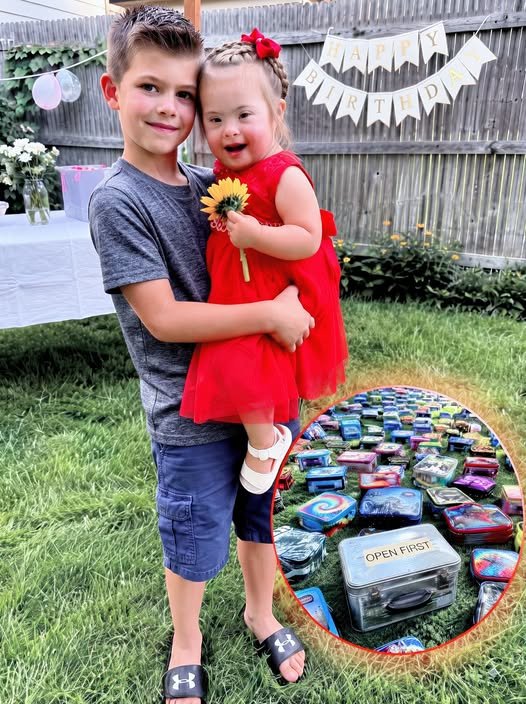
Part 1 — The Red Dress
The first time my eight-year-old son, Noah, noticed the red dress, he stopped so abruptly in front of me that I nearly bumped into him.
“Mom, look.”
I followed his gaze toward the shop window.
A tiny red dress hung beneath the warm display lights. It had a wide skirt, a satin bow around the waist, and the sort of bright, cheerful color that seemed impossible to ignore.
Noah pressed closer to the glass.
“Lucy needs that dress.”
I smiled.
“Needs it?”
He thought for a moment.
“Okay. Maybe she doesn’t need it. But she should have it.”
“She hasn’t even seen it.”
“She’d love it.”
I studied my son’s completely serious expression.
“And how exactly do you know that?”
He gave me the look children give adults when they believe we are being especially slow.
“Because she’d look like a princess.”
Lucy lived next door with her mother, Hannah.
She was almost two years old and had Down syndrome. From the moment she became old enough to recognize people, Noah had somehow become one of her favorite humans.
Whenever he walked through Hannah’s gate, Lucy’s entire face changed.
Noah brought her dandelions from our yard.
He drew pictures of dogs that looked more like potatoes with legs.
He made ridiculous animal sounds just to hear her giggle.
And Lucy adored every second of it.
Hannah was raising her alone, and although she rarely complained, I knew money was often tight.
A few weeks before Lucy’s second birthday, Hannah and I were having coffee on her patio while Lucy sat nearby stacking plastic cups.
“I’m keeping her birthday really simple this year,” Hannah told me.
“No party?”
She shook her head.
“Just cake at home. Maybe a few balloons.”
She glanced toward Lucy.
“We’ve had more appointments lately. Therapy, specialists, transportation. None of it seems huge by itself, but it all adds up.”
I understood.
Later that evening, Noah asked why Lucy wasn’t having what he called a “real birthday party.”
I tried to explain without making Hannah’s situation sound sad.
“Her mom has some important things she needs to spend money on right now.”
Noah frowned.
“Things for Lucy?”
“Yes.”
“Like helping her learn things?”
“Exactly.”
He looked toward the house next door for a long moment.
Then he nodded.
I should have recognized that look.
Noah had already made a decision.
I just didn’t know it yet.
Over the next three weeks, my son became strangely careful with money.
One afternoon, I offered him five dollars to grab something after school.
Normally, Noah considered after-school snacks a basic human right.
Instead, he pushed the money back toward me.
“I’m fine.”
I stared at him.
“You? Turning down French fries?”
“I’m not hungry.”
That was suspicious enough.
Then I offered him another dollar “for later.”
He accepted that one immediately.
A few days later, he asked my husband, Cyril, if he could earn money by raking our yard.
Cyril blinked at him.
“You live here.”
“I know.”
“You’re asking me to pay you to clean your own yard?”
Noah nodded.
Cyril looked at me.
“I admire the business model.”
When Cyril refused to pay him, Noah marched across the street and offered his services to Mrs. Reynolds.
Soon, he was knocking on other neighbors’ doors asking if they needed leaves raked, weeds pulled, or garbage cans rolled back from the curb.
Every dollar he earned disappeared into an old pencil case under his bed.
I assumed he was saving for some new toy.
Then one afternoon, I noticed three crumpled dollar bills sitting on his dresser.
Beside them was a school cafeteria receipt several days old.
Something felt wrong.
That evening, after homework, I sat beside him.
“What did you eat for lunch today?”
He kept looking at his worksheet.
“Food.”
“What food?”
“School food.”
“What kind of school food?”
His pencil stopped moving.
“Noah.”
He looked toward the hallway.
Then he jumped out of his chair and hurried into his bedroom.
I followed.
He dropped to his knees, reached underneath the bed, and pulled out the pencil case.
One bill at a time, he emptied it onto his comforter.
Thirty-eight dollars.
Before I could ask what was happening, he walked to his closet.
And opened the door.
Hanging from the handle was a clear garment bag.
Inside was the little red dress.
For several seconds, I could only stare.
“You bought it?”
His face lit up.
“I got the last one.”
I looked from the dress to the money.
Then back to him.
“Noah… did you stop eating lunch so you could save money for this?”
His smile disappeared.
“Not every day.”
“That isn’t the point.”
“But Lucy’s birthday is tomorrow.”
I sat beside him and took his hands.
“Listen carefully. What you wanted to do for Lucy is incredibly kind.”
His expression brightened slightly.
“But kindness should never mean secretly going hungry.”
“I needed the money.”
“You could have asked us.”
“You might have said no.”
“Then you could have asked how to earn it.”
“I did earn some.”
“I know.”
He sighed.
“Mrs. Reynolds doesn’t pay very much.”
I tried not to laugh.
Then I pulled him against me.
“You don’t have to hurt yourself to prove you care about someone. Promise me you understand that.”
After a moment, his arms tightened around me.
“I understand.”
“Promise?”
“I promise.”
I kissed the top of his head.
At that moment, I thought the hardest part of the whole situation was over.
I was very wrong.
Part 2 — “She Understands Kindness”
That evening, my mother-in-law stopped by.
She happened to be standing in our kitchen when Noah proudly carried the garment bag downstairs.
“Grandma, look what I got Lucy!”
At first, she smiled.
Then I explained how he had paid for it.
Her expression changed immediately.
“You skipped your school lunches for that?”
Noah nodded.
She looked at the dress again.
Then she laughed.
“Oh, sweetheart. That was a waste of money.”
The smile vanished from Noah’s face.
I turned toward her.
“What did you just say?”
She shrugged as though she had said something perfectly reasonable.
“Lucy is only two years old.”
Then she lowered her voice slightly.
“And with everything she has going on, does she even understand birthdays?”
I felt my shoulders stiffen.
She continued.
“If you’re going to work that hard and save all that money, buy something for yourself. Lucy probably wouldn’t know the difference.”
Noah looked directly at her.
When he answered, his voice was quiet.
But there was no hesitation in it.
“She knows when somebody is being nice to her.”
My mother-in-law stared at him.
For once, she had absolutely nothing to say.
Cyril had just entered through the garage and had heard the last part of the conversation.
“Mom.”
She lifted both hands defensively.
“Don’t turn this into something ugly. I’m only being practical.”
Cyril walked over to Noah, crouched beside him, and looked through the clear plastic at the dress.
“That’s a great color, buddy.”
Noah looked up.
“You think so?”
“I think Lucy’s going to spin all over the place in it.”
That brought back Noah’s smile.
My mother-in-law sighed.
“You people always hear things the wrong way.”
I pointed toward the door.
“I think tonight’s visit is over.”
She stared at me.
“You’re asking me to leave because of a dress?”
“No.”
I kept my voice calm.
“I’m asking you to leave because an eight-year-old just explained compassion more clearly than you did.”
She looked at Cyril.
He said nothing.
A few moments later, she left.
The following afternoon, we walked next door for Lucy’s birthday.
Calling it a party might have been generous.
There were seven people.
Six balloons.
A grocery-store cake.
Some paper plates.
And one little girl who didn’t seem to care that the celebration wasn’t elaborate.
Noah carried the garment bag with both hands.
“This is for Lucy.”
Hannah blinked.
“For Lucy?”
“Open it.”
The moment she saw the dress, she looked straight at me.
“Adele, this is too much.”
I shook my head.
“Noah bought it.”
He immediately corrected me.
“I earned most of it.”
I raised one eyebrow.
He quickly added, “And I’m never skipping lunch again.”
Cyril turned away to hide his smile.
Hannah knelt in front of Noah.
“You really bought this for her?”
He nodded.
“I thought she’d like it.”
Hannah’s eyes softened.
“I think she’s going to love it.”
Twenty minutes later, Hannah carried Lucy outside.
The moment Noah saw her, he froze.
There she was.
Red dress.
Little white shoes.
Bright eyes.
And an enormous smile.
For several seconds, Lucy simply stood there.
Then she discovered the skirt.
She grabbed the fabric with both hands.
And spun.
Once.
Twice.
Then too fast.
She stumbled sideways into Hannah’s legs, burst into laughter, and immediately tried again.
Noah laughed so hard he had to sit down.
Lucy squealed and spun again, the red skirt floating around her like a flower opening in the wind.
Beside me, Hannah wiped tears from her cheeks.
I looked toward the fence.
My mother-in-law was standing there.
She had come after all.
She watched Lucy twirl across the yard in the red dress Noah had sacrificed so much to buy.
This time, she didn’t say a word.

Part 3 — The Lunchboxes
That night, I stood in Noah’s doorway watching him sleep.
Cyril appeared behind me.
“Proud of him?”
“More than I can explain.”
He nodded.
“Still angry about the lunches?”
“Extremely.”
“Same.”
Neither of us had any idea that before sunrise, the entire story would become much bigger than our family.
At 6:30 the next morning, Noah burst into our bedroom.
“Mom! Dad!”
I shot upright.
“What happened?”
“You have to come outside!”
There was something in his voice that instantly woke us.
Cyril reached the hallway first.
I followed Noah through the house and onto the front porch.
Then I stopped cold.
Our lawn had disappeared.
It was covered with lunchboxes.
There had to be at least fifty.
Maybe more.
Some had dinosaurs on them.
Others had superheroes.
There were pink ones, blue ones, old-fashioned metal boxes, insulated bags, cartoon characters, and plain brown lunch sacks.
They stretched from our porch almost all the way to the sidewalk.
Noah slowly turned toward me.
“Are these all mine?”
“I have no idea.”
Cyril stepped outside.
“What on earth…”
Then Noah noticed one lunchbox sitting by itself in the center of the yard.
It was huge.
Old.
Metal.
And badly scratched.
Across the lid, someone had taped a white card.
OPEN THIS FIRST.
“Noah, don’t—”
Too late.
He hurried toward it and dropped to his knees.
The metal latch clicked open.
He lifted the lid.
And went completely still.
“Noah?”
No answer.
Then he stumbled backward so fast that he almost tripped over another lunchbox.
His face had gone pale.
“Mom…”
I ran toward him.
Inside the large metal box were several thick bundles of cash.
Beside them lay a work identification badge with a woman’s photograph.
There was also a key with a bright plastic tag attached to it.
And a wedding photograph.
Noah stared at me.
“Someone left all their important stuff here.”
His eyes moved back to the money.
Then to the badge.
Then to the key.
“Mom, call the police.”
Before I could answer, a woman shouted from near the sidewalk.
“Wait! Please don’t!”
I spun around.
A woman was hurrying toward us with both hands raised.
She looked to be in her thirties.
She was laughing breathlessly.
And she had Down syndrome.
Several other adults stood just beyond our hedge.
Hannah was among them.
So was Lucy.
And Lucy was still wearing the red dress.
The woman reached the yard.
Noah pointed at the metal lunchbox.
“Why is your money on our lawn?”
The woman looked inside the box.
Then back at Noah.
“Because apparently I’m terrible at arranging surprises that don’t look like crimes.”
Cyril covered his mouth.
I knew he was trying not to laugh.
The woman pointed to the work badge.
“That’s me. My name is Tessa.”
Noah looked suspicious.
“You put the money there?”
“With several responsible adults supervising me.”
She smiled.
“I’ve heard eight-year-olds can be very strict accountants.”
That finally made Cyril laugh.
Hannah came closer, carrying Lucy.
“The lunchboxes came from families connected to the community center,” she explained.
“I posted a picture of Lucy wearing her dress last night.”
Noah’s eyes widened.
“You told everyone I stopped eating lunch?”
“I told them what you did,” Hannah said gently.
“And I also told them that your mother made you promise never to do it again.”
“Good,” I added.
“Very important part of the story.”
Tessa crouched beside the large metal box.
“This lunchbox belongs to me. I’ve had it for years.”
She touched the stacks of cash.
“But this money isn’t for you, Noah.”
His shoulders immediately dropped with relief.
“Oh.”
“It’s for something we’ve been trying to build.”
Part 4 — One Small Act Becomes Something Bigger
Tessa explained that the neighborhood community center had been raising money for a weekend program.
The goal was simple.
Children with Down syndrome could come together with their siblings and friends for music, art, games, dancing, gardening, movement, and anything else that allowed them to simply enjoy being children.
They had been fundraising for months.
They were close to their goal.
But not close enough.
Then Hannah shared Noah’s story.
Tessa looked toward the dozens of lunchboxes spread across our lawn.
“Someone said that if one little boy could give up his lunches because he wanted another child to feel special, maybe the rest of us could give something too.”
Noah stared across the yard.
“So everyone brought lunchboxes?”
Tessa smiled.
“You gave up yours.”
She pointed to the others.
“So everybody else decided to fill theirs.”
Twenty minutes later, we were all inside the community center.
Each lunchbox represented something different.
One held dance shoes.
Another contained gardening gloves.
There were paintbrushes, music sheets, library cards, small toys, handwritten notes, and donations from families.
Then Tessa brought over her battered metal lunchbox.
She removed the work badge first.
“I’ve worked at the same bakery for seven years.”
Noah examined it.
Then she held up the key.
“This is the key to my apartment.”
Finally, she lifted the wedding photograph.
“And this is my husband.”
Noah stared at the picture.
“You’re married?”
Tessa gave a dramatic sigh.
“Yes.”
Then she leaned toward him.
“He snores.”
Noah nodded seriously.
“My dad does too.”
Cyril put a hand against his chest.
“After everything I’ve done for you?”
Noah ignored him.
Tessa placed the photograph beside the badge and key.
“When I was little, people had a lot of opinions about what I might never be able to do.”
Her voice was still warm, but something deeper entered her expression.
“They wondered if I would ever have a real job.”
She touched the badge.
“They wondered if I could live independently.”
She touched the key.
“And some people wondered whether I would ever fall in love and get married.”
She touched the photograph.
Then she smiled.
“People can be very confident when they predict somebody else’s future.”
Noah looked up at her.
“And they were wrong?”
“Very.”
Across the room, Lucy suddenly grabbed the sides of her red dress.
And spun.
The skirt rose around her.
She laughed.
And spun again.
My mother-in-law had entered the center quietly.
She stood a short distance away, watching Lucy.
Noah noticed her.
“Grandma.”
She looked at him.
“What?”
He pointed toward Lucy.
“See?”
She frowned.
“See what?”
“She understood.”
For a moment, nobody spoke.
At first, I thought Noah meant that Lucy understood what birthdays were.
Then I realized that wasn’t what he meant at all.
He meant she understood joy.
She understood being loved.
She understood that Noah had come carrying something beautiful just for her.
My mother-in-law looked at Lucy again.
Her expression changed.
She gave Noah the smallest nod.
But it was enough.

Part 5 — What Hannah Had Forgotten
Hannah stood beside me, twisting a tissue between her fingers.
“The money really has been tight,” she said softly.
“I know.”
“But that wasn’t the only reason I kept her birthday small.”
I turned toward her.
She watched Lucy playing across the room.
“So much of my life is about what Lucy needs.”
Her voice trembled.
“What therapy should we try? What should she practice? Which appointment matters most? What skills should we work on? What will make life easier for her next year?”
She wiped at one eye.
“I became so focused on helping her prepare for the future that I forgot to ask one simple question.”
“What?”
Hannah smiled through her tears.
“What would make her happy today?”
Across the room, Tessa handed Noah a brand-new lunchbox.
He opened it.
Inside was a sandwich, fruit, a juice box, and a cookie.
He looked confused.
“It’s just lunch.”
Tessa nodded.
“Exactly.”
Cyril crouched beside him.
“Son, the next time you decide to change the world, can you please tell your parents before you stop eating?”
Noah looked genuinely puzzled.
“I wasn’t trying to change the world.”
Cyril glanced around the crowded community center.
“Well, apparently nobody told these people.”
Later, someone offered Lucy a small slice of birthday cake.
My mother-in-law opened her mouth.
“She probably doesn’t…”
Then she stopped herself.
She looked toward Hannah instead.
“Is cake okay for her?”
Hannah smiled.
“Yes. She can have some.”
It was a tiny question.
Five words.
But I knew exactly what it meant.
Instead of assuming what Lucy could or couldn’t do, my mother-in-law had finally asked the person who knew her best.
She was learning.
Maybe kindness sometimes looked like buying a red dress.
And maybe sometimes it looked like changing the way you asked a question.
Part 6 — The Dress Had Done Its Job
By evening, our lawn looked normal again.
The lunchboxes had been collected.
The families had gone home.
There had been no television cameras.
No dramatic speeches.
No giant ceremony.
Just people quietly deciding to help one another.
Noah sat on our front porch with his new lunchbox beside him.
He was eating the sandwich Tessa had packed.
Lucy sat next to him.
Still wearing the red dress.
She immediately reached for his sandwich.
Noah pulled it away.
“Lucy. This is mine.”
She reached again.
He sighed with the exhaustion of a seventy-year-old man dealing with an unreasonable coworker.
Then he tore off a little piece and handed it to her.
I raised an eyebrow.
Noah noticed.
He immediately took an enormous bite from his own sandwich.
“I’m eating too, Mom.”
His words came out muffled because his mouth was full.
“Good.”
Lucy squeezed the piece of sandwich in one hand.
A streak of jelly landed right across the front of her beautiful red dress.
My first instinct was to reach for a napkin.
I almost did.
Then Lucy laughed.
That wonderful, carefree laugh that had made Noah choose the dress in the first place.
I lowered my hand.
The stain didn’t matter.
The dress had never been meant to stay perfect.
It had been meant to make Lucy happy.
And there she was on our porch, laughing with jelly on her dress while Noah guarded the rest of his sandwich.
A few days earlier, I had believed my son was simply trying to buy a birthday present for the little girl next door.
Instead, his small act of kindness had reminded an entire community of something adults forget far too easily.
People do not need our assumptions about what they can understand.
They do not need us deciding in advance what kind of happiness is meaningful enough for them.
Sometimes they simply need to be seen.
Included.
Celebrated.
Loved.
Noah had looked at a little red dress in a shop window and imagined Lucy spinning in it.
And somehow, that simple picture in the mind of an eight-year-old boy had become real.
Lucy spun.
Hannah remembered that joy mattered too.
My mother-in-law learned to ask instead of assume.
A community finished funding a program that would give more children a place to play, create, laugh, and belong.
And Noah?
He learned that generosity should never require him to go hungry.
He also learned one more important lesson.
If you leave a giant metal lunchbox filled with cash, keys, identification, and somebody’s wedding photograph on an eight-year-old’s lawn…
you should probably explain yourself before he calls the police.