
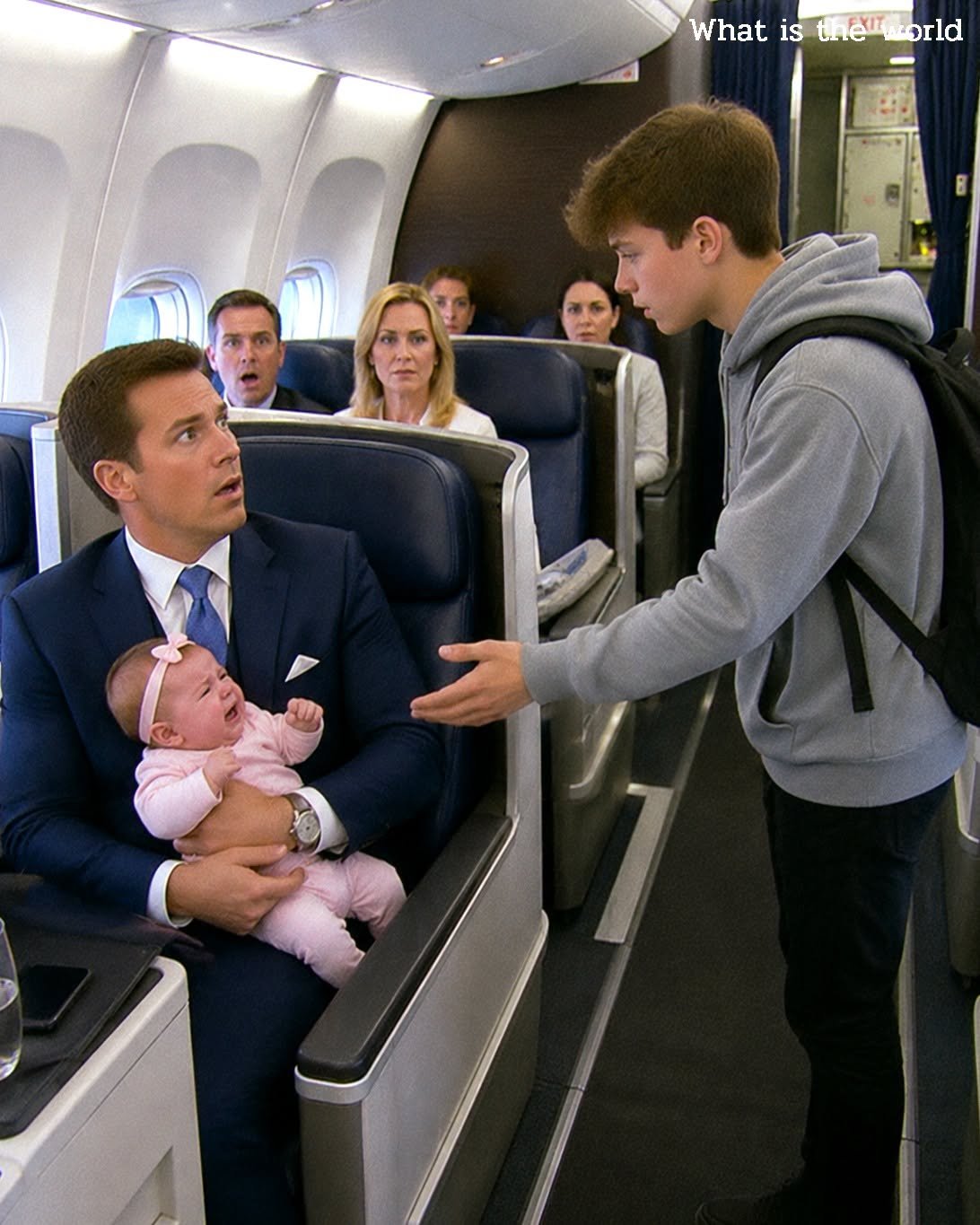
“That was her name.”
“She was my wife.”
The words fell heavily between them.
Mason stopped rocking.
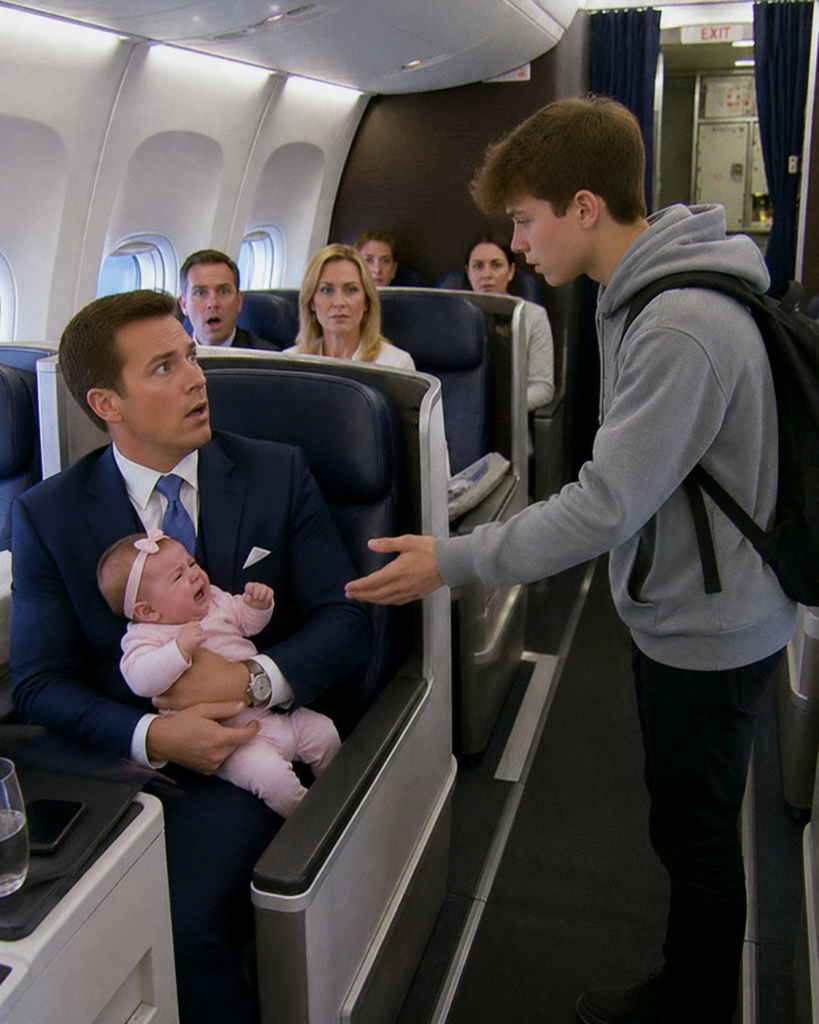
The color slowly left his face. “Was?”
Henry could not answer immediately. Three weeks had passed, but saying it still felt like stepping into cold water.
“She died shortly after Nora was born.”
Mason stared at him.
The first-class cabin, which had been filled with whispers only minutes earlier, now seemed unusually still. The other passengers pretended not to listen, but Henry felt their attention pressing in from every direction.
Mason looked down at Nora again. His mouth opened, but no words came.
Finally, he whispered, “I didn’t know.”
The pain in his voice was so unguarded that Henry’s suspicion faltered.
A flight attendant stepped forward. She was the same woman who had been trying to help with Nora earlier. Her name tag read Elise.
“Mr. Whitman,” she said quietly, “there’s an unused private suite behind the galley. You may be more comfortable speaking there.”
Henry nodded.
Mason hesitated. “I should go back to my seat.”
“No,” Henry said.
The boy’s shoulders stiffened.
Henry forced himself to soften his tone. “Please. I need to understand why my wife gave you that photograph.”
Mason glanced at the sleeping baby in his arms.
“I don’t want to wake her.”
“Then bring her.”
Elise led them through a narrow door into a small private compartment normally reserved for crew rest. It was not luxurious, but it was quiet. There were two seats, a folding table, and a narrow couch beneath a shaded window.
Mason sat at one end of the couch and continued holding Nora with practiced care.
Henry remained standing.
He turned the photograph over once more.
Claire looked different in the picture. Her hair was tied loosely behind her head, and she wore the blue coat Henry had bought her the previous winter. She was smiling, but there was something in her expression he had not noticed at first—something cautious and hopeful.
Mason stood beside her in front of the Boston Public Garden. He looked younger, although the photograph could not have been taken more than a few months ago.
Henry placed it on the table.
“When did you meet her?”
“Last year.”
“Where?”
“At the Harbor Street Community Center.”
Henry frowned. “Claire never mentioned that place.”
“She helped with the Saturday music program.”
That made even less sense.
Claire served on the boards of two major charities, but she had always disliked ceremonial appearances. She preferred anonymous donations and quiet visits. Still, Henry knew her schedule. Or he had believed he did.
“What were you doing there?” he asked.
“I played piano.”
“You’re a musician?”
“I’m trying to be.”
There was no pride in Mason’s answer, only caution.
Henry sat across from him. “Start from the beginning.”
Mason’s gaze shifted toward the closed door.
“I’m not sure Claire would want me to tell you everything.”
“She wrote a message asking someone to protect you. That photograph fell at my feet while you were holding my daughter. I think we’re past keeping everything separate.”
Mason flinched slightly at the impatience in Henry’s voice.
Nora stirred.
Without looking away from Henry, Mason began humming again.
The melody was soft and simple, only a few notes repeated in a slow pattern.
Henry felt his breath catch.
He knew that song.
Claire had hummed it while folding tiny clothes in Nora’s nursery. She had sung it under her breath during late-night drives and once while standing barefoot in the kitchen, one hand resting on her pregnant belly.
Henry had asked her what it was called.
She had smiled and said, “I don’t know. It’s just something my mother used to sing.”
Mason stopped humming when he noticed Henry’s expression.
“Where did you learn that melody?” Henry asked.
“My mother.”
“What was her name?”
Mason paused.
“Rachel Brooks.”
The name meant nothing to Henry, yet the room suddenly felt smaller.
“Did Claire know your mother?”
“She said she did.”
“Said?”
“My mother died two years ago. Claire came to the community center after one of my performances. She asked my teacher if she could speak to me.”
Mason adjusted Nora’s blanket before continuing.
“At first, I thought she was another donor. People sometimes came to watch us play, took pictures, and talked about giving opportunities to kids who needed them. Most of them never came back.”
“But Claire did.”
“Every Saturday.”
Henry looked at the photograph again.
“What did she want from you?”
“Nothing.”
“Everyone wants something.”
Mason’s eyes met his then, steady and unexpectedly mature.
“Maybe that’s true in your world.”
The answer carried no insult, but Henry felt it.
He had spent years judging people by what they wanted from him—access, money, influence, approval. Claire had often told him that his caution protected him from dishonesty but sometimes blinded him to sincerity.
He looked at Nora, peaceful in the arms of a boy he had met less than an hour ago.
“Tell me what she said about your mother.”
“Not much at first. She asked what I remembered.”
“And what did you tell her?”
“That my mother worked at a small bookstore. That she sang when she cooked. That she hated driving in snow and always carried peppermints in her coat pocket.”
Mason’s voice grew quieter.
“She got sick when my little sister, Grace, was a baby. I took care of Grace a lot while my mother was going through treatment. That’s why I know how to hold babies.”
Henry remembered Mason’s earlier words.
I just know what it feels like when someone important is gone.
“Where is your sister now?”
“With our grandmother in Maine. That’s where I live too, except during the school term. I have a scholarship at a boarding school outside Boston.”
“Did Claire arrange that?”
“No. My mother did before she died. Claire helped with the things the scholarship didn’t cover. Books. Train tickets. Piano lessons.”
“Why?”
Mason’s jaw tightened. “I asked her that more than once.”
“And?”
“She said my mother had once helped someone in her family. She said she was returning a kindness.”
Henry leaned back.
Claire had no surviving siblings. Her father had died before Henry met her, and her mother, Margaret, had passed away four years earlier. Claire rarely spoke about her childhood except in fragments: summers near the coast, piano lessons she had hated, a mother who saved every letter she received.
“What kind of kindness?”
“She never explained.”
“You never pressed her?”
“I did. She said she would tell me when she was certain.”
“Certain of what?”
Mason looked toward the photograph.
“That we were connected.”
The aircraft hummed around them.
Henry felt an old, familiar instinct awaken—the instinct that had made him successful. When information was incomplete, he assembled facts. When people avoided direct answers, he looked for what they feared revealing.
Claire had found Mason at a music program.
She had known his dead mother.
She knew a lullaby Rachel Brooks had sung to her children.
And she had given Mason a photograph with a message written in Henry’s wife’s handwriting.
“Why are you going to Zurich?” Henry asked.
Mason shifted again.
“I’m supposed to meet someone.”
“Who?”
“A woman named Anna Adler.”
Henry waited.
“That’s all you know?”
“She sent me a plane ticket and an address. Claire told me the trip would explain everything.”
“When did Claire tell you that?”
“About five weeks ago.”
Five weeks.
Claire had been eight months pregnant.
Henry remembered that time as a blur of appointments, nursery furniture, and late-night conversations about whether they were ready to become parents. Claire had seemed distracted, but he had assumed she was nervous about the birth.
“Did she plan to travel with you?”
“She said she would already be in Zurich.”
Henry turned toward the darkened window.
He and Claire had been scheduled to make this journey together.
It was meant to be their final trip before retreating from public life for several months. Henry had business meetings in Zurich, and Claire had told him she wanted to settle a personal matter while they were there.
After her death, Henry had canceled almost everything.
But one of Claire’s doctors had recommended a specialist in Switzerland who could review Nora’s early medical records. Henry had resisted traveling with a newborn, yet remaining in the silent house they had prepared together had become unbearable.
So he had kept the flight.
Had Claire known Mason would be on it?
Had she arranged their meeting?
Or was this only chance?
Henry opened his phone and connected to the aircraft’s wireless network. Several messages waited from employees, advisors, and board members. He ignored them.
Instead, he wrote to Mara Levin, the attorney who had handled Claire’s personal affairs.
Do you know anyone named Mason Brooks or Anna Adler?
He added a photograph of the picture and sent it.
Mason watched him.
“Who are you contacting?”
“Our attorney.”
“I don’t need an attorney.”
“I didn’t say you did.”
“It usually means something bad when someone rich says they’re calling a lawyer.”
Despite everything, Henry almost smiled.
“You’ve met many rich people?”
“Enough.”
Nora made a soft sound.
Mason looked down immediately, but this time Henry moved first.
“Let me try.”
The boy studied him for a moment, then carefully transferred Nora into his arms.
Henry held her the way Mason had—upright against his chest, one hand supporting her head, the other resting lightly across her back.
“Not so stiff,” Mason said.
“I’m not stiff.”
“You look like you’re holding something that might explode.”
Henry loosened his shoulders.
“Better?”
“A little.”
Nora’s eyes opened.
Henry expected her to cry, but she stared up at him, wide-eyed and solemn.
“She knows you,” Mason said.
“I’m her father.”
“That isn’t always the same thing.”
The words were quiet, almost absentminded, but Henry heard the meaning behind them.
“Did you know your father?”
Mason shook his head.
“My mother said he died before Grace was born.”
“What was his name?”
“She never told me.”
“That didn’t bother you?”
“It bothered me every day.”
The honesty in his answer silenced Henry.
His phone vibrated.
Mara had replied.
Where are you?
Henry typed back.
On Claire’s Zurich flight. Mason is here.
The answer came almost immediately.
Do not let him leave when you land. Anna Adler is a notary Claire retained last year. There is a sealed file. Claire instructed that it could only be opened if you and Mason were present together.
Henry read the message twice.
Then he handed the phone to Mason.
The boy’s face changed as he read.
“She planned this,” Mason said.
“It appears so.”
“Then why didn’t she tell either of us?”
Henry looked at the photograph.
“Maybe she was afraid.”
“Of you?”
The question was not accusing, but it struck deeper than one would have.
Henry wanted to say Claire had never feared him. He wanted to believe there had been no part of her life she felt compelled to hide.
But grief had forced him to reconsider many things.
In the weeks after her death, he had found half-finished notes in drawers and unopened packages in closets. He had discovered that she had ordered a mobile for Nora’s crib and written letters to their daughter for future birthdays.
Claire had prepared for possibilities she never discussed.
Perhaps she had been afraid not of Henry, but of time.
“She may have been waiting until she understood the whole story,” he said.
Mason returned the phone.
“What happens when we land?”
“We meet Anna Adler.”
“I can go alone.”
“You’re sixteen.”
“Seventeen.”
“That doesn’t strengthen your argument as much as you think.”
Mason’s expression tightened. “I’ve traveled alone before.”
“I’m sure you have.”
“I don’t need someone taking control just because he owns a private company and sits in first class.”
Henry glanced around the cramped crew compartment.
“At the moment, neither of those facts seems especially useful.”
Mason looked surprised.
Henry lowered his voice.
“I’m not trying to control you. But Claire wanted us there together. Whatever she was doing, she believed it concerned both of us.”
Mason studied him for a long time.
“Will you tell me the truth if you learn something you don’t like?”
Henry had been asked harder questions in boardrooms, but none that made him examine himself so quickly.
“Yes.”
“Even if it changes what you think about Claire?”
Henry looked down at his daughter.
“Especially then.”
For the remaining hours of the flight, the tension between them slowly changed shape.
It did not disappear. Henry still had questions Mason could not answer, and Mason remained guarded whenever the conversation moved too close to his mother. But they were no longer strangers divided by a curtain and the cost of their seats.
Mason showed Henry how to recognize the difference between Nora’s hungry cry and the restless sound she made when she needed to be moved. Henry listened with a humility that would have astonished anyone who knew him professionally.
In return, Henry told Mason small things about Claire.
He described how she read the final page of a novel first because she claimed it helped her appreciate the journey. He told him about the time she had tried to repair a leaking sink and flooded half the kitchen rather than admit she needed help.
Mason smiled at that.
“She told me she was good at fixing things.”
“She was good at convincing people she could fix things.”
“She fixed my school application.”
“Then perhaps she improved with practice.”
The smile faded from Mason’s face.
“She talked about Nora before she was born.”
Henry’s chest tightened. “What did she say?”
“That she hoped Nora would be curious. She said curiosity was more important than being impressive.”
“That sounds like her.”
“She also said you would probably buy too many things for the baby.”
Henry looked at the designer diaper bag, the portable bottle warmer, the specialized travel crib, and three unopened packages of infant accessories.
Mason raised an eyebrow.
“Not a word,” Henry said.
For the first time, Mason laughed.
It was a small sound, but it changed the atmosphere in the compartment.
When the plane began its descent into Zurich, morning light appeared beneath the clouds. The city emerged in shades of gray and silver, rooftops glistening after rain. Beyond them, the lake stretched toward distant mountains wrapped in mist.
Nora slept against Henry’s chest.
Mason sat beside the window, staring at a folded piece of paper Claire had given him.
Henry noticed that the edges had been opened and closed so many times they had begun to fray.
“What does it say?” he asked.
Mason handed it to him.
There were only three lines.
Take the flight. Meet Anna Adler. Do not decide what the truth means until you have heard all of it.
Below the message was an address near the old city.
Henry traced the letters with his thumb.
Claire had written those words while still alive, believing she would be waiting at the end of the journey.
The thought was almost more painful than remembering the hospital.
At the airport, Henry’s driver was waiting beside a dark sedan. Mason stopped several feet away.
“I can take the train.”
“You can,” Henry said. “But Anna Adler’s office is expecting both of us.”
Mason looked at Nora, who had begun to wake.
“Is she coming too?”
“I’m not leaving her.”
Mason nodded. “Good.”
They drove through Zurich in silence.
The rain had stopped, but water still clung to the windows and turned passing lights into pale streaks. Cyclists moved along the river. Cafés were opening, their chairs arranged beneath striped awnings. The city seemed calm in a way Henry found almost disorienting.
Anna Adler’s office occupied the second floor of an old stone building on a narrow street near the Limmat River.
There was no polished reception desk or row of assistants. Only a brass plaque, a quiet hallway, and the faint scent of paper and beeswax.
Anna Adler herself opened the door.
She was a tall woman in her sixties with silver hair cut neatly at her jaw. Her expression softened when she saw Mason.
Then she looked at Henry and the baby in his arms.
“I am very sorry about Claire,” she said.
Henry nodded, unable to offer the usual polite response.
Anna led them into a book-lined room. A wooden box rested on the table.
“I expected Claire to be with you,” she said. “When Ms. Levin contacted me from Boston, I understood that this meeting would be different from what she planned.”
“Why did my wife come to you?” Henry asked.
“Because some records are protected by Swiss privacy law, and others had been deposited with my father’s office many years ago.”
“What records?”
Anna looked at Mason.
“Records concerning Rachel Brooks.”
Mason sat forward.
“My mother?”
“Yes.”
Anna opened the wooden box.
Inside were several envelopes tied with a faded blue ribbon, a small leather notebook, and a black-and-white photograph.
She placed the photograph on the table.
It showed a young woman standing beside Lake Zurich. She could not have been more than nineteen. She wore a light summer dress, and her hair blew across her face.
Henry recognized her instantly.
“Margaret,” he said.
Claire’s mother.
Beside her stood another young woman in a nurse’s uniform, holding a newborn wrapped in a pale blanket.
Mason stared at the picture.
Anna untied the ribbon around the envelopes.
“Margaret came to Zurich as a university student,” she explained. “She remained here for almost a year. During that time, she gave birth to a daughter.”
Henry felt the truth approaching before she spoke it.
“The child was placed with an American couple living temporarily in Switzerland. Their surname was Brooks.”
Mason did not move.
Anna slid a certified copy of an adoption record across the table.
The infant’s original first name had been covered under privacy rules, but the date of birth matched the date engraved on a small bracelet Mason wore around his wrist.
“Rachel,” he whispered.
Anna nodded.
“Rachel Brooks was Margaret’s daughter.”
Mason looked at Henry.
Henry could barely speak.
“Claire’s half-sister,” he said.
“Her older half-sister,” Anna confirmed.
The room fell silent.
Mason looked down at the documents again, as though the words might rearrange themselves if he stared long enough.
“My mother never said she was adopted.”
“She may not have known until shortly before her death,” Anna said. “The Brooks family kept the original documents sealed. Rachel contacted this office after finding a reference among her adoptive father’s papers. She asked for information, but she became ill before the process was completed.”
“And Claire?” Henry asked.
“Margaret told Claire before she died. She gave her the photograph and the old correspondence. Claire spent several years searching for Rachel. By the time she found her, Rachel had already passed away.”
Mason stood abruptly and walked to the window.
His reflection appeared faintly in the glass.
“So she came looking for me because she felt guilty.”
“No,” Henry said.
Mason turned.
Henry had not planned the answer. It came from someplace deeper than certainty.
“Claire did not visit people every Saturday because of guilt. She didn’t memorize your performances, help with your books, or plan this trip because she wanted to settle a debt.”
“You don’t know that.”
“I knew her.”
“Did you?” Mason asked.
The question might have sounded cruel from someone else. From Mason, it sounded frightened.
Henry looked at the documents Claire had hidden from him.
“Not as completely as I thought,” he admitted. “But I know how she loved people. She did it carefully. Quietly. Sometimes so quietly that the rest of us understood too late.”
Mason turned back toward the window.
Nora began to fuss.
Henry held her close, but her face tightened.
Before the cry could build, Mason hummed the familiar melody.
Nora quieted.
Anna listened, her expression changing.
“Margaret used to sing that song,” she said.
Mason stopped.
“You knew her?”
“My father handled the adoption. Margaret stayed with my family for several weeks afterward. She sang the melody every night because she believed the baby could still hear her.”
The room seemed to narrow around that simple truth.
A song had crossed decades and families without a name. Margaret had sung it to Rachel. Rachel had sung it to Mason. Claire had carried it without knowing why it felt like memory. And now Mason had used it to comfort Claire’s daughter in the sky.
Henry looked down at Nora.
For the first time since Claire’s death, the ache in his chest held something other than emptiness.
It held connection.
Anna removed one final envelope from the box.
Claire had written Henry’s name across the front.
His hands trembled as he opened it.
The letter inside was several pages long.
He read the first lines silently, but Mason turned from the window.
“Please,” he said. “Read it aloud.”
Henry swallowed.
Then he began.
“Henry, if you are reading this, I probably lost my nerve again, and chance has done what courage should have done sooner.”
His voice broke.
He paused, took a breath, and continued.
“Mason’s mother, Rachel, was my sister. I discovered the truth after my mother died. At first, I told myself I needed proof before speaking to you. Then I found Mason, and I told myself I needed his trust. After that, there was always another reason to wait.
“The truth is that I was afraid.
“I was afraid Mason would think I came into his life out of pity. I was afraid you would believe I had hidden something because I did not trust you. Most of all, I was afraid of promising Mason a family before I knew whether he wanted us.
“He does not need to be rescued. He is thoughtful, proud, talented, and more capable than he realizes. But he has spent too much of his life believing that needing people is a weakness.
“You understand that better than anyone.”
Henry stopped again.
A faint, sad smile touched Mason’s face.
Claire’s words continued.
“The message on the photograph is for you, Henry. Protect him, but not from life. Protect his right to choose what this discovery means. Do not turn him into a responsibility, a project, or a debt to be repaid.
“Let him become family at his own pace.
“And let Nora know him.
“I wanted our daughter to grow up with someone who remembers the parts of me she will never have the chance to ask about. Mason knows my favorite song, my worst jokes, and the way I take tea when I am too tired to pretend I do not like sugar.
“I had planned to tell you in Zurich. I thought there would be more time.
“I am sorry I waited.”
Henry lowered the letter.
No one spoke.
Outside, a tram passed along the wet street, its bell ringing once before fading into the distance.
Mason returned to the table.
“She knew she might die,” he said.
Henry looked at the date on the letter.
It had been written nine days before Nora’s birth.
“She knew there were risks,” he replied. “But I don’t think she believed she would die.”
“She still prepared everything.”
“She always prepared for the people she loved.”
Mason’s eyes filled, though he blinked before the tears could fall.
“I didn’t get to say goodbye.”
“Neither did I.”
For a moment, their grief stood between them without competition.
Henry had lost his wife.
Mason had lost an aunt he had barely been given time to know.
Nora shifted in Henry’s arms, unaware that the room had redrawn the boundaries of her family.
Mason touched one finger to her tiny hand.
Nora closed her fist around it.
“My cousin,” Mason said softly.
Henry nodded.
“Your cousin.”
Anna allowed them several minutes before reaching beneath the wooden box.
“There is one more document,” she said.
Henry looked up.
“I believed Claire’s letter was the last.”
“It was the last personal letter. This is different.”
She placed a thick folder on the table.
A red seal crossed the front, and the name of Mara Levin’s law firm appeared in the upper corner.
Mason withdrew his hand from Nora’s grasp.
“What is it?”
Anna broke the seal.
“Claire knew that Mason’s grandmother had been struggling with her health. She also knew his boarding scholarship would end when he completed the academic year.”
Mason’s expression hardened.
“My grandmother is fine.”
“She is recovering,” Anna said gently. “But she contacted Claire because she was worried about what would happen if she could no longer serve as your legal guardian.”
Henry looked at Mason.
“You knew she was ill?”
“She told me it was nothing serious.”
“She may have been trying not to worry you.”
Anna opened the folder.
“Claire and Mrs. Brooks began preparing a contingency plan. Nothing in this folder can force a decision. Mason’s wishes would have to be heard, and any arrangement would require review by a court.”
Mason remained standing.
“What arrangement?”
Anna turned the first page toward them.
It was a petition drafted but not yet filed. Claire’s name appeared in several places, followed by detailed provisions concerning Mason’s education, residence, and continued relationship with his grandmother and sister.
Henry felt an uneasy pressure building behind his ribs.
“Claire intended to become his guardian,” he said.
“Yes,” Anna replied. “But she included a contingency in case she became unable to do so.”
Henry looked down at the document.
Near the bottom of the page was a blank signature line.
Above it, beneath the words Proposed Guardian, a name had already been typed.
Mason leaned closer.
Henry read it once.
Then again.
The name was his.
Henry James Whitman.
PART 3
“She mentioned helping someone at the community center. She said there was a student she believed in. I didn’t know that student was you.”
Mason’s expression tightened.
“A student she believed in,” he repeated. “That sounds much nicer than a problem she was trying to solve.”
“You are not a problem.”
“You barely know me.”
“That doesn’t make you a problem.”
“It doesn’t make us family either.”
The words landed with painful accuracy.
Anna Adler remained seated at the end of the table, giving them space without leaving them alone. Nora stirred against Henry’s chest, sensing the tension in his body.
Mason reached for his backpack.
“I’m going.”
Anna rose. “Mason, there is more you should understand.”
“I’ve understood enough.”
“No one has filed the petition,” she said.
His hand stopped on the strap.
Anna touched the document with two fingers.
“This was a draft. Claire instructed that it was never to be submitted without your agreement and Henry’s. She was very specific.”
Mason did not sit down.
“She still wrote his name.”
“She considered him someone she trusted.”
“She trusted him so much she didn’t tell him any of this.”
Henry felt the truth beneath Mason’s anger. The boy was not only upset that Claire had made plans for him. He was grieving the fact that she was no longer there to explain them.
Henry understood that kind of anger.
He had carried it since the hospital.
Questions had become a way of keeping Claire present. Every secret he discovered felt like another conversation she had denied him, even though he knew she had never intended to die.
“Mason,” he said, “you don’t have to sign anything.”
The boy looked at him.
“You don’t have to come with me. You don’t have to accept money, a room, a school, or a family simply because Claire hoped you might.”
“Then what exactly do you want?”
Henry glanced at the line bearing his name.
“I want ten minutes in which neither of us decides the rest of our lives.”
Mason’s grip loosened slightly on his backpack.
Henry continued, “After that, you may leave. I won’t stop you.”
For a moment, Mason said nothing.
Then he walked toward the office door.
Henry believed he had lost him.
But Mason stopped with his hand on the brass handle.
“Ten minutes,” he said.
He opened the door and stepped into the hallway.
Henry followed.
The old building’s stairwell was narrow and dim, lit by a tall window at the landing. Mason descended quickly, but instead of leaving, he pushed through the front entrance and stood beneath the stone archway outside.
The street still shone from the morning rain.
Across the road, the Limmat River moved steadily between rows of old buildings. A tram passed at the end of the block, its windows glowing gold against the gray sky.
Henry remained several feet away.
Mason stared at the river.
“My whole life,” he said, “people have decided what I can handle.”
Henry shifted Nora higher on his shoulder.
“My mother didn’t tell me she was getting worse because I had exams. My grandmother tells me everything is fine because she doesn’t want me to worry. Teachers arrange meetings about my future when I’m standing right outside the door.”
He looked back at the building.
“And Claire prepared papers about where I should live without asking me.”
“She may have intended to ask.”
“She ran out of time.”
“Yes.”
Mason rubbed the frayed strap of his backpack between his fingers.
“That keeps happening.”
Henry waited.
Mason’s voice dropped. “People run out of time, and I’m left with whatever they decided was best.”
Nora made a small, restless sound. Henry placed one hand against her back, rocking her carefully.
“I have the opposite problem,” he said.
Mason glanced at him.
“People expect me to decide everything. Sometimes I make a decision simply because everyone is waiting for one.”
“That sounds terrible.”
“It can be.”
Mason almost smiled, but the expression disappeared.
Henry looked toward the river.
“When Claire told me she was pregnant, I immediately started planning. Doctors. Security. Schools. A larger house, even though we already had more rooms than we used.”
“Did she tell you to stop?”
“Frequently.”
“What did she want?”
“She wanted me to sit beside her and be happy.”
Mason studied him.
“Did you?”
“Eventually.”
The confession left Henry feeling unexpectedly exposed.
“I thought planning was how I protected people,” he continued. “Claire understood that sometimes planning is simply another way to avoid being frightened.”
Mason’s gaze moved to Nora.
“Are you frightened now?”
“Constantly.”
The answer came so quickly that Mason blinked.
Henry looked down at his daughter.
“I’m afraid I’ll hold her wrong. Feed her wrong. Miss something important. I’m afraid she’ll grow up knowing her mother only through stories, and I’ll tell the stories badly.”
“You won’t.”
“You’ve known me for less than a day.”
“I’ve seen the way you look at her.”
Henry had no response to that.
Mason turned back toward the building.
“If I say no to the guardianship, what happens?”
“I don’t know.”
“That’s not a very billionaire answer.”
“It may be my first honest one.”
This time, Mason’s smile lasted.
They returned upstairs.
Anna had gathered the papers into a neat stack, but she had left Claire’s letter open on the table.
“There is someone else we need to speak with,” she said. “Mason’s grandmother is expecting a call.”
Mason’s smile vanished. “You contacted her?”
“Claire asked me to. She believed this conversation should include everyone affected.”
Anna opened a laptop and began the video call.
The screen rang twice before the image appeared.
An elderly woman sat in a bright kitchen with flowered curtains behind her. Her silver hair had been pinned loosely at the back of her head, and she wore a thick green cardigan despite the afternoon sunlight pouring through the window.
Beside her was a little girl with dark curls and serious brown eyes.
“Mason!” the girl cried.
His entire posture changed.
“Hey, Gracie.”
Grace leaned so close to the screen that only one eye and half her nose remained visible.
“Grandma said you’re in Switzerland.”
“I am.”
“Did you see a mountain?”
“From the plane.”
“Did it have snow?”
“A little.”
“Did you bring me anything?”
Mason glanced at Henry. “I’ve been here for about an hour.”
“That’s enough time to buy chocolate.”
Despite the tension, Henry laughed.
Grace finally noticed him.
“Who’s that man?”
“This is Henry.”
Her eyes moved to the baby in his arms.
“Is that Nora?”
Mason looked surprised. “You know about Nora?”
Grace nodded enthusiastically.
“Claire showed me pictures before the baby came. She said Nora would have your nose.”
Everyone went still.
Mason touched his face as if he had forgotten what his nose looked like.
His grandmother cleared her throat.
“Grace, sweetheart, would you take your drawing into the sitting room? I need to speak with your brother.”
Grace frowned. “Am I in trouble?”
“No.”
“Is Mason?”
“No one is in trouble.”
Grace considered this before slipping down from the chair.
“Bring chocolate,” she ordered Mason.
Then she disappeared from view.
Mason waited until the kitchen door closed.
“How much did Claire tell you?”
His grandmother folded her hands on the table.
“Enough to know she cared deeply for both of you.”
“You knew she was my aunt?”
“Not at first.”
“When did you find out?”
“Last spring.”
Mason stepped away from the laptop.
“Last spring?”
“I wanted to tell you.”
“You always want to tell me later.”
His grandmother’s face tightened with regret.
“I was trying to choose the right time.”
“There is no right time. There’s only the time people actually have.”
Henry watched the words strike her.
Mason seemed to regret them immediately, but he did not take them back.
His grandmother lowered her eyes.
“You’re right.”
The simple admission changed the room.
She reached for a glass of water, and Henry noticed the slight tremor in her hand.
Mason noticed too.
“What’s wrong?”
“I’m having a procedure next month.”
“What kind of procedure?”
“A heart valve replacement.”
Mason went completely still.
“You said your tests were normal.”
“I said the doctors knew what was wrong.”
“That isn’t the same thing.”
“No,” she admitted. “It isn’t.”
“Why didn’t you tell me?”
“Because you had examinations. Because Grace watches your face whenever bad news enters a room. Because you already carry too much.”
Mason pushed both hands through his hair.
“So you decided I couldn’t handle it.”
“I decided I wanted you to have one peaceful month.”
“It wasn’t peaceful. I knew you were hiding something.”
His grandmother’s eyes shone.
“I’m sorry.”
Mason turned away from the screen.
Henry understood the impulse. It was easier to look at a wall than at someone whose love had caused pain.
After a moment, Mason faced her again.
“Are you going to be okay?”
“The doctors believe so. But recovery may take time. Claire helped me consider what would happen if I needed assistance with Grace or if you required an adult legally responsible for school matters.”
“And you chose Henry?”
“No. Claire suggested him.”
“You never met him.”
“Claire trusted him.”
Mason looked at Henry.
Henry felt the weight of that trust more strongly than he had when Anna first showed him the petition.
Mason’s grandmother continued, “Nothing has been decided. I signed no permanent transfer. I would never give either of you away.”
Grace’s voice came from outside the kitchen.
“I can hear you!”
Her grandmother closed her eyes briefly.
Grace appeared in the doorway, clutching a drawing.
“You said nobody was in trouble.”
“We aren’t,” Mason said.
“Are you coming home?”
The question erased the last of his anger.
Mason moved closer to the screen.
“Yes.”
“When?”
“After I finish what Claire asked me to do.”
“Tomorrow?”
“I don’t know.”
Grace’s lower lip began to tremble.
Henry stepped forward.
“Mason will come home,” he said.
Grace studied him suspiciously.
“Promise?”
Henry had made promises involving money, deadlines, and outcomes he could control. This promise involved people, courts, illness, and grief.
He chose his words carefully.
“I promise no one here is trying to take your brother away from you.”
Grace looked at Mason.
“Is that true?”
Mason nodded.
“Yes.”
She seemed satisfied.
“Then don’t forget the chocolate.”
When the call ended, Mason remained near the laptop.
“She looked tired,” he said.
“She did,” Henry replied.
“I should go home now.”
“You can.”
Mason looked toward the wooden box and the letters.
“But if I leave, I may never understand what Claire wanted me to find.”
“You can finish this and still go home.”
“What about the guardianship?”
“We won’t discuss it again today.”
Mason turned. “You mean that?”
“Yes.”
“And you won’t have your lawyer file something while I’m not looking?”
“No.”
“How do I know?”
Henry took the draft petition from Anna’s stack.
For a second, Mason’s body tensed.
Henry tore the signature page neatly in half.
Anna inhaled. “Mr. Whitman, that was an official draft.”
“Then you have another copy.”
“I do.”
Henry placed the torn page on the table.
“Mason’s answer is not a formality,” he said. “Until he gives one freely, my name does not belong there.”
Mason stared at the two halves.
Something in his expression softened—not into trust, but into the beginning of it.
Anna closed the folder.
“There is one additional envelope in my father’s archive,” she said. “It was deposited by Rachel Brooks shortly before her death. Claire requested access, but the identification process was not completed before Nora was born.”
“What’s in it?” Mason asked.
“I don’t know. The archive office is verifying the release now.”
“How long will that take?”
“We should hear from them this afternoon.”
Henry’s phone vibrated.
The screen displayed Mara Levin’s name.
When he answered, the attorney spoke before he could greet her.
“Henry, I found something on Claire’s private drive.”
“What?”
“A recording. It was scheduled to be sent to you yesterday, but the delivery failed because her personal account was closed.”
Henry looked at Mason.
“Can you send it now?”
“I already have.”
The audio file appeared in his messages.
Mason took a slow breath.
“Play it.”
Henry set the phone on the table and pressed the screen.
For a few seconds, there was only soft background noise.
Then Claire’s voice filled the room.
“Henry, if you’re listening to this, one of two things has happened. Either I finally told you everything and you’re annoyed that I made a recording anyway, or I lost my courage and left you to untangle the mess.”
Henry closed his eyes.
Her voice was warm and slightly breathless. Nora moved against him, reacting to a sound she had once heard from inside her mother.
Claire continued.
“Mason may be with you. If he is, please tell him I’m sorry I missed his final winter recital.”
Mason lowered his head.
“I know both of you,” Claire said. “You will be standing in the same room, each pretending you need less than you do. Henry will try to solve everything before breakfast. Mason will prepare to leave before anyone can ask him to stay.”
Mason let out a quiet, broken laugh.
“So I’m asking you both to do something difficult.
“Henry, listen before you fix.
“Mason, give him the chance to stay when staying becomes uncomfortable.
“You are not replacements for the people you lost. You do not owe each other perfect answers. But there is more kindness in both of you than either of you knows what to do with.
“Start there.”
The recording paused.
In the background, Claire spoke to someone away from the phone.
“No, I’m not crying. Pregnancy makes people sound emotional.”
A man’s distant voice answered, too muffled to understand.
Claire laughed.
Henry gripped the edge of the table.
“I also arranged for Mason and Grace to receive financial support from a family trust,” she continued. “That support is theirs whether Mason chooses Henry as guardian, remains with his grandmother, or decides never to speak to another Whitman again.
“Mason, this is not charity. It is part of what should have belonged to your mother.
“And Henry, please do not buy him a building.”
Mason glanced at Henry’s suit.
“Were you going to buy me a building?”
“No.”
“A piano?”
Henry hesitated.
Mason almost smiled.
Claire’s voice softened.
“There is one more truth I hoped to confirm in Zurich. Anna will know where to find it.
“Whatever it is, remember that adults sometimes hide the truth because they are afraid of losing the people they love. That does not make the hiding harmless. But it may help explain the fear.
“Take care of each other.
“And tell Nora that her mother loved her before she knew the color of her eyes.”
The recording ended.
No one moved.
Nora opened her eyes.
They were gray, like Claire’s.
Henry turned his face away, but not before Mason saw the tears.
Mason did not offer an empty reassurance. He simply stepped closer and rested one hand on Nora’s blanket.
“She’ll know,” he said.
Henry looked at him.
“We’ll tell her.”
The word we remained between them.
Mason seemed to realize he had said it, but he did not correct himself.
They spent the next several hours in a small hotel near the river.
Henry arranged a separate room for Mason, though the boy refused new clothes and declined three times when Henry offered to replace his worn sneakers.
He did accept a phone charger.
“This isn’t a gift,” Mason said. “Mine stopped working.”
“Understood.”
“And I’m paying you back.”
“It cost twelve francs.”
“I’ll pay you back twelve francs.”
Henry made a note on his phone.
Mason looked alarmed. “What are you doing?”
“Recording the debt.”
“You’re serious?”
“No.”
Mason stared at him for a second, then laughed.
Later, he accompanied Henry to Nora’s appointment with the pediatric specialist.
The clinic overlooked the lake, where sunlight had begun breaking through the clouds. Henry sat stiffly while the doctor examined Nora, listening to her heart and checking her reflexes.
“She is developing well,” the doctor said. “Her early breathing difficulty appears to have resolved.”
Henry did not relax.
“What about the sound she makes while sleeping?”
“Normal.”
“She sneezes often.”
“Also normal.”
“Sometimes her hands feel cold.”
“Babies do not regulate temperature as efficiently as adults.”
Henry frowned. “You seem very calm about all of this.”
The doctor smiled. “One of us should be.”
Mason covered a grin with his hand.
When the examination ended, the doctor placed Nora against Henry’s chest.
“Talk to her,” she said.
“What should I say?”
“Anything.”
Henry looked helplessly at Mason.
Mason shrugged. “Tell her about your day.”
Henry looked down at Nora.
“I met your cousin on an airplane,” he began. “He has strong opinions about my parenting.”
Nora blinked.
“He also owes me twelve francs.”
Mason leaned against the wall. “That is not how the story happened.”
Nora made a soft bubbling sound.
The doctor smiled. “She likes hearing you.”
Henry’s expression changed.
For weeks, he had believed Nora calmed for everyone except him. Claire had held her only briefly after the birth, and since then Henry had mistaken his own fear for proof that his daughter could feel his inadequacy.
He continued speaking.
Nora remained peaceful.
Outside the clinic, Mason stopped beside the lake.
“You’re better with her than you think.”
Henry adjusted the baby carrier.
“You’re less difficult than you pretend.”
“That isn’t a compliment.”
“It was intended as one.”
Before Mason could reply, Henry’s phone rang.
Anna’s name appeared on the screen.
“The archive has released Rachel’s envelope,” she said. “There is something you both need to see.”
They returned to her office as evening settled over Zurich.
The wooden box had been moved aside. In its place lay a single cream-colored envelope.
Mason’s name was written on the front.
Not Claire’s handwriting.
Not Anna’s.
“My mother wrote that,” Mason whispered.
Anna nodded.
“The letter inside was addressed to Claire, but the envelope included instructions that it should eventually be given to you.”
Mason sat down.
His fingers hovered over the paper.
“Can you open it?” he asked Henry.
Henry did not reach for it.
“Are you sure?”
Mason nodded.
Henry broke the seal.
The letter inside was dated six weeks before Rachel’s death.
Claire,
If you found this, then you found the truth about our mother.
I wish I had more time to understand what that makes us. I wish we could have sat in the same room and argued about which one of us inherited her stubbornness.
There is something you must know about Mason.
I told him his father died before Grace was born.
That was not true.
Mason stood so quickly that his chair struck the wall.
Henry stopped reading.
“No,” Mason said.
Anna remained silent.
Mason shook his head.
“She wouldn’t lie about that.”
Henry lowered the letter.
“We don’t have to continue.”
“Yes, we do.”
“Mason—”
“Read it.”
Henry looked down at the page.
His father is alive.
His name is Adrian Vale. We met when we were young and both studying music. He wanted to marry me, but I was frightened, proud, and convinced that I would lose Mason if I allowed Adrian’s family into our lives.
I left before Mason was born.
Adrian was told that the baby did not survive.
Henry’s voice faltered.
Mason’s face had gone pale.
“That’s impossible,” he whispered.
Anna rose from her chair, but Mason stepped away when she approached.
Henry continued.
Years later, I learned Adrian had moved to Zurich. I planned to tell him the truth, but each year made the confession more difficult. Then I became ill.
I know silence has consequences.
Please do not tell Mason until you have spoken with Adrian. Let him explain what he knew, what he was told, and whether he wants to be part of Mason’s life.
Mason deserves the choice I took from both of them.
There was one final sentence.
Claire, Adrian still keeps the unfinished song we wrote for our son.
Henry lowered the letter.
The room was so quiet that the ticking clock on Anna’s bookshelf seemed unnaturally loud.
Mason stared at nothing.
“My mother told me he was dead.”
“She may have believed the lie was easier than the truth,” Anna said gently.
“She wrote that she knew where he was.”
“Yes.”
“She had years.”
“Yes.”
Mason walked to the window.
Below, evening lights shimmered along the river.
Henry did not follow him. Claire’s voice remained in his mind.
Listen before you fix.
After a long silence, Mason asked, “Did Claire find him?”
Anna’s expression shifted.
“I believe so.”
Mason turned.
“You believe so?”
“Claire arranged a meeting for this evening.”
“Here?”
Anna nodded.
“She did not tell Adrian that Rachel was his mother’s sister. She told him only that she had information concerning the child he believed he had lost.”
Henry checked the clock.
The meeting time had passed by seven minutes.
“Is he coming?” Mason asked.
“I don’t know.”
The building’s front buzzer sounded.
Everyone froze.
Anna looked toward the hallway.
The buzzer sounded again.
Mason’s hands closed into fists at his sides, not with anger but with the effort of remaining still.
“I can’t do this,” he said.
Henry stepped beside him.
“You don’t have to.”
“What if he leaves?”
“Then we find another way.”
“What if he doesn’t believe me?”
“He will see the records.”
“What if he does believe me?”
Henry had no answer.
The question was more frightening than rejection.
Anna went to the door.
They heard quiet voices in the hallway, followed by slow footsteps approaching the office.
A man appeared in the doorway.
He looked to be in his early forties, with dark hair touched by gray at the temples. A worn leather music case hung from one shoulder. He held no flowers, no gifts, and no carefully prepared speech.
He looked like someone who had crossed the city while trying not to hope.
His gaze moved first to Anna, then Henry, then the baby carrier against Henry’s chest.
Finally, he saw Mason.
The music case slipped from his shoulder and struck the floor.
Neither of them spoke.
Mason’s breathing became shallow.
Without realizing it, he began humming the melody that had calmed Nora on the plane.
The stranger’s face changed.
He completed the next four notes.
Mason stopped.
The man’s eyes filled with recognition and disbelief.
“Rachel and I never finished that song,” he said.
His voice trembled.
“We only played it for one person.”
Mason stared at him.
The man reached slowly into his music case and removed a folded sheet of handwritten music.
Across the top, in faded ink, were the words:
For Mason.
But beneath the title, another line had been added in Claire’s handwriting.
Henry stepped closer to read it.
His breath caught.
The note said:
Adrian is not the only person who was told Mason died. Ask him who else was in the hospital that night.