

THE DEAD MAN AT THE DOOR
The smile vanished from Julian’s face when the front door opened.
Not slowly. Not cautiously.
It swung inward with the unmistakable confidence of someone who still believed he had the right to enter.
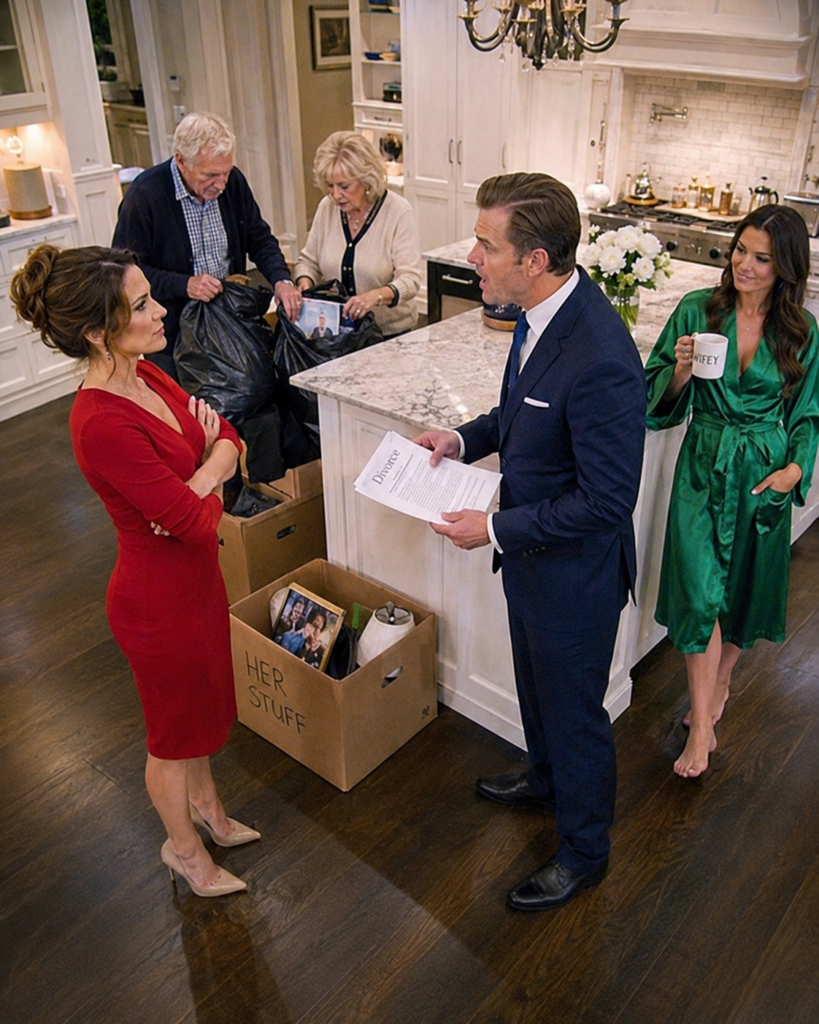
A gust of cold morning air rushed through the foyer, lifting the loose corners of the divorce papers on the marble island. Beatrice stopped wrapping my grandmother’s photograph. Julian’s father, Harold, froze with one of my handbags dangling from his hand.
Elena lowered my mug.
And I heard the sharp, involuntary breath escape my own lungs.
The man standing in the doorway was tall, broad-shouldered, and silver-haired. Time had carved deep lines into his face, but it had not changed the blue-gray eyes I had seen in exactly three surviving photographs.
One of them had been hidden beneath my grandmother’s mattress.
One had been burned around the edges.
And one had been placed inside her coffin.
“Hello, Vivian,” the dead man said.
My fingers tightened against the edge of the counter.
Julian glanced between us. “Who the hell are you?”
The man stepped inside and closed the door behind him.
“My name is Adrian Vale.”
The ceramic mug slipped from Elena’s fingers.
It shattered across the floor.
Beatrice turned white.
Not pale.
White.
Her lips trembled as she stared at him, her smugness stripped away so completely that she looked twenty years older.
“No,” she whispered. “You’re dead.”
Adrian’s gaze moved to her.
“That was the arrangement, Beatrice.”
Silence swallowed the room.
I had imagined this moment since I was sixteen years old, since the night I discovered the first photograph and demanded answers from my grandmother. She had refused to tell me anything except one sentence.
Your father loved you enough to disappear.
Adrian Vale—my father—had supposedly died in a boating accident twenty-three years earlier. His body had never been recovered. My mother died two years after that, and I had been raised by my grandmother with little more than a handful of stories and a trust fund I was forbidden to discuss.
Now the dead man stood in my foyer wearing a charcoal coat and looking at Beatrice as if she were a ghost he had finally come to bury.
Julian laughed uneasily.
“This is ridiculous. Vivian, whoever this man is, he needs to leave.”
“No,” I said. “You need to leave.”
Julian slapped the divorce papers with his palm.
“This house is marital property.”
“Actually,” I replied, “it isn’t.”
His expression hardened. “We’ve lived here for six years.”
“And for six years, the house has been owned by the Vale Preservation Trust.”
Beatrice’s eyes snapped toward me.
I continued before anyone could interrupt.
“The furniture belongs to the trust. The artwork belongs to the trust. The vehicles outside are leased by a company that belongs to the trust. Even the wine collection your father has been quietly stealing from belongs to the trust.”
Harold dropped my handbag.
Julian’s face reddened. “You’re lying.”
I reached for my laptop.
At 9:02 a.m. the previous morning, I had not transferred $150,000 to Julian’s creditor.
I had transferred it to an acquisition account managed by my attorneys.
Then that account purchased the debt.
Every dollar.
Every penalty.
Every secured claim.
Every personal guarantee Julian had signed without reading.
I turned the screen toward him.
“I didn’t pay off your debt, Julian. I became your creditor.”
For the first time since I entered the kitchen, real fear entered his eyes.
Elena pulled the silk robe tighter around herself. “What does that mean?”
“It means Julian’s company defaulted on its loan three months ago. It means the debt was secured by its equipment, receivables, intellectual property, and his personal shares.”
I looked directly at my husband.
“It means I own the right to take everything.”
His mouth opened, but no sound came out.
I nodded toward the shattered mug.
“And Elena, take off my robe.”
Her expression twisted with humiliation.
“You can’t speak to me like—”
A low mechanical groan rose beneath our feet.
Everyone stopped.
The sound came from under the kitchen floor.
A deep click followed, then another. The marble tile beside the island shuddered. Fine dust rose along a nearly invisible seam.
Julian backed away.
“What is that?”
Adrian removed his coat.
Beneath it, he wore a dark suit and an old brass key on a chain around his neck.
He looked at me with an emotion I could not yet name.
“Your grandmother kept her promise,” he said.
Then the kitchen floor began to open.
PART 4 — THE VAULT BENEATH THE MARBLE
The island moved first.
Not sideways, as I expected, but upward by less than an inch. Hidden locks released beneath the marble with a chain of heavy metallic snaps. A rectangular section of flooring slid back, revealing narrow stone stairs descending into darkness.
Cold air drifted up from below.
It smelled of dust, iron, and something older than the house itself.
Elena screamed.
Her shriek tore through the kitchen and echoed down the opening until it sounded as though another woman were screaming beneath us.
Adrian barely reacted.
“That,” he said quietly, “is why your grandmother insisted this house could never be placed in your husband’s name.”
Julian stared into the darkness.
“There’s a basement?”
“No,” Adrian replied. “There’s evidence.”
Beatrice lunged for the door.
Two men in dark suits stepped through it before she could escape.
They were followed by a woman carrying a leather briefcase. I recognized her immediately.
Marian Holt, senior counsel for the Vale Preservation Trust.
She nodded to me.
“Mrs. Mercer.”
“Ms. Vale,” I corrected.
Julian flinched at the name.
Marian placed her briefcase on the counter and removed a stack of documents.
“Effective at nine this morning, Mercer Aeronautics has been placed under emergency receivership. Its accounts are frozen. Its facilities are secured. All company devices are subject to preservation order.”
Julian’s face contorted.
“You can’t do that.”
“I already have,” I said.
He moved toward me, but Adrian stepped between us.
The motion was small.
The effect was immediate.
My father did not threaten Julian. He simply stood there, and Julian stopped.
Perhaps it was Adrian’s height. Perhaps it was the calm in his eyes. Or perhaps cowards always recognized someone who was not afraid of them.
Marian continued.
“Mr. Mercer, your company’s debt includes a fraud provision. Any concealment of assets or falsification of financial statements triggers personal liability.”
Harold swore under his breath.
Beatrice rounded on him.
“You said those records were destroyed.”
The room went still.
Julian stared at his mother. “What records?”
Beatrice realized too late what she had said.
Adrian looked toward the opening in the floor.
“Those records.”
He descended first.
I followed.
Each stone step carried me farther from the kitchen and deeper into a history that had been kept from me. Small lights flickered on automatically along the walls, revealing a narrow underground room lined with metal cabinets.
At the center stood an oak table.
On it were ledgers, photographs, cassette tapes, sealed envelopes, and several old computer drives.
The far wall held a faded architectural drawing of a manufacturing plant.
Mercer Precision Systems.
Julian’s grandfather’s company.
The company from which Mercer Aeronautics had eventually grown.
I touched the edge of the table.
“What is all this?”
Adrian’s voice turned rough.
“Proof that the Mercer family stole the first Vale company.”
Beatrice appeared at the bottom of the stairs, escorted by the two security officers. Her eyes darted across the room.
“No one will believe him,” she said. “He’s a fugitive.”
I turned sharply.
Adrian did not deny it.
Twenty-three years earlier, he explained, Vale Dynamics had developed a compact navigation system for civilian aircraft. The prototype was revolutionary. Julian’s grandfather had been a manufacturing partner. Harold handled supplier contracts. Beatrice, then a junior accountant, had access to the financial records.
Together, they diverted funds, falsified safety reports, and blamed Adrian when a test aircraft crashed.
Two pilots died.
Adrian was accused of negligence, embezzlement, and evidence tampering.
Before he could testify, someone tried to kill him.
“My boat exploded,” he said. “The world assumed I died.”
“But you survived.”
“Barely.”
“Why didn’t you come back?”
His eyes met mine.
“Because the people who framed me threatened your mother. Then they threatened you.”
Anger rose inside me so quickly that my vision blurred.
All those birthdays.
All those empty chairs.
All those years of believing I had not been loved enough to keep.
“You let me believe you were dead.”
“I did.”
His answer struck harder than an excuse would have.
“I watched from a distance,” he said. “I sent money through your grandmother. I made sure you were protected.”
“Protected?” My voice cracked. “I married into the family that destroyed you.”
Pain passed across his face.
“That was the one thing none of us predicted.”
Behind me, Julian descended the stairs.
His arrogance was gone.
He looked small beneath the low ceiling.
“This has nothing to do with me,” he said. “Whatever my grandparents did—”
Adrian picked up a recent photograph from the table and slid it toward him.
It showed Julian entering a private warehouse.
Beside him stood Elena.
Between them was a man I recognized from news reports: Conrad Pike, the creditor who had supposedly held Julian’s business debt.
Julian’s face drained of color.
I looked at Elena.
She shook her head violently. “I don’t know anything about that.”
But the photograph showed her carrying a black document case.
Marian opened it.
Inside were duplicate corporate seals, transfer agreements, and a life-insurance policy.
The insured person was me.
The beneficiary was Julian.
The payout was ten million dollars.
The policy had been issued six months earlier.
My signature had been forged.
I looked at my husband.
He could no longer meet my eyes.
“You weren’t planning to divorce me,” I whispered.
No one spoke.
The truth arrived with a terrible, perfect clarity.
The divorce papers were only part of the performance.
Julian had never expected me to leave the house alive.
PART 5 — THE MISTRESS BEGAN TO SCREAM
Elena’s scream came five minutes after I told her to remove my robe.
But it was not because of humiliation.
It was because Marian placed a second document beneath the vault lights.
A marriage certificate.
Julian Mercer and Elena Voss.
Dated fourteen months earlier.
Elena stared at it.
“No.”
Julian closed his eyes.
“No,” she repeated, louder. “That isn’t possible.”
Marian turned the page.
The certificate was genuine.
The marriage was legal.
Which meant Julian’s marriage to me—performed six years earlier—had been legal first.
His secret ceremony with Elena was bigamy.
But that was not what made Elena scream.
The third document did.
It was a beneficiary amendment for Julian’s life-insurance policy.
The original beneficiary had been Elena.
Three weeks earlier, Julian had changed it to his mother.
Elena read the signature twice.
Then she looked at Beatrice.
“You said we were family.”
Beatrice’s expression remained cold.
“You were useful.”
The words struck Elena with the same cruelty Julian had used against me.
Her eyes widened.
She turned slowly toward him.
“You told me Vivian was the obstacle.”
Julian said nothing.
“You told me once she was gone, we’d leave the country.”
“Stop talking.”
“You said the warehouse was for the new company.”
“Shut up, Elena.”
“You said the medicine would make her sleep.”
The silence that followed was absolute.
My skin turned cold.
Adrian stepped closer to me.
Marian lifted her phone, recording every word.
Julian moved toward Elena.
One of the security officers blocked him.
Elena began to tremble.
Perhaps she finally understood the structure of the trap around her. She had believed herself to be the chosen woman, the clever mistress who would inherit my home and my husband’s future.
Instead, she had been selected as a witness, an accomplice, and eventually a corpse.
“What medicine?” I asked.
Elena looked at me.
Her glossy confidence was gone. Mascara pooled beneath her eyes.
“Julian gave me a bottle,” she whispered. “He said it was a sedative. He wanted me to put it in your tea after you signed the divorce papers.”
My pulse thudded in my ears.
“And then?”
“He said you’d be confused. That you’d fall down the stairs.”
Adrian’s jaw tightened.
Elena looked toward the stone steps.
Only then did I understand.
The kitchen floor had been opened as part of my grandmother’s final security protocol. But Julian had known there was some kind of lower chamber. Perhaps not what it contained, but enough to improvise.
A fall.
A tragic accident.
A grieving estranged husband.
A ten-million-dollar insurance payout.
Beatrice folded her arms.
“She’s lying to save herself.”
Elena whirled on her.
“You bought the pills!”
Harold sat down heavily against a metal cabinet.
Julian pressed both hands to his head.
“This is insane.”
“No,” I said. “This is your family.”
My voice sounded calmer than I felt.
I picked up the forged insurance policy.
For years, I had blamed myself for the distance in my marriage. I believed Julian’s resentment came from business pressure, from pride, from the humiliating burden of debt.
I had made excuses for his cruelty.
I had confused endurance with devotion.
Now the final illusion collapsed.
He had not fallen out of love with me. He had decided my death was more profitable than my life.
Sirens sounded in the distance.
Julian looked toward the stairs.
Marian smiled faintly.
“I called the authorities before we entered.”
Panic sharpened his face.
He shoved the nearest security officer and bolted up the steps.
Harold followed.
Beatrice tried to run, but Elena grabbed her by the sleeve.
“You were going to kill me too!”
Beatrice slapped her.
Elena tackled her against the table.
Ledgers scattered across the floor. Cassette tapes rolled beneath cabinets. The old brass key slipped from Adrian’s neck when Beatrice clawed at him, and it struck the stone with a bright metallic ring.
Then a deeper sound answered from behind the far wall.
A lock released.
A concealed panel opened.
Beyond it stood a smaller room.
Inside was a steel trunk, a reel-to-reel recorder, and a chair.
On the chair sat a human skeleton.
A single bullet hole marked the center of its skull.
Harold stopped halfway up the stairs.
He turned and stared.
Adrian’s face changed.
“Daniel,” he whispered.
Daniel Vale had been Adrian’s younger brother.
My uncle.
Officially, he had vanished two weeks after the aircraft crash.
Beatrice’s struggle ceased.
Harold’s knees buckled.
And Julian, standing at the top of the stairs, looked down at his father.
“You told me he ran away.”
Harold began to cry.
Not softly.
Not with remorse.
He cried like a man whose buried crimes had finally learned how to breathe.
“Your mother pulled the trigger,” he said.
PART 6 — THE FAMILY THAT BUILT ITS FORTUNE ON A BODY
Beatrice did not deny it.
She straightened her torn blouse, wiped blood from the corner of her mouth, and looked at the skeleton with irritation rather than horror.
“He was going to expose us.”
Adrian moved so quickly that the security officers barely stopped him.
His hands reached for her throat.
I caught his sleeve.
“Don’t.”
He turned toward me, eyes burning.
“She murdered my brother.”
“And she will live long enough to be convicted for it.”
For several seconds, I felt the violence shaking through him.
Then he stepped back.
Above us, police flooded the house.
Julian did not escape. Officers found him in the garage attempting to open the gate with a key fob that had already been deactivated.
Harold confessed before noon.
Once he began, he could not stop.
He told investigators everything.
Beatrice had discovered that Daniel possessed copies of the original flight-test records proving the navigation system had not caused the crash. She lured him to the house, shot him, and forced Harold to hide the body behind the vault wall.
Years later, they renovated the kitchen and sealed the entrance beneath marble.
My grandmother somehow learned the truth. She purchased the property through the trust and spent decades gathering evidence, waiting for the moment when the Mercer family could no longer destroy it.
But she died before she could finish.
That responsibility passed to me.
I had not understood why she insisted I keep the house even after marrying Julian.
Now I did.
She had placed me directly above the truth.
By sunset, Julian, Beatrice, Harold, and Elena were all in custody.
Elena accepted a cooperation agreement within hours. She handed over text messages, recordings, financial documents, and the bottle Julian had given her.
It did not contain a sedative.
It contained a concentrated cardiac drug that could have killed me before I hit the floor.
Elena had been meant to poison me.
Then Julian planned to poison Elena and stage her suicide.
The mistress had never been replacing me.
She had been standing in line behind me.
For three days, my home became a crime scene.
Technicians moved through every room. Floorboards were photographed. Devices were seized. The silk robe was taken as evidence after traces of the drug were found in its pocket.
That detail disturbed me more than I expected.
Julian had hidden the bottle there.
He wanted Elena to wear my robe while killing me.
Some twisted final insult.
As if he intended to erase me before my heart even stopped.
On the fourth night, I sat alone on the back terrace.
The house felt hollow.
Adrian approached carrying two cups of coffee. He set one near me and remained standing until I gestured toward the empty chair.
For a long time, neither of us spoke.
Finally, he said, “You have every right to hate me.”
“I don’t know you well enough to hate you.”
The words hurt him.
I saw it.
Part of me was glad.
“You could have come back,” I continued. “You could have told me the truth when I became an adult.”
“I was afraid.”
“Of Beatrice?”
“No.”
He looked at me.
“Of what you would see when you looked at me.”
The answer disarmed me.
He reached into his coat and removed a small velvet box.
Inside was a silver compass.
My initials were engraved on the back.
V.A.V.
Vivian Amelia Vale.
“I made it before you were born,” he said. “Your mother chose the initials.”
My throat tightened.
“She used to say you would never be lost as long as you knew your own name.”
I closed the box.
“Did she know you survived?”
“Yes.”
“Then why did she never tell me?”
His face became still.
“Because your mother did not die from illness, Vivian.”
I stared at him.
The official story was a sudden aneurysm.
There had been no autopsy because my grandmother refused one.
Adrian took a breath.
“Your mother was murdered.”
The terrace seemed to tilt.
He continued before I could speak.
“She was preparing to testify. Beatrice discovered it.”
“Beatrice killed her too?”
“I believed so for twenty-one years.”
“Believed?”
He slid a sealed evidence bag across the table.
Inside was an old photograph taken outside a hospital.
My mother stood near the entrance.
Beside her was a younger Beatrice.
And behind them, partially hidden by a newspaper, stood my grandmother.
On the back, someone had written a date.
The day my mother died.
I looked up.
Adrian’s eyes were filled with grief.
“The toxicology report was hidden in the vault,” he said. “The poison was administered in tea.”
My grandmother had been the only person in the hospital room when my mother drank it.
I shook my head.
“No.”
“Vivian—”
“No.”
My grandmother had raised me.
Protected me.
Built the trust.
Preserved the evidence.
She had loved me more fiercely than anyone alive.
“She wouldn’t.”
“I don’t know what happened,” Adrian said. “But there is one person who might.”
He nodded toward the French doors.
A woman stood inside the house.
She was thin, elegant, and trembling.
Her dark hair had turned almost entirely silver, but I recognized her face from the photographs in the vault.
My coffee cup slipped from my hand.
The woman pressed her palm to the glass.
My mother was alive.
PART 7 — THE MOTHER WHO CAME BACK FROM THE GRAVE
I could not move.
The woman opened the French door and stepped onto the terrace.
“Vivian.”
My name broke in her mouth.
I had heard recordings of my mother’s voice only twice in my life. Both were damaged cassette tapes from my childhood. In one, she sang to me. In the other, she laughed while I mispronounced the word butterfly.
This voice was older.
Fragile.
But it was hers.
I stood so abruptly that the chair fell backward.
“You’re dead.”
Tears filled her eyes.
“So were we all, in one way or another.”
I struck her.
The sound cracked across the terrace.
Adrian did not interfere.
My mother touched her cheek.
“I deserved that.”
“You let me bury you.”
“It was the only way to keep you alive.”
“Stop saying that!” My voice tore from me. “Both of you keep calling abandonment protection.”
She flinched.
Good.
I wanted them to feel something—some fraction of the loneliness they had left me to carry.
My mother’s name was Celeste Vale.
After the poisoning attempt, my grandmother discovered that the tea had been tampered with before entering the hospital room. Celeste survived because she drank only a small amount.
My grandmother immediately staged her death.
A falsified certificate.
A closed casket.
A private transfer to a medical facility overseas.
For years, Celeste suffered neurological damage and memory loss. By the time she recovered enough to return, Beatrice had powerful allies, and Adrian was still wanted.
So my mother remained hidden.
“Grandmother didn’t poison you,” I said.
“No. She saved me.”
Relief hit so violently that I had to grip the table.
“Then why the photograph?”
“She wanted anyone searching the hospital records to believe she was responsible. She planted false evidence around herself.”
A final layer of protection.
Even dead, my grandmother had been willing to be hated if it kept the truth alive.
Celeste stepped closer.
“I watched you from a distance when I was able. School plays. Graduation. Your wedding.”
“My wedding?”
Her face tightened.
“I begged your father to stop it.”
Adrian looked away.
“And you didn’t?”
“We had no proof Julian knew what his family had done.”
I laughed bitterly.
“So you watched me marry him.”
“We believed you were safer before the Mercers knew who you truly were.”
The sentence settled heavily between us.
“Who I truly am?”
Celeste reached into her handbag.
She removed a folded document and placed it on the table.
It was not a birth certificate.
It was an adoption record.
My name appeared beside the words legal guardianship transfer.
The birth mother’s name was redacted.
I stared at it.
“What is this?”
Celeste’s tears fell silently.
“I gave birth to a daughter,” she said. “But she died after three days.”
The world narrowed to the paper beneath my hands.
“No.”
“Your grandmother brought you to me two weeks later.”
“Whose child was I?”
Neither of them answered.
My heart began to pound.
“Whose child?”
Celeste whispered the name.
“Beatrice Mercer’s.”
I stopped breathing.
The terrace lights blurred.
Adrian caught my arm, but I pulled away.
“No.”
“Beatrice was nineteen,” Celeste continued. “Unmarried. Ambitious. Her family would have disowned her. She planned to abandon you.”
“Why would Grandmother take me?”
“Because your biological father was Daniel.”
The skeleton beneath my kitchen.
My murdered uncle.
The man Beatrice had shot.
I sat down before my legs gave way.
Daniel Vale and Beatrice Mercer had been lovers.
When she became pregnant, Beatrice hid the birth. Daniel wanted to raise me, but she refused. My grandmother arranged a private adoption, giving me to Adrian and Celeste after their newborn died.
Years later, Daniel threatened to reveal everything—not only the stolen company and falsified crash evidence, but also that Beatrice had abandoned his daughter.
Beatrice killed him before he could speak.
“She knew I was her daughter?” I asked.
“Yes,” Celeste said.
“And she packed my belongings into trash bags.”
Adrian’s voice was cold.
“She never saw you as her daughter. She saw you as evidence.”
The cruelty of it should have shattered me.
Instead, something inside me became quiet.
Beatrice had stood in my home and insulted my lack of legacy.
All while knowing that I carried both bloodlines.
Vale and Mercer.
Victim and thief.
The hidden child of the man she murdered.
Celeste took my hand.
“There is more.”
I almost laughed.
“How could there possibly be more?”
“The shares in Mercer Aeronautics were inherited through Harold’s father. But the original founding agreement included a blood-heir reversion clause. If fraud by the Mercer controlling family were ever proven, ownership reverted to Daniel Vale or his lawful descendants.”
I looked toward the house.
Police lights still flashed beyond the gates.
“His lawful descendant,” I said.
Adrian nodded.
“You.”
The fraud had been proven.
Daniel’s remains had been found.
My identity could be established through DNA.
By attempting to steal my home and murder me, the Mercer family had triggered a clause that transferred their entire company into my hands.
Not Julian’s failed version of it.
The original corporation.
Its patents.
Its land.
Its remaining international holdings.
Everything.
But before I could absorb it, my phone rang.
Marian’s name appeared on the screen.
I answered.
Her voice was tense.
“Vivian, Julian has escaped custody.”
A crash sounded inside the house.
Then the lights went out.
In the darkness, Julian’s voice came from behind me.
“None of you are leaving with my company.”
PART 8 — THE WOMAN THEY TRIED TO ERASE
A hand closed around my throat.
Cold metal pressed beneath my jaw.
Celeste screamed.
Adrian lunged forward, but Julian dragged me backward against his chest.
“Move and she dies.”
Emergency lights flickered on inside the house, staining the terrace in dim red.
Julian’s face reflected in the glass doors.
Sweat.
Blood.
Desperation.
He held a pistol in one hand and a small black device in the other.
A detonator.
Adrian saw it.
His expression hardened.
“What did you do?”
Julian smiled.
“The vault was built under the oldest gas line in the house. My grandfather showed my father where the shutoff was.”
“You’ll kill yourself too,” I said.
“I don’t need to survive. I just need all of you to disappear.”
He had escaped during a hospital transfer after claiming chest pain. An accomplice had left the weapon and device in a restroom ceiling.
That accomplice, we later learned, was Conrad Pike.
The creditor Julian believed he had bribed.
The same man who had quietly sold the debt to me.
Julian backed us toward the open French doors.
“You ruined everything, Vivian.”
“No,” I whispered. “I revealed it.”
His arm tightened.
“You were supposed to sign the papers.”
“And then drink poisoned tea?”
“You always made everything difficult.”
The absurdity of the sentence nearly made me laugh.
To Julian, my survival was an inconvenience.
My intelligence was betrayal.
My refusal to die quietly was cruelty.
He raised the detonator.
Adrian stepped forward.
“Take me instead.”
Julian’s smile widened.
“You’ve been dead for twenty-three years. You’re worthless.”
The word hung in the air.
Worthless.
Useless.
That was how men like Julian understood people. Not by love. Not by loyalty. Only by utility.
I looked at the black device in his hand.
Then at the tiny green light on its side.
Steady.
Not blinking.
A memory surfaced.
Three months earlier, Julian had complained that the company’s prototype remote switches required two-step activation. The light remained steady until the safety latch was released.
He had only one free hand.
The latch was still locked.
The detonator was not armed.
Julian was bluffing.
I let my body go limp.
The sudden weight startled him.
His grip shifted.
I drove my heel down onto his foot and slammed the back of my head into his nose.
Bone cracked.
The gun fired.
Glass exploded beside us.
Adrian struck Julian’s wrist. Celeste pulled me away. The pistol skidded across the terrace.
Julian scrambled for it.
Before he reached it, another figure stepped from the dark kitchen.
Elena.
She wore police-issued clothing beneath a borrowed coat. A tracking band circled her ankle. She had been released temporarily to help investigators locate documents hidden in the house.
She picked up the gun.
Julian froze.
“Elena,” he said softly. “Give it to me.”
Her hands shook.
“You were going to kill me.”
“I loved you.”
“You changed the insurance policy.”
His eyes flicked toward the detonator.
“Press the button,” he urged. “If I can’t have the company, none of them should.”
Elena looked at me.
For a terrible second, I could not tell what she would do.
Then she removed the magazine from the gun, cleared the chamber exactly as the officers had taught her, and tossed both pieces in opposite directions.
“No,” she said. “I’m done being useful.”
Julian roared and charged her.
Police burst through the house.
He was thrown to the ground three feet from the pistol.
The detonator cracked beneath an officer’s boot.
It had never been connected to anything.
Julian’s final act of terror had been as empty as his promises.
Six months later, he pleaded guilty to conspiracy to commit murder, insurance fraud, forgery, financial crimes, and escape from custody.
Beatrice was convicted of Daniel’s murder.
Harold received a reduced sentence for his cooperation.
Elena entered witness protection after testifying against all three of them. Before she left, she returned my emerald robe in an evidence bag.
I never wore it again.
I had it cut into narrow strips and sewn into the lining of six new coats—one for every woman’s shelter funded by the liquidation of Julian’s hidden accounts.
Mercer Aeronautics became Vale Meridian.
I kept the engineers.
I paid the employees.
I shut down the divisions built on fraud and reopened the research program my father and uncle had once dreamed of creating.
Adrian was formally cleared of every charge.
Celeste returned home.
Not to the old life.
That life was gone.
We did not pretend twenty-three years could be repaired with tears and explanations. We began awkwardly, painfully, with weekly dinners and long silences.
Then one evening, my mother burned the soup.
My father laughed.
I laughed too.
And for the first time, the sound did not feel borrowed from another family.
A year after the arrests, we gathered in the restored kitchen.
The hidden vault remained below, but the marble opening had been replaced with glass. Beneath it, softly lit, stood an exhibit containing Daniel’s compass, the original company charter, and my grandmother’s final letter.
I read that letter only once.
Vivian, it began.
People will try to tell you that inheritance is money, land, or a name. They are wrong. Inheritance is the truth someone was brave enough to keep for you.
I stood over the glass floor while sunlight filled the room.
The house no longer felt like a cage.
It felt like a witness.
Marian entered carrying a folder.
“There’s one final matter.”
I groaned. “Please don’t tell me there’s another secret relative.”
“No relatives.”
She opened the folder.
Inside was a handwritten purchase offer for the Mercer family estate—the vast mansion where Beatrice had grown up and where Daniel had first met her.
The buyer’s signature was familiar.
Elena Voss.
I stared at it.
“How?”
“She received a witness-compensation settlement and wrote a book under a pseudonym.”
Marian smiled.
“It sold extremely well.”
I began to laugh.
Not delicately.
Not politely.
I laughed until tears filled my eyes.
Elena had purchased Beatrice’s childhood home and converted it into a recovery center for women escaping coercive relationships.
On the brass plaque outside, she had placed a single sentence:
YOU ARE NOT USEFUL. YOU ARE HUMAN.
That evening, I walked alone through my garden.
The air smelled of jasmine. Through the windows, I could see Celeste setting the table while Adrian argued with the oven.
My parents.
Alive.
Impossible.
Mine.
I touched the silver compass around my neck.
For most of my life, other people had decided what I was.
An orphan.
An heiress.
A wife.
A resource.
A problem to be removed.
But the truth was stranger and kinder than anything I could have imagined.
I was the abandoned child Beatrice tried to erase.
The daughter Daniel died protecting.
The heir who unknowingly married into the family that stole her birthright.
And the woman who bought her husband’s debt one morning and brought an empire down before dinner.
Julian’s last words to me before sentencing were spoken through thick courtroom glass.
“You took everything.”
I leaned closer.
“No,” I told him. “I only took back what you stole.”
Then I walked away.
Outside the courthouse, my mother waited beside my father. Cameras flashed. Reporters shouted questions. The city roared around us.
Adrian offered me his arm.
Celeste took my hand.
And together, beneath a sky so bright it seemed newly made, the family that had been buried for twenty-three years finally went home.