
Part 1 — The Neighbor Who Always Needed Something
By the time Denise asked to borrow my stand mixer, I should have known better.
In fact, I had known better for months.
Over the course of that year alone, my neighbor had borrowed so many things from my house that I could practically have opened a small rental business.
It began innocently enough.
In the spring, she needed my ladder.
A few weeks later, she asked for the pressure washer.
Then somehow, little by little, her borrowing habit migrated from my garage into my kitchen.
My crock pot.
My vegetable steamer.
My large cooler.
My best roasting pan.
Every request sounded temporary and harmless.
“Just for the afternoon.”
“I’ll bring it right back.”
“I only need it this once.”
But Denise had a strange way of treating borrowed things.
The moment one of my belongings crossed the invisible line between our properties, it seemed to lose any connection to me.
Things came back late.
Sometimes dirty.
Sometimes with pieces missing.
My ladder returned with dried mud packed around the bottom.
The cooler smelled strongly of fruit punch for days.
My roasting pan came home with a fresh dent in one corner.
One lid disappeared completely.
Whenever I mentioned something, Denise always had an explanation ready.
“Oh, I was going to clean that.”
Or:
“Wasn’t that dent already there?”
And, naturally, her favorite defense:
“You know what kids are like.”
Apparently, her children were responsible for every scratch, stain, missing lid, dent, and late return within several miles of our street.
Still, I kept lending things.
Not because I enjoyed it.
Because I was terrible at saying no.
Denise and I had lived beside each other for six years. Our children had played together when they were younger. We collected each other’s mail during vacations and watered each other’s plants.
She wasn’t some horrible neighbor constantly causing trouble.
She was friendly.
She waved when she saw me.
She occasionally brought over extra tomatoes from her garden.
Her problem was strangely specific.
She simply didn’t respect anything she borrowed.
And because I hated conflict, I had spent years teaching her that I would tolerate it.
That finally changed on a Tuesday afternoon.
Around four o’clock, someone knocked on my door.
When I opened it, Denise stood on the porch wearing the hopeful smile I had learned to fear.
“Please tell me you own a stand mixer.”
My heart sank.
“I do.”
Her entire face brightened.
“I knew you would! You are literally saving me.”
I already had a feeling I wasn’t going to like the rest of the conversation.
“What are you making?”
“A cake for Saturday. My hand mixer is awful, and I need something that can handle the frosting.”
Then she glanced past me toward the kitchen.
“The cream-colored one?”
My stomach tightened.
Because that mixer was different.
It wasn’t just another appliance.
It was my mother’s.
Part 2 — The One Thing I Should Have Refused to Lend
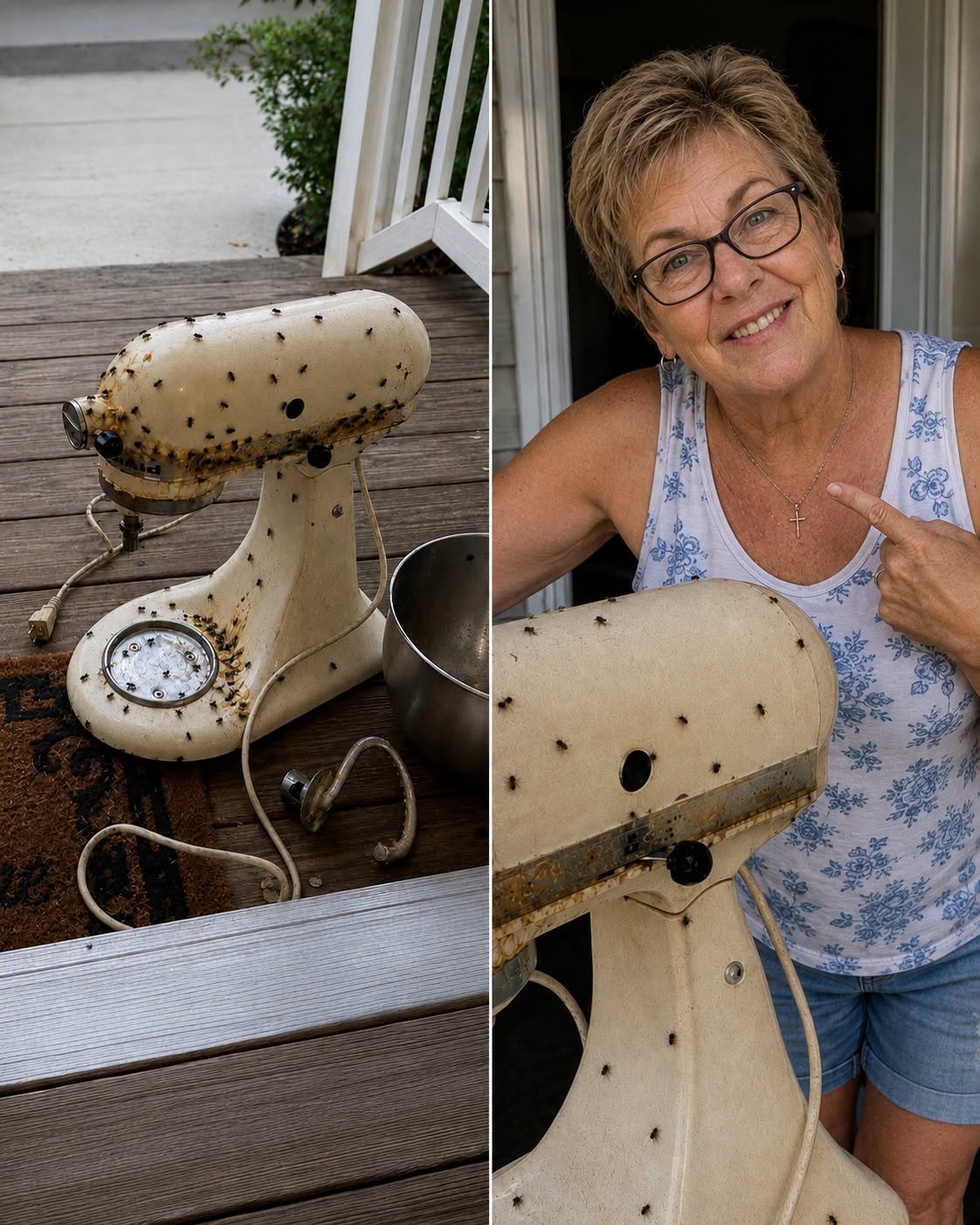
The mixer was an old cream-colored KitchenAid.
Heavy.
Solid.
Scratched around the base from decades of use.
There was even a tiny chip in the enamel where my father had once accidentally knocked a metal measuring cup against it.
My mother had bought it in 1989.
For years, she used it almost every Sunday.
Cakes.
Bread dough.
Cookies.
Birthday frosting.
Holiday desserts.
If there was something being baked in my childhood home, chances were that mixer had been involved.
Later, when Mom became older and standing in the kitchen became difficult, she stopped using it as often.
After she passed away, my sister and I divided most of the things from her kitchen.
Neither of us fought over anything.
There were newer appliances.
More expensive cookware.
Prettier dishes.
But I wanted the mixer.
Not because it had monetary value.
Because it carried a sound.
Whenever I switched it on, that low, steady motor brought me back to Sunday mornings in my parents’ kitchen.
I could almost smell coffee.
I could picture Mom standing at the counter, reading a recipe she probably already knew from memory.
It may sound foolish to become emotional about a kitchen appliance.
But sometimes grief attaches itself to ordinary objects.
A chipped mug.
A sweater.
A handwritten recipe.
A cream-colored mixer.
So when Denise asked for it, I did something unusual.
I said no.
“Denise, I’d rather not lend that one out. It belonged to my mother.”
She laughed lightly, almost as if she thought I was exaggerating.
“Oh, come on. I’m making one cake. I’ll treat it like gold.”
“I really don’t feel comfortable—”
“Please?”
She remained standing there.
Waiting.
Smiling.
Expecting me to surrender the way I always did.
My daughter Sophie was sitting nearby on the porch steps, quietly watching the entire exchange.
I wish I could say I stood my ground.
Instead, after several uncomfortable seconds, I heard myself say:
“All right.”
I regretted it immediately.
Denise’s smile widened.
“Thank you! I’ll have it back Saturday.”
“Please clean it before you return it.”
“Of course.”
She carried it away.
I stood there watching her cross the lawn with my mother’s mixer in her arms.
Every instinct told me I had made a mistake.
Three days later, I learned just how big that mistake had been.
Saturday morning, I opened my front door and found the mixer sitting beside the welcome mat.
Denise hadn’t knocked.
She hadn’t handed it back.
She had simply left it outside.
Where anyone passing the house could have taken it.
That alone irritated me.
Then I looked closer.
And my irritation turned into something else.
Yellow cream had dried into the narrow seam near the mixer’s head.
Something sticky coated part of the electrical cord.
The whisk attachment had been tossed into the bowl with hardened icing still stuck to it.
Nothing had been washed.
Nothing had even been rinsed.
Sophie came up behind me.
“She just left Grandma’s mixer outside?”
“Apparently.”
She looked into the bowl.
“That’s disgusting.”
“Yes.”
I carried everything into the kitchen.
I washed the bowl.
Scrubbed the attachment.
Wiped the cord.
Then I spent nearly twenty minutes carefully loosening dried cream from the mixer’s seams.
Finally, after everything was clean, I plugged it in.
I flipped the switch.
Instead of the familiar smooth hum, the motor made a rough grinding noise.
My hand froze.
There was a click.
The mixer’s head jerked.
Then everything stopped.
I switched it off.
Waited several seconds.
Tried again.
Grinding.
Click.
Nothing.
I unplugged it slowly.
Sophie was standing beside me.
Her voice became quiet.
“Is Grandma’s mixer broken?”
Something inside me snapped into focus.
I walked straight across the lawn to Denise’s house.
At that point, I still expected an apology.
That may have been the most naive part of the whole situation.

Part 3 — “You Should Just Buy a New One”
Denise opened her door holding a coffee mug.
When she saw me, she didn’t look surprised.
“Oh. Hey.”
I skipped the small talk.
“The mixer isn’t working.”
She barely reacted.
“Yeah. I noticed.”
I stared at her.
“What happened?”
She took a sip of coffee.
“It stopped halfway through the frosting.”
“You knew it stopped working?”
“Well, obviously.”
“Then why didn’t you tell me?”
She shrugged.
“I figured you’d find out.”
For a moment, I genuinely couldn’t believe what I was hearing.
“What exactly happened when it stopped?”
“It started making this awful sound.”
“And then?”
“And then it quit.”
“Did you turn it off as soon as it started making the noise?”
Denise hesitated.
Only slightly.
But I noticed.
“I had frosting to finish.”
“That isn’t what I asked.”
She sighed impatiently.
“I had eleven people at my house waiting for dessert. I couldn’t exactly stop everything.”
“So you kept running it?”
“I was trying to finish the cake.”
There was my answer.
I felt my jaw tighten.
“That mixer worked perfectly when you borrowed it.”
Denise rolled her eyes.
“Honestly, you should probably just buy another one. That thing is ancient.”
I stared at her.
“It was my mother’s.”
“I know, but it’s what—thirty years old?”
“Thirty-six.”
She gave me a small smile, as though I had just helped prove her argument.
“Exactly. It was bound to break sooner or later.”
“Not necessarily.”
“Well, it broke.”
Then she added something that stunned me even more.
“And honestly, the whole thing ruined my evening. I had people waiting around for cake.”
For several seconds, I said nothing.
She was actually blaming me.
She had borrowed my mixer.
Ignored the sound of the motor struggling.
Kept forcing it to run.
Returned it filthy.
Left it outside without saying a word.
And somehow, in her version of the story, she was the inconvenienced one.
I went home before I said something I would regret.
Sophie was waiting at the kitchen table.
“What happened?”
“She thinks the mixer broke because it’s old.”
Sophie frowned.
“Is she paying to fix it?”
“No.”
“Why not?”
I looked at her.
“That is an excellent question.”
That night, I barely slept.
I kept thinking about my mother.
About Sunday mornings.
About that mixer sitting on her counter year after year.
But I also kept thinking about myself.
I had allowed this pattern.
Every dirty appliance I silently cleaned.
Every late return I excused.
Every time I laughed off a missing lid because I didn’t want to seem difficult.
I had mistaken avoiding conflict for being kind.
The next morning, I decided I needed facts before I confronted Denise again.
So on Monday, I carried the mixer into an appliance repair shop.
The technician’s name was Greg.
He looked like the kind of man who had been repairing machinery since before I was born.
He opened the housing, examined the motor, and turned several parts by hand.
After a few minutes, he looked up.
“What were you mixing when this happened?”
“I wasn’t using it. My neighbor borrowed it.”
Greg paused.
“Ah.”
It was only one syllable.
Somehow it sounded like an entire paragraph.
“What happened to it?”
He pointed inside.
“The motor overheated. Looks like it was working under a heavy load and someone kept running it after it started straining.”
“So it didn’t simply die from old age?”
Greg actually laughed.
“These older KitchenAids are built like tanks. Age matters, sure, but this isn’t just normal wear. Whoever was using it should have shut it down the moment the motor started complaining.”
My stomach tightened.
“How much to repair it?”
He calculated the parts and labor.
“Three hundred forty-seven dollars.”
I took a picture of the estimate and sent it to Denise.
My message was simple.
“The repair shop says the motor was damaged by overload and continued use after it began straining. The repair is $347. Please reimburse me.”
Twenty minutes later, my phone buzzed.
Her reply read:
“LOL. Absolutely not. I’m not paying $347 for a mixer from the 80s.”
A second message appeared.
“You should thank me. Now you finally have a reason to replace that dinosaur.”
I stared at the screen.
Sophie leaned over my shoulder and read it.
“Mom?”
“Yes?”
“Can I say a bad word?”
“No.”
“Can I think one?”
I nodded.
“Definitely.”
I paid Greg for the repair myself.
Then I went home.
And printed a document.
Because three days later, Denise was planning a graduation party.
And I knew something she didn’t.
Sooner or later, she was going to need to borrow something again.
Part 4 — The New Lending Policy
Denise’s niece was graduating that weekend.
A large congratulatory sign had been sitting in her front yard for nearly two weeks, and judging by the number of cars she expected, the party was going to be big.
About three days before the event, there was a knock on my door.
I almost smiled before opening it.
Denise stood outside.
“Hey, neighbor.”
“Hi, Denise.”
“I need to borrow a few things.”
Of course she did.
“What do you need?”
“The big cooler, your crock pot, and those two folding tables you keep in the garage.”
“I still have them.”
“Perfect.”
She started moving toward the garage as if the matter were settled.
“Wait.”
She stopped.
I went inside and returned carrying a clipboard.
Denise looked down at it.
Her smile disappeared.
“What’s that?”
“A lending agreement.”
She laughed.
I didn’t.
Her eyes narrowed.
“You’re serious?”
“Completely.”
I handed her the clipboard.
At the top, I had listed every item she wanted.
Large cooler — replacement value: $120.
Crock pot — replacement value: $80.
Two folding tables — replacement value: $75 each.
Below that were the conditions.
All items returned by Sunday at 6 p.m.
All items returned clean and completely dry.
All items returned in the same condition in which they were borrowed.
Then came the final section.
Refundable security deposit: $350.
Outstanding mixer repair: $347.
Denise stared at the paper.
Then she stared at me.
“You want seven hundred dollars for me to borrow some tables?”
“No. The $350 deposit comes back when my things come back properly.”
“And the rest?”
“That’s what you owe for the mixer.”
Her mouth fell open.
“This is ridiculous.”
“You taught me that I needed clearer rules.”
“I always return your stuff.”
“Yes. Eventually.”
“Nothing has ever happened to anything!”
“The mixer happened.”
She exhaled sharply.
“That old thing again?”
“It mattered to me.”
She tossed the clipboard onto the small table beside my porch.
“I cannot believe you’re doing paperwork now.”
“I can.”
“We’ve borrowed things from each other for years!”
“You’ve borrowed things from me for years.”
She glared.
“All this because of one stupid mixer?”
My voice became quieter.
“It wasn’t stupid to me.”
For one brief second, Denise had no answer.
Then she rolled her eyes.
“Fine. I’ll rent what I need.”
“Okay.”
She marched back toward her house.
The front door opened behind me.
Sophie stepped outside.
“That was terrifying.”
I turned.
“Me?”
“Yes.”
“Was it a good terrifying?”
She thought about it.
“Mostly.”
I laughed for the first time in days.
I assumed Denise would rent everything and that would be the end of it.
I was wrong.
Saturday morning, at exactly 8:15, someone knocked urgently on my door.
When I opened it, Denise looked completely different from three days earlier.
Her hair was curled on only one side.
One eye had makeup.
The other didn’t.
She looked exhausted.
“Do you still have the folding tables?”
“Yes.”
“And the cooler?”
“Yes.”
She closed her eyes briefly.
“The rental company messed up.”
“What happened?”
“They delivered four chairs and no tables.”
“That’s unfortunate.”
She glared at me.
“People are arriving in less than two hours.”
I waited.
She hated that I was making her say it.
Finally:
“Can I borrow yours?”
Without saying a word, I went inside.
Then I returned with the clipboard.
Her shoulders dropped.
“You’re still serious about that?”
“Very.”
“Today?”
“Especially today.”
“I have forty people coming!”
“Then I suppose you need to make a decision quickly.”
She looked from the clipboard to me.
“You’re enjoying this.”
I considered lying.
“A little.”
At least I was honest.
Denise sighed, grabbed the pen, and started signing.
I held out my hand.
“Deposit first.”
Her head snapped up.
“You cannot be serious.”
“I am.”
She disappeared back into her house.
Five minutes later, she returned holding a checkbook.
“Who even uses checks anymore?”
I glanced at the book.
“Apparently you do.”
She wrote a check for $697.
I looked at the amount.
“Just so we’re clear, $347 of this is not refundable.”
Her jaw tightened.
“I know.”
I almost wanted to frame that check.
Instead, I helped her carry the tables.
Because despite everything, I wasn’t trying to destroy her niece’s graduation party.
That was never the point.
I wanted Denise to understand that borrowing someone else’s possessions came with responsibility.
She took the cooler.
The crock pot.
Both folding tables.
Then she looked back at my garage.
“Could I also borrow your outdoor drink dispenser?”
I picked up my pen.
“I’ll add it.”
She groaned.
But she signed beside that item too.
Part 5 — Amazing What a Deposit Can Do
The party started around noon.
Cars lined both sides of the street.
Music drifted across the yards.
Balloons decorated Denise’s porch.
Every so often, I could hear people laughing.
I stayed home and minded my own business.
I wasn’t waiting for something to go wrong.
Honestly, I hoped everything went perfectly.
Because by then, I had already made my point.
The real test came the next afternoon.
At 4:20 on Sunday, Denise knocked on my door.
The folding tables were standing neatly beside her.
The cooler had been washed and dried.
The crock pot looked spotless.
The drink dispenser was so clean that I briefly wondered whether she had polished it.
I inspected everything carefully.
No stains.
No dents.
Nothing missing.
Everything returned early.
Denise folded her arms.
“Well?”
I looked up.
“Everything looks great.”
“Are you satisfied?”
“Very.”
I went inside and returned with the security-deposit check.
She looked at it.
Then frowned.
“Where’s the rest?”
“What rest?”
“The mixer money.”
“That wasn’t part of the deposit.”
“You’re actually keeping it?”
“No.”
I smiled.
“The repair shop is.”
Her face shifted.
First irritation.
Then embarrassment.
And underneath both, perhaps the smallest trace of respect.
She put the deposit check into her pocket.
“This entire thing is still ridiculous.”
“Maybe.”
“I really believed that mixer broke because it was old.”
I looked at her.
“That wasn’t actually the worst part.”
She frowned.
“What do you mean?”
“Let’s say you really believed the mixer had simply reached the end of its life.”
“Okay.”
“You still left it filthy on my porch without telling me.”
Denise looked away.
For perhaps the first time since I had known her, she didn’t immediately have an excuse.
I continued.
“If you had knocked on my door and said, ‘I’m sorry. The mixer stopped while I was using it, and I don’t know what happened,’ this whole situation would have been different.”
She stared at the grass.
“I had people at the house.”
“I know.”
“I was stressed.”
“I know.”
“I still had half the food to finish.”
“I understand.”
Silence stretched between us.
Then Denise spoke more quietly.
“I shouldn’t have left it like that.”
“No.”
“And I shouldn’t have acted like it was your problem.”
“No.”
She took a slow breath.
“I’m sorry.”
There it was.
Not a dramatic apology.
No tears.
No long speech.
Just two words.
But for once, they sounded genuine.
I nodded.
“Thank you.”
Denise walked home.
And strangely enough, I didn’t feel triumphant.
I simply felt relieved.
I hadn’t wanted revenge.
I had wanted acknowledgement.
Sometimes that matters more.

Part 6 — The Sound of Sunday Morning
Two days later, Greg called.
The mixer was ready.
I drove to the repair shop that afternoon with Sophie.
Greg placed the cream-colored KitchenAid on the counter.
From the outside, it looked exactly the same.
Same scratches.
Same tiny enamel chip.
Same decades-old body.
He plugged it in.
Then flipped the switch.
The motor started immediately.
Smooth.
Steady.
Familiar.
That sound hit me harder than I expected.
For half a second, the repair shop disappeared.
I was back in my parents’ kitchen.
Mom was at the counter.
Sunlight came through the window.
Something sweet was baking.
That mixer was humming while she worked.
I had to blink quickly.
I was dangerously close to crying in front of a man surrounded by microwaves and broken vacuum cleaners.
Greg rested a hand on top of the machine.
“You’ve still got a good mixer here.”
“Really?”
“Oh, yes. Take care of this thing and it’ll probably outlast both of us.”
I laughed.
“That’s what I wanted to hear.”
That Sunday, Sophie and I pulled out one of Mom’s recipes.
Chocolate cake.
Nothing elaborate.
No fancy decorations.
Just the cake my mother used to make.
Sophie measured the flour while I prepared the wet ingredients.
Then I locked the bowl into place.
I wrapped my fingers around the switch.
For a second, I hesitated.
Then I turned it on.
The paddle began to rotate.
The familiar hum filled the kitchen.
Sophie smiled.
“Sounds normal again.”
I looked at the mixer.
“It does.”
The batter slowly came together.
And while it mixed, I thought about Mom.
About all the ordinary Sundays I never realized I would one day miss.
That was why the mixer mattered.
It wasn’t valuable because it was rare.
It wasn’t valuable because it was expensive.
It mattered because memories had accumulated around it.
Thirty-six years of birthdays, holidays, conversations, flour-covered counters, family arguments, laughter, and Sunday afternoons.
You can buy another mixer.
You cannot walk into a store and buy thirty-six years of memories.
Part 7 — What Denise Actually Learned
After the graduation party, Denise stopped asking to borrow things.
For several months, nothing crossed the lawn between our houses.
I didn’t mind.
Our relationship wasn’t ruined.
We still waved.
We still talked occasionally.
There just seemed to be a new understanding between us.
Then one afternoon in October, Denise knocked on my door.
I opened it.
She pointed toward my garage.
“Do you still own that pressure washer?”
“Yes.”
She sighed heavily.
“And do you still have those forms?”
I smiled.
“Absolutely.”
She rolled her eyes.
But this time, she signed.
And when the pressure washer came back?
It arrived exactly when she promised.
It had been cleaned.
The tank was full.
The cord was wrapped neatly.
I almost didn’t recognize it.
That experience taught me something I probably should have learned years earlier.
People often say that being generous with neighbors is part of building a community.
I agree.
If someone needs a ladder, a casserole dish, or an extra table and I can help, I’m happy to do it.
But generosity does not require accepting disrespect.
For years, I believed that saying no would make me selfish.
I thought setting rules would make me difficult.
I worried that asking someone to replace what they damaged would make me petty.
What I didn’t realize was that every time I quietly accepted Denise’s carelessness, I was showing her that there were no consequences.
My things had value to me.
But because they cost her nothing, she had no reason to treat them as though they mattered.
The deposit changed that.
Suddenly, she had something at stake.
And miraculously, every borrowed item returned clean.
Nothing disappeared.
Nothing broke.
Nothing sat forgotten in her garage.
It wasn’t that Denise had suddenly learned how to wash a cooler or wipe down a crock pot.
She had always known how.
What changed was her reason to care.
And maybe that was the bigger lesson for me too.
Boundaries aren’t punishment.
They aren’t revenge.
Sometimes a boundary is simply the clearest way to tell someone:
“This matters to me, even if it doesn’t matter to you.”
The old KitchenAid still sits on my counter.
The cream-colored enamel has faded slightly.
The scratches are still there.
So is the little chip from my father’s measuring cup.
And whenever I turn it on, the motor still makes that same steady sound.
The sound my mother listened to almost every Sunday for years.
Denise had said one thing during our argument that was technically true.
The mixer was ancient.
But she never understood that its age wasn’t the problem.
Its age was exactly what made it impossible to replace.