
Part 2:
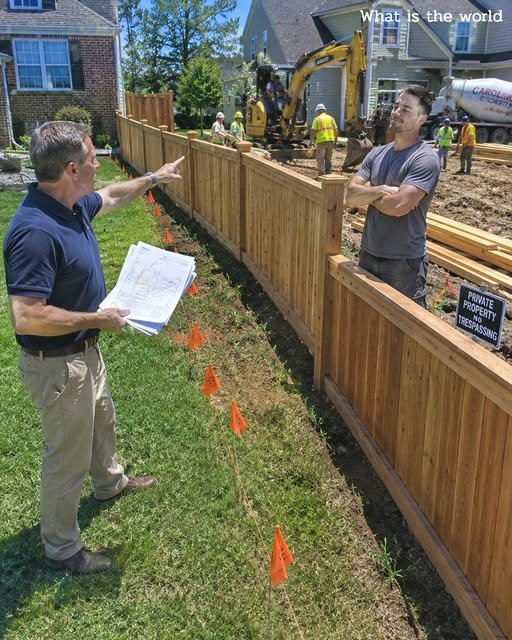
I watched the concrete truck reverse toward Tyler’s backyard.
Every instinct told me to run outside.
Rachel told me not to.
“Document everything,” she said. “Do not touch the fence. Do not enter into an argument.”
So I stayed on my side.
I took photos from my property.
Timestamped.
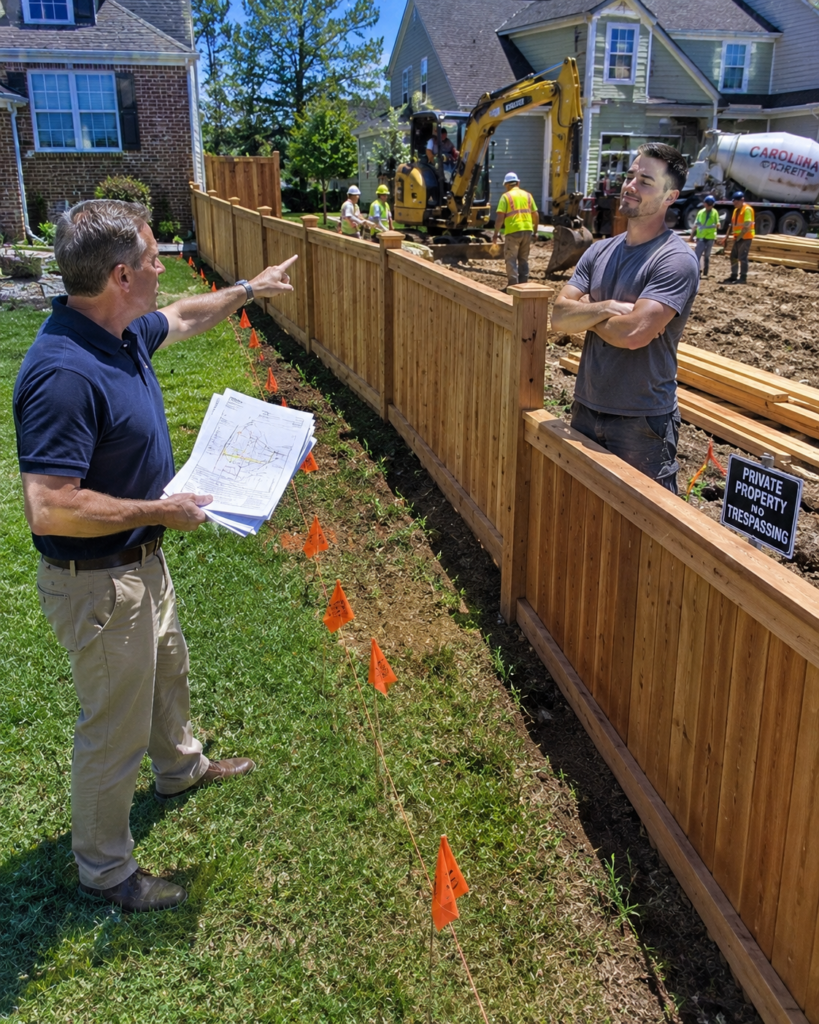
Wide shots showing the survey flags.
Closer shots showing the fence.
Then I noticed something.
One of the contractors was holding a printed site plan.
The same approved drawing Rachel had shown me.
I zoomed in.
The pool outline on the paper was positioned ten feet from the true boundary.
But the strings in the yard were not.
They were measured from Tyler’s fence.
Not from the actual property line.
I called Rachel again.
“They’re using the fence as the setback.”
“That’s what I was afraid of.”
“What now?”
“We notify the county.”
Less than thirty minutes later, a code inspector arrived.
Tyler came outside furious.
“What is this?”
The inspector asked to see the approved pool plan.
Then he walked to Carl’s orange survey markers.
Measured once.
Measured again.
His expression changed.
“This layout doesn’t match your approved setback.”
Tyler pointed at the fence.
“That’s the property line.”
The inspector shook his head.
“No. That appears to be an interior fence.”
Tyler’s face went blank.
The concrete crew stopped working.
Then the inspector asked the question that finally erased Tyler’s smile.
“Who told you this fence marked the legal boundary?”
Tyler looked at me.
I said nothing.
The inspector opened the permit file on his tablet.
Then looked back at Tyler.
“You signed the original site plan yourself.”
For the first time since this started, Tyler didn’t have an answer.
“Did you personally submit this permit?”
Tyler looked at the inspector, then at the tablet showing his name beneath the owner certification.
For a few seconds, nobody moved.
The concrete crew stood beside the unfinished pool forms. Rachel remained near the driveway with her folder of documents. Carl’s orange survey flags marked the actual boundary behind the fence Tyler had insisted was his.
Tyler finally crossed his arms.
“Yes,” he said. “But that doesn’t mean the survey is right.”
The inspector did not argue with him. She simply looked back at the permit drawing.
“That certification states you reviewed the site plan and confirmed the information submitted was accurate.”
Tyler shook his head quickly.
“My contractor handled the details.”
The inspector turned toward the contractor.
The contractor looked uncomfortable.
“I built according to the measurements I was given,” he said.
That sentence changed the entire conversation.
The fence had not become a boundary because Tyler built it. It had become a reference point because Tyler told other people it was one.
Rachel stepped forward carefully.
“That is exactly the issue,” she said. “The approved drawing shows the correct line. The installed fence does not.”
The inspector photographed the survey markers and compared them with the permit file again.
Then she asked Tyler one more question.
“Before the fence was installed, did you have this boundary marked by a licensed surveyor?”
Tyler hesitated.
That hesitation mattered.
“No,” he said.
The inspector wrote something on her tablet.
The pool crew was told to stop work until the setback issue was resolved.
Tyler’s expression changed immediately.
“You’re stopping my whole project over a fence?”
The inspector shook her head.
“I’m stopping work because the approved plans and the physical layout do not match.”
That distinction was important.
This was no longer a disagreement between two neighbors looking at grass and cedar boards.
It was a county-approved project built on a measurement that did not exist.
After the inspector left, Tyler came over to my driveway.
His confidence was gone, but his anger was still there.
“You went too far,” he said.
I looked at him.
“You built on my land and told me I couldn’t stand on it.”
He looked away.
For the first time since the fence went up, he did not have an answer.
Rachel told me the next step was important.
We could not just celebrate the inspection.
The county process would determine what happened next, and Tyler still had options to challenge the findings.
So we kept documenting everything.
Carl returned with updated measurements showing the full encroachment area.
The county reviewed the fence permit, the pool permit, and the survey together.
A week later, Rachel received a letter from the planning department.
The county had confirmed that Tyler’s approved documents showed the correct boundary, and the installed fence location was inconsistent with those records.
The pool permit was placed on hold until the layout was corrected.
Tyler was required to address the fence encroachment before moving forward with construction.
But the part that mattered most to me was not the paperwork.
It was what happened when the fence finally came down.
I stood near the oak tree where Emma’s old swing had hung for years.
The same strip of land Tyler had called “his yard” was exposed again.
The contractors removed the cedar panels carefully because they were still new.
Some boards were reused.
Some were not.
A few weeks later, a new fence was installed along the surveyed boundary.
Tyler and I never became friends after that.
I don’t think we were supposed to.
There are some conflicts where the best outcome is not forgiveness or friendship.
Sometimes it is simply having the truth recorded correctly and having a line respected again.
I still mow that narrow strip every Saturday.
I still stop by the oak tree.
And I still keep the survey copy in my filing cabinet.
Not because I expect another fight.
Because I learned something from Tyler’s fence.
A boundary only works when people agree where it actually is.
Part 3:
The fence came down on a Tuesday morning.
I remember the day because the sky was perfectly blue.
No clouds.
No wind.
Just one of those Carolina mornings when everything looked peaceful enough to make you forget that people could spend months fighting over a strip of grass.
I stood beside my oak tree and watched the contractors remove the cedar panels one by one.
The same fence Tyler had once called permanent.
The same fence he had told me was too expensive to move.
The same fence he had built eight feet inside my property and then dared me to challenge.
Now it was coming down.
Piece by piece.
Post by post.
Tyler stood on his back porch with his arms crossed.
Ashley stood beside him.
Neither of them spoke.
But I could see the anger on Tyler’s face.
This wasn’t the expression of a man who had discovered he was wrong.
It was the expression of a man who couldn’t believe the world had refused to cooperate with him.
Rachel stood beside me.
She had a folder under one arm and her phone in the other hand.
Carl was there too, holding the final boundary report.
The county inspector had already signed off on the corrected measurements.
The pool construction was still suspended.
And the fence had to be relocated.
Everything was finally moving in the direction it should have moved months earlier.
Then Tyler walked down from the porch.
He stopped several feet away from us.
“You happy now?”
I looked at him.
“No.”
He frowned.
“You got what you wanted.”
“I wanted you to build your fence on your property.”
“You’ve cost me thousands.”
I almost laughed.
“You cost yourself thousands.”
His jaw tightened.
“You could’ve just let it go.”
I stared at him.
“Eight feet?”
He didn’t answer.
“Nearly five hundred square feet?”
Still nothing.
“Your pool?”
His expression changed.
“That has nothing to do with you.”
Rachel spoke before I could.
“It does when the pool is being constructed according to an incorrect property reference.”
Tyler looked at her.
“You lawyers always make everything bigger than it is.”
Rachel smiled calmly.
“No, Tyler. Documents do.”
He stared at her.
She opened the folder.
“Would you like to know what the county found?”
He said nothing.
“The fence permit contains a site plan showing the correct property boundary.”
“I already told you. My contractor handled it.”
“And your signature is on the owner certification.”
He looked away.
Rachel continued.
“The pool permit also contains the same boundary.”
“I didn’t measure the property.”
“You certified the site information.”
“My contractor—”
“Your name is still on the certification.”
Silence.
The contractors kept working behind us.
A post came loose from the ground.
The sound of metal scraping against concrete made Tyler flinch.
Rachel closed the folder.
“The county isn’t interested in who you blame. They’re interested in what was submitted, what was approved, and what was actually built.”
Tyler looked at me.
“You really want to destroy me over a fence?”
I shook my head.
“No.”
I pointed toward the survey markers.
“I just want you to stop building on my land.”
He stared at the orange flags.
Then something happened that I hadn’t expected.
He laughed.
It wasn’t a happy laugh.
It was short.
Bitter.
“You think this is over?”
Rachel’s expression became serious.
“That’s enough, Tyler.”
He ignored her.
“You think because the county made you feel important, you own everything?”
“I never said that.”
“You’ve been waiting for this.”
“For what?”
“For me to fail.”
I shook my head.
“I’ve been waiting for you to move the fence.”
He stepped closer.
“I’ve lived here almost as long as you.”
“Eleven years?”
“Nine.”
“So you’ve lived here nine years.”
“Yes.”
“And I lived here eleven.”
“What does that prove?”
“That neither of us gets to change the boundary because we feel like it.”
He stared at me.
Then he walked away.
I thought that was the end.
I was wrong.
Three days later, Rachel called me at work.
“Jason.”
Something about her voice made me stop what I was doing.
“What happened?”
“I found something.”
“What?”
“Can you come to my office?”
“Is it bad?”
She paused.
“I don’t know yet.”
That wasn’t an answer.
I left work early.
When I arrived, Rachel was sitting behind her desk with several documents spread across it.
Carl was there too.
He looked unusually serious.
I sat down.
“What did you find?”
Rachel slid a document toward me.
It was a copy of Tyler’s original property survey from when he purchased his house.
I looked at it.
The boundary line was clearly marked.
I looked at Rachel.
“So?”
“Look at the date.”
I did.
Nine years earlier.
The same year Tyler had purchased his house.
Then I looked at the surveyor’s name.
I recognized it.
Carl recognized it too.
“That’s the same firm that prepared the old subdivision plat.”
Rachel nodded.
“Exactly.”
I looked back at the document.
“What’s the problem?”
Rachel pointed to the eastern boundary.
“The original survey shows the exact same boundary Carl found last month.”
“Okay.”
“Now look at this.”
She handed me another document.
It was a copy of Tyler’s fence permit.
The site plan was marked in red.
Rachel had circled something.
I leaned closer.
There was a handwritten measurement.
Eight feet.
I stared at it.
“Who wrote that?”
“We don’t know.”
“Tyler?”
“We can’t say yet.”
Carl leaned forward.
“But look at the line.”
I followed his finger.
The line on the site plan showed the actual property boundary.
Then there was another line.
The fence line.
Eight feet inside mine.
I looked at Rachel.
“So he knew.”
“That’s what we’re trying to establish.”
I sat back.
“Maybe he made a mistake.”
Carl shook his head.
“Jason, mistakes don’t usually get measured twice.”
I looked at him.
“What do you mean?”
He opened his laptop.
“I pulled the county records from the subdivision’s original development file.”
He turned the screen toward me.
There was a drainage easement running along the back of my property.
My eyes moved across the document.
Then stopped.
The easement extended farther into Tyler’s side than I realized.
Carl zoomed in.
“See this?”
I nodded.
“This strip isn’t just your land.”
“What else is it?”
“It’s part of a recorded drainage easement.”
I frowned.
“What does that mean?”
Rachel answered.
“It means neither you nor Tyler can simply build whatever you want there.”
I looked at the map again.
The drainage ditch behind the properties suddenly made more sense.
The county had maintained it for years.
There were access rights.
Utility restrictions.
Drainage requirements.
And then I remembered something.
“The pool.”
Rachel nodded.
“Exactly.”
I felt something cold move through my stomach.
“The pool is over the easement?”
“Partially.”
“And the pergola?”
“Partially.”
“The hot tub?”
“Potentially.”
I stared at the documents.
Suddenly this wasn’t about five hundred square feet anymore.
Tyler hadn’t just put his fence on my property.
He had placed multiple permanent structures inside an area subject to a recorded easement.
And if those structures interfered with drainage or access, the county could require their removal.
I looked at Rachel.
“How much is all of this worth?”
She didn’t answer immediately.
“What’s the pool contract?”
“Tyler told me sixty thousand.”
Rachel nodded.
“Pool, concrete deck, retaining work, electrical, landscaping…”
She started counting on her fingers.
“If the pergola is another twelve or fifteen thousand, the landscaping maybe twenty…”
She stopped.
“The number could get ugly.”
I looked down at the documents.
I wasn’t smiling.
I wasn’t celebrating.
For the first time, I felt almost sorry for him.
Almost.
Then Rachel said something that changed everything.
“There’s another document.”
“What?”
She pulled out a printed email.
“It came from the county archive.”
She placed it in front of me.
It was correspondence between the original developer and the homeowners’ association.
The subject line read:
Drainage Easement — Fence and Permanent Structures
I read the first paragraph.
Then the second.
My hands became still.
The original developer had specifically warned homeowners not to build permanent structures over the easement.
There was a reason.
The subdivision sat on land that flooded during major storms.
The easement allowed county crews to access drainage channels.
And the fence line was supposed to remain clear enough for maintenance.
Rachel looked at me.
“Jason.”
I looked up.
“What?”
“Tyler’s fence isn’t just over your property.”
She pointed at the map.
“It crosses the drainage easement and blocks the maintenance corridor.”
I swallowed.
“So the county could order it removed anyway.”
“Yes.”
“Even if it wasn’t on my land?”
“Potentially.”
I stared at the fence location on the map.
Then another thought hit me.
“Why didn’t the county catch this when they approved the fence?”
Rachel’s expression changed.
“That’s the question.”
Carl leaned back.
“Maybe they didn’t review the old easement map.”
Rachel shook her head.
“The easement is recorded.”
“So?”
“So it’s part of the property records.”
She looked at me.
“And Tyler’s survey showed it.”
Silence filled the office.
I looked at the old survey again.
The drainage easement was clearly marked.
The boundary was clearly marked.
Everything Tyler needed to know had apparently been there before he built a single post.
Rachel folded her hands.
“I want to be careful here.”
“About what?”
“Don’t accuse him of intentionally doing anything we can’t prove.”
I nodded.
“But we can document what happened.”
“Yes.”
“Then let’s document it.”
She smiled faintly.
“That’s exactly what we’re going to do.”
The next morning, Rachel contacted the county engineering department.
They sent an inspector.
The inspector walked the easement.
Measured the access corridor.
Checked the fence.
Then photographed the concrete pad where Tyler’s hot tub had been installed.
When the inspector finished, he said only one thing.
“This needs to be reviewed.”
Two days later, Tyler received a notice.
Then another.
Then another.
The fence was one issue.
The pool setback was another.
The drainage easement was a third.
And suddenly the perfect backyard he had spent months building began to look very different.
The pool contractor stopped work.
The landscaping company stopped.
The pergola crew didn’t return.
The hot tub company was asked to provide installation documentation.
Tyler’s backyard became a construction site frozen in time.
And then Tyler came to my house.
He didn’t knock.
He stood at the end of my driveway.
I walked outside.
“What do you want?”
He looked exhausted.
“You need to call them off.”
“Who?”
“The county.”
“I don’t control the county.”
“You started this.”
“No.”
“You called them.”
“I reported an encroachment.”
“You knew what would happen.”
“I didn’t know what would happen.”
He rubbed his face.
“You could’ve talked to me.”
I stared at him.
“I did.”
He looked away.
“I mean before all this.”
“I sent you an email.”
He said nothing.
“I sent you a certified letter.”
Nothing.
“I knocked on your door.”
His jaw tightened.
“And you told me to stop harassing you.”
He looked at me.
“I was angry.”
“So was I.”
“I didn’t think it would get this far.”
“Neither did I.”
He looked down.
For a moment, he seemed less like the arrogant man who had leaned against my fence and more like a person who had finally realized his mistake was expensive.
“How much do you want?”
I blinked.
“What?”
“Money.”
“No.”
“I’ll pay you.”
“For what?”
“For the land.”
I shook my head.
“You don’t get to buy my property because you built a fence on it.”
“I’ll pay fair market value.”
“I don’t want to sell.”
“I’ll make it worth your while.”
“Tyler.”
He looked at me.
“Move the fence.”
He stared.
“That’s it?”
“That’s it.”
“And the county?”
“Handle the permits.”
“The pool?”
“Move it if they require it.”
He laughed bitterly.
“Do you have any idea how much that will cost?”
I looked at him.
“Probably less than trying to pretend the land is yours.”
He walked away.
I thought that was the end of the conversation.
It wasn’t.
That evening, Rachel called.
“Jason, Tyler’s attorney contacted me.”
“What does he want?”
“Negotiation.”
“For what?”
“They want to resolve everything privately.”
I sat at my kitchen table.
“Meaning?”
“They want you to sign a boundary agreement.”
“Why?”
“So they can keep part of the fence where it is.”
I immediately said no.
Rachel didn’t argue.
“I expected that.”
“What else?”
“They’re also asking for temporary access across your property so they can reconstruct the pool.”
I almost laughed.
“They want to use my property to fix the pool they put there by mistake?”
“That’s what they’re asking.”
“No.”
“I know.”
“Anything else?”
She hesitated.
“There’s a third request.”
“What?”
“They want you to agree not to pursue damages.”
I leaned back.
“Damages?”
“They’re worried about the cost of removal and reconstruction.”
I stared at the wall.
“Rachel.”
“Yes?”
“Do I have a case for damages?”
“Potentially.”
“For what?”
“That depends on what we can prove.”
“What could we prove?”
“Costs associated with the encroachment. Interference with your property. Potential diminution in value. Legal expenses in some circumstances. And if there was intentional conduct, the analysis changes.”
I thought about the handwritten eight-foot measurement.
The approved site plan.
The old survey.
The fence.
The pool.
The easement.
Then I remembered Tyler’s first words.
Too expensive to move now.
He had known the fence was wrong.
Even if he hadn’t intended everything that followed, he had made a decision.
He knew there was a problem.
And instead of fixing it, he doubled down.
“Don’t settle yet,” I said.
Rachel was quiet.
“Are you sure?”
“Yes.”
“Why?”
“Because I want to know the whole story first.”
Three days later, we got it.
Not from Tyler.
From the county.
A records clerk had found an older permit file.
It was from two months before the fence was built.
The document was an email from Tyler to the county planning department.
I read it twice.
Then a third time.
Tyler had asked a very specific question.
He had written:
Can the fence be placed along the existing landscaping edge instead of the recorded boundary?
The county employee had replied:
No. The fence must remain within your parcel and cannot encroach upon the neighboring property or the drainage easement.
Tyler had responded:
Understood.
I stared at the screen.
There it was.
The warning.
In writing.
Before construction.
Rachel sat across from me.
She didn’t say anything.
She didn’t need to.
I looked at the date.
Then the fence construction date.
Then the pool application.
Then the handwritten eight-foot measurement.
Suddenly the timeline became painfully clear.
Tyler had asked.
The county had answered.
He knew.
And he built anyway.
I closed my eyes.
For months, I had wondered whether I was being too stubborn.
Maybe the fence was a mistake.
Maybe the contractor measured incorrectly.
Maybe Tyler honestly believed the property line was somewhere else.
That email destroyed all three explanations.
Rachel spoke softly.
“Now we know.”
I opened my eyes.
“What happens next?”
“Now we let the documents speak.”
The county scheduled a formal compliance meeting.
Tyler attended with his attorney.
I attended with Rachel.
Carl attended as the survey expert.
There were six people around the conference table.
No shouting.
No dramatic courtroom.
Just fluorescent lights, printed maps, laptops, and folders.
But the tension was heavier than anything I had experienced in a courtroom.
The county engineer started.
“We’re here to resolve three issues.”
He placed the first map on the table.
“Boundary encroachment.”
Second map.
“Pool setback.”
Third.
“Drainage easement obstruction.”
Tyler’s attorney immediately raised a hand.
“We dispute the characterization of intentional encroachment.”
Rachel didn’t react.
The engineer nodded.
“Intent isn’t the primary issue for today’s compliance determination.”
He opened the file.
“We are concerned with the physical location of the structures and whether they comply with recorded restrictions and approved plans.”
Tyler sat silently.
Then the engineer said:
“However, there is documentation indicating the property owner was informed of the boundary requirements before construction.”
Tyler’s attorney looked at him.
Tyler looked down.
The engineer displayed the email.
I watched Tyler’s face.
He didn’t look angry anymore.
He looked trapped.
The engineer continued.
“You asked whether the fence could be placed along the landscaping edge.”
Tyler said nothing.
“The county told you no.”
Silence.
“You acknowledged that response.”
Still nothing.
“And yet the fence was installed approximately eight feet beyond the property boundary.”
Tyler finally spoke.
“I thought the contractor knew where the line was.”
The engineer looked at him.
“Then why did you ask us the question?”
Tyler had no answer.
His attorney leaned toward him and whispered something.
The engineer moved to the next document.
“The pool plan was later submitted using the same boundary.”
He pointed to the drawing.
“Your approved setback was measured from the actual property line.”
Then he pointed to the construction layout.
“The contractor appears to have measured from the fence.”
The engineer looked directly at Tyler.
“That created a second compliance issue.”
Tyler’s attorney sighed.
“Can we discuss a correction schedule?”
The engineer nodded.
“Yes.”
Rachel looked at me.
I knew what that meant.
This wasn’t about punishment.
It was about making the property right again.
The county issued a written compliance order.
The fence had to be relocated to the surveyed boundary.
The pool layout had to be corrected.

Any structure obstructing the drainage easement had to be removed or modified as required by the county.
The construction site had to remain suspended until revised plans were approved.
And Tyler had to pay the costs associated with bringing his property into compliance.
When we left the building, Tyler stood beside his truck.
He looked at me.
For a moment, neither of us spoke.
Then he said something I never expected.
“I was wrong.”
I stopped.
He looked exhausted.
“I should’ve moved the fence when you first showed me the survey.”
I nodded.
“Yes.”
“I thought if I finished everything, nobody would make me undo it.”
I looked at him.
“That’s exactly what you said.”
He frowned.
“When?”
“Too expensive to move now.”
His face changed.
He remembered.
I continued.
“You weren’t protecting your investment.”
He looked at me.
“You were gambling that I wouldn’t fight.”
He didn’t answer.
“And you lost.”
His eyes dropped.
“I know.”
I walked away.
But I wasn’t finished.
Not yet.
Because Rachel still had one thing to tell me.
We were halfway to her car when she said:
“Jason.”
I stopped.
“What?”
She held up her phone.
“There may be another problem.”
I sighed.
“What now?”
“The HOA records.”
I stared at her.
“More?”
She nodded.
“I checked the original covenants.”
“And?”
“Tyler’s fence wasn’t just violating your property boundary.”
She paused.
“He may have violated the subdivision’s fence restrictions too.”
I almost laughed.
“What did he build?”
“Eight-foot privacy fencing.”
“So?”
“The HOA maximum is six feet along the side and rear boundary.”
I stared at her.
“You’re kidding.”
“No.”
I looked back toward Tyler’s truck.
He was still standing there.
His head bowed.
His perfect fence.
His perfect backyard.
His perfect pool.
Everything he had built to make his property look more impressive than mine had become a collection of violations.
And for the first time, I realized something.
Tyler hadn’t just made one bad decision.
He had made a series of decisions based on the belief that once something expensive existed, nobody would make him undo it.
The fence.
The pergola.
The hot tub.
The pool.
The landscaping.
He kept building.
Each project made the previous mistake harder to fix.
Until the mistake became an entire backyard.
Two weeks later, the HOA sent its own notice.
The fence had to comply with the community restrictions.
The pergola needed architectural approval.
The hot tub needed documentation.
The pool required revised approval.
The drainage easement had to remain accessible.
Tyler’s attorney requested another meeting.
This time, Rachel agreed.
We met at her office.
Tyler arrived alone.
No smug smile.
No folded arms.
No jokes.
He looked older.
He sat down.
“I can’t afford all of this.”
I didn’t respond.
“I mean it.”
Rachel looked at him.
“The compliance costs are your responsibility.”
“I know.”
“Then what do you want from Jason?”
Tyler looked at me.
“Time.”
I said nothing.
“Give me six months.”
“To do what?”
“Fix everything.”
Rachel glanced at me.
I thought about it.
Six months wouldn’t hurt me.
The boundary was established.
The fence was coming down.
The county had issued its orders.
I could afford to wait.
But I wanted one condition.
“You move the fence first.”
Tyler nodded.
“Okay.”
“Then the rest follows the county schedule.”
“Okay.”
“And you don’t build anything else.”
He almost smiled.
“I won’t.”
“Not even a flower pot outside the approved area.”
That actually made him laugh.
A tired laugh.
“Fair.”
The fence was relocated the following week.
The new line looked strange at first.
Not because it was wrong.
Because I had spent months looking at the wrong one.
The new fence sat exactly where the survey markers showed.
Straight.
Simple.
Legal.
And suddenly my yard looked bigger.
Not because I had gained anything.
Because something that never belonged there had finally been removed.
The pool was another story.
The contractor had to redesign part of it.
The concrete deck was cut back.
A section of the landscaping was removed.
The pergola was moved.
The hot tub pad had to be modified.
Tyler lost money.
A lot of it.
But he didn’t lose his house.
He didn’t lose his family.
He didn’t lose everything.
He simply paid the cost of correcting what he had refused to correct when the solution was cheap.
One Saturday morning, about three months after the fence came down, I was mowing the grass.
I reached the old boundary.
Stopped.
Looked toward Tyler’s yard.
His new fence was six feet high.
Exactly where it belonged.
He was standing near the pool.
He raised a hand.
I raised mine.
That was it.
No friendship.
No apology speech.
No handshake.
Just two neighbors acknowledging that the line between their properties was finally where it should have been.
Then something unexpected happened.
Tyler walked over.
He stopped at the fence.
“Jason.”
“Yeah?”
“I wanted to tell you something.”
I shut off the mower.
“What?”
He looked embarrassed.
“I found the old survey.”
I nodded.
“The one from when you bought the house?”
“Yeah.”
He reached into his pocket and pulled out a folded copy.
“I looked at it again.”
He unfolded it.
The boundary was obvious.
The drainage easement was obvious.
Everything had been there.
All along.
He looked at me.
“I don’t know why I convinced myself I could move the line.”
I didn’t answer.
He folded the paper again.
“I think I just wanted more space.”
I nodded.
“I understand wanting more space.”
He looked at my yard.
“But I didn’t understand that wanting something doesn’t give you the right to take it.”
That was probably the closest thing to an apology I was going to get.
So I accepted it.
“You’re right.”
He looked relieved.
Then he said:
“Your daughter still uses that swing?”
I looked toward the oak.
The wooden swing hung from the thickest branch.
Emma had replaced the old ropes last summer.
“Sometimes.”
He smiled.
“She always liked that tree.”
“She does.”
He nodded.
“Good.”
Then he walked away.
I started the mower again.
The blade rolled over the grass.
The line was clean.
Straight.
Mine.
And for the first time in months, mowing felt ordinary again.
But there was one final piece of the story.
It came almost a year later.
I received a letter from the county.
At first, I thought it was another compliance notice.
It wasn’t.
The county was updating its subdivision drainage records.
During the review, they discovered that several properties in the neighborhood had old fences or landscaping that crossed portions of the recorded drainage easement.
They wanted to inspect the area.
I agreed.
So did Tyler.
We walked the drainage corridor together.
The county engineer pointed out several places where landscaping had gradually crept into the easement.
One neighbor had planted shrubs.
Another had built a small retaining wall.
Someone farther down had installed a storage shed.
The engineer explained that most of the homeowners had probably never realized the easement existed.
Then he looked at me.
“Your dispute actually helped us identify a larger compliance problem.”
I didn’t know what to say.
Tyler looked uncomfortable.
“Because of my fence?”
“Because the records were compared carefully after the complaint.”
The engineer handed us updated maps.
“The county is going to notify the affected homeowners.”
Tyler looked at the map.
“So this whole thing started because of my fence.”
The engineer smiled.
“Sometimes one problem forces everyone to look more closely at the records.”
I looked down at the map.
There were lines everywhere.
Property lines.
Easements.
Setbacks.
Rights of way.
Things nobody could see when they stood in a backyard.
Things that nevertheless mattered.
I realized that was the real lesson.
Property wasn’t just grass.
It wasn’t just fences.
It wasn’t just where one person’s lawn ended and another began.
It was history.
Records.
Measurements.
Promises.
Legal rights.
And sometimes one person could ignore all of those things for a while.
But eventually, reality caught up.
That evening, I sat beneath the oak tree.
Emma came over and sat beside me.
“You look thoughtful.”
“I am.”
“About Tyler?”
I smiled.
“How did you know?”
“Because you make that face every time you think about something annoying.”
I laughed.
She leaned back against the tree.
“So what happened?”
I told her about the county inspection.
She shook her head.
“All that over a fence.”
“Not just a fence.”
“What then?”
I looked across the yard.
“A boundary.”
She smiled.
“Same thing?”
“No.”
I looked at the survey marker.
“A fence can move.”
She waited.
“A boundary has to be respected.”
She nodded slowly.
Then she looked at the fence.
“Does it feel good now?”
I thought about it.
The months of arguments.
The letters.
The attorney.
The inspectors.
The permits.
The surveys.
The contractors.
The meetings.
The money.
The stress.
Finally, I answered.
“It feels quiet.”
She smiled.
“That’s better.”
It was.
Because the truth was, I never wanted Tyler to suffer.
I never wanted his family to struggle.
I never wanted his pool project ruined.
I never wanted to spend months in a property dispute.
I wanted one simple thing.
For the line on the ground to match the line on the records.
That’s all.
But Tyler had taught me something I wouldn’t forget.
When someone makes a mistake on your property, the longer you allow it to remain, the more expensive that mistake becomes.
A misplaced fence becomes landscaping.
Landscaping becomes a patio.
The patio becomes a pool.
The pool becomes a permanent structure.
And suddenly the person who caused the problem tells you that fixing it is too expensive.
But expensive doesn’t mean impossible.
And inconvenience doesn’t create ownership.
A fence doesn’t rewrite a deed.
Concrete doesn’t erase a survey.
A permit doesn’t change a property line.
And money doesn’t turn someone else’s land into yours.
A year after the fence dispute began, I received one final envelope.
It was from Tyler.
Inside was a short handwritten note.
No legal language.
No excuses.
Just one sentence.
You were right to stop me when you did. I should have listened.
I folded the note.
Put it in my desk drawer.
Then I walked outside.
The oak tree was turning green again.
The swing moved slightly in the breeze.
The fence stood exactly where it belonged.
And beyond it, Tyler’s yard was quiet.
There was no pool construction.
No contractors.
No arguments.
Just two properties separated by a line that had been there long before either of us arrived.
I stood there for a while.
Then I picked up my mower.
It was Saturday.
And I had grass to cut.
This time, I didn’t need a survey.
I didn’t need orange flags.
I didn’t need a lawyer.
I simply followed the line.
Because now everyone knew where it was.
And nobody was pretending otherwise.
The fence had never made Tyler the owner of my land.
It had only revealed something much more important.
When someone builds their mistake big enough, sooner or later, the entire world can see exactly where it began.
And sometimes the most powerful thing you can do isn’t to tear everything down yourself.
Sometimes you simply stand on your side of the line.
Keep your records.
Tell the truth.
And let the people who ignored the boundary discover just how expensive it can be to pretend a line doesn’t exist.