
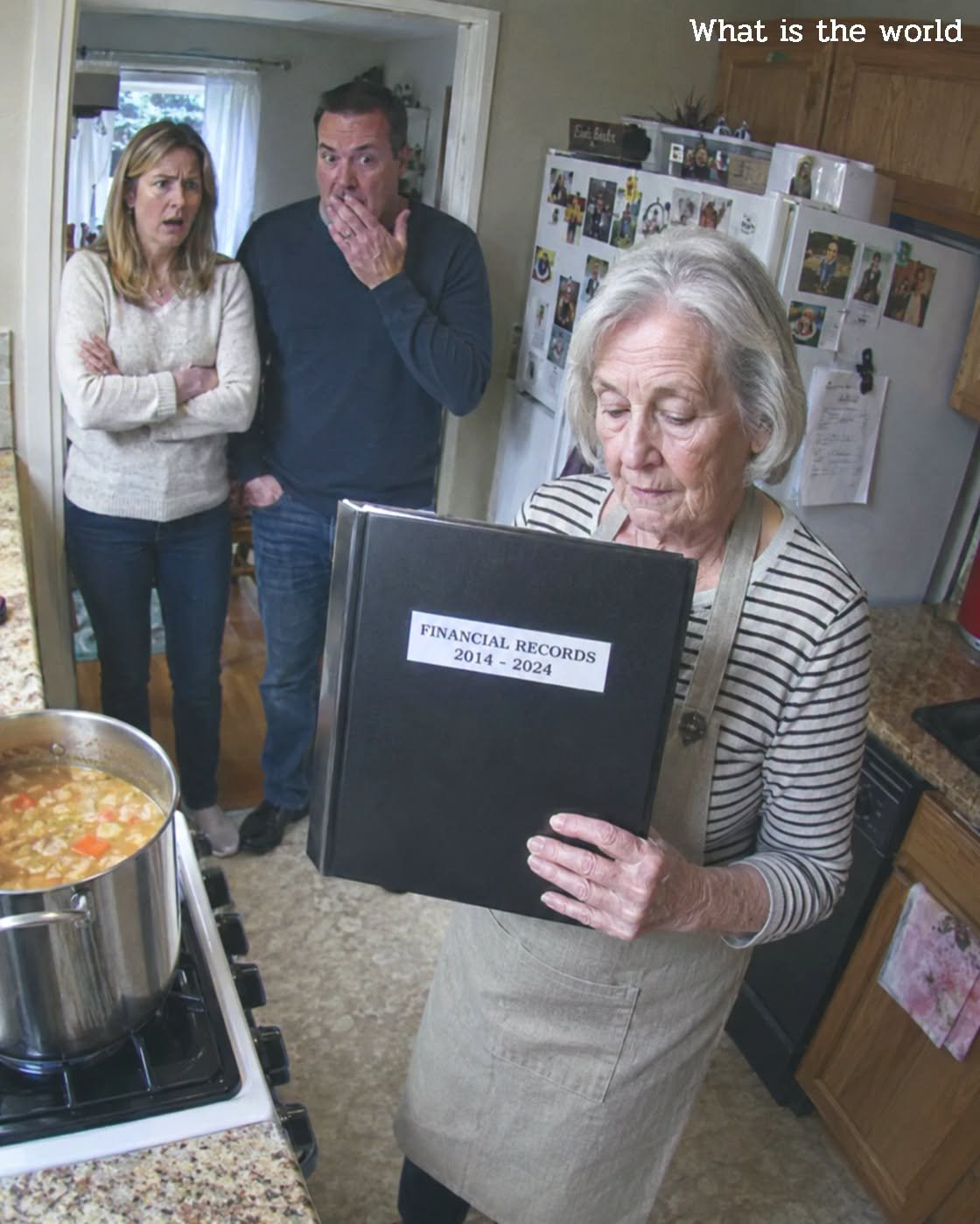
I was in my kitchen making soup when Natalie and her husband let themselves into my house without knocking.
No call.
No warning.
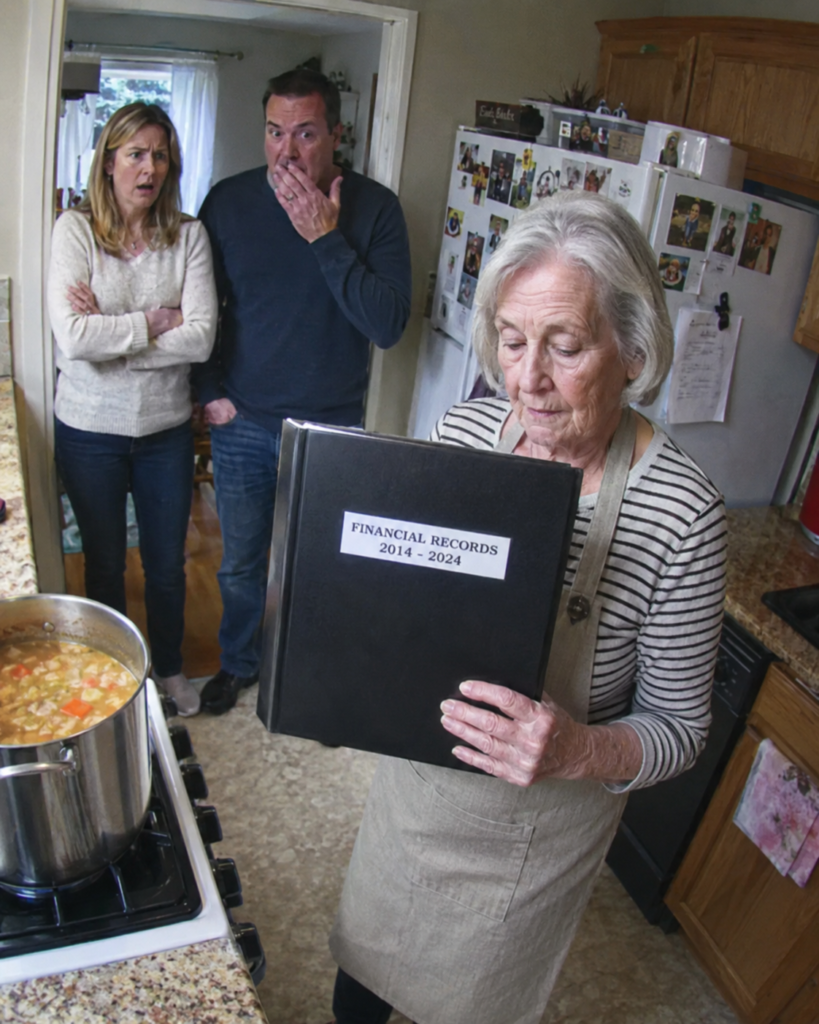
Just the front door opening and my daughter’s voice echoing down the hallway like she still believed she had the right to walk into my life whenever she wanted.
“Mom, are you here? We need to talk.”
That phrase had never meant anything good with Natalie. Not in recent years.
By the time I stepped into the living room, Adrien was already sitting on my sofa, one ankle resting over his knee, looking around the room the way people do when they’re quietly evaluating what something is worth.
Natalie stood near the coffee table with her arms crossed, impatient, like I was late to a meeting she had arranged in my own home.
She didn’t ask how I was.
She didn’t ask if I needed anything.
She went straight to the money.
“We heard your pension finally came through,” she said. “How much is it every month?”
I looked at her for a moment longer than necessary.
After forty years as a nurse in a city hospital—double shifts, overnight emergencies, missed holidays, tired feet, weak coffee, and hands that never seemed to stop moving—that money felt less like income and more like proof that I had earned every piece of my life.
“Three thousand,” I said.
Adrien leaned forward so quickly it was almost amusing.
“Perfect.”
That was the exact word he used.
Then Natalie nodded and said it as if it were reasonable. As if it were fair.
“So fifteen hundred for us each month makes sense. You don’t need that much, Mom. The house is paid off.
Your expenses are small. We’re family.”
We’re family.
Strange how those words always appear when someone wants access to something you’ve earned.
I stayed still in my chair and looked at both of them. My daughter, polished and confident in her entitlement. My son-in-law, carrying the ease of someone who had never built anything but still believed he deserved a share of it.
Then Adrien smiled.
“It’s the least you can do for us after everything.”
I almost laughed.
Everything?
Everything was me raising Natalie after her father died.
Everything was overtime shifts.
Everything was tuition, groceries, rent support, last-minute loans, wedding expenses, and every emergency she brought to my door wrapped in tears and excuses.
Everything was not them.
But I had learned something by then. People who want too much usually reveal themselves if you stay quiet long enough.
So I let the silence sit.
Adrien relaxed. Too relaxed. He even looked around the room and said, “Honestly, once this place is finally ours, we should update everything. It feels outdated.”
Finally ours.
Natalie didn’t correct him. She simply adjusted her blouse and added, “You should also think about making things official while you’re still… clear-headed. It would save everyone trouble later.”
There it was.
Not concern.
Not care.
A timeline.
My decline, my absence, my eventual disappearance from the home I had paid for and maintained for years had already become part of their planning.
And the strange part was—I wasn’t surprised.
Not really.
Because by then, I had already noticed the shift. I had already seen the way Natalie looked at my house as if it were something waiting to be claimed. I had already heard the impatience in her voice whenever I talked about needing peace or space. I had already sat in my kitchen with my neighbor Sarah while she told me the truth I had been avoiding.
“Eleanor,” she said, holding her teacup with both hands, “your daughter doesn’t come here out of love anymore. She comes here to see what’s left.”
That was the day I bought the binder.
A plain black binder from the stationery store on the corner. Nothing special. But heavy enough to hold everything I was finally ready to face.
Dates.
Messages.
Bank transfers.
Promises never repaid.
Notes.
Witnesses.
Documents.
A record of every time they mistook my love for weakness.
So when Natalie sat in my living room and told me half my pension belonged to them, I didn’t argue.
I simply stood up.
Slowly.
I walked to the cabinet by the window, opened the lower drawer, and took out the binder I had been waiting to use.
When I came back, I placed it on the coffee table between us.
Natalie’s lips curved like she thought she had already won.
Adrien leaned forward to see better.
I slid the binder toward them and said calmly,
“Go ahead. Open it.”
Natalie reached for it first.
Adrien leaned over her shoulder.
PART 2
Natalie reached for it first.
Adrien leaned over her shoulder.
For a few seconds, neither of them said anything.
The room was so quiet I could hear the refrigerator humming in the kitchen.
Natalie opened the cover.
The first page was nothing dramatic.
Just a date.
January 14.
Underneath it, I had written:
Money given to Natalie and Adrien — $8,420.
Natalie frowned.
She turned the page.
Another date.
Another amount.
Then another.
And another.
Her expression slowly changed.
“What is this?” she asked.
“You told me to give you half my pension,” I said. “I thought we should first establish how much of my money you’ve already received.”
Adrien laughed nervously.
“This is ridiculous.”
“Keep reading.”
He stopped laughing.
Natalie flipped through the pages.
There were bank statements.
Screenshots of text messages.
Copies of checks.
Receipts.
A spreadsheet showing every payment I had made to them over the previous eleven years.
Wedding deposit.
Car repair.
Medical bill.
Credit card balance.
Rent.
Utility payments.
Their first apartment security deposit.
A loan for Adrien’s business.
A second loan for Adrien’s business.
Money Natalie promised she would repay after receiving her promotion.
She never did.
There were even grocery receipts from the months when they claimed they were “barely surviving.”
I had remembered everything.
Not because I was obsessed with money.
Because I had finally become tired of being told that I had never done enough.
Natalie stared at one page for a long time.
“You kept records?”
“Yes.”
“Why?”
I looked at her.
“Because you kept forgetting.”
Her face reddened.
Adrien reached for the binder.
“This doesn’t prove anything. Parents help their children.”
“I agree.”
“Then why are you acting like this is some kind of business transaction?”
“Because you just walked into my house and demanded half my monthly income.”
Silence.
Adrien closed his mouth.
Natalie turned another page.
Then another.
Her fingers began moving faster.
She reached the middle of the binder.
There was a yellow divider.
Written across it in black ink were four words:
THE HOUSE.
Natalie froze.
I saw it happen.
That tiny pause.
The moment she realized there was more.
She slowly opened the section.
Inside was a copy of my property deed.
A current appraisal.
My mortgage statement showing the house had been paid off years ago.
And one additional document.
Natalie picked it up.
“What is this?”
“My updated estate plan.”
Her eyes moved across the page.
Then stopped.
She looked at me.
“No.”
I didn’t answer.
“No,” she repeated.
Adrien took the document from her.
His eyes scanned it.
His face went pale.
“What did you do?”
I folded my hands in my lap.
“What do you think I did?”
“You changed the beneficiary.”
“Yes.”
“To who?”
I looked toward the window.
My garden was visible beyond the glass.
The roses Sarah had helped me plant were blooming.
For years, I had looked at that garden and imagined Natalie playing there as a little girl.
Now I looked at it and imagined something else.
Peace.
“I created a trust,” I said.
Adrien stared at me.
“For the house?”
“For the house, my savings, and the remainder of my retirement accounts.”
Natalie shook her head.
“But I’m your daughter.”
“Yes.”
“So why would you do this?”
“Because being my daughter doesn’t give you ownership of my life.”
Her eyes filled with tears.
But I had learned to recognize the difference between grief and anger.
This wasn’t grief.
It was the pain of losing something she believed already belonged to her.
“Who gets it?” she whispered.
I hesitated.
Then I told her.
“The hospital foundation.”
Neither of them moved.
Natalie looked genuinely stunned.
“You’re giving our inheritance to a hospital?”
“I’m leaving most of it to a foundation that helps nurses and low-income patients.”
“But that’s our inheritance!”
“No.”
My voice remained calm.
“It was never yours.”
Adrien stood abruptly.
“This is unbelievable.”
“No,” I said. “What’s unbelievable is that you came here expecting me to hand over half my pension because you decided three thousand dollars was too much for me.”
He pointed toward the binder.
“You’ve been planning this behind our backs.”
“I’ve been planning my own future.”
Natalie stood too.
“You don’t trust us.”
I looked directly at her.
“No.”
The word seemed to hurt more than anything else I had said.
Her lips trembled.
“I’m your daughter.”
“And I am your mother.”
She waited.
I continued.
“For forty years, I was the person everyone expected to care for them. Patients. Doctors. Coworkers. You. Your father. Your husband. Everyone had a reason why they needed something from me.”
I touched the binder.
“And somewhere along the way, I forgot that I was allowed to need something too.”
Natalie wiped her cheek.
“What do you need?”
I smiled sadly.
“Respect.”
She looked down.
“I need to know that if I say no, my no will be accepted.”
Adrien scoffed.
“So that’s what this is? Revenge?”
“No.”
I closed the binder.
“It’s a boundary.”
He laughed.
“You think some paperwork is going to stop us?”
I looked at him.
“It already has.”
That was when the doorbell rang.
All three of us turned.
Natalie frowned.
“Who is that?”
“Sarah.”
Adrien’s expression changed.
“Why is your neighbor coming here?”
“Because I asked her to.”
I stood.
I walked toward the door.
Before opening it, I looked back at my daughter.
“There is one more section in that binder.”
Natalie looked frightened.
“The blue divider.”
She turned back.
Her hands shook as she searched for it.
I opened the front door.
Sarah stood outside.
She was holding a small folder.
She looked at me.
“Ready?”
I nodded.
“Yes.”
She stepped inside.
Adrien stared at her.
“What is she doing here?”
Sarah ignored him.
She walked to the coffee table and placed the folder beside my binder.
Then she looked at Natalie.
“I think your mother wants you to see this.”
Natalie opened it.
The first page was a copy of a text message.
Sent from Adrien to someone whose name had been saved as Mark — Real Estate.
The message was dated three months earlier.
Natalie read it once.
Then again.
Her face changed.
“What is this?”
Adrien didn’t answer.
She looked at him.
“Who is Mark?”
“Natalie—”
“Who is Mark?”
Sarah remained silent.
I did too.
Natalie kept reading.
There were several messages.
Adrien had asked about the estimated value of my house.
He had asked whether it would be possible to refinance it without my involvement.
He had asked about “taking over the property eventually.”
One message contained a sentence that made Natalie stop breathing.
If she signs over the house, we can finally clear the business debt.
Natalie slowly lifted her head.
“You said you weren’t interested in Mom’s house.”
Adrien rubbed his forehead.
“I was just exploring options.”
“You said you wanted us to have a place for the kids.”
“I was trying to protect our family.”
“You were going to sell her house?”
“No.”
“You were going to use her house to pay your debt.”
He didn’t answer.
That was answer enough.
Natalie looked at me.
“Mom…”
I said nothing.
She looked back at Adrien.
“How long?”
“Natalie, listen to me.”
“How long have you been doing this?”
He lowered his voice.
“About a year.”
She stared at him.
“A year?”
He reached for her.
She stepped away.
“You told me Mom was getting old and needed help managing things.”
“I was worried about her.”
“You told me she was confused.”
“I said she might become confused.”
“You told me we should get her to add us to the deed.”
Adrien said nothing.
Natalie’s face crumpled.
I watched my daughter discover the person she had trusted was not who she thought he was.
And despite everything, I felt sorry for her.
That was the hardest part.
Even after everything she had done to me, I was still her mother.
I still wanted to protect her from pain.
But I had finally understood something important.
Protecting someone from the consequences of their choices was not the same as loving them.
Sometimes love meant letting someone face the truth.
Natalie sank onto the sofa.
“What else is in there?”
I glanced at the binder.
“Enough.”
She shook her head.
“No. I want to know.”
Adrien stared at me.
“Don’t.”
I looked at Natalie.
“You should know.”
I opened the red section.
There were photographs.
Not of anything dramatic.
Just photographs of my house.
The locks.
The windows.
The basement.
The garage.
The storage room.
Every photograph had a date.
One was from seven months earlier.
The back door lock had been changed.
I looked at Adrien.
“You remember when I said someone had tried to force the back door?”
He didn’t answer.
Natalie turned toward him.
“You did that?”
“No.”
I placed another photograph on the table.
It showed the new lock.
The receipt was attached.
Paid for with Adrien’s credit card.
Natalie covered her mouth.
“Why?”
Adrien finally exploded.
“Because she was never going to give us anything!”
His voice filled the room.
I didn’t flinch.
He continued.
“She has this huge house. She’s getting three thousand dollars every month. She’s sitting on all this money while we’re drowning!”
“You weren’t drowning,” I said.
“You don’t know what we’re dealing with!”
“I know you bought a new television last month.”
He froze.
“I know you took a vacation in July.”
Natalie looked at him.
“You told me that was for a work conference.”
Adrien swallowed.
I continued.
“I know you bought a new SUV.”
Natalie slowly closed her eyes.
“And I know you stopped paying the loan I gave you two years ago.”
Adrien’s shoulders dropped.
The anger disappeared.
What remained was desperation.
“I was going to pay you back.”
“When?”
“When things got better.”
“They never got better because you kept spending money you didn’t have.”
He looked at me.
“You don’t understand.”
“No,” I said softly. “I understand perfectly.”
I stood.
“I understand that you believed my retirement was the solution to your financial problems.”
Adrien looked at Natalie.
“Natalie…”
She didn’t look at him.
Then she whispered something I had never heard from her before.
“I’m sorry, Mom.”
The room became completely still.
I looked at her.
She was crying.
Not dramatically.
Not loudly.
Just tears running down her face.
“I didn’t know about all of it,” she said.
“I know.”
“I knew he wanted help.”
“I know.”
“I thought you had more than enough.”
“I know.”
She looked at me.
“I thought because you were my mother, you’d always help me.”
“That was my mistake too.”
She lowered her head.
For a long moment, neither of us spoke.
Then she said,
“Can I ask you something?”
“Yes.”
“Did you stop loving me?”
My heart broke.
Because that was the question I had been afraid of.
“No.”
She looked up.
“Then why does it feel like you’ve chosen strangers over me?”
I walked toward her.
I sat beside her.
“I didn’t choose strangers.”
I took her hand.
“I chose you.”
She stared at me.
“What?”
“I chose to stop enabling you.”
Her tears fell faster.
“If I gave you half my pension, would you be happier?”
She shook her head.
“I don’t know.”
“If I gave you the house, would your marriage be fixed?”
“No.”
“If I paid Adrien’s debt?”
She didn’t answer.
“And if I kept doing it, what would happen when the money ran out?”
She whispered,
“You’d have nothing.”
“Yes.”
“And we’d ask for more.”
“Yes.”
She closed her eyes.
That was the first moment I saw understanding begin.
Not complete understanding.
But enough.
Adrien suddenly walked toward the door.
“Natalie, we’re leaving.”
She didn’t move.
“Come on.”
She looked at him.
“No.”
He stopped.
“What?”
“I said no.”
“You’re really going to sit here and let her turn you against me?”
Natalie looked at him with a sadness I had never seen before.
“You did that yourself.”
He stared at her.
Then he walked out.
The door slammed.
Natalie remained beside me.
Sarah quietly stepped into the kitchen.
She gave us privacy.
My daughter sat there for almost twenty minutes.
Then she whispered,
“I don’t know what to do.”
“You don’t have to know tonight.”
“What happens now?”
“Now you go home.”
She nodded.
“And tomorrow?”
“Tomorrow you start taking responsibility for your own life.”
She looked at me.
“Will you still be my mother?”
I smiled.
“I never stopped.”
She cried again.
But this time, she leaned against my shoulder like she had when she was a child.
For the first time in years, I allowed myself to hold her without feeling like I was holding together her entire life.
Just my daughter.
Just my child.
Not her bank.
Not her emergency fund.
Not her safety net.
Her mother.
That night, after Natalie left, I sat alone at my kitchen table.
Sarah brought me tea.
“You okay?”
I looked at the binder.
“No.”
She sat across from me.
“But I will be.”
She smiled.
“You finally believe that?”
“Yes.”
The next morning, I met with my attorney.
We finalized everything.
The trust.
The updated will.
The financial safeguards.
The medical directives.
The restrictions on the house.
And one additional document.
A letter to Natalie.
I didn’t write it to punish her.
I wrote it because there were things I needed her to understand.
I wrote about her childhood.
About the first time I held her.
About her father’s death.
About the nights I worked double shifts so she could stay in the same school.
About the wedding.
About every time I had said yes when I should have said no.
And finally, I wrote this:
I gave you everything I could because I believed that was what a mother was supposed to do. But I finally understand that love without boundaries teaches people to confuse sacrifice with obligation.
I signed the letter.
Then I placed it inside the binder.
Three weeks passed.
Natalie didn’t ask for money.
That was the first sign something had changed.
She called once.
Not to ask for anything.
Just to say hello.
The second time, she asked how my garden was doing.
The third time, she told me she had started looking for work.
I didn’t celebrate.
I simply listened.
Progress was fragile.
I knew that.
Then, one Saturday afternoon, someone knocked on my door.
It was Natalie.
Alone.
She held a small box.
“Can I come in?”
I opened the door.
“Yes.”
She stepped inside.
She looked different.
Not dramatically.
Just tired.
More honest.
She put the box on the table.
“What is that?”
“Something I should have given you a long time ago.”
She opened it.
Inside were old photographs.
Photographs of me and her.
Her first birthday.
Her graduation.
Her wedding.
A picture of us standing outside the hospital on the day she had given birth to her first child.
I looked at them.
“Why are you giving me these?”
“Because I realized something.”
She sat down.
“I spent so much time looking at what you had that I forgot what you had already given me.”
I didn’t speak.
She continued.
“I was angry because I thought you owed me.”
She took a breath.
“But you don’t.”
I felt tears forming.
“I still need help sometimes,” she said. “But I’m trying to learn the difference between asking for help and expecting someone to rescue me.”
I smiled.
“That is a very important difference.”
She nodded.
“Adrien moved out.”
I looked at her.
“I’m sorry.”
She shook her head.
“I am too.”
“Are you divorcing?”
“I don’t know yet.”
I didn’t tell her what to do.
That was another boundary I had learned.
Her life was hers.
Her decisions were hers.
Her consequences were hers.
She looked around the room.
“You really aren’t giving me the house?”
I laughed softly.
“No.”
She smiled.
“I figured.”
Then she looked at me.
“Can I still come here?”
I understood the question.
Not Can I have something?
Can I still belong?
I reached across the table.
“Anytime you come as my daughter.”
She nodded.
“And not as my landlord?”
“Especially not as my landlord.”
She laughed.
It was the first real laugh we had shared in years.
Months passed.
My pension continued to arrive.
Three thousand dollars every month.
I used what I needed.
I saved some.
And I gave a portion to the hospital foundation.
One afternoon, I received a letter from the hospital.
They were naming a small nursing scholarship after me.
I read it three times.
Then I cried.
Not because of the money.
Because for forty years, I had believed my work disappeared into endless hospital corridors.
Patients came.
Patients left.
Some survived.
Some didn’t.
Some remembered my name.
Most didn’t.
But now I realized something.
A life doesn’t have to be famous to matter.
Sometimes you measure a life by the people who were still breathing because you stayed awake.
By the hand you held at three in the morning.
By the frightened family member you comforted.
By the child who went home because you refused to give up.
My career had given me more than a pension.
It had given me a reason to be proud.
And I wasn’t going to let anyone turn that into an inheritance argument.
A year later, Natalie came to my house for Thanksgiving.
She brought a pie.
A terrible pie.
Burned around the edges.
I took one bite and smiled.
“It’s awful.”
She laughed.
“I know.”
We ate it anyway.
Sarah joined us.
The three of us sat around my kitchen table.
No arguments.
No demands.
No conversations about money.
At one point, Natalie looked at me.
“Mom?”
“Yes?”
“Do you ever regret changing your will?”
I thought about it.
“No.”
She nodded.
“I used to think that answer would hurt me.”
“Does it?”
“No.”
She smiled.
“It actually makes me proud.”
I looked at her.
“Why?”
“Because you’re finally taking care of yourself.”
I reached across the table and squeezed her hand.
“I should have learned that much earlier.”
“Maybe.”
She smiled.
“But then I wouldn’t have learned it from you.”
I laughed.
“That’s my daughter.”
She looked down at her plate.
Then she said,
“I hope someday my kids understand what you taught me.”
“What did I teach you?”
“That family isn’t someone who gets everything you have.”
She paused.
“Family is someone who loves you enough to let you become responsible for your own life.”
I didn’t answer.
I didn’t need to.
Outside, the evening light settled over the garden.
The same house Natalie had once looked at like an asset.
The same house Adrien had tried to claim.
The same house I had spent years believing I needed to defend.
Now it was simply my home.
Not an inheritance.
Not a bargaining chip.
Not a family prize.
My home.
My life.
My choice.
And for the first time since I could remember, I felt completely free.
But the story didn’t end there.
Six months later, I received a phone call from an unknown number.
I almost ignored it.
I answered anyway.
“Hello?”
A man’s voice spoke.
“Is this Eleanor?”
“Yes.”
“My name is Mark.”
I immediately recognized the name.
The real estate agent.
My stomach tightened.
“Yes?”
“I owe you an apology.”
I sat down.
“For what?”
There was a pause.
“Your son-in-law contacted me about your property.”
“I know.”
“I didn’t know what he was planning at first.”
“Then what happened?”
“He asked me to prepare paperwork for a potential transfer.”
I closed my eyes.
“Did you?”
“No.”
“Why?”
“Because I called the county records office to verify the ownership.”
He paused.
“That’s when I realized the property had additional protections attached to it.”
The trust.
Of course.
“What are you calling me for?”
“To tell you that he tried again.”
My heart sank.
“When?”
“Last week.”
I was silent.
“He wanted to know whether there was any way around the trust.”
“Was there?”
“No.”
I thanked him.
After I hung up, I sat quietly for a long time.
Then I called Natalie.
She answered immediately.
“Mom?”
“Where is Adrien?”
Silence.
“I don’t know.”
“You haven’t spoken to him?”
“Not in months.”
I told her what Mark had said.
She went quiet.
Then she whispered,
“I’ll handle it.”
“No.”
She sounded confused.
“What?”
“You won’t handle it for me.”
“But Mom—”
“I’ll handle my legal affairs. You handle yours.”
She took a breath.
“Okay.”
That single word told me how much she had changed.
A year earlier, she would have argued.
Now she understood.
A few days later, my attorney sent Adrien a formal notice.
He never contacted me again.
Eventually, I heard he had moved to another state.
His business failed.
His debts caught up with him.
None of that gave me satisfaction.
Because revenge had never been what I wanted.
I wanted peace.
And peace doesn’t come from watching someone fall.
It comes from no longer caring whether they do.
Two years after that afternoon in my living room, I stood in the hospital where I had worked for forty years.
The nursing foundation had invited me to speak at the scholarship ceremony.
There were twenty young nurses sitting in the front row.
Nervous.
Excited.
Hopeful.
I looked at them and remembered myself at twenty-three.
Before the exhaustion.
Before the grief.
Before the mortgage.
Before Natalie.
Before I understood how complicated love could become.
I took the microphone.
“I used to think being strong meant never saying no,” I told them.
The room was silent.
“I thought strength meant working one more shift. Lending one more dollar. Forgiving one more betrayal. Carrying one more burden.”
I looked toward the scholarship recipients.
“I was wrong.”
A few people smiled.
“Strength isn’t carrying everything.”
I paused.
“Sometimes strength is knowing what belongs to you—and having the courage to protect it.”
I looked toward the back of the room.
Natalie was standing there.
She had come without telling me.
Our eyes met.
She smiled.
I smiled back.
Then I continued.
“Your time belongs to you. Your labor belongs to you. Your money belongs to you. Your home belongs to you. And your kindness is a gift—not a debt someone else can collect.”
The applause came slowly.
Then it filled the room.
I looked at my daughter.
She was crying.
So was I.
After the ceremony, we walked outside together.
She slipped her arm through mine.
“You were good.”
“Thank you.”
“I didn’t know you were going to say all that.”
“I didn’t know either.”
She laughed.
We walked toward the parking lot.
Then she stopped.
“Mom?”
“Yes?”
“Can I tell you something?”
“Of course.”
She looked embarrassed.
“When I first heard about your pension, I was angry that you were getting three thousand dollars a month.”
I nodded.
“I remember.”
“I thought it meant you had more money than you needed.”
She looked at me.
“Now I think it means you survived forty years of giving yourself away.”
I smiled.
“That sounds more accurate.”
She hugged me.
Not because she wanted something.
Not because she was afraid of losing something.
Just because she loved me.
And that hug was worth more than anything inside the black binder.
Years later, when I finally retired from volunteering at the hospital, I gave the binder to Natalie.
She looked confused.
“What am I supposed to do with this?”
“Keep it.”
“Why?”
“Because someday you might forget.”
She opened it.
The first pages were the old records.
The money.
The receipts.
The messages.
Then she reached the final section.
There was one handwritten page.
She read it silently.
I watched her eyes move across the words.
When she finished, she looked at me.
“What does it say?”
“You just read it.”
“I want to hear you say it.”
I smiled.
Then I said,
“It says I forgive you.”
Her eyes filled with tears.
“But it also says I will never go back to the way things were.”
She nodded.
“I understand.”
“And it says forgiveness doesn’t mean forgetting.”
“I know.”
“And finally…”
I touched her shoulder.
“It says I love you.”
She hugged me.
We stood there for a long time.
Then she whispered,
“I love you too.”
The black binder remained between us.
A record of everything that had almost destroyed our relationship.
But it also became something else.
A reminder.
Not of betrayal.
Of boundaries.
Of survival.
Of the moment a mother finally realized that loving her child did not require abandoning herself.
That three thousand dollars a month had never been the real issue.
The real issue was whether I believed my life had value after forty years of giving it to everyone else.
I did.
And once I finally believed that, everything changed.
My daughter didn’t get half my pension.
She didn’t get my house.
She didn’t get access to my savings.
She didn’t get the future she had once assumed was hers.
Instead, she got something better.
She got a mother who could finally love her without resentment.
A mother who could say yes without fear.
A mother who could say no without guilt.
And I got something I had spent forty years earning.
Not money.
Not property.
Not security.
Myself.
And when I looked at the house that evening—the little garden, the warm kitchen lights, the photographs on the walls—I realized that the greatest thing I had ever inherited was not something someone left me.
It was the courage to finally stop leaving myself behind.