
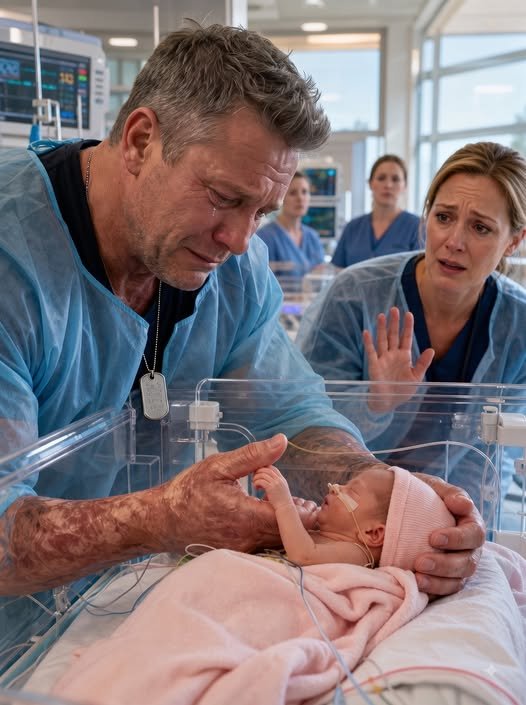
Every Tuesday, a towering stranger with trembling hands and old burn scars showed up at our NICU asking for the one baby nobody visited. When his dog tag slipped out from under his collar, I finally understood why he couldn’t stay away. What he was carrying wasn’t just grief—it was a promise made to a dying friend, twenty-six years old and still unpaid.
PART 1
The first time Elias Whitfield walked into the neonatal intensive care unit at Ridgeview Children’s Hospital in Cedar Falls, Iowa, I assumed someone had sent him to the wrong floor.
I’d worked there as a neonatal respiratory therapist for thirteen years, long enough to know how most visitors carried themselves at our doors. New parents came in with wide, frightened eyes and short steps. Grandparents showed up clutching coffee cups and crocheted blankets, like softness could be handed through a door. Even our trained cuddler volunteers usually hesitated at the threshold, as if the air itself might bruise.
Elias didn’t hesitate.
He stood six-foot-five, built like a man who’d spent thirty years taking orders and giving them. Fifty-three years old, though the creases around his eyes made him look closer to sixty-five. A rope of pale scar tissue ran from beneath his collar up the side of his neck, and more of it wrapped both forearms, skin healed thick and uneven from a vehicle fire somewhere I never asked about directly.
It was his hands I noticed most. Big enough to palm a dinner plate. And they shook. Constantly. A fine, involuntary tremor that never fully stopped, the kind you get from nerve damage that doesn’t heal on any timeline a doctor can give you.
Nothing about him looked like it belonged three feet from an incubator holding a baby small enough to fit inside a winter hat.
But his volunteer badge was real. He’d finished our six-week Comfort Care training, passed his background check and two psychological screenings, and been cleared for our infant-holding program — the one built for babies whose parents couldn’t be there around the clock.
I was still double-checking his paperwork at the desk when the baby in Room 9 started crying.
We only had a placeholder on her chart: Baby Girl Hollis.
She’d been born ten weeks early, weighing one pound fourteen ounces, after her mother, twenty-two-year-old Melissa Hollis, delivered in an ER bathroom and was gone from the building within eleven hours — before the hospital social worker could get a single form signed. No father listed. No grandparents who’d called. No name chosen by anyone who loved her enough to pick one.
Other babies in our unit had construction-paper hearts taped above their incubators and stuffed animals waiting for the day they’d go home. Baby Girl Hollis had a printed ID bracelet and a state-issued gray blanket.
She was also in withdrawal. Her mother’s chart flagged opioid use during pregnancy, and the first ten days of this baby’s life had been one long fight against her own nervous system — every sound too loud, every bit of light too sharp, every touch, even a gentle one, sending her tiny fists shaking and her heart rate climbing past 180.
That morning we’d dimmed the lights, repositioned her, checked every line twice. She was still crying, thin and furious, a sound too big for a body that small.
Elias turned toward Room 9 like he’d heard his name called.
“Is that the baby who needs a holding volunteer?” he asked.
“She needs someone calm,” I said. “She startles at almost everything. We go slow.”
He nodded. Then his eyes dropped to his own shaking hands, and so did mine.
I’m not proud of what went through my head. I wondered if hands that unsteady could safely support a skull smaller than a softball. I wondered if the monitor alarms — sharp, sudden, medical — might drag him somewhere he wasn’t ready to go back to.
“If you don’t think I’m ready, say so,” Elias said, before I could. “I won’t take it personal.”
There was no defensiveness in it. Just plain honesty, the kind that made refusing him feel almost like an insult to both of us.
“Let’s try,” I said. “I’ll stay right here.”
He scrubbed in at the sink, water scattering off his unsteady knuckles, then pulled on a fresh gown and waited while I opened the incubator’s side port.
The second his fingertip touched the edge of the mattress, Baby Girl Hollis screamed harder. Her monitor alarm went off. Her heart rate spiked to 194.
Elias went rigid, like something invisible had landed across his shoulders.
For three, four, five seconds, he didn’t move at all. His eyes had gone somewhere else — somewhere with a different kind of alarm, a different kind of heat. I’ve worked with enough veterans’ families to recognize that particular stillness.
“Mr. Whitfield, step back a second,” I said, reaching for his arm.
“Give me ten seconds,” he said, eyes shut, breathing slow through his nose. “Please.”
I kept my hand near his elbow and gave him the ten seconds.
His shoulders came down. His hands kept shaking — that never stopped — but he leaned back over the incubator anyway.
“All right, sweetheart,” he murmured. “Neither one of us likes alarms much. Guess we already got something in common.”
That was the moment the baby’s cry, for just a second, hitched into something closer to a hiccup than a scream.
And that was the moment I saw it — a thin silver chain shifting loose from under his collar as he leaned forward, and on the end of it, catching the light, a dog tag that didn’t have his name stamped on it at all.
It had someone else’s.
I didn’t know it yet, but that was the first sign that this story was never really about a paper form and a volunteer badge. It was about a debt I couldn’t see the shape of yet, and a man who’d walked into my unit already carrying it.
PART 2
I didn’t ask about the dog tag that first day. You learn, in this job, that people show you their scars in their own time, or not at all.
Elias came back the next Tuesday. And the Tuesday after that. By early March, five weeks in, the nursing staff had started calling him “the Tuesday man,” and Baby Girl Hollis — who still had no legal name, just a hospital number and a placeholder on a whiteboard — had started doing something none of us expected.
She stopped fighting him.
It took four visits before she’d tolerate his hand resting flat against her back without her heart rate climbing. By the fifth, she was falling asleep against his chest during skin-to-skin holds, her whole body no bigger than the space between his elbow and his palm. He held her the way you’d carry something you were terrified of dropping and even more terrified of not being trusted to hold.
“You’re good at this,” I told him one afternoon, adjusting her nasal cannula while he sat in the recliner we kept in the corner of Room 9.
“I had practice a long time ago,” he said. “Different circumstances.”
That was as far as he’d go, most days. I didn’t push. I had my own life to manage — a mortgage in Cedar Falls, a teenage son who needed rides to hockey practice, a father in assisted living forty minutes away who called me by my late mother’s name more often than not. I didn’t have room to carry other people’s history on top of my own.
But I noticed things. That’s part of the job too.
I noticed that Elias never scheduled his visits around convenience — he came on Tuesdays because Tuesdays were the day Melissa Hollis’s court-ordered drug treatment check-ins were supposed to happen, according to the file our social worker, Priya Anand, kept updated. I noticed he asked Priya, more than once, whether there’d been any contact from the mother, phrased carefully, like a man asking about someone he wasn’t allowed to say he already knew.
I noticed the extra case of preemie-sized diapers that appeared in the supply closet in February, paid for out of pocket, receipt folded inside with no name on it — until Priya recognized the handwriting on the delivery slip. Forty-one dollars and change, for a baby he had no legal claim to at all.
I noticed, too, that he always left before Melissa’s would-be check-in window closed at 4 p.m., like a man clearing a room before someone else was due to arrive. And I noticed the small crocheted hat that showed up on Amara’s incubator one morning in late February — not hospital-issued, hand-stitched in pale yellow, no card, no name. When I asked the day-shift volunteer coordinator about it, she just shrugged and said a man his size had asked her, almost sheepishly, whether preemies got cold easier than other babies.
And in mid-March, I noticed something else.
Baby Girl Hollis had been having a rough morning, oxygen dipping, monitor screaming its alarm again and again, and Elias sat with her through all of it, murmuring the same low rhythm he always used to settle her.
Except this time, without seeming to realize it, he used a name.
“I got you, Ray,” he said. “I got you.”
Then he caught himself. His whole body stiffened, the way a man’s does when he’s said something out loud that he’d meant to keep buried for good.
“Sorry,” he said quickly. “Force of habit. Old friend’s name.”
I let it go. I told myself it wasn’t my business.
But that Friday, Priya came to find me in the break room, holding a printout from the county family court database, her face carrying the particular stillness of someone who’d just found a thread she didn’t know whether to pull.
“Claire,” she said. “Melissa Hollis’s father — the name on her birth certificate, next-of-kin section, before he passed — was Raymond Hollis. Everyone called him Ray.”
I felt something go cold and slow behind my sternum.
“He was a Marine,” Priya went on. “Died overseas in 2003. Melissa was two years old.”
I thought about a dog tag on a chain that wasn’t his own, slipping loose from a scarred collar in Room 9. I thought about a fifty-three-year-old man who flinched at alarms like they were mortar fire, and who murmured a dead man’s name to a baby with no one else coming for her.
“Claire,” Priya said, lowering her voice, “I think we need to ask Mr. Whitfield exactly how he found this baby.”
That same afternoon, hospital security called down to the unit. A young woman matching Melissa Hollis’s description had been spotted pacing the visitor parking lot for nearly twenty minutes, staring up at the third-floor windows.
By the time anyone reached the doors, she was gone.

PART 3
Priya asked me to sit in when she finally asked Elias the question directly. I think she wanted a witness. I think she also wanted someone in the room who’d watched him hold that baby for six weeks and could vouch, if it came to it, that whatever he was about to say wasn’t the opening of something dangerous.
We found him in the family lounge on a Tuesday afternoon in late March, turning a folded photograph over and over in his unsteady hands without quite looking at it.
“Mr. Whitfield,” Priya said gently, pulling up a chair across from him. “I need to ask you something, and I need you to be straight with me, because it affects a child’s welfare.”
He set the photograph face-down on his knee. “Ask.”
“Is your connection to this baby’s family personal?”
For a long moment, he didn’t answer. Then he turned the photograph over and slid it across the table.
It was old, the color gone slightly orange with age. Two young men in desert fatigues, arms slung over each other’s shoulders, squinting into hard sunlight. One of them was unmistakably a much younger Elias. The other was shorter, wiry, grinning like he’d just won a bet.
“That’s Ray Hollis,” Elias said. “Lance Corporal. We served together outside Fallujah, 2003. Twenty-six years old. He had a wife back home and a little girl who wasn’t even two yet — Melissa.”
His voice didn’t shake the way his hands did. It stayed level, like a man reciting something he’d said to himself ten thousand times so it wouldn’t break him saying it out loud.
“Our vehicle took a hit in April that year. I got thrown clear. Ray didn’t. He pulled me out of the fire before he went back for our gunner, and that’s the part that didn’t come back out with him.”
He turned his forearm over, showing the ridged scar tissue that ran from wrist to elbow. “I got these getting dragged, not giving. I’ve had twenty-three years to be ashamed of that math, and it never comes out even.”
“Before he shipped out that last time,” Elias went on, “Ray asked me to look after his family if anything happened to him. I told him nothing was going to happen. I was wrong, and I meant to keep the promise anyway. I sent money for a few years. Then Ray’s wife died of an overdose when Melissa was eleven, and Melissa went into the foster system, and I lost the thread. I was fighting my own battles by then — two hospitalizations for PTSD, a stretch of about eight months where I didn’t have a fixed address myself. I wasn’t in any shape to raise anybody’s daughter. I told myself I’d find her again once I was steady.”
“That took a while,” Priya said. Not unkindly.
“Nineteen years,” Elias said. “I finally traced her to Cedar Falls in January, through a caseworker who used to run the shelter where I got back on my feet. She remembered a Melissa Hollis cycling through intake twice, once at seventeen and once the year after. By the time I got here, she’d just delivered early and disappeared from the hospital. I saw the name Hollis on the whiteboard outside Room 9 the day I came in for my volunteer orientation, and I thought I was losing my mind. I sat in my truck in this parking lot for forty minutes before I could make myself walk in.”
“Why volunteer at all, instead of just asking to see her file?” Priya said.
“Because a stranger asking for a stranger’s baby gets a door shut in his face,” Elias said. “A trained volunteer gets a chair in the room. I figured I’d earn my way to the truth instead of demanding it.”
“Why didn’t you say something sooner?” I asked.
“Because the second I say I knew Ray Hollis, this stops being a story about a scared young woman getting her feet under her,” Elias said. “It becomes a story about an old vet with a psychiatric discharge history showing up trying to attach himself to a baby that isn’t his. I’ve seen how fast people redraw the lines around somebody like me. I wanted to earn a place in that room before anybody had a chance to decide I didn’t belong in it.”
“There’s something else,” Elias added, before Priya could respond. “I’ve been putting twenty dollars a week into a savings account under Amara’s hospital case number since February. It’s not much. It’s what I could spare. I didn’t want it flagged as some anonymous mystery donor thing — I want it on record, under my name, so nobody has to wonder later whether I was hiding money the same way I hid everything else.”
Priya was quiet for a moment, the printout from the county database still sitting between them.
“I believe you,” she said finally. “But I have to file a report on this conversation today, because Melissa was seen outside this building yesterday, and if she resurfaces, the court is going to want to know exactly who you are to this family before anyone lets you near that baby again.”
Elias nodded once, like a man accepting a verdict he’d already expected.
That evening, my phone rang at 9:40 p.m. It was Priya.
“Melissa Hollis was picked up two hours ago,” she said. “Trespassing call, behind the hospital loading dock. She’s at the county jail on Grant Avenue. And Claire — she’s asking for the baby by a name nobody put on any chart. She’s calling her Amara.”
PART 4
Melissa Hollis’s arraignment was set for the following Monday, and in the four days between that phone call and the hearing, I watched Elias Whitfield do something I hadn’t seen him do in six weeks of Tuesdays.
I watched him hesitate.
He still came in every day that week, not just his usual Tuesday, sitting with Baby Girl Hollis — Amara, though nothing official carried that name yet — for hours at a stretch. But he stopped reaching for her the moment he walked in. He’d stand by the incubator with his hands loose at his sides, waiting for me or another nurse to tell him it was all right, as if his own judgment about what he deserved had gone unreliable.
“You’re allowed to hold her,” I told him on Thursday.
“Am I, though,” he said. It wasn’t really a question.
He explained it to me in pieces over that week, the way people explain the things that scare them most — sideways, in fragments, testing how it sounds out loud before committing to the whole shape of it.
He wanted to petition the court for recognition as kinship support — not custody, he was careful to specify that, not even close, just a formal, documented role as an approved adult support person in Amara’s life while Melissa worked her case plan. It was a real legal pathway, Priya confirmed, but a narrow one, and it meant a judge would review everything: his two psychiatric hospitalizations, the eight months without stable housing, his VA disability rating for PTSD and the nerve damage in both hands, the DUI he’d picked up nine years earlier during the worst stretch of his drinking, four years before he got sober.
“They’re going to put all of it on a table in open court,” he said. “And a judge who’s never met me is going to decide whether a man who couldn’t hold his own life together for a decade has any business standing near somebody else’s kid.”
“You held your life together for the last nine years,” I said.
“Nine years doesn’t erase the file,” he said. “It just sits on top of it.”
I want to say I had some wise, steadying thing to tell him, but mostly I just listened, the way I’d learned to do with parents in that unit who were carrying more than any person should have to carry alone.
On Wednesday, I found him in the parking garage before his shift with the Comfort Care program, sitting in his truck with his phone against his ear, talking to someone at the VA about pulling his psychiatric records for the hearing. I only caught the end of it. “I know what it’ll cost me if the judge reads it wrong,” he was saying. “I’d rather it cost me something than cost her another year of nobody showing up.” When he saw me through the windshield, he didn’t look embarrassed. He just rolled the window down and said, “Might as well hear it from me instead of a hallway rumor.”
What Elias didn’t know yet — because Priya hadn’t been cleared to tell him — was that Melissa had spent her two days in county lockup asking every visitor the same question: whether the man who came on Tuesdays was really who she thought he was. A caseworker from her foster years, the one who’d placed her in three homes across two states after her mother died, remembered a photograph Melissa had kept since she was fourteen — a young Marine with his arm around another young man, laughing in the sun.
Melissa had grown up believing that man was dead too.
On Sunday night, Priya called me at home. “Melissa’s out on conditions — mandatory outpatient treatment, weekly drug testing, supervised contact for now. She’s coming to the hospital tomorrow morning to see the baby for the first time since she left. And Claire — she’s asked specifically whether Elias will be there.”
“What do I tell him?”
“Tell him to come,” Priya said. “But tell him to be ready. She doesn’t just want to see her daughter tomorrow. She wants to know why a man she thought was a stranger has been the only person showing up.”
I called Elias that night. He was quiet for a long time on the other end of the line, long enough that I checked to see if the call had dropped.
“Twenty-six years I’ve owed that family something I couldn’t give,” he finally said. “Tomorrow I find out if it’s too late to give it.”

PART 5
Melissa Hollis arrived at 10:15 Monday morning wearing a state-issued ankle monitor under her jeans and a coat that looked two sizes too big, like it belonged to someone else’s life. She was smaller than I expected — twenty-two years old but carrying herself like someone much younger, shoulders curled inward, eyes moving fast around the room the way people’s do when they’ve learned not to trust a place to stay calm.
Elias was already there when she walked in, standing near the window, giving the room as much space as a man his size could give it.
Melissa stopped just inside the door. She looked at Amara in the incubator first — really looked, for almost a full minute, one hand pressed flat against the glass. Then she looked at Elias.
“You’re him,” she said. “From the picture.”
“I’m him,” Elias said.
“My mom used to say you died with my dad.”
“I should have,” Elias said. “I’ve spent a long time trying to earn being wrong about that.”
Melissa’s jaw tightened. “Where were you? I was eleven when Mom died. I went through three houses before I turned thirteen. Nobody came.”
“I was in the worst years of my life right about then,” Elias said, and he didn’t soften it, didn’t make it smaller than it was. “I was drinking myself out of a job and sleeping in my truck some nights. I wasn’t fit to raise a goldfish, let alone your dad’s daughter. I told myself I’d find you once I got steady. That took longer than it should have, and you paid for every year I took.”
“That’s not an apology,” Melissa said. “That’s an explanation.”
“It’s both,” Elias said. “I don’t get to decide which one you hear.”
“Did you love him?” Melissa asked suddenly. “My dad. Or did you just owe him.”
Elias was quiet for a moment. “Both of those things can be true about the same person, same as they can about you and me right now. I loved him like a brother, and I owe him a debt I’ll be paying the rest of my life either way. Neither one cancels the other out.”
The room was quiet except for the soft, steady chirp of Amara’s monitor. I stayed by the door, close enough to step in, far enough to let the moment belong to them.
“I ran because I knew what they’d say about me the second she was born early,” Melissa said, her voice cracking. “Addict mom, no support, no plan. I figured she’d get a better shot at a family without me showing up to ruin it. So I left. And then I couldn’t stop coming back to look at her through that parking lot window like some kind of ghost.”
“You’re not required to have all of this figured out today,” Elias said. “But I need you to know something, and I need to say it now, in front of somebody, so I can’t take it back later.”
He nodded toward me, an unspoken witness this.
“I’m not here to take her from you,” he said. “I made your dad a promise I’ve been paying off wrong for two decades — money instead of showing up, distance instead of honesty. I’m not going to fix that by trying to become her father in your place. I want to petition the court to be recognized as her kinship support, which means supervised time with her, a documented role in her life, someone the state can call if you ever need backup at two in the morning. That’s the whole ask. Nothing more.”
“They’re going to bring up everything you’ve done,” Melissa said. “The hospital stays. The drinking.”
“They already are,” Elias said. “I decided that’s a price I’m willing to pay in open court so you don’t have to carry this alone anymore. That’s the choice in front of me. I’m making it.”
Melissa was quiet for a long moment, looking between him and the incubator.
“If the judge says no,” she said, “does that mean you disappear again?”
“No,” Elias said. “It means I show up on Tuesdays and every day the hospital lets me, exactly like I have been, for as long as you’ll let me, court order or none. The only thing that changes is the paperwork.”
Melissa’s shoulders came down, just slightly, the first give in a posture I suspected she’d been holding since she was eleven years old.
“Then hold her,” she said. “Before you tell me anything else. Just — hold her. Let me see what I keep hearing about.”
PART 6
The kinship hearing was held on a Thursday in late April, in a small county courtroom that smelled like old carpet and cold coffee. Elias wore a gray suit that didn’t fully hide the scars climbing his neck, and he answered every question the judge put to him without flinching — the hospitalizations, the DUI from nine years back, the eight months without an address, the nerve damage that made him set his water glass down with both hands.
“I’m not asking you to overlook any of it,” he told the judge, echoing almost exactly what he’d told Melissa weeks earlier. “I’m asking you to weigh it against nine years sober, a documented promise to a man who died getting me out of a burning vehicle, and six weeks this hospital can confirm I showed up for a baby nobody else came for.”
Priya testified. I testified. A caseworker from the shelter where Elias had rebuilt his footing eleven years earlier drove three hours to testify too.
The judge approved supervised kinship support status on a ninety-day trial basis, with review, and a note in the file that read, in the plain language judges sometimes allow themselves: This court finds Mr. Whitfield’s history relevant, not disqualifying.
Melissa entered a longer-term residential treatment program the following week, one with a mother-and-baby track that let her keep Amara close while she worked her recovery. Elias drove the ninety minutes to visit them both every Tuesday and every second Saturday, the trembling in his hands never fully going away, though the nurses at the treatment facility told Priya he’d gotten steadier at holding a bottle without spilling it — small progress, the kind nobody puts on a headline, the kind that actually holds a life together.
I saw them again in late August, four months later, back at Ridgeview for Amara’s follow-up pulmonology appointment. She was seven months old by then, round-cheeked, gripping fistfuls of Elias’s shirt with a strength that would’ve surprised anyone who remembered how small she used to be.
Melissa looked different too — steadier on her feet, sixty-one days sober by her own count, working part-time at a plant nursery near the treatment facility. She still flinched a little around hospital smells, the way people do when a place holds too much history for them. But she reached for Amara without hesitation, the way a mother does when she’s stopped bracing to be told she isn’t allowed to.
“She still doesn’t sleep unless somebody’s got a hand flat on her back,” Melissa told me, adjusting the baby against her shoulder. “Same as when she was in that incubator.”
“Some things don’t change,” Elias said. “Some people just get better at showing up for them.”
Melissa laughed at that, a short, surprised sound, like she hadn’t expected to laugh in a hospital hallway. “He says that to everybody. Nurses. The judge, probably, if they’d let him.”
“I said it to the judge,” Elias admitted. “Word for word. She didn’t laugh either.”
Before they left that afternoon, Elias asked if he could show me something. He pulled the same worn photograph from his wallet — Ray Hollis, twenty-six years old, grinning into hard desert sunlight — now tucked beside a new one. Amara, seven months old, asleep against his scarred forearm, one small fist curled around the dog tag that wasn’t his.
“Her middle name’s Ray now,” he said. “Melissa’s idea, not mine. Amara Ray Hollis.”
I still think about Room 9 sometimes, the way it looked that first Tuesday — a baby with no name, a stranger too big for the room, a chain of promises made twenty-three years earlier by a man who never stopped paying on them, one shaking, steady hand at a time.