
PART 1
The box sat open on my kitchen counter, and I could not make my hands stop shaking long enough to close the lid.
A gold ring inside. Catching the morning light like it was mocking me.
Beneath it, tucked flat against the velvet, a jeweler’s receipt. Yesterday’s date, stamped in plain black ink.
My left thumb found the crooked copper wire on my ring finger, the way it had found that same spot ten thousand mornings before. Fifty-five years of habit. Fifty-five years of Thomas.
Then three knocks came at my front door.
Quiet. Patient. Not going away.
I did not move. I could not. Somewhere on the other side of that door was the person who had left an unstamped, unaddressed brown paper box in my mailbox with one word written across the top in careful block letters.
MARGARET.
Before I tell you what happened next, you need to understand what that copper wire cost me, and why a stranger’s gold ring on my kitchen counter felt less like a gift and more like a wound reopening after fifty-five years of careful healing.
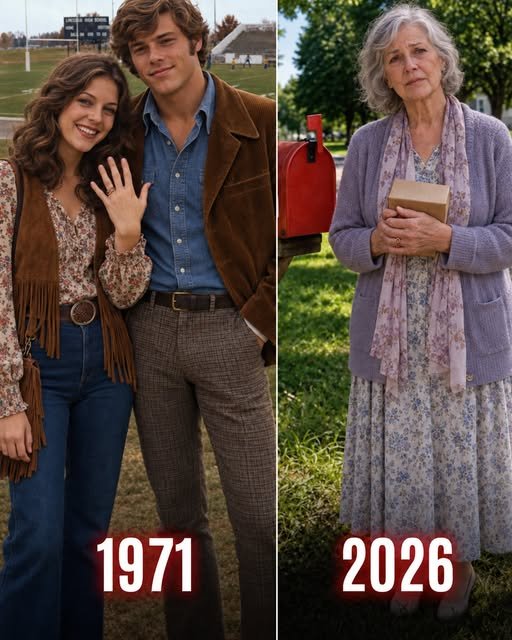
I was eighteen the September evening Thomas walked me behind the high school football field, out to the spot where the bleacher lights didn’t quite reach. He was leaving for the war in four days. His hands were shaking worse than mine are shaking right now, if that tells you anything about how young we both were.
“I don’t have a real ring yet,” he said. His voice cracked on the word real, and he looked almost ashamed of himself, like the shame was a coat two sizes too small. He held out a thin twisted piece of copper wire, bent by his own fingers into a crooked little circle. “I couldn’t afford one. But someday I’ll replace this. I promise you that, Margaret.”
I laughed. Not because it was funny — because I loved him so much in that moment it physically hurt somewhere behind my ribs, and laughing was the only place the feeling had left to go.
“Then I’ll wear this one until you do,” I told him, and I meant it the way only a girl who has never yet been disappointed by the world can mean something.
Four days later, Thomas left with his unit. I stood on the train platform in a dress my mother had ironed twice, and I watched him get smaller and smaller until the tracks curved and he was gone.
For months I waited. I clung to every ringing telephone, every knock at the door, every letter that came addressed in his slanting hand. Six letters arrived in total. I still have them, upstairs, in a shoebox that has moved house with me four times.
The seventh letter never came from Thomas.
It came from the Army, and then it came again from his mother, and I sat on her kitchen floor while she read it out loud to me with her hands shaking so badly the paper made a sound like dry leaves.
I never took the copper ring off after that. Not once. Over fifty-five years, the metal darkened from a bright penny color to a deep, bruised brown. It bent slightly further out of true, the way soft metal does when you press your thumb into the same worn groove every single day for over half a century.
A jeweler downtown once offered, kindly, to straighten it for me for free. This was maybe twenty years ago. I very nearly bit the poor man’s head off.
“My fiancé made it exactly this way,” I told him, my voice sharper than I intended, sharp enough that another customer turned to look. “With his own hands. You will leave it exactly as it is.”
I never married. I know some people find that sad. But I don’t see it that way. I had a life. Thirty-eight years as the town librarian, a job I loved. A little house with good morning light and quiet rooms that never once felt empty, because I had filled them myself, one book and one chair at a time.
My younger sister Carol calls me every Sunday at four o’clock, rain or shine, and has for decades. Her boys, Danny and Peter, have called me their second mother since they were small enough to fall asleep on my shoulder during Sunday dinner, and they still show up at my door on my birthday every year without fail.
That morning — the morning of my seventy-third birthday — I had already gotten their texts. Happy birthday, Aunt Margaret! See you at six! Don’t cook, we’re bringing everything.
It was supposed to be an ordinary birthday. Cake. Carol fussing over too many candles. Danny telling jokes that had been bad twenty years ago and had somehow gotten worse.
Instead, I had a gold ring on my kitchen counter and a small white card, tucked beneath the string, that read: Someone owed you this.
And now, three knocks at my door.
I set the box down. I wiped my palms against my apron, though they weren’t wet, not really — it was something else making them slick, something I did not yet have a name for. And I walked toward the door, the crooked copper wire warm against my skin, my whole steady and ordinary life narrowing down to whoever was standing on the other side of that wood.
PART 2
Across the street from my kitchen window lived a man named Walter.
He’d been there since before I retired from the library, going on thirty years now, though it had never once occurred to me to count them precisely until that morning made me start doing the math. An older gentleman. Quiet. He waved from his porch some mornings, the way neighbors do out of gentle habit rather than real intimacy, but we rarely stopped to actually talk. His wife had passed a couple of years back, and I’d brought a casserole to the service, and beyond that single dish of chicken and rice, we had barely exchanged forty words in three decades.
And yet.
My lawn always seemed to get itself mowed every summer, and I had simply assumed it was some neighborhood kid working a paper route of yards. More mornings than not, my driveway was already shoveled clean before I’d finished my first cup of coffee, and I had never once stood at that window long enough to ask myself who was doing it, or why.
I had gone out for the mail that morning the way I go out for the mail every morning of my life. Inside the box, resting on top of a phone bill and a grocery flyer, was the small brown paper package, no stamp, no return address, my name written across the top in block letters that gave away nothing.
I carried it inside. I untied the string with fingers that did not yet know to be afraid. And I lifted the lid to find a beautiful gold engagement ring resting against dark blue velvet.
My own fingers went instinctively to the crooked copper wire I had worn for fifty-five years, an old reflex, a kind of prayer. And when I saw the jeweler’s receipt tucked beneath the gold band, I very nearly dropped the whole box onto the floor. I had to grip the edge of the counter with both hands to keep my knees from doing something undignified.
I could not understand who would do this, or why. For one long, ugly moment I wondered if someone was trying to make my heart hurt on purpose, the way people sometimes are cruel to the elderly because they assume no one is paying close enough attention to notice.
Then came the knock. The first one. Followed, a long moment later, by two more.
I closed the box slowly. I tucked it under one arm like something that might break, or bite, and I walked to the door.
When I opened it, my chest tightened so hard and so fast that for a second I thought something was actually, medically wrong with me.
Walter stood on my porch. His cap was crumpled between both hands, held the way men his age used to hold their hats at funerals. His eyes were wet. He would not look at me directly, his gaze sliding off to the side like my face was too bright to look at straight on.
“Margaret,” he said. “Can I come in? I owe you a long conversation.”
I stepped aside without saying a word, because I did not trust my own voice yet to behave itself. He had lived across the street for twenty-eight years, and I could count on one hand the number of times he had said more than good morning to me over the fence line between our yards.
“So it was you,” I said, once we were both standing in my kitchen, the box between us on the table like evidence.
“It was me.”
My hands went cold. All at once, an entirely different and far uglier possibility crossed my mind, and I did not have the patience left in me that morning to be gentle about voicing it.
“Walter, I don’t know what you thought you were doing here, but if this is some kind of — if you are trying to tell me something, at our age, about you and me — I need you to stop right there before you say another word.”
He blinked, genuinely confused for a second, and then something that was almost a laugh, sad and short, moved through his shoulders.
“Oh — Margaret. No. God, no. I am not proposing to you.”
“Then what is this?” My voice came out sharper than I meant it to, sharper than I think I have spoken to anyone in years. “Because I have loved exactly one man my entire life. One. And I will not have his memory disrespected on my birthday, of all days, by some grand gesture from a lonely widower across the street who has never said more than four words to me in three decades.”
“It isn’t that.” He set the cap down on my table, and I watched his fingers tremble against the brim. “I left the box in your mailbox first because I wasn’t sure I would have the courage to knock afterward. I stood in my own front doorway for a full hour this morning before I made myself cross the street. I wanted you to have it either way. In case I lost my nerve standing right here on your porch.”
“Okay,” I said, because I did not yet have a better word available to me.
Walter’s hands were shaking so badly now that he had to press them flat against the tabletop to steady them.
“I knew Thomas,” he said.
Everything in the house seemed to stop at once. The refrigerator hum. The clock on the wall. My own heartbeat, or so it felt.
“What did you say?”
“I served in his unit. I was there. The day it happened, Margaret. I was there.”

PART 3
I sat down.
I did not decide to sit down. My body simply did it for me, the way it sometimes makes decisions faster than the mind can keep up with.
“That’s not possible,” I said.
“It is. I was nineteen. Thomas was two months older than me, and he never let me forget it.” Something flickered across Walter’s face, almost fond, almost unbearable. “He talked about you every night, Margaret. The girl behind the football field.”
I put a hand over my mouth.
Fifty-five years, and no one — not one single soul — had ever spoken those words to me directly. Nobody had ever confirmed, out loud, in a voice that had actually been there, that Thomas had said my name somewhere far from home, in the dark, to someone who was still alive to remember it.
“You’ve lived across the street for thirty years,” I said.
“Twenty-eight.”
“And you never told me. Why? Twenty-eight years, Walter. Twenty-eight years of good mornings over a fence and you never once told me you knew him.”
His mouth moved, but for a long moment nothing came out. Then he reached into the inside pocket of his coat and drew out an envelope. It was folded twice, water-stained along one edge, the paper aged to the exact color of old tea left too long in the cup.
My name was written across the front.
I knew that handwriting the instant I saw it. I have six letters upstairs in a shoebox written in that same hand, and I would know it if I lived to be two hundred. The T in Thomas curled the same particular way. The M in Margaret leaned the same particular way, a little forward, a little eager, like the letters themselves couldn’t wait to get where they were going.
“Oh,” was all I managed to say.
“Thomas wrote it the night before,” Walter said quietly, each word coming slower than the last, like he was setting down something heavy one piece at a time. “He asked me to keep it safe. He asked me to —” His voice cracked clean in half, and he stopped, pressing his knuckles hard against his mouth.
“He asked you to what, Walter.”
“To bring it to you. If he didn’t come back.”
I stared at the envelope lying on my kitchen table between us. My hand rose halfway toward it and then stopped in midair, as if it had struck an invisible wall of glass.
“You’ve had this,” I said, very slowly, testing each word before I let it out of my mouth, “all these years. You’ve had a letter from Thomas to me. Across the street from my house. For twenty-eight years.”
“Yes.”
“Walter.”
“I know.”
“I cried for months after his mother’s letter came. Do you understand that? For months. His mother waited by that phone until her hands shook too badly to hold a coffee cup steady. We didn’t know if he’d spoken at the end. We didn’t know if he’d been alone. We didn’t know if —”
“I know, Margaret.”
“How could you.” The words tore loose from somewhere underneath my ribs, louder than I intended, louder than I think I have spoken inside my own house in years. “How could anyone hold something like this in their hands and just — live their life. Mow a lawn. Wave over a fence. How.”
“I couldn’t,” he said. “I couldn’t do it, and I also couldn’t hand it over. Every year that went by made the wall between us one brick taller. And now I am out of years, Margaret. My doctor gave me months, not years. I could not take Thomas to the grave with me a second time.”
My hands would not stop shaking as I finally reached for the envelope. The paper felt impossibly thin, softened by decades of being folded and unfolded, folded and unfolded, the crease lines gone as soft as cloth. I unfolded it there at my kitchen table, with Walter sitting across from me, his cap still crushed between both hands like something he was afraid to let go of.
Thomas’s handwriting hit me first, before a single word of it registered as meaning. The same slanted letters I had traced with my fingertip a thousand times on six other pages, decades ago, until the ink had nearly worn away under my touch.
I read the first line out loud without meaning to.
“If you’re reading this, it means I didn’t make it back.”
My voice cracked in half. I had to stop.
Walter did not move. He did not say a single word. He simply sat there and let me have the silence I needed, which was, I would come to understand, the exact opposite of what he had done for the twenty-eight years before this one.
PART 4
“He says he loves me,” I whispered, when I could finally speak again, my eyes still moving down the page. “He says he’s sorry about the ring. He says —” My voice broke a second time. “He says he asked whoever survived to buy me a real one. No matter how many years passed. No matter how long it took.”
I set the letter down, because I could no longer trust my own hands to hold it steady.
“Thomas asked whoever survived,” Walter said, very quietly. “That ended up being me.”
I looked at him then, really looked, in a way I do not think I had ever once looked at him in twenty-eight years of good mornings across a fence. The deep lines carved around his eyes. The tremor along his jaw that I had mistaken, all this time, for simple old age.
“Please talk,” I said. “Because I need to understand how a person sits on something like this for fifty-five years and still sleeps at night.”
Walter turned the cap slowly in his hands, like a wheel that couldn’t decide where to stop.
“I came home a few years later,” he said, his voice low and rough. “I was twenty-three. Broke. I couldn’t sleep through a single night. I told myself I would deliver the letter the moment I had the money for a real ring. Then, once I had the right words. Then, once the moment felt right.”
“And the moment never came.”
“No. I got married instead. Raised two boys. Buried my wife two years ago.” He swallowed hard enough that I heard it. “The letter sat in a drawer under my socks for most of that time. Every time I opened that drawer for something else entirely, I heard Thomas asking me why I still hadn’t done it.”
“You could have mailed it,” I said. “You could have knocked on this door during any one of those twenty-eight years.”
“I could have,” he agreed. “I didn’t.”
I stood up, because sitting still was making the pressure in my chest genuinely unbearable.
“Why did you move across the street from me in the first place?”
Walter looked down at the floor, at his own shoes, like the answer was written somewhere down there among the tiles.
“I kept tabs on you over the years,” he admitted. “And then, twenty-eight years ago, I saw that the house across from yours had gone up for sale. I could just barely afford it. So I told myself that if I lived close enough, one day I would finally find the nerve.”
“But you never did.”
“Every single time I saw that copper ring on your hand, Margaret, I lost my voice completely. You were still faithful to him, after everything, after all those years. And I was the man who had failed him.”
My throat closed so tight I had to breathe around it. I pressed my palm flat against my forehead.
“Do you have any idea what I have done with my mind for fifty-five years, Walter? I have wondered whether Thomas said my name at the very end. Whether he was scared. Whether he thought I would simply move on and forget him.”
“He wasn’t scared for himself,” Walter said. “He was scared for you. That is the entire letter, if you read the rest of it.”
I hated how steady his answers were. I wanted him to argue with me, to give me something solid to swing at. Instead he simply sat there and absorbed every blow I threw, the way a person absorbs a punishment they have already decided they deserve.
“Why now,” I said. “Why the ring yesterday, of all the days you’ve had.”
Walter finally lifted his head and looked at me directly.
“My doctor gave me a few weeks. Maybe a few months, if I’m fortunate. Pancreatic cancer, Margaret. I went to that jeweler yesterday because I refused — I absolutely refused — to take Thomas’s promise into the ground with me a second time.”
Silence filled the kitchen whole. I thought about a teenage boy behind a chain-link fence, holding out a piece of bent copper wire like it was the crown jewels. I thought about that same wire circling my finger for a lifetime afterward. I thought about the quiet man across the table, who had carried Thomas’s last words like a stone for fifty-five years, mowing my lawn in silence, paying a debt he’d never told me existed.
I could not hold all of it at once. It was too much weight for one kitchen.
“Get out of my house,” I said.
“Margaret.”
“Get out.”
PART 5
Walter stood up slowly, the careful, deliberate way old men rise from chairs when their bodies have started charging interest on every sudden movement.
“I’m sorry,” he said. “For all of it. For every year of it.”
“Get out, Walter.”
He set his cap back on his head and walked to my front door without another word. It clicked shut behind him, gently, the way a considerate person closes a door they know they have no right to slam.
I stood alone in my kitchen, a copper wire in my left hand where I had been twisting it without noticing, and a gold ring sitting on the table beside a letter from a boy who had now been dead for longer than most of my neighbors had been alive.
I sat back down. I picked the letter back up. And for the first time in decades — the very first time since I was eighteen and sitting on a kitchen floor listening to a mother’s hands shake against dry paper — I let myself cry the way an eighteen-year-old girl cries when the worst news of her life arrives.
But my birthday dinner was still three hours away, and grief, I have learned across seventy-three years, does not care what is on your calendar.
That evening, Carol, Danny, and Peter came through my front door with two grocery bags and a small store-bought cake, my name spelled slightly wrong in blue icing, the way it always is, every year, at the same bakery.
I tried to hide the box. I tried to hide my face, too, which was harder. My sister saw my red, swollen eyes before she’d even set the bags down.
“Marg.” Carol’s voice went instantly serious. “What happened?”
I told her everything, in a rush that came out faster and more disordered than I intended — the package, the receipt, the knock, the letter, Walter’s confession, the war, the twenty-eight years of silence across a single street. I braced myself for her to be furious on my behalf, the way I had wanted to be furious and somehow could not fully manage.
Instead, Carol sat down slowly at my kitchen table and folded her hands in her lap, the way she does when she is about to say something she has clearly already thought through many times before.
“Margaret,” she said. “Who do you think has been mowing your lawn every single summer since Dad passed?”
I looked up at her and blinked, uncomprehending for one full second. Then, all at once, the realization arrived, whole and complete, like a held breath finally released.
“It was Walter,” I said. “Wasn’t it.”
“Who shoveled your driveway every winter before you were even awake? Who brought you soup when you had pneumonia four years ago and left it on your porch without ringing the bell? Who fixed that loose step last spring, when nobody had asked him to?”
I could not answer her.
“Your neighbor wasn’t some stranger who stole fifty-five years from you,” Carol said quietly, taking my hand. “He was a frightened boy who grew into a frightened old man, quietly paying a debt the only way he knew how, for twenty-eight years, without ever once asking for anything back.”
Danny reached across the table and squeezed my other hand without saying a word. Peter simply nodded, the small, certain nod he has always given when he recognizes something as true before he has the words for it.
I sat with all of it for a long time after that. Longer than the candles on my cake were built to last.

PART 6
After they left that night, hugging me too hard and too long at the door the way they do every year, I stood alone in my kitchen for a while with the gold ring in my palm.
Then I slipped it into my sweater pocket and walked across the street.
The night air was cool against my face, the kind of early-autumn cool that used to mean Thomas was only four days from leaving. I crossed my own driveway, then the empty street, then Walter’s, and knocked on his door three times, the same number he had knocked on mine that morning, though I had not planned it that way.
Walter opened the door almost immediately, as though he’d been standing just behind it, waiting. He looked thinner than he had that morning, or perhaps I was only seeing him clearly for the first time. His cap was already in his hand, like a man bracing for a conversation he expects to lose.
“I can’t forgive you immediately,” I told him, standing on his own porch this time, “for the years I sat with unanswered questions I didn’t even know were unanswered. I won’t lie to you and say the anger is gone. It isn’t. It may not be gone for quite some time.”
“I wouldn’t want you to lie to me,” he said. “Not about that. Not about anything, not anymore.”
“But you were one of the people Thomas chose to trust with the most important thing he ever wrote,” I said. “And I find, much to my own surprise, that I trust him more than I trust my own hurt feelings tonight.”
I took the gold ring out of my sweater pocket and held it out to him on my open palm.
“Would you put it on,” I said. “Beside the copper.”
Walter’s hands shook so badly it took him three attempts to get the band past my knuckle. When it finally slid into place beside the crooked, darkened wire that had circled that same finger for fifty-five years, he wept without making a sound, an old soldier finally setting down something he had carried alone for far too long.
I did not fully forgive him that night, and I want to be honest about that — this is not a story about forgiveness arriving all at once. It arrived slowly, over the weeks that followed, over shared coffee on my porch, over silences that stopped feeling like accusations and started feeling, instead, like company.
He told me more about Thomas in those weeks than I had learned in fifty-five years combined. What he laughed at. How he complained about the food. How he kept a photograph of me tucked behind a torn seam in his jacket, worn soft from being touched so often it had nearly rubbed through.
In turn, I told Walter things I had never told anyone, not even Carol. That I had sometimes been angry at Thomas for leaving, a hot little coal of resentment I had never let myself examine directly. That I had wondered, more than once, whether I had wasted my whole life waiting faithfully for a memory instead of living for someone real.
Walter never tried to argue me out of any of it. He only listened, the way he apparently always had, quietly, from across a street, for twenty-eight years, without once asking anything in return.
PART 7
That was eight months ago now.
Walter is still here, which the doctors did not fully expect, though none of us say that out loud too often, as if saying it might jinx it. He is thinner. Slower. He needs a cane now for the walk across the street, and some mornings I simply walk over to him instead, coffee in both hands.
I wear both rings now, one on each hand, since neither one of us could quite bring ourselves to put them on the same finger. The copper for the boy who loved me first, at eighteen, behind a chain-link fence, with a piece of bent wire and a promise he never got the chance to keep himself. The gold for the promise that outlived him, carried across fifty-five years by a frightened, faithful man who finally found the courage to set it down before it was too late for either of us.
Walter and I share coffee on my porch most mornings now, when his strength allows it. It is not romance, and I want to be honest about that too, because I think people want a clean, simple answer at the end of a story like this one, and I don’t have one to give them. It is something quieter than romance, and in some ways older. Two people who loved the same person, in entirely different ways, finally sitting in the same silence together instead of on opposite sides of a street.
Some mornings we don’t speak at all. Some mornings he tells me another small piece of Thomas I never knew — a joke, a habit, a fear — and I add it, carefully, to the small collection I am building at seventy-three years old, decades later than I ever expected to still be adding to it.
I think often about that morning: the box on my counter, my hands shaking, three patient knocks at a door I nearly didn’t open. I think about how close I came to throwing that ring in a drawer out of pure wounded pride, and never learning a single thing about the twenty-eight years across the street that I had somehow managed not to see at all.
Love doesn’t always arrive on time. Sometimes it arrives fifty-five years late, in a brown paper box with no stamp, carried across a street by a dying man who could no longer bear to keep his last promise buried in a drawer beneath his socks.
But it arrives.
And on the morning of my seventy-third birthday, I learned that sometimes that is exactly enough.