
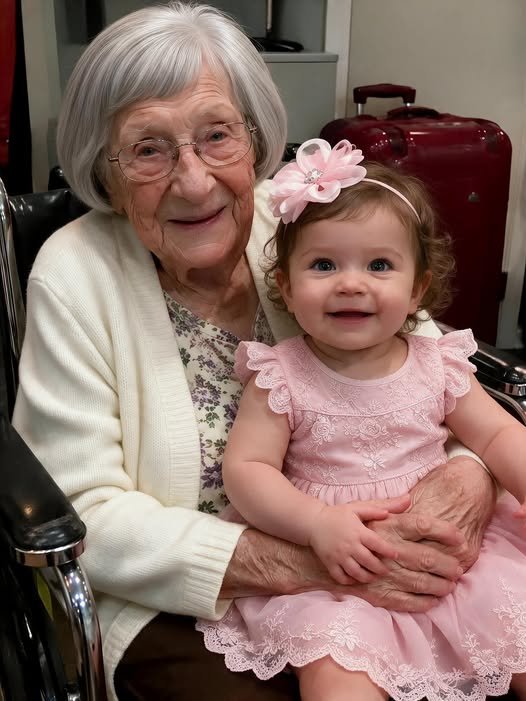
We thought Grandma leaving her bed after two years would be the biggest surprise of Sophie’s first birthday. Then she looked down at my daughter’s bare foot, went white, and told us to lock the door.
PART 1
“Lock the front door.”
Grandma’s voice cut through “Happy Birthday” like a struck glass.
The singing stopped mid-line. Somewhere behind me, a phone camera kept recording, red light blinking, aimed at nothing anyone cared about anymore.
“Grandma?” I said.
She wasn’t looking at the cake. She was looking at my daughter’s foot, and her hands were shaking so hard the wheelchair’s armrests rattled under her fingers.
“Take off her sock,” she said. “The left one. Now.”
Nobody moved. Sophie kept banging her palm against the high chair tray, delighted by all the attention, one year old and utterly unaware that the room around her had just gone still.
I need to back up, because none of this made sense yet — not to me, not to anyone standing in my living room in party hats, and least of all to the one relative who had gone quiet the moment Grandma’s eyes landed on him.
It had started three days earlier with a phone call I almost didn’t answer.
My grandmother Evelyn was 101 years old, and she hadn’t left her bed in almost two years. That single fact had become so ordinary to our family that I’d stopped picturing her anywhere else. Whenever I thought of her, I saw the same room: pale curtains, a wooden dresser crowded with photographs, a glass of water sweating on the nightstand, her thin hands folded over a blanket while the afternoon light crawled slowly across the floor.
She had always been stubborn. Age had simply shrunk the size of the world she got to be stubborn in.
So when she called on the morning of Sophie’s first birthday and said, “I’m coming,” I genuinely thought I’d misheard her.
I was standing in my kitchen with a roll of pink streamers wedged under one arm and frosting drying on my thumb. Sophie was in her high chair, whacking a plastic spoon against the tray like she was keeping time for a song only she could hear.
“Grandma, you can barely sit up,” I said.
“I said I’m coming.”
Her voice was thin, but the tone underneath it was the one that had outlasted two husbands, four doctors, and every nurse who had ever tried to tell her what she could and couldn’t do.
“Grandma, the party’s here. At our house.”
“I know where you live, Elena.”
I closed my eyes. There was no point arguing once she used that tone. My mother had lost that argument her whole life. So had every doctor who’d ever met her.
“How are you even planning to get here?” I asked.
“You worry too much.”
“You’re a hundred and one.”
“And somehow I still know that.”
I almost laughed. Then I heard her cough — deep, and wet, and long enough that my irritation curdled into something closer to fear.
“Grandma.”
“I’m fine.”
She wasn’t. We both knew it. But I also knew better than to say so out loud and watch her pretend I hadn’t.
“Does Mom know you’re doing this?”
“Not yet.”
“Of course she doesn’t.”
“I called you first.”
That detail stayed with me long after we hung up. Grandma never explained herself. She certainly never spent energy reassuring anyone. But something about the order of that phone call — me before my own mother — sat in my chest like a stone I couldn’t quite identify.
She wasn’t just attending a birthday party.
She had decided she needed to be there. And whatever her reason was, it had been enough to pull a woman who hadn’t stood up in two years back out into the world.
I just didn’t know why yet.
Three hours later, a medical transport van turned into my driveway, and I stood at the front window unable to make my legs carry me to the door.
PART 2
Bryce came up behind me and looked over my shoulder at the van idling in the driveway.
“No way,” he said.
“I told you she was serious.”
“You said she called. I thought she’d change her mind by lunch.”
“Grandma doesn’t change her mind. Other people eventually surrender.”
“That explains you,” he said, and I elbowed him in the ribs, smiling despite myself.
Then the van’s back doors swung open, and my smile disappeared.
Two attendants lowered a wheelchair ramp and helped Grandma down into it, and seeing her outside hit me harder than I’d expected it to. She looked smaller than she ever looked in bed — her shoulders narrow under a cardigan someone had buttoned for her, her white hair brushed back, a little color rubbed into her cheeks. Knowing Grandma, she had probably demanded the blush herself.
There was something almost unreal about it. A woman who had spent nearly two years confined to one room was sitting in my driveway in the open air, on my daughter’s first birthday, blinking up at a sky she hadn’t seen in longer than I wanted to think about.
And strapped to the back of the wheelchair was a small red suitcase.
It looked ancient. Scratched leather gone dull at the corners, brass fittings gone soft with tarnish, and a tiny padlock hanging from the clasp like an afterthought that wasn’t an afterthought at all.
I noticed it instantly, because it made no sense. Grandma hadn’t packed an overnight bag. She hadn’t brought a purse. She had brought one strange little suitcase that looked older than my own parents, and she’d had it strapped to her wheelchair like it mattered more than she did.
Bryce noticed it too. “What is that?” he murmured.
“No idea.”
“Maybe it’s a present for Sophie.”
“If it is, she wrapped it like evidence.”
He laughed. I didn’t, because I couldn’t stop looking at that lock.
The attendants rolled her toward us, and I finally got my legs moving and hurried out to meet her.
“Grandma.”
Her eyes moved slowly over my face. “Don’t make that face.”
“What face?”
“The one where you’re deciding whether I’m about to die.”
“I wasn’t.”
“You were.”
I bent down and kissed her cheek. She smelled faintly of lavender powder, and for one unguarded second I was eight years old again, sitting on the edge of her bed while she told me stories about people I’d never met.
Bryce stepped up beside me. “Good to see you, Evelyn.”
She studied him. “You’ve gotten thinner.”
“I’ll take that as a compliment.”
“It wasn’t one.”
That made me laugh out loud, and even Bryce smiled, before his eyes drifted back to the suitcase.
“Here, let me get that for you,” he said, reaching for the strap.
Grandma’s hand shot out and slapped his away so fast the attendants froze mid-step.
“Nobody touches that.”
“Okay. Okay.” Bryce pulled his hand back like he’d touched a stove.
Her expression didn’t soften. “I mean it.”
“I got it,” I said quickly. “Good,” she said, and I could hear it — not annoyance, not the ordinary stubbornness I’d grown up with. Something sharper. Something closer to fear wearing the mask of authority.
The suitcase came inside still strapped to the wheelchair, and nobody dared suggest moving it anywhere else.
We settled her in the living room where she could see the whole party, and relatives descended on her in waves — hugging her, angling for photographs, asking how she felt in the particular tone people use with the very old and the very sick.
She tolerated it the way she tolerated everything. “Yes, I’m alive. Yes, I’m comfortable. No, I don’t need another pillow.” When my mother hovered a beat too long, fussing with her blanket, Grandma finally snapped, “If I need something, I’ll ask,” and Mom stepped back wearing the exact defeated expression she’d worn her whole life around her own mother.
For a while, things felt almost normal. Kids ran between the kitchen and the living room. Someone knocked over a cup of juice near the hallway. Bryce’s sister took an alarming number of photos of a banner that said ONE.
But Grandma wasn’t acting normal, and I was the only one who seemed to notice.
She barely looked at the decorations. She barely looked at the cake. She watched Sophie — only Sophie — with an intensity that didn’t match a woman simply enjoying her great-granddaughter.

PART 3
At first I told myself it was sentimental. Grandma had only seen Sophie a handful of times in her life. Maybe she was just trying to memorize her face before she ran out of chances to.
But the longer I watched her watch my daughter, the less that explanation held together.
When Bryce carried Sophie across the room, Grandma’s eyes tracked her like a hawk following something small through grass. When my mother bounced her on one knee, Grandma leaned forward in her chair. When I finally set Sophie down on the rug with her toys, Grandma went so still I thought, for one terrible second, that something had happened to her.
I crouched beside her wheelchair. “You okay?”
“Fine.”
“You keep staring at Sophie.”
“She’s my great-granddaughter.”
“I know that, Grandma.”
She looked at me then, and for a moment I was sure she was about to say something that would explain everything. Instead she looked away, out toward the window.
“Enjoy the party, Elena.”
That answer bothered me more than any explanation would have. Grandma was never vague unless she wanted to be, and she never wanted to be vague without a reason.
I didn’t have time to press her, because Bryce was already calling everyone over for the cake.
We buckled Sophie into her high chair. Someone perched a paper crown, slightly crooked, on her head. Phones rose into the air on every side of the room. Bryce lit the single candle, and Sophie stared at the small flame with the wide, unblinking wonder that only a one-year-old can manage, and I stood behind her chair with both hands resting on the tray, and for one bright, ordinary moment I let myself believe the whole day was exactly what it looked like.
I glanced across the room at Grandma.
She wasn’t smiling.
Then the singing started. “Happy birthday to you—”
Sophie clapped along, off-rhythm, and everyone laughed, and Bryce leaned over to whisper in my ear, “She has no idea what’s happening.”
“Neither do half the adults here,” I whispered back, and he grinned, and I turned to see if Grandma had caught the joke.
She was crying.
Not the quiet, private kind of tears people wipe away before anyone notices. Tears were running freely down her face, and she made no move to stop them, and something about the sheer size of her grief in that small, frail body made my stomach drop before I even understood why.
I moved around the table toward her.
“Grandma?”
She pointed one shaking finger at my daughter.
“Take off her sock.”
The room went silent in a way I had never heard a room go silent before — not polite quiet, not embarrassed quiet, but the particular silence of twenty people simultaneously deciding something was wrong.
“What?” I said.
“Her left sock. Now.”
I stared at her, and she stared back, and there was no stubbornness left in her face at all. There was only fear.
She didn’t answer me. Instead her eyes moved past me, toward the guests gathered near the hallway, and settled on one person in particular.
“Lock the front door.”
My husband laughed, the nervous kind of laugh people use when they’re hoping a joke will retroactively make something less strange. “Why?”
Grandma’s fingers closed around my wrist, cold and surprisingly strong.
And for the first time in my entire life, I watched terror move across my grandmother’s face.
PART 4
“Lock the front door,” she said again, and this time nobody laughed.
The room was so quiet I could hear Sophie’s small hands slapping happily against her high chair tray, the only sound left that hadn’t yet understood what was happening.
Bryce looked from Grandma to me. “Elena?”
“Just do it.”
He hesitated half a second, then crossed the room. The deadbolt clicked into place with a sound that felt far louder than it should have. Relatives exchanged confused glances. My mother pushed forward.
“Mom, what is going on?”
Grandma didn’t answer her. Her eyes never left Sophie.
“Take off the sock.”
I crouched beside the high chair, my hands unsteady in a way I couldn’t explain yet. Sophie kicked happily as I reached for her foot.
“It’s okay, baby,” I murmured, more to steady myself than her.
I pulled off the small white sock.
At first I saw nothing unusual — just my daughter’s foot, soft and small, exactly as it had looked every day of her life.
Then Grandma made a sound behind me. Almost a gasp.
There, just above her heel, was a small brown mark, no larger than the tip of my thumb. An irregular birthmark. I had seen it a hundred times. I had never once thought about it.
I turned back to Grandma. “That’s what this is about? It’s a birthmark.”
Her face had gone the color of the tablecloth.
“Turn her foot,” she said.
“What?”
“Turn it toward me.”
I lifted Sophie’s leg gently, angling her heel toward my grandmother, and Grandma leaned so far forward in her wheelchair I thought she might tip out of it. Her hands trembled violently.
My mother frowned. “Mom, it’s a birthmark. Plenty of babies have birthmarks.”
“I know what it is.”
Something in the way she said it stopped every other sound in the room.
Bryce came back to my side. “What does it mean?”
Grandma’s gaze lifted from Sophie’s foot and moved, deliberately, toward our guests. I followed it and found my uncle Dean standing near the doorway, unusually quiet, his wife Trina beside him with a paper plate she’d forgotten she was holding.
Dean was sixty-eight. He had said maybe a dozen words all afternoon.
Grandma pointed a finger straight at him.
“You stay exactly where you are.”
His jaw tightened. “Mom, this is ridiculous.”
“No.” Her voice cracked, but it didn’t waver. “What’s ridiculous is that I waited this long.”
My stomach dropped. “Waited for what?”
She released my wrist. Her hand moved instead to the back of the wheelchair, to the small red suitcase that had ridden into my house strapped to her chair like it was the only thing keeping her upright.
“Bring it around.”
Bryce moved toward it, then stopped, waiting for permission he’d already been denied once that day. Grandma nodded. This time she let him touch it.
He unstrapped the suitcase and set it gently in her lap. The tiny padlock faced upward, and Grandma reached beneath the collar of her cardigan and pulled out a thin chain with a small brass key hanging from it. Her hands shook so badly I had to steady them, guiding the key into the lock myself while twenty relatives stood frozen around a locked front door.
The click of the padlock opening sounded enormous.
Inside were old photographs curling at the corners, a stack of envelopes gone soft with age, a yellowed baby blanket folded with more care than anything else in the case, and a thin leather journal with a cracked spine.
None of it made any sense yet. But it was about to.

PART 5
Grandma lifted the first photograph with hands that hadn’t stopped shaking since the suitcase touched her lap.
“Come here, Elena.”
I knelt beside her wheelchair. The photo showed a young woman holding an infant, and something about her face stopped me cold — not because I recognized her, but because she looked like me. The same dark eyes. The same narrow chin. Even the faint tilt of her head, caught mid-laugh, was a gesture I’d seen in my own bathroom mirror a thousand times.
“Who is she?” I asked.
Grandma swallowed hard. “My sister. Margaret.”
I had heard the name exactly twice in my life, always in passing, always followed by silence. All I’d ever known was that Margaret had died young.
Grandma turned the photograph over. A date was written on the back in faded pencil, and beneath it, two words: Baby Rose.
My mother leaned in over my shoulder. “Mom — who was Rose?”
Grandma’s eyes filled again. “My niece.”
That was when Dean moved for the first time.
“Enough,” he said, and took a step toward the door.
Bryce shifted his weight and planted himself between Dean and the deadbolt without seeming to decide to do it.
“Get out of my way,” Dean said.
“No.”
I looked at Grandma. “Why is he trying to leave?”
She opened the leather journal in her lap. “Because he knows.”
Trina turned to her husband, her voice thin. “Knows what, Dean?”
Grandma drew a slow, unsteady breath. “Margaret had a daughter when she was seventeen.”
Nobody spoke. Somewhere behind us, the abandoned birthday cake sat with its single candle burned down to a stub.
“Her parents were ashamed,” Grandma went on. “Our parents. They sent her away before anyone in town could know she was pregnant.”
My mother’s voice came out barely above a whisper. “Our grandparents did that?”
Grandma nodded, and her hand drifted to the folded baby blanket resting in the suitcase like it was still warm. “Rose was born in secret. Margaret wanted to keep her. They wouldn’t allow it.”
My chest went tight. “What happened to the baby?”
“She was given to another family.” Grandma’s eyes met mine, steady now despite the tears. “A closed adoption. The kind nobody was supposed to be able to undo.”
I glanced down at Sophie’s bare heel, at the small brown mark above it, and something in my body understood before my mind did.
“I still don’t understand,” I said anyway.
Grandma reached for a second photograph, older and more faded than the first. It showed an infant alone, wrapped in what I now recognized as the same yellowed blanket sitting in the suitcase. The baby’s left foot was turned toward the camera.
Above the heel was the same irregular brown mark.
I stopped breathing.
Bryce whispered, “Oh my God,” and my mother sank into the nearest chair as if her legs had simply stopped being willing to hold her.
I looked at Sophie. Then at the photograph. Then back at my grandmother.
“Birthmarks repeat in families sometimes,” I said, grasping for the ordinary explanation even as it slipped through my fingers.
“Sometimes,” Grandma agreed, her voice breaking on the word. “But this isn’t the first time I’ve seen it since Rose.”
She turned, slowly, to look directly at Dean.
His expression changed. Not much. Just enough that I finally understood why he’d been trying so hard to leave.
PART 6
“What did you do?” I asked him.
Dean shook his head. “Don’t start.”
“Tell her,” Grandma said, her voice rising for the first time all day.
Dean stared at the floor like it owed him an answer. “Tell me what?” I said, and my own heartbeat had gotten loud enough that I could feel it in my ears.
Grandma reached back into the suitcase and pulled out an envelope, its edges gone soft and gray with age.
“I found this after your grandfather died,” she said, handing it to me.
Inside was a letter, the paper so fragile I was almost afraid to unfold it all the way. I read only a few lines before my hands started shaking on their own.
Margaret had spent years searching for the daughter she’d been forced to give up. And eventually, she had found her.
Rose had grown up. Rose had married. Rose had a daughter of her own.
My mother leaned over my shoulder to read, and then covered her mouth with both hands.
Near the bottom of the letter, in Margaret’s careful, slanted handwriting, was a name I knew better than my own.
It was my mother’s name.
I looked up at her. She looked at Grandma.
“No,” my mother said, in the voice of someone hoping a single word could undo a sentence she’d already read.
Grandma nodded slowly. “Yes.”
My mother started to cry — not the composed tears of earlier in the evening, but something raw and startled, like grief for a version of her own life she hadn’t known she’d lost yet.
“This proves nothing,” Dean muttered.
Grandma’s head snapped toward him. “It proves everything.”
Then she reached into the suitcase one final time and drew out the last envelope, holding it against her chest for a moment before she spoke.
“This is what Dean didn’t want anyone to see.”
Dean lunged forward, and Bryce caught him by the shoulder before he’d made it two steps.
“Don’t,” Bryce said quietly.
Dean shoved his hand away, breathing hard, and Trina stared at her husband like she was seeing a stranger standing in his clothes.
“Dean,” she said. “What is in that envelope?”
He said nothing. He had gone somewhere far away behind his own eyes, somewhere none of us could follow him, and I understood, watching him, that whatever was in that envelope was the real reason he’d spent all afternoon trying to leave a house he’d walked into hours earlier without a second thought.
Grandma held the envelope out to me instead of him.
My hands were shaking too badly to open it cleanly. I tore the flap instead of unsealing it, and a folded set of documents slid out onto my lap along with a second letter, this one typed instead of handwritten.
I looked up at Dean one more time before I started reading, and for just a second, I felt something I hadn’t expected to feel toward him in that moment.
Not anger yet.
Pity — because whatever he had spent years protecting himself from, it was about to be over in the next sixty seconds, whether he wanted it to be or not.
PART 7
The documents were adoption records — old, official, and stamped with a date decades in the past. The typed letter beneath them was addressed to Dean himself.
He had found all of it years earlier, while settling the paperwork on a piece of family property after our grandfather died. Buried among deeds and old bank statements, he’d found proof that my mother wasn’t Grandma’s biological daughter at all.
She was Margaret’s granddaughter. Rose’s daughter. A secret two generations deep, and Dean had been the one holding the flashlight when it finally surfaced — and instead of telling anyone, he had folded the papers back into their envelope and put them away.
“You knew,” my mother said. It wasn’t a question.
Dean’s shoulders sank in a way I had never seen a grown man’s shoulders sink before. “It wasn’t my secret to tell.”
“No,” Grandma said, and her voice was steadier now than it had been all day, steady with the particular calm of someone who has waited a very long time to say something out loud. “It was simply convenient for you not to tell it.”
He looked away. He didn’t argue.
Because the truth — the one Grandma laid out plainly in the minutes that followed, while my mother sat gripping the arm of Grandma’s wheelchair and Dean stood with his back nearly against the locked front door — was that an inheritance dispute had been quietly simmering in our family for years, one nobody outside a handful of relatives had ever discussed at a birthday party. If it became known that my mother wasn’t Grandma’s biological child, questions might be raised about property, about wills, about who was entitled to what and why. Dean had decided, on his own, that the safest thing to do with the truth was to bury it. Not out of cruelty, exactly. Out of the ordinary, cowardly math people do when honesty costs them something and silence doesn’t.
For years, he had let all of us believe the truth had died with the generation before us.
I felt angry, standing there — genuinely, cleanly angry in a way I rarely let myself feel toward family. But underneath the anger was something stranger, something that arrived almost immediately afterward and refused to leave.
Relief.
Because for my entire life, Grandma had treated my mother differently from her other children. Not cruelly — never cruelly — but carefully, protectively, in a way none of us had ever been able to explain. I had chalked it up to Mom being the youngest, or the most sensitive, or simply Grandma’s favorite for reasons nobody questioned out loud.
Now I understood. It had never been favoritism.
It had been vigilance.
Grandma reached for Sophie’s small bare foot again, resting two fingers gently against the mark above her heel.
“The mark disappeared for two generations,” she said quietly. “And then she was born.”
I sat down slowly on the arm of Grandma’s wheelchair. “That’s why you came today.”
She nodded. “I needed to see it with my own eyes. I wasn’t certain, not from what your mother sent me in photographs over the years. I needed to touch it.”
“You could have told me first. Warned me.”
“I wasn’t sure,” she said again. “And I wasn’t going to tear this family apart over a suspicion.” Her eyes drifted to the small red suitcase, empty now in her lap, its lock hanging open for the first time in decades. “Not without proof.”

PART 8
My mother knelt on the other side of the wheelchair, her knees on the hardwood floor, her hand covering Grandma’s.
“You raised me,” she said.
“Yes.”
“You knew I wasn’t your biological daughter. This whole time.”
“Since the day your mother brought you to me,” Grandma said, and her voice finally broke all the way open. “Since the very first day.”
My mother’s face crumpled the way a child’s does, not the careful, contained crying of an adult trying to hold a room together, but something older and rawer than that, something that had probably been waiting seventy years for permission to come out.
Grandma reached for her hand and held it the way she used to hold mine when I was small and frightened of something I couldn’t name.
“Margaret couldn’t protect Rose,” she said. “Rose couldn’t protect you. So I did.”
My mother rested her forehead against Grandma’s hand and stayed there, and for a long moment nobody in the room moved, not even Dean, who stood by the door with the particular stillness of a man waiting to find out how much of his life was still standing once the dust settled.
The choice, once the truth was fully out, wasn’t really a dramatic one. There was no lawsuit, no scene, no dividing of property that night. What there was, instead, was a decision my mother made out loud, twenty minutes later, once she’d stopped crying long enough to speak clearly: the inheritance question — whatever Dean had been protecting himself from for all those years — could go to a lawyer, properly, in daylight, with everyone’s name on the table instead of buried in a filing cabinet. She wasn’t interested in fighting Dean for money. She was interested in never again being the only person in the family who didn’t know what she actually was.
“You don’t get to decide what I’m allowed to know about my own life,” she told Dean, quietly, without raising her voice the way I might have in her place. “Not anymore. Whatever happens with the property, it happens with everyone knowing the truth first.”
Dean didn’t answer her. He didn’t need to. Something in his face had already started to loosen, the particular unclenching of a man who has spent years bracing for a moment that has finally, unavoidably, arrived.
Trina touched his arm, and for the first time all evening, he let her.
PART 9
Sophie squealed.
Everyone turned at once, and for a moment the whole room simply forgot what it had been doing thirty seconds earlier.
She had grabbed a fistful of frosting off her abandoned cake and smeared it triumphantly across one cheek, delighted with herself in the particular, uncomplicated way only a one-year-old can manage in the middle of a family catastrophe she would never remember.
Bryce laughed first. Then I did. Even my mother laughed, through tears that hadn’t finished falling yet, and Grandma — Grandma smiled. A real one. The first unguarded smile I’d seen on her face since she’d stepped out of that van.
I knelt down and slid Sophie’s little white sock back over her foot, pressing a kiss against her tiny heel before I tucked it away.
That birthday had started with pink streamers and a plastic spoon banging against a high chair tray. It ended with our family’s history quietly, permanently rewritten — a truth that had waited three generations finally allowed to breathe in a living room full of people who loved each other and hadn’t fully known each other, not until that afternoon.
Grandma had carried it across town in a locked red suitcase strapped to a wheelchair, the same suitcase that would sit, unlocked now, on my hallway table for weeks afterward because none of us quite knew what to do with it.
But what stayed with me longest wasn’t the secret itself.
It was the shape of the woman who’d guarded it. A hundred and one years old, barely able to sit upright, and she had still found a way to drag herself out of that bed one more time — not for cake, not for streamers, but to make sure the truth finally belonged to the people who deserved to hold it.
She had spent a lifetime protecting the people she loved, in the only way she knew how.
And on the one day she understood she could no longer wait, she came anyway — small, furious, trembling, and utterly unstoppable — to make sure none of us had to go on not knowing who we really were.