
PART 1 — The Ice Cream That Didn’t Add Up
For almost two weeks that summer, my nine-year-old daughter, Ellie, kept walking back into the house holding ice cream she hadn’t paid for. Under normal circumstances, that wouldn’t have registered as anything at all. But I knew for a fact she hadn’t taken a single dollar outside with her, and I have learned, in the years since I became a single mother, that the small details are the ones worth paying attention to. Where your child goes. What they carry out the door. What they come back with. Whether the story actually adds up.
This one didn’t.
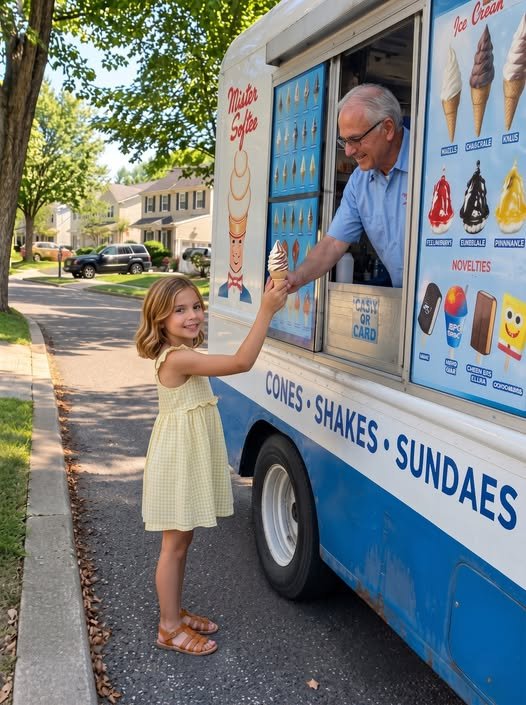
We live in the kind of quiet, orderly neighborhood where the streets are named after trees — Oak, Maple, Pine — and every child on the block knows exactly which houses give out the good candy at Halloween. A few evenings a week that summer, an ice cream truck rolled slowly through, its tinny little jingle announcing itself from blocks away. And the instant Ellie heard it, she would come tearing toward me, hand already out. “Mom, can I have three dollars?”
She’s a good kid. Bright, funny, curious, and lately observant in ways I sometimes wish she weren’t, because she notices things. Her father and I split up when she was four — no war, no ugliness, just two people who’d quietly figured out they were better apart — so now it’s mostly the two of us, building something smaller than what I once pictured for my life, but safe. Warm. Ours.
The first time it happened, Ellie came inside holding a strawberry shortcake bar, pink and white, already melting in a sticky line down her wrist. I remember thinking, distantly, that she’d spent the last of her allowance three days earlier on slime supplies and had been complaining about being broke ever since.
“I thought you were out of money,” I said.
“I didn’t need money,” she answered, mouth full. “The ice cream man gave it to me.”
I let it go. Maybe he had one going soft in the freezer. Maybe he was just being kind to a neighborhood kid. I told her to say thank you next time, and to please wash her arm before she touched anything in the house.
But then it happened again. And again. By the fourth free ice cream, I stopped her at the door before she could run back out.
“Why does this man keep giving you free ice cream?”
Ellie gave me the enormous, unbothered shrug that children reserve for things they’ve never once thought to question.
“He says strawberry was your favorite too.”
I was standing at the sink, and I remember my hands going still in the water.
“My favorite?”
“Yeah.” She was already glancing back toward the street, worried the truck might leave without her. “He said you always picked this one when you were little.”
Something cold moved through me, because he was right. Strawberry shortcake had been my favorite — not sometimes, not occasionally, every single time, from the summer my mother had to lift me up to reach the truck window until I was old enough to walk there myself with quarters warm in my fist. Other kids wanted rocket pops and drumsticks and the ones with gumball eyes. I always wanted strawberry shortcake.
That childhood, though, belonged to a different life. Thirty years earlier. Four hundred miles away, in a town called Millbrook, which I’d left the day I turned eighteen and never really gone back to. There was no reasonable explanation for how a man driving an ice cream truck through my current neighborhood could possibly know any of that.
“Ellie, did you tell him my name?”
“No.”
“Did you tell him strawberry used to be my favorite?”
“No.” She looked at me like I’d lost the thread of the conversation. “I didn’t tell him anything about you. He just knew.”
He just knew.
That sentence sat in my chest all through dinner and refused to leave.
Two evenings later, Ellie came inside without any ice cream at all. Instead she was holding a small folded piece of paper, pinched carefully between two fingers like it might blow away in the wind.
“He gave me this instead, tonight,” she said. “He told me, make sure your mom reads this.”
I unfolded it standing at the kitchen counter. The handwriting was careful, almost old-fashioned, like something out of my grandmother’s recipe box.
You used to run down Maple Street for strawberry shortcake too, didn’t you. Ask your mother about it — or better yet, come find me yourself.
I read it twice. Then a third time. None of it made sense, and all of it made my hands go cold. Maple Street was my childhood street, four hundred miles and thirty years away from this kitchen — written down, apparently, by a stranger who drove an ice cream truck through my own neighborhood.
So the following evening, when the truck’s faint melody drifted down our street again, I didn’t stay on the porch. I walked outside with my daughter to see for myself.
PART 2 — “You’re Ellie’s Mother?”
The truck was idling near the corner, surrounded by the usual chaos of a summer evening — bikes dropped in the middle of driveways, kids elbowing toward the window, the light coming gold and slanted through the trees the way it only does in July. Behind the glass stood a man who looked, at first glance, entirely unremarkable. Somewhere around sixty. Gray hair, glasses, a faded ball cap — the kind of face you could pass in a grocery store and forget within five minutes.
Ellie ran straight for him.
“Hey, kiddo,” he said, and his whole face lit up the way it does for someone you’re genuinely fond of. His hand was already moving toward the freezer — reaching, I realized, for her usual — when he looked up and saw me standing behind her.
And he stopped.
It wasn’t fear on his face. It wasn’t guilt, either — nothing that made my instinct scream to grab Ellie and go. What crossed his expression instead was something closer to disbelief, like a man looking at a face he recognized from very far away and couldn’t quite place how. His hand stayed frozen halfway to the freezer door.
“You’re Ellie’s mother?” he finally asked.
“Yes.” I kept my voice level and stepped slightly in front of my daughter without really deciding to.
He nodded slowly, like he was confirming something to himself. Then, quietly:
“Sarah?”
Every hair on my arms rose at once. I had never told this man my name. I was certain Ellie hadn’t either.
“Do I know you?”
He laughed, a small, nervous sound. “Probably not anymore.”
Somehow that answer landed worse than a simple yes would have. Probably not anymore — meaning there had once been a time when I did.
“What is that supposed to mean?”
He wiped his hands slowly on a cloth hanging inside the truck, clearly deciding how much to say, while around us the other children kept chattering and pointing at the menu, oblivious to the fact that something strange was unfolding six feet away from them. Finally he looked past me, down at Ellie.
“Why don’t you pick out whatever you want tonight, sweetheart. It’s on me. Let me talk to your mom for a minute.”
Every protective instinct I owned wanted to say no. But there was something in his face that wasn’t threatening at all — just careful, and sad in a way I couldn’t yet explain. I gave Ellie a small nod, and she turned happily to study the freezer, already negotiating with herself over what counted as “whatever.”
The man took off his glasses, cleaned them against his shirt, and put them back on before he spoke again.
“I’m sorry,” he said. “I shouldn’t have said it like that.” He took a breath. “I’ve driven this neighborhood for three summers. Two weeks ago your daughter walked up to my window, and when I looked at her, I felt like I was looking at a ghost.”
I said nothing. I couldn’t.
“She looks exactly like you did at her age.”
My stomach tightened.
“Then she told me her name was Ellie, and I asked her, just to make conversation, what her mother’s name was. She said Sarah.” He shook his head slowly. “I couldn’t believe it.”
“I still don’t understand how you know me.”
He hesitated, and then asked, so quietly I almost missed it:
“Do you remember Maple Street?”
My chest went tight in a way that had nothing to do with fear.
“In Millbrook?”
The whole evening seemed to tilt slightly on its axis. Maple Street. My childhood street. Four hundred miles from where I was standing, in the town where my own mother used to walk me down to an ice cream truck on summer nights just like this one.
“How do you know that?”
He took off his cap and held it against his chest like a man at a graveside.
“Because I used to drive that route. Back in the eighties and nineties. Almost twenty years.” He smiled, faint and a little sad. “You wouldn’t remember me. You were little.”
His eyes were wet by the time he finished the next sentence.
“But I remember you.”
He glanced at the strawberry shortcake bar Ellie was now holding, already unwrapping it without looking up.
“You always ordered that one.”
And something stirred loose in my memory — not a full picture, just fragments. A white truck. Warm coins pressed into my palm. A kind face behind a window. And, somehow, always, my strawberry shortcake waiting for me before I’d even asked.
“That was you? You were that man?”
“That was me.” His voice had dropped to almost nothing. “I used to have yours ready the second I saw you running down the street.”
I stood there in the middle of my own driveway, trying to understand how a piece of childhood I’d half-forgotten had somehow followed me four hundred miles and thirty years into my adult life.

PART 3 — The Envelope
“But Millbrook is four hundred miles from here,” I said.
“I know.”
“And you’ve been driving this neighborhood for three summers?”
“Yes.”
“How? Why?”
His expression shifted again — something heavier settling underneath it this time. He reached into his shirt pocket and drew out an envelope, folded soft and worn at the edges, as if it had been carried around for days rather than hours. My name was written across the front in careful handwriting.
Sarah.
“This is the rest of it,” he said quietly. “Couldn’t exactly fit it on a scrap of paper small enough for a nine-year-old to carry in her pocket.” He gave a small, embarrassed laugh. “I’ve had it about a week. I kept trying to work out how to explain who I was without sounding like some strange old man telling a little girl he used to know her mother.” He held the envelope out through the window. “But you’re here now. So I suppose you can just read it yourself.”
I took it. It was warm from being pressed against his chest all evening.
“Why are you here, Walter?” I’d finally learned his name from the little placard on the truck’s dash. “Why this town? Why my street, specifically?”
He looked down for a moment before answering.
“Read the letter tonight. It explains things better than I can standing here.” Then he met my eyes again. “But you deserve the short version now.”
He took a breath, the kind people take before saying something they’ve rehearsed for a long time.
“I came looking for you.”
I just stared at him.
“Not specifically here,” he clarified quickly. “I didn’t know where you’d ended up. But for the last few years, I’ve been trying to find the children from Maple Street. All of you. As many as I could still track down.”
“The children? Why?”
He looked up at the darkening sky for a second, like he was gathering the words.
“Because I made a promise to someone.” A sad smile crossed his face. “And when you get to my age, and the doctors start giving you a certain kind of news, you start thinking hard about the promises you haven’t finished keeping.”
His eyes came back to mine.
“You were on my list, Sarah. For three years.” He gave a soft laugh. “I never imagined I’d finally find you because your own daughter walked up to my truck looking exactly like you did thirty years ago.”
PART 4 — Margaret’s Promise
That night, once Ellie was asleep, I sat alone at the kitchen table and opened Walter’s letter. My tea went stone cold beside me and I never once noticed.
The letter broke something open in me. Then, somehow, it put part of it back together in a different shape.
Walter wrote that he had driven the Maple Street route for twenty years, and that those summers had been among the happiest of his life. He and his wife, Margaret, had wanted children desperately and had never been able to have them. So gradually, without either of them ever quite saying it out loud, the neighborhood children became something like borrowed family. He learned our names. Our favorite flavors. Which of us were shy, which were loud, which always tried to cut the line, and which ones — like me, apparently — never forgot to say thank you. For Walter and Margaret, Maple Street had quietly become the family life they were never able to build any other way. And for a long time, that had been enough.
Then Margaret got sick. Cancer. She died in 2003, after a long illness that took nearly everything they had saved. Walter lost Margaret. Then the house. Then, eventually, the truck. By the time he reached his fifties he was widowed, nearly broke, and entirely alone. The children of Maple Street had grown up, gone off to college, moved away, married, changed their names, built their own families, and forgotten the ice cream man — exactly the way children are supposed to.
For years afterward, Walter drifted. Different jobs, different towns, nowhere that ever felt like his. He missed Margaret more than he could put into words. But he also missed, in a quieter way, all those children he’d watched grow up from behind a truck window and then simply vanish from his life.
Near the end of her life, Margaret had made him promise her one thing. Someday, when his grief became bearable enough to carry, he was to find an ice cream truck again. Then he was to find the children of Maple Street — the grown versions of us, scattered wherever life had taken them — and tell them something.
You were loved.
That was the entire mission. Margaret wanted every one of us to know that somewhere inside our childhood had been a man and a woman we barely remembered, who had genuinely loved watching us grow, who had never been given children of their own but had quietly treated an entire neighborhood as theirs. She wanted us to know the love had been real. That even if we’d never noticed it happening, it had mattered. That someday, when adulthood turned complicated and disappointing and lonely — as it does — we might remember that once, simply running toward the sound of an ice cream truck, we had made two people happy.
It took Walter more than a decade to keep that promise. Grief, he wrote, doesn’t follow anyone’s schedule. But eventually he bought a used ice cream truck and started searching — old neighbors, public records, the internet, whatever thread he could pull. Some of us were easy to find. Others had vanished completely. A few had died, and he wrote that those were the hardest names to cross off the list. When he did find someone, he would sometimes spend an entire summer driving their local route, waiting for a natural opening to make contact, and then he would deliver Margaret’s message.
You were loved. It was real. It mattered.
I was one of the ones he could never find. I’d married, changed my last name, and moved hundreds of miles from home — there was almost no thread left connecting the woman I’d become to the girl who used to be Sarah from Maple Street.
Then one evening, driving a route hundreds of miles from Millbrook for no particular reason, Walter looked through his serving window and saw Ellie. Nine years old. My face. My exact expressions. My childhood, standing in front of him all over again.
He knew almost instantly. That was why the strawberry shortcake bars started. He admitted in the letter that he probably shouldn’t have done it that way — he understood how it might frighten a mother to see her child accepting free gifts from a stranger — but for those few minutes, handing my daughter the same ice cream he’d once handed me decades earlier made him feel, briefly, like the man he used to be. The neighborhood ice cream man. The keeper of small, ordinary summer happiness. And he hoped that telling Ellie strawberry had been my favorite would eventually make me curious enough to come outside myself.
It worked.
Near the end of the letter was a line I ended up memorizing without meaning to. He wrote that he didn’t know what kind of life I’d lived since Millbrook, and he hoped it had been good. But no matter what had happened in the years since — before I became a mother, before the marriage, before the divorce, before bills and heartbreak and work and all the ordinary weight adults learn to carry — there was something Margaret had insisted I needed to hear.
I had been a little girl running toward an ice cream truck. And two people I barely remembered had been genuinely, quietly happy every single time they saw me coming. They never had children of their own. But in the only way life had allowed them, they’d had us.
You were somebody’s joy, he wrote.
Then he mentioned Ellie — how seeing my childhood face looking back at him through that window had nearly stopped his heart, and how Margaret would have been thrilled to know that the little girl who always said “thank you, mister” had grown up and raised a kind little girl of her own.
His last line made me laugh out loud through the tears already running down my face.
Save one strawberry shortcake bar for me. — Walter.
PART 5 — Being Seen
I sat at that table and cried until the tea was completely, uselessly cold, because there was something Walter could never have known when he wrote that letter.
For years, I had felt profoundly alone. Not constantly. Not dramatically. Just in the quiet places nobody really talks about out loud. The divorce had reshaped my whole life. My family lived far away. Raising Ellie mostly by myself meant carrying a thousand small responsibilities that nobody else ever noticed — I was the only one keeping track of whether the free ice cream made sense, the only one checking the school forms, the only one lying awake at night wondering if everything was actually going to be okay. Somewhere along the way, without ever deciding to, I had quietly started believing I moved through my own life mostly unseen.
And then a letter arrived from a man I’d forgotten existed, and it told me that long before I knew what loneliness felt like, I had already been witnessed. Remembered. Loved, by people who owed me absolutely nothing and gave it to me anyway.
The next evening, I went back to Walter’s truck. I brought Ellie. I brought Walter a coffee.
“I read it,” I told him.
His face changed instantly. “All of it?”
“All of it.” I paused. “Tell me about Margaret.”
So he did. We talked until the sun disappeared behind the rooftops. He told me about his wife; I told him about my marriage, my divorce, Ellie, the life I’d slowly built out of the pieces. He listened to me with the same quiet attention he’d apparently once given a little girl’s ice cream order, thirty years ago, on a street neither of us lived on anymore.
Before he drove off that night, I told him: “You kept your promise.”
He looked down at the steering wheel. “Did it help?”
“Yes.” I swallowed hard. “It reached exactly where Margaret wanted it to.”

PART 6 — Grandpa Walt
Walter stayed on our route for the rest of that summer. A few evenings a week he’d park near the corner, Ellie would get her strawberry shortcake, and I’d bring him coffee, and somehow the three of us built our own small, strange routine out of it. Ellie adored him completely. On the slow evenings he taught her card games through the truck window while I sat on the curb, half-listening, half-marveling at how ordinary it had all started to feel.
I learned, eventually, that he was basically living out of the truck and cheap motel rooms — that most of whatever money he had left went toward gas and toward the search for the last of the Maple Street children on Margaret’s list.
As the summer wound down, I found myself thinking about what his life actually looked like once the season ended. One evening I finally asked him:
“Would you like to stop driving?”
He looked at me like I’d spoken a foreign language. “What?”
“I have a finished basement. Its own entrance, its own bathroom. Nobody uses it.”
He refused immediately — didn’t want to be a burden, he said. Burden. The word people reach for when they’ve spent too long believing nobody should have to make room for them. He still had names left on Margaret’s list. He wasn’t finished yet.
“You can finish the list from here,” I told him. “I’ll help you. The internet works just as well in my basement as it does in a motel room.” Then, because it was true: “And in the meantime, I think Ellie’s decided she needs a grandfather.”
Walter cried. He moved into our basement that fall.
For the last four years of his life, Walter became something he and Margaret had once believed he’d never get to be. Family. Ellie started calling him Grandpa Walt. He picked her up from school, sat through her recitals, ate ordinary dinners at our kitchen table, helped with homework he barely understood, and told her endless stories about a street she’d never seen. Together, the two of us finished Margaret’s list. We tracked down whoever we could. Walter wrote letters, and some people wrote back. One man, now in his forties and living in Oregon, actually flew across the country just to hear Margaret’s message from Walter in person.
You were loved. It was real. It mattered.
Walter died two summers ago. Peacefully, in his sleep, in the basement of my house. His list was finished. His promise had been kept. And upstairs, a girl who loved him enough to call him Grandpa slept through the night without knowing it was the last one.
Ellie is thirteen now. She still cries about him sometimes. So do I.
We buried him beside Margaret, back in Millbrook — he’d kept the plot next to hers reserved all those years, waiting. At the funeral, I told everyone the whole story: the strawberry shortcake bars, a little girl named Sarah, her daughter Ellie, and an old ice cream man who looked through a truck window one ordinary evening and saw the face of a child he’d loved three decades earlier. There wasn’t a dry eye in the chapel.
PART 7 — The Extra One
Sometimes I think about how easily none of this could have happened. If Ellie hadn’t looked so much like me. If Walter hadn’t happened to drive our particular street. If I hadn’t followed her outside that one evening. If he’d decided Margaret’s promise was simply too hard to keep, or let all that invisible love stay invisible forever. An entire family came into existence because of one strawberry shortcake bar.
Walter taught me something I still think about, more often than I expected to. Most of us move through our days quietly convinced we aren’t really being noticed — the crossing guard, the cashier, the neighbor who waves from the porch, the teacher, the ice cream man. All the people standing at the edges of our lives can start to feel almost invisible to us, and we probably feel just as invisible to them. But sometimes that isn’t true at all. Sometimes someone remembers exactly how you take your order. Sometimes someone notices that you always remember to say thank you. Sometimes someone quietly hopes, for years, that you turn out okay. And sometimes that small, ordinary affection becomes part of the rest of someone’s life without you ever finding out — unless, one day, they find a way to tell you.
Walter spent the last years of his life doing exactly that. Making invisible love visible. Finding people who had no idea they’d once mattered enormously to someone, and telling them so.
You were loved. From the beginning. By people you may have forgotten. And it was real.
Ellie knows the whole story now. She carries it with her. So do I.
Every summer, when we hear that same tinny little tune drifting down our tree-named street, Ellie and I go outside together. We each buy a strawberry shortcake bar. Then we sit on the porch in the last of the evening light, and we buy one extra. We unwrap it and set it on a little plate between us, and we let it melt slowly, the way it’s supposed to.
For Walter. For Margaret. And for an entire neighborhood of children who once ran toward an ice cream truck without ever knowing how deeply they were loved.