
I stared at the sentence for what felt like an entire minute.
THE ACTIONS OF SERGEANT THOMAS HAIL REMAINED SEALED BY ORDER OF THE SECRETARY OF DEFENSE.
My grandfather’s name was printed beneath it like he belonged in history books.
Not in the dusty corner of a forgotten house.
Not as the quiet old man my parents complained about.
Not as someone they described as difficult, stubborn, and impossible to please.
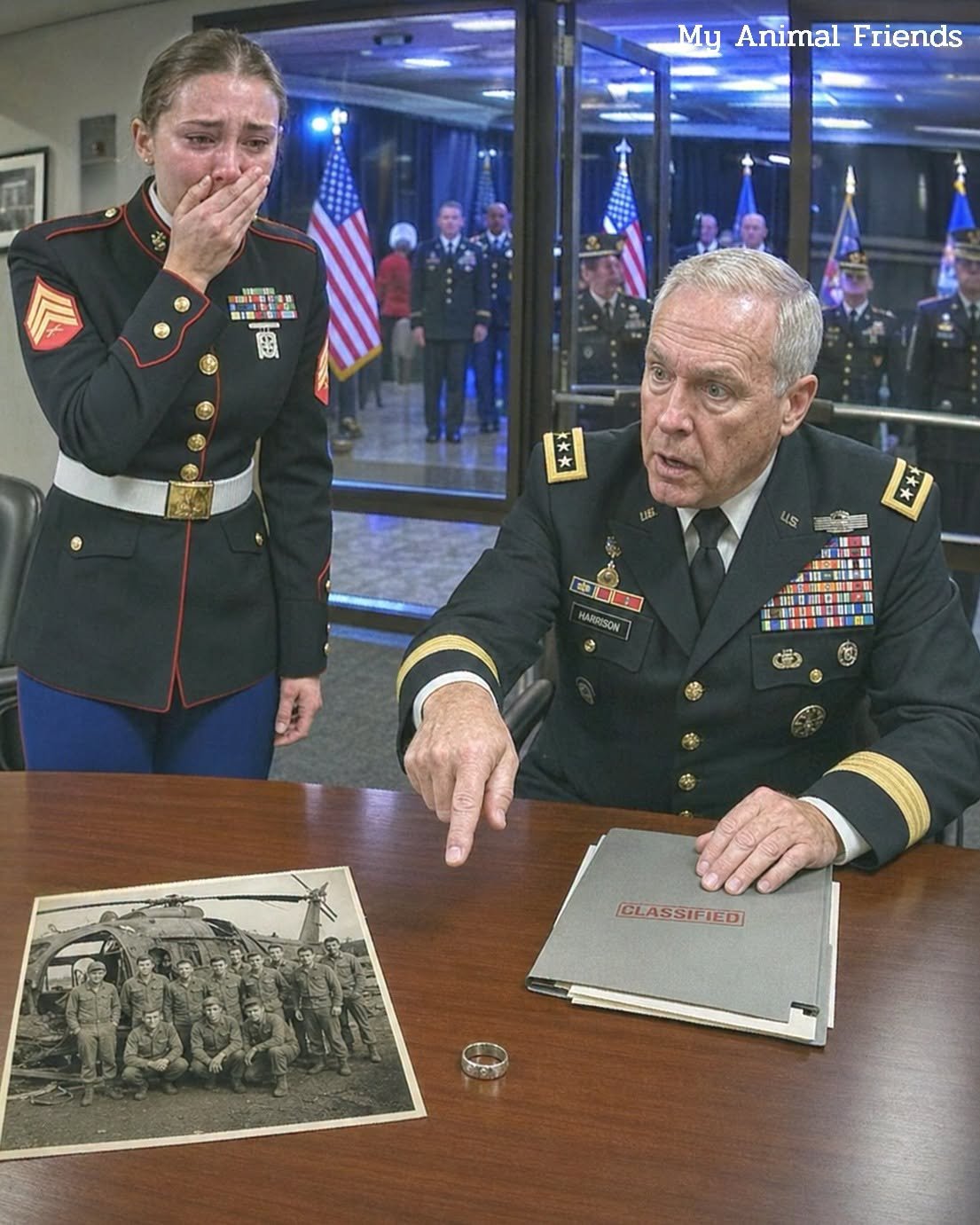
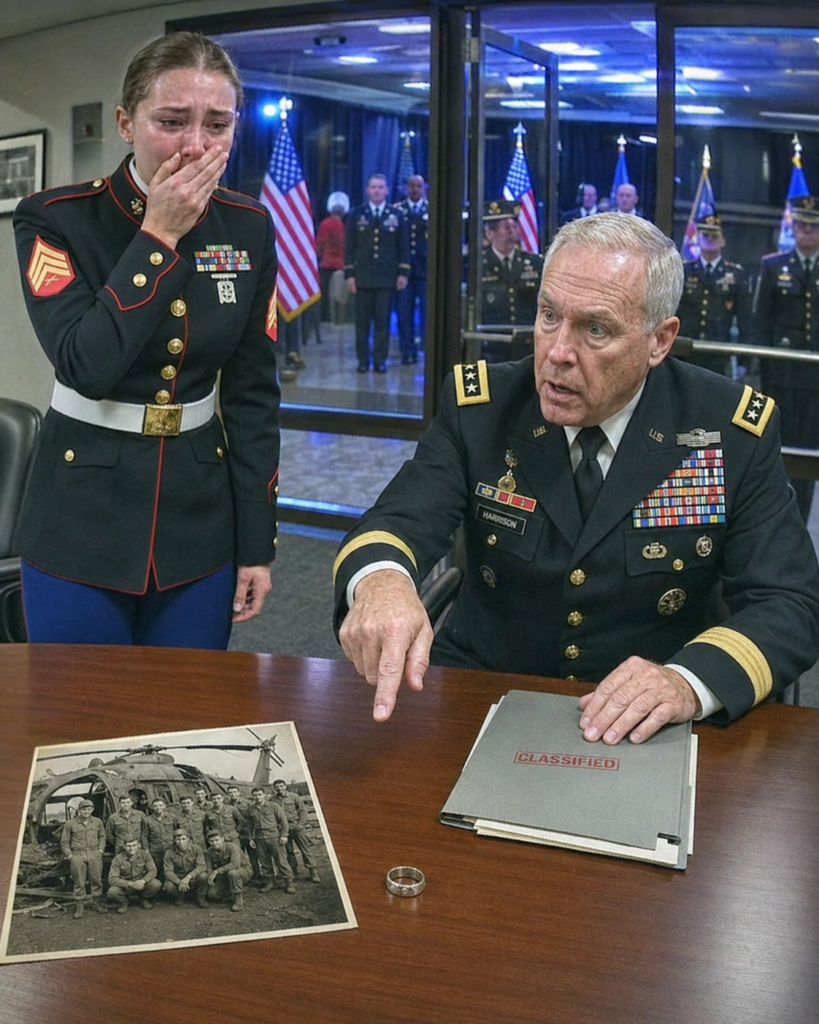
The general sat across from me, his expression heavy.
“Do you understand what you’re holding?” he asked.
I looked down at the ring resting on the table.
The same ring my mother probably would have thrown into a donation box.
The same ring my father would have sold at a garage sale.
The same ring I saved because it was the last thing my grandfather touched.
“No, sir,” I admitted.
The general leaned back slowly.
“Your grandfather was part of a mission that was never supposed to exist.”
The room suddenly felt smaller.
Outside the conference room, I could hear the distant sounds of the ceremony continuing. Officers laughing. Shoes moving across the polished floor. Cameras flashing.
But inside that locked room, everything changed.
Because I wasn’t just learning about my grandfather.
I was learning that my entire family had been wrong about him.
The general opened the folder carefully.
Inside were documents, photographs, and reports that looked older than I was.
Some pages had been sealed for decades.
Others contained handwritten notes from commanders who were no longer alive.
He pointed to a photograph.
“This was taken after the rescue.”
I picked it up.
There they were.
Thirteen soldiers.
Young faces.
Confident smiles.
My grandfather stood near the center, much younger than the man I remembered.
But even in the old photograph, I recognized him.
The same eyes.
The same calm expression.
The same quiet strength.
“He wasn’t a man who talked about what he did,” the general said.
“No, sir,” I replied. “He never wanted to discuss the military.”
The general nodded.
“Because men like Thomas weren’t looking for attention.”
He tapped the photograph.
“They were trying to live with what they carried.”
For the first time, I wondered how many nights my grandfather sat alone in that old Montana house, remembering things nobody knew.
How many memories he buried because he didn’t want anyone else to carry his pain.
And how many times my parents dismissed his silence without ever asking why.
The general explained that decades earlier, his unit had been sent into a dangerous mountain region during a classified operation.
Their helicopter had been damaged.
Communication was lost.
They were surrounded.
The official report claimed the team had been eliminated.
But the truth was different.
Thomas Hail refused to leave his injured commander behind.
That commander was the young officer who eventually became the four-star general standing in front of me.
“He saved my life,” the general said quietly.
“He carried me through freezing conditions for three days.”
I swallowed hard.
“My grandfather did that?”
The general looked directly at me.
“Your grandfather carried every injured soldier he could reach.”
“He wasn’t the strongest.”
“He wasn’t the loudest.”
“But when everyone else was trying to survive, Thomas Hail was thinking about everyone except himself.”
Those words hurt more than I expected.
Because I remembered my parents saying the opposite.
They said Grandpa only cared about himself.
They said he was too negative.
Too old-fashioned.
Too demanding.
But they never knew the man he had been.
They never bothered to find out.
When I returned home after the ceremony, I couldn’t stop thinking about my parents.
For years, they had treated Grandpa like a burden.
A responsibility they wanted someone else to handle.
When he needed them most, they found excuses.
When he died, they asked about his property.
When they sold his house, they never once wondered if they were selling pieces of a life they didn’t understand.
I drove back to Montana the following week.
I needed answers.
I needed to see his house again.
The place where everyone believed nothing important had ever happened.
The old wooden porch still creaked when I stepped onto it.
The same porch where Grandpa drank coffee every morning.
The same porch where he waved at neighbors.
The same porch my parents called “an old man’s mess.”
Inside, everything looked untouched.
His chair was still near the window.
His books were still stacked beside the fireplace.
His old military jacket hung in the closet.
I reached inside the pocket.
There was a folded piece of paper.
My hands started shaking.
It was a letter.
Addressed to me.
“Dear Emily,
If you are reading this, then I suppose I am no longer here to explain things myself.
I always hoped I would have more time with you.
You were the only person in the family who looked at me like I was still a person, not a problem to solve.
I know you will probably wonder why I never told you about my past.
The truth is simple.
Some memories are not meant to become stories.
They are meant to remind us to stay humble.
The ring you found belonged to the men I served with.
They were brothers.
Better brothers than anyone could ask for.
I kept it because remembering them was more important than being remembered myself.
If you are wearing it now, then I know it found the right person.”
I had to stop reading.
My vision blurred.
Because my grandfather had known.
He knew the world might forget him.
He knew people might misunderstand him.
But he never expected recognition.
He only wanted someone to remember.
Two days later, my parents called.
My mother sounded unusually nervous.
“Your grandfather’s house sale is complicated,” she said.
I stayed quiet.
“What do you mean?”
“There are people asking questions.”
My father suddenly grabbed the phone.
“Some military office contacted the realtor. They said there may be historical documentation connected to the property.”
I almost laughed.
Historical documentation.
That was how they described it.
Not Grandpa’s sacrifice.
Not his service.
Not his life.
Just paperwork that might affect the sale.
“Did you know?” my father asked.
“Know what?”
“That your grandfather was important?”
I looked at the ring on my hand.
For the first time, I understood something.
My parents didn’t just overlook Grandpa.
They never truly saw him.
And now that the world finally recognized him, they wanted to know what they could gain.
A month later, the military held a special ceremony in Montana.
Not a public celebration.
Not something designed for cameras.
A private gathering for the families of the thirteen soldiers connected to the mission.
The general stood beside me.
He placed a medal display in my hands.
“This belongs to your grandfather’s family,” he said.
I looked around.
The people there knew Thomas Hail.
Not as an old man from a small town.
Not as someone difficult.
They knew him as a soldier.
A leader.
A man who chose courage when nobody was watching.
After the ceremony, the general looked at me.
“Your grandfather would be proud of you.”
I smiled sadly.
“I just wish he knew.”
The general shook his head.
“He did.”
Those two words stayed with me.
Because maybe Grandpa never needed the world to know his name.
Maybe he only needed one person to sit beside him.
One person to hold his hand.
One person to say:
“I remember you.”
And I realized something my family never understood.
A person’s worth is not measured by the house they leave behind.
Not by the money they own.
Not by how convenient they are for others.
Sometimes the quietest person in the room is carrying the greatest story.
And sometimes the person everyone ignores…
is the one history has been waiting to remember.
For several days after the ceremony, I couldn’t bring myself to take the ring off.
It wasn’t because of what it might be worth.
It was because, for the first time, I understood what it meant.
Thirteen men had worn those rings.
Twelve had died.
My grandfather had survived.
And somehow, the man who survived had spent the rest of his life being treated like someone who had accomplished nothing.
Then the general called me again.
“Emily, there’s something else you need to know.”
I immediately knew from his voice that it wasn’t good.
“What is it, sir?”
“There was a reason your grandfather’s file remained sealed for so long.”
I sat down.
“The mission wasn’t the only thing classified.”
He paused.
“Someone deliberately tried to erase Thomas Hail from the record.”
My stomach tightened.
“Why?”
“Because if the truth came out, several senior officers would have been held responsible for abandoning your grandfather’s unit.”
He explained that when the helicopter went down, Thomas had been ordered to retreat.
Instead, he stayed.
He found the wounded.
He organized them.
He crossed the mountains carrying two men at a time.
And when he finally reached safety, he discovered something horrifying.
The official report had already declared them dead.
The government had chosen to erase the mission rather than admit what had happened.
Thomas could have exposed them.
He could have demanded recognition.
Instead, he signed a confidentiality agreement and disappeared into civilian life.
“Why would he agree to that?” I asked.
The general’s eyes lowered.
“Because they offered him something.”
“What?”
“The families of the surviving soldiers would receive protection and financial assistance.”
I stared at him.
“And did they?”
“For a while.”
“Then what happened?”
“The program was eventually dismantled. Records disappeared. Promises were forgotten.”
I looked down at my hands.
My grandfather had spent decades believing that keeping silent would protect other people.
And nobody had protected him.
Not the government.
Not the people who owed him their lives.
Not even his own family.
The general leaned forward.
“There is one more document.”
He pushed a thin envelope across the table.
“This was written by your grandfather thirty years ago.”
I opened it.
Inside was a single page.
His handwriting was immediately recognizable.
I read slowly.
I don’t need anyone to remember my name.
I only need someone to remember that those men existed.
If one day my story becomes important, tell it correctly.
Don’t make me a hero.
I was simply a man who couldn’t leave his brothers behind.
My eyes filled with tears.
That was Grandpa.
Even at the end, he wasn’t asking anyone to praise him.
He was asking them to remember the twelve men who never came home.
I folded the letter carefully.
Then I asked the question that had been haunting me.
“Why did my parents never know?”
The general became silent.
“They knew.”
My heart stopped.
“What?”
“They knew more than you think.”
He opened another folder.
This one contained correspondence from years earlier.
There were letters.
Bank records.
Legal documents.
And one handwritten statement from my father.
I read it once.
Then again.
My hands began to shake.
My father had discovered the classified history years ago.
He had contacted a military attorney asking whether Thomas might be entitled to compensation.
The attorney had explained that the records were still restricted and that any financial claim would require a formal investigation.
My father had refused.
Not because he wanted to protect Grandpa.
Because he was afraid the investigation would uncover something else.
The sale of Grandpa’s property.
The money he’d secretly taken from his father’s accounts.
The forged signature.
The documents were all there.
My father hadn’t simply ignored Grandpa.
He had been stealing from him.
And my mother had helped cover it up.
I couldn’t breathe.
For years, they had called Grandpa difficult because he questioned missing money.
They called him paranoid when he accused them of taking things.
They told everyone his memory was failing.
But he wasn’t confused.
He knew.
My grandfather had been trying to protect what little he had left.
And my parents had spent years convincing everyone that he was too old to understand what was happening.
Including me.
I closed the folder.
“I want to report them.”
The general nodded.
“I expected you would.”
The investigation began quietly.
Then everything exploded.
My parents were contacted by federal investigators.
The real estate sale was frozen.
My father’s accounts were examined.
My mother’s name appeared on documents she had insisted never existed.
Within weeks, the house sale was canceled.
The property was returned to my grandfather’s estate.
And the truth about the man who had lived there finally began to emerge.
My parents tried to contact me.
First came anger.
Then guilt.
Then excuses.
My mother cried over the phone.
“We were under so much pressure.”
My father said Grandpa had always been difficult.
“He made us feel like we were failures.”
I listened without interrupting.
Then I asked one question.
“Did he deserve to die alone?”
Silence.
“Did he deserve to have his house sold before he was even buried?”
Nothing.
“Did he deserve to have his memory destroyed because you were ashamed of him?”
My mother began crying.
I hung up.
I never spoke to them again.
Not because I hated them.
Because I finally understood that forgiveness did not require me to return to the place where I had been lied to.
Six months later, the military unveiled a memorial in Montana.
Thirteen names were carved into black granite.
Twelve had already been there in older records.
One name was new.
SERGEANT THOMAS HAIL
The general stood beside me.
He handed me the ceremonial cloth.
“Will you do it?”
I nodded.
Together, we pulled the cloth away.
The sunlight struck the polished stone.
For a moment, I couldn’t speak.
There was Grandpa’s name.
Finally.
Not hidden.
Not erased.
Not forgotten.
Around me stood the families of the men he’d served with.
An elderly woman approached me afterward.
She was the widow of one of the soldiers.
She took my hand.
“I’ve waited forty-seven years to know who brought my husband home.”
I couldn’t stop the tears.
“I didn’t know either.”
She smiled through her own tears.
“Now we both do.”
That was when I realized what Grandpa had meant.
He never wanted to be famous.
He wanted the truth to survive him.
A year after his death, I moved back to Montana.
I restored the old house instead of selling it.
I repaired the porch.
Repainted the walls.
Fixed the windows.
And placed Grandpa’s chair beside the same window where he used to sit every morning.
On the wall above it, I framed the photograph of the thirteen soldiers.
Beside it, I placed his silver ring.
I didn’t lock it away.
I didn’t put it in a safe.
I wanted it where people could see it.
Because Grandpa had spent his life believing that memories mattered more than possessions.
One winter morning, I stood on the porch with a cup of coffee.
Snow covered the mountains in the distance.
For a moment, I could almost hear his voice.
“That was a long time ago, sweetheart.”
I smiled.
“Not anymore, Grandpa.”
Because now I knew.
He hadn’t been difficult.
He hadn’t been insignificant.
He hadn’t been a burden.
He had been a soldier who carried wounded men through the mountains.
A brother who refused to leave his brothers behind.
A man who sacrificed recognition so other families could sleep safely.
And when everyone else forgot him, he still chose silence.
Not because he was weak.
Because he had already spent his entire life proving that he didn’t need anyone’s applause.
The world finally learned his name.
But I learned something even more important.
Sometimes the greatest legacy isn’t the fortune someone leaves behind.
It isn’t the house.
It isn’t the medals.
It isn’t even the stories.
Sometimes a legacy is simply this:
Someone remembers.
And as the snow began falling around me, I looked down at the silver ring on my hand.
The lantern.
The mountains.
The thirteen men.
I whispered the words I should have said years earlier.
“I remember you.”
And for the first time since my grandfather died,
the silence didn’t feel empty.
It felt like peace.