
PART 1
“I’m your mother! You can’t do this to me!”
Vivian’s scream cut through the kitchen like breaking glass, her manicured fingers clamped around my sleeve as two sheriff’s deputies stepped through the front door with a warrant in hand.
Three days earlier, I would have called that scene insane.
Three days earlier, I still believed my mother had spent four years taking care of my wife while I was half a world away.
My name is Nathan Reyes. I’m a staff sergeant in the U.S. Army, and for four years I sent almost every spare dollar of my deployment pay home to a small town outside Columbus, Ohio — nearly $100,000, wired straight from a forward operating base in the Middle East to a joint account with my wife, Maren.
I didn’t send it for a new truck or granite countertops.
I sent it so Maren would never have to worry about a single bill while I was gone. I sent it so that when I finally came home, we could start the life we’d been planning since we were twenty-two years old, broke, and stupidly in love — a house with a real yard, maybe a dog, the kind of ordinary future neither of us had grown up with.
Maren and I met in a community college parking lot, both of us late for the same accounting class. We got married eleven months later in her aunt’s backyard with folding chairs and a borrowed speaker system. When I told her I was enlisting, she cried for one night, then packed my bag herself and told me she’d be right here when I got back.
I believed her. I never once doubted it.
We didn’t have much when I left. A used Civic with a cracked windshield, a one-bedroom rental above a hardware store, and a shared checking account that usually ran close to zero by the fifteenth of every month. I used to tell her that once my enlistment bonus and deployment pay started coming in, we’d finally get ahead of it — a real down payment, maybe her own car that started on the first try. She used to laugh and say she didn’t care about any of that, she just wanted me to come home in one piece. I wanted both.
I pictured our reunion on every miserable night in that barracks. The dust that got into everything. The heat that never let up, even after dark. The satellite calls that dropped every ninety seconds, so that entire conversations happened in three-second fragments. None of it mattered, because somewhere in Ohio, I told myself, my wife was safe, and my own family was looking after her the way I couldn’t.
When my unit finally got emergency leave after a brutal rotation, I didn’t call ahead. I wanted the real reaction, not a rehearsed one. I wanted Maren running barefoot across the lawn, laughing and crying and probably yelling at me for scaring her half to death.
I did not get that.
The house came into view first, at the end of a long paved driveway — two stories, fresh white paint, a wrought iron gate, a brand-new Ford truck gleaming in the sun like a showroom display. Leather furniture visible through the front windows, still wearing that stiff, untouched look of something nobody actually sits on.
For one stupid, proud second, I actually smiled. I thought, we did it. Look what the money built.
Nobody answered when I knocked, so I walked around the side of the house toward the backyard, my duffel bags still slung over both shoulders.
That’s where it ended.
I stopped at the corner of the house and didn’t move for a long time.
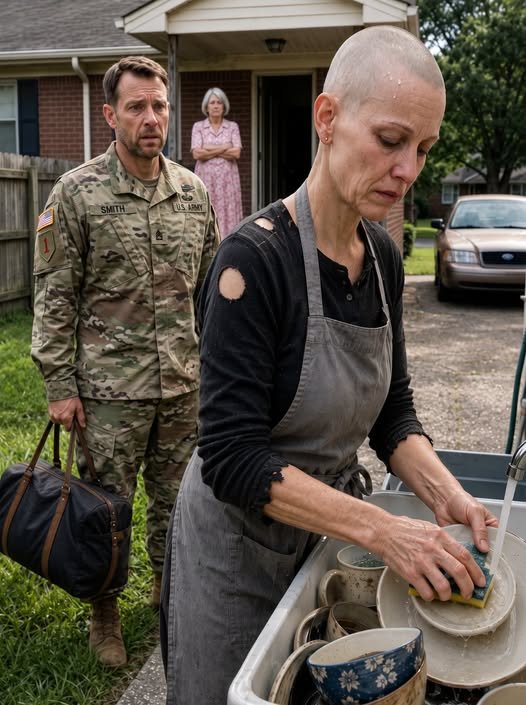
Because kneeling in the mud beside a rusted washtub was a woman I almost didn’t recognize — thin as a coat hanger, wearing clothes three sizes too big for her, a knitted cap pulled low over her head despite the ninety-degree heat, picking broken pieces of a shattered plate up out of the dirt with shaking hands.
It took me three full seconds to understand that woman was my wife.
PART 2
A voice shrieked from an open window before I could say a word.
“That bald woman shouldn’t even be out here when we have guests!”
My younger sister, Brooke. I would have known her voice anywhere, even after four years and one continent between us.
Maren froze.
Her shoulders went rigid, like she’d been struck.
Then she turned and saw me standing at the corner of the house, and I understood, finally, why she hadn’t come running the way I’d imagined for four straight years.
She didn’t cry out my name. She didn’t reach for me.
She stumbled backward into the mud, both hands flying up to grab the cap on her head, like she needed to hide before I got close enough to really see her.
That reaction scared me more than anything I’d faced overseas.
I dropped my duffel bags where I stood and walked to her. She didn’t fight me when I reached up and gently lifted the knitted cap away.
Her head was shaved down to bare skin. Small, angry cuts scattered across her scalp, the kind you get from a razor used too fast, by hands that weren’t being careful.
Behind me, the back door opened.
My mother, Vivian, stepped out onto the porch in silk and gold jewelry, like she was hosting a garden party instead of standing three feet from a woman who looked like she hadn’t eaten a real meal in weeks. Brooke trailed behind her, thumbing through a brand-new phone, a designer bag hanging off one shoulder.
Neither of them looked happy to see me.
They looked inconvenienced.
“She did this to herself, Nathan,” Vivian said, no shame anywhere in her voice. “Ruined her hair with some cheap drugstore chemical, and then got it into her head that she needed to starve herself, too. We’ve tried to talk sense into her.”
Brooke laughed. Actually laughed. “She burns through your money on nonsense and then acts like the whole town owes her sympathy for it.”
Maren said nothing. She stared at a spot on the ground somewhere near my boots and reached up to pull the cap back over her head, her hands trembling.
That’s when her sleeve slid down her arm and I saw it. A clean white bandage taped over the crook of her elbow, and beside it, the fading purple bruise of an IV line that had clearly been there for days.
I felt something in my chest go white-hot.
Four years in the Army had taught me exactly one thing about liars: the moment they know you’re onto them, they stop talking, and they start covering their tracks instead. So I did the hardest thing I have ever done in my life. I smiled.
“Actually,” I said, keeping my voice easy, almost cheerful, “I came home early because I’ve got incredible news.”
I told them my final combat pay and disability back-pay had cleared — nearly $400,000, landing in my account any day now.
It wasn’t true. Not one word of it.
But I needed to see what my mother and sister would do with a lie that size, because a person who’s been telling the truth all along doesn’t light up over money that was never theirs to spend.

PART 3
Vivian’s whole face changed in about two seconds.
“We could finally finish the upstairs properly,” she said, already pacing the porch, already spending it in her head.
Brooke clapped. “A second truck. Hawaii, finally. I am done wearing last season’s everything.”
Neither of them asked why Maren couldn’t stand up straight.
Neither of them asked about the bandage on her arm.
I stood there and watched my own mother and sister build an entire vacation itinerary in front of a woman who looked like she hadn’t slept in days, and something in me went very quiet and very cold. That’s the version of me that made it through four years overseas. The version that doesn’t react in the moment. The version that watches, and waits, and remembers everything.
That night, once the house had gone dark and the lights upstairs finally clicked off, I went looking for my wife.
I checked our old bedroom first. Empty, untouched, made up like a hotel room nobody had slept in for years. Her side of the closet was gone entirely — not moved, just gone, like someone had needed the space for something else.
I checked both guest rooms next. One had been turned into what looked like a walk-in closet for Brooke, shelves of shoes still in their boxes. The other held exercise equipment with the tags still on.
Nothing that looked like it belonged to my wife.
I finally found her in a storage room off the laundry area — no window, no real bed, just a thin mattress laid straight on the concrete floor between stacked cardboard boxes and a broken lawnmower missing a wheel. The smell of bleach and mildew hung in the air.
My wife had been sleeping in a closet.
I sat down next to her on the cold floor, and for a long moment neither of us said anything. She reached over once and touched my hand, like she needed to check I was real.
Then she looked around the little room, checking the door twice, like she needed to be sure we were really alone before she said whatever she was about to say.
“Nathan,” she said quietly. “There’s something I never got the chance to tell you. Something I tried to tell you a hundred times and never could.”
Her hands were shaking as she reached for the top button of her blouse.
She undid the second button.
A long, red surgical scar ran across her chest, still healing at the edges.
PART 4
“I have stage three cancer, Nathan.”
Her voice cracked on the word three. Tears filled her eyes, but she kept talking anyway, like she’d been holding this in so long it all had to come out at once or not at all.
“They found the tumor almost five months ago. At the free clinic downtown, during a routine exam I almost didn’t go to.”
Five months.
I did the math without meaning to. Five months was almost exactly when Vivian had started forwarding me those cheerful updates about the “home renovations coming along nicely” and how “everyone’s doing just fine, don’t worry about a thing over here.” I had read those messages in a tent with dust in my teeth and felt, every single time, a small wave of relief. I had thanked her for them. I had actually thanked her.
Five months of me writing her letters about our future. Five months of her lying awake on a concrete floor with a diagnosis she couldn’t afford to fight, one wall away from a family that called her ungrateful.
She told me she’d begged my mother for $300 — just $300 — to see a specialist two towns over, the only oncologist within driving distance who was taking new patients. Vivian had refused outright, and worse, had accused Maren of faking an illness just to steal my deployment pay for herself.
Brooke had gone through Maren’s phone while she slept. Deleted numbers one by one. Blocked contacts from my unit. Made sure Maren couldn’t reach anyone who might actually help her, couldn’t reach me, couldn’t even call her own sister two states away without Brooke finding out and taking the phone entirely.
Every dollar I’d sent home for four years had been sitting in accounts Maren wasn’t even allowed to see, let alone touch.
So she’d done the only thing she had left to do.
She took a pair of kitchen scissors to her own hair one night in the bathroom, alone, and sold it the next morning to a wig maker downtown for $150.
That $150 paid for a round-trip bus ticket and a biopsy.
That biopsy was the only reason she was still alive to tell me any of this at all.
I held her against my chest for a long time, not trusting myself to speak. When I finally did, I told her to hang on just a little longer, because I was about to fix everything, whatever it cost.
But the man who said those words wasn’t the same one who’d left four years earlier hoping for a quiet, ordinary life.
I stayed awake on that concrete floor long after Maren finally fell asleep against my shoulder, listening to the floorboards creak above us — my mother and sister, sleeping soundly in a house my sacrifice had paid for, one wall away from the woman they’d nearly let die rather than spend three hundred dollars on her.
Before the sun came up, I got up as quietly as I could and started opening drawers in the study down the hall.
In an unlocked desk, behind a stack of unopened junk mail, I found a folder Vivian clearly hadn’t expected anyone to go looking for.
Bank statements. Wire transfer confirmations. And underneath all of it, folded small, Maren’s actual medical bills — the ones she’d apparently hidden here herself, terrified of what would happen if my mother found them first.
Proof. Real, undeniable proof, sitting in my hands before seven in the morning.
PART 5
I spent the next four hours at that desk with a legal pad, a calculator, and a pot of coffee I made myself so nobody upstairs would hear the machine running.
By the time the sun was fully up, I understood exactly how deep this went.
The $100,000 I’d sent home hadn’t gone into our joint account at all — not most of it. Vivian had opened a second account at Maple Grove Bank two weeks after I deployed and set up an automatic transfer that skimmed a fixed seventy percent off the top of every wire before it ever touched the account Maren could actually access.
Four years. Forty-eight separate transfers. Every one of them dated, documented, and authorized with my mother’s own signature.
The truck in the driveway: $61,000, paid in cash the same month Maren said she’d first felt the lump under her collarbone.
A ring on Brooke’s finger I hadn’t recognized: $8,200, financed the same week Maren was refused her $300 consultation.
None of it was carelessness. None of it was a misunderstanding, the way Vivian would later try to frame it.
I called Maple Grove Bank at nine sharp and asked to speak to a branch manager, gave my name and my Power of Attorney status on the joint account, and asked her to walk me through the account history line by line. She hesitated at first — until I mentioned the words federal allotment and elder account holder not the servicemember. Then she went quiet in a different way.
“Sergeant Reyes,” she said carefully, “I want to be honest with you, because this account has actually been flagged twice internally for unusual activity. Once eighteen months ago, and again four months ago, for withdrawal patterns that didn’t match the account’s stated purpose. Both flags were cleared after your mother provided a letter claiming she had your written authorization.”
“I never wrote her one,” I said.
There was a long pause on the line.
“Then you may want to speak with our fraud department directly,” she said. “And likely a federal prosecutor. This isn’t a small case, Sergeant.”
She pulled up two more things before we hung up. A cashier’s check for $14,000, issued to Brooke directly, memo line left blank, dated the same week Maren’s biopsy results came back. And a wire reversal — an attempt, three months earlier, by someone using Maren’s name to move $300 out of the joint account into a separate consultation fund. The reversal request had been filed and approved within four hours, signed by Vivian, citing “unauthorized activity, dependent not permitted independent transfers.”
Maren had tried. She had actually tried to move the money herself, once, and my mother had personally shut it down in an afternoon.
That call confirmed the one detail that reframed everything I thought I understood. The very first transfer into that second account was dated two weeks after my deployment orders came through — months before Maren ever felt a single symptom, before there was anything at all to hide behind.
My mother hadn’t started stealing because Maren got sick.
She’d started the moment I left the country, and Maren’s illness had simply handed her a story to hide behind once the money started running out in places people might notice.
I sat with that for a long time.
Stolen money, I could get back. A stolen four years of my wife’s life, spent hiding a death sentence in a storage closet, was something nobody could ever give either of us back.
I put the folder in my jacket, walked out to my truck, and called the Military Legal Assistance Office first. Then the county Sheriff’s Department. Then, on the legal office’s direct recommendation, a federal prosecutor who specialized in fraud against military allotments and dependents.
Every one of them wanted to see the folder in person, that same morning.
I told them to come to the house.
Then I went back inside to wait for my mother to wake up.

PART 6
Vivian came down the stairs a little after nine, dressed like she had somewhere important to be, holding a thin stack of papers pressed against her chest like a shield.
“Nathan, dear,” she said, setting the papers on the granite counter with a satisfied little smile. “Since you’ll be so busy readjusting to civilian life, I had our family lawyer draw up a power of attorney. I’ll manage the four hundred thousand for you, so you don’t have to worry about a single thing.”
Brooke wandered in behind her, already scrolling through car listings on her phone, not even bothering to look up.
“Yeah, Nathan. Mom’s handled everything else while you were gone. It only makes sense she’d handle this too.”
I looked down at the papers. Then back up at both of them.
“You really think I came home blind,” I said. Quiet. Flat.
Vivian blinked, caught off guard by the tone. “What on earth are you talking about? We are only trying to help you—”
“Where did the hundred thousand go, Mom?”
Silence.
“The money,” I said again, stepping closer to the counter. “Four years of it. For Maren, for our future. Where is it?”
“I already told you!” Brooke snapped, finally looking up, stepping in beside our mother like she needed backup. “That sick leech spent it wasting her own hair and starving herself for attention! You should be thanking us for putting up with her this long!”
“Don’t,” I said, and something in my voice made her actually stop talking mid-sentence.
I set the folder down next to Vivian’s papers and opened it. Bank statements. Wire transfers. Forty-eight of them, signed in my mother’s own handwriting, spread across the granite counter she’d paid for with money meant to keep my wife alive.
“I went through the whole house last night,” I said. “Your desk. Your accounts. Maren’s actual medical records — the ones you hid from her so she couldn’t even prove what was wrong with her own body if she ever tried to get outside help.”
Vivian’s face lost every trace of color.
“You diverted every dollar I sent home for four years,” I said. “You bought a truck. Jewelry. And when my wife found a tumor in her own chest and begged you for three hundred dollars to see a doctor, you called her a liar and let her sleep in a storage closet.”
“Nathan,” Vivian stammered, both hands out now, reaching for me. “Listen to me. She’s not really family. She was turning you against us this whole time. We’re your real family. Blood is blood.”
“My wife,” I said, “cut off her own hair with kitchen scissors and sold it for a hundred and fifty dollars just to find out if she was going to live. While she froze on a concrete floor, you slept upstairs in silk sheets I paid for with combat pay.”
Brooke started backing toward the hallway, phone still in hand. “Mom — tell him he’s wrong. Nathan, you cannot talk to us like this, not after everything we—”
“After everything you what?” I said. “After everything you did for her? Name one thing. One meal you brought her. One ride to a doctor’s appointment. One single afternoon you spent making sure she was still breathing instead of counting how much longer you’d have to wait for my next deposit to clear.”
Brooke didn’t answer that. She looked at Vivian instead, like she expected our mother to have a script ready for this part too.
Vivian didn’t have one.
PART 7
“I’m not just talking,” I said, pulling my phone out of my pocket. “I spent this morning on the line with the Military Legal Assistance Office, the Sheriff’s Department, and a federal prosecutor who handles fraud against military dependents and allotments.”
I checked the screen.
“They should be pulling into the driveway right about now.”
Red and blue light washed across the front windows before either of them could get another word out.
Vivian’s hand shot out and grabbed my forearm, nails digging into my sleeve.
“Nathan, please. I’m your mother. You cannot do this to your own mother. Think about our family’s name, what people will say—”
I looked down at her hand until she finally let go on her own.
“My family,” I said, “is in the back room. And today, I’m finally taking care of her the way I should have been able to this whole time.”
Two deputies came through the front door with a warrant built entirely on the documents I’d handed over that morning, plus the bank’s own internal flags going back eighteen months. It took less than ten minutes from the moment they stepped inside to the moment both women were in handcuffs.
Vivian sobbed the entire way to the cruiser, insisting there had been a terrible misunderstanding, that she had only ever wanted to help, that surely a judge would see reason.
Brooke didn’t say anything at all. She just stared down at the phone still clutched in her hand, like it might somehow undo the last hour if she looked at it long enough.
Neighbors came out onto their own porches to watch two women in silk and gold jewelry get folded into the back of a sheriff’s car in broad daylight, on a street where everyone had always assumed the Reyes family had it all figured out.
One of the deputies, an older guy with a name tag that read Halvorsen, stopped next to me on the porch steps before he got back in his car.
“You did the right thing calling this in yourself,” he said. “Most families wait until somebody else finds out and forces their hand. You didn’t wait.”
I didn’t have a response for that. I just nodded.
I didn’t stay to watch the cruiser pull away. I’d already turned back toward the house, my mind somewhere else entirely.
I walked down the hallway to the storage room, opened the door slowly so it wouldn’t startle her, and knelt down beside Maren where she lay curled on that thin mattress.
For a moment, neither of us said anything.
Then I lifted her off that concrete floor, carried her out of the dark room and down the hallway, and didn’t stop walking until we were both standing outside in full daylight, the sun on both our faces for the first time in what felt like years.
PART 8
I buckled her into the passenger seat of my truck myself, the way you’d handle something fragile you were terrified of dropping.
“Where are we going?” she whispered, eyes wet, searching my face like she still wasn’t sure any of this was actually happening.
I leaned across the seat and kissed the top of her bare head.
“The best cancer center in the state,” I told her. “I already called this morning. And I moved my deployment funds into a trust in your name alone — not my mother’s account, not a joint account either of them can ever touch again. Yours.”
That was the real decision. Not the arrest. Not the sirens in the driveway. Not even the moment I opened that folder at four in the morning with the whole house asleep around me. The decision was this: every dollar I had earned overseas, all $100,000 already sent and every cent still coming to me, was going toward Maren’s treatment and nothing else. Not the family house. Not my mother’s legal defense. Not a lawyer to help Brooke keep whatever job she still had left after this.
I knew exactly what that decision was going to cost me.
It cost me the house I grew up in, which would sit empty for months while the state sorted out what could legally be seized as restitution.
It cost me my mother, permanently. Not because a judge would eventually decide that for me, but because I had already decided it myself, sitting on a concrete floor at three in the morning with my wife asleep against my shoulder.
It cost me the version of my family I had spent four years overseas believing still existed, the one I used to describe to the guys in my unit during long, quiet watches.
I signed the paperwork releasing the trust two days later, sitting in a hospital parking lot while Maren was inside getting blood drawn for her very first appointment with a real oncologist. My hand didn’t shake once while I signed it.
Some things are worth more than a mother’s forgiveness. I learned that on a concrete floor, and I never once doubted it again.
Maren didn’t say much when I told her what I’d done with the money. She just reached over, in the hospital waiting room, and laced her fingers through mine, the IV tape still fresh on the back of her hand.
“You didn’t have to give up all of it,” she said quietly.
“Yes,” I told her. “I did.”

PART 9
The federal case moved faster than I expected, mostly because the paper trail was so complete it barely needed a prosecutor to build the argument from scratch.
Vivian was charged with wire fraud and financial exploitation of a dependent, for systematically diverting military allotment funds meant for her son’s spouse. Brooke was charged as an accessory, for the deliberate isolation alone — the blocked calls, the confiscated phone, months of preventing a sick woman from reaching anyone who might have actually helped her in time.
Neither of them made bail at the first hearing.
I sat two rows behind the prosecution’s table, not because I needed to watch them suffer, but because Maren asked me to be there so she wouldn’t have to sit through it herself. She still couldn’t manage more than twenty minutes in a hard courtroom chair without getting lightheaded. Chemo does that to a person.
I sold the truck Vivian had bought with stolen money and put every dollar of it straight toward Maren’s out-of-pocket treatment costs. I signed a lease on a small two-bedroom apartment twelve miles from the hospital, close enough that on her worst days, I could carry her from the car to the front door myself without either of us having to say anything about it.
It wasn’t the house with the iron gate and the untouched leather furniture.
It didn’t need to be.
The restitution hearing came four months in. Vivian’s lawyer argued for a reduced sentence based on her age and lack of prior record. The judge wasn’t especially moved — she pointed out, reading directly from the transfer records, that this wasn’t an isolated lapse in judgment but a sustained pattern spanning nearly four years, carried out against a servicemember’s spouse while he was deployed overseas. Vivian was ordered to pay full restitution and received thirty-two months. Brooke’s plea deal came with eighteen months and a restitution order of her own, tied specifically to the $14,000 cashier’s check and the ring she’d financed.
I didn’t feel triumphant sitting in that courtroom. Mostly I just felt tired, in a way four years of deployment had never actually made me feel.
Some nights, sitting in that small apartment listening to Maren finally sleep without flinching at every sound from the hallway, I thought about how much simpler this all could have been. One phone call. One three-hundred-dollar consultation. That’s all it would have taken to avoid almost everything that came after.
Nobody in that house had been willing to make it.
PART 10
Six months later, Maren’s oncologist told us the tumor had shrunk enough that surgery was finally on the table as a real option, not just a stopgap.
Her hair had started growing back in soft, dark, uneven patches across her scalp — stubborn, patchy, and somehow the most beautiful thing I had seen in five years.
She still keeps the knitted cap from that first day in the mud, folded in the top drawer of our dresser. Not because she needs it anymore. She says it reminds her what she survived before I even knew there was anything to survive.
Vivian pled guilty rather than risk a trial and a longer sentence. Brooke took a plea deal for eighteen months. Neither of them has called, not once, not even on Maren’s surgery date, which I’d half expected someone to at least mention.
I don’t expect them to call now, either.
Some nights I still think about the man who walked around the side of that house after four years overseas, so sure he was finally about to be handed the life he’d spent every mile of that deployment dreaming about.
He was wrong about almost everything he thought he’d built.
He was right about the one thing that actually mattered.
Some evenings, Maren and I sit out on the small concrete step behind our apartment, nothing like the wraparound porch on the house with the iron gate, and she tells me it’s her favorite place in the world anyway. I believe her. I’ve stopped assuming a bigger house means a safer one.
Maren is still here.
That’s the whole story.