
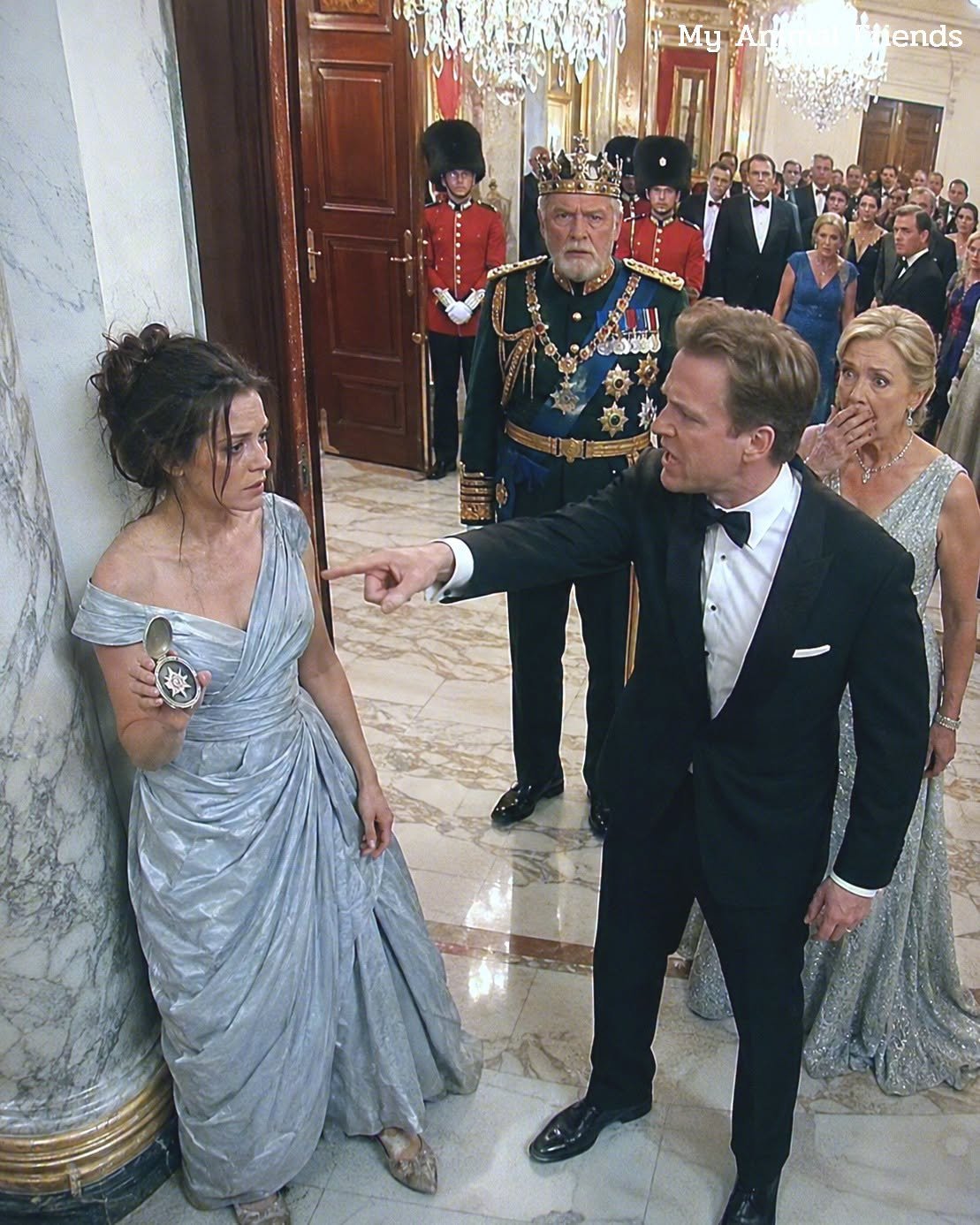
“Before His Majesty discusses Madeleine’s identity, there is something this firm must hear about Mr.Smith.”
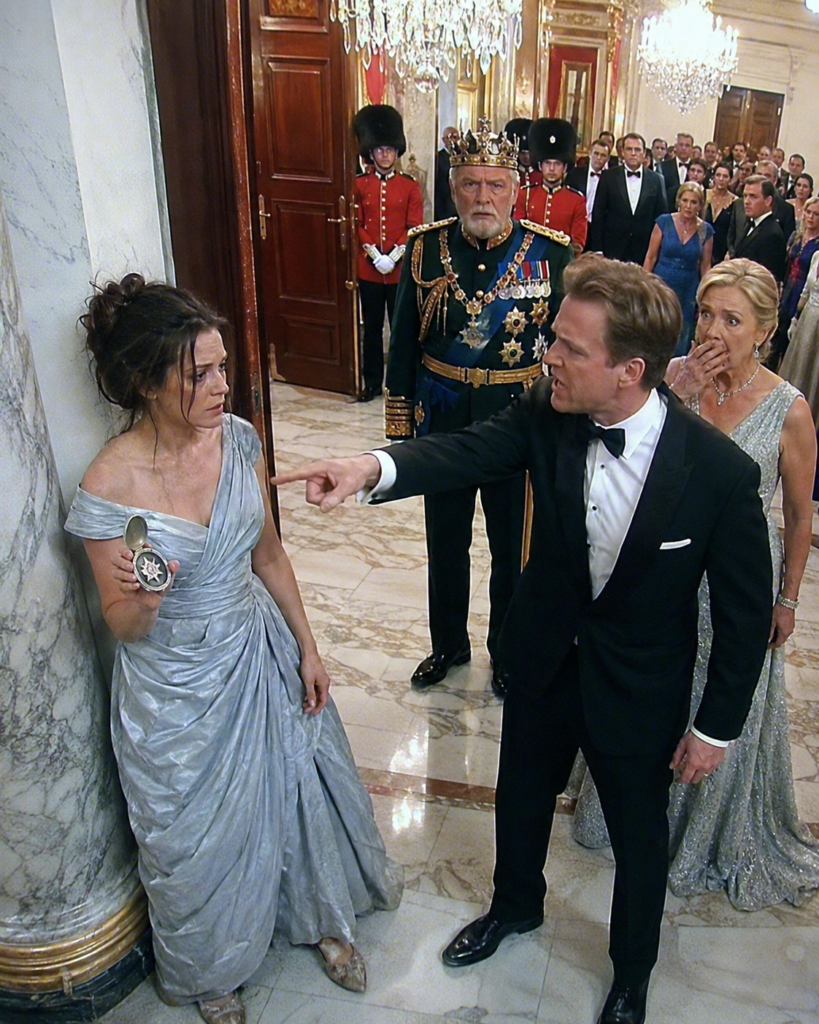
The king’s chief counsel, a silver-haired woman named Celeste Armand, placed the second envelope beside Madeleine’s open locket.
No one in the ballroom moved.
Bradley stood several feet away, his hand still half raised from the moment a royal guard had stopped him from grabbing his wife.
The confident smile he had worn while approaching King Leopold had vanished.
Sweat shone along his hairline.
“This is absurd,” he said.
“My wife is a nurse from Seattle.
Her mother died when she was a baby.
She grew up in foster care.
Whatever resemblance you think you see—”
“I know where she grew up,” the king interrupted.
His voice was not loud, but it silenced the room.
He held the tiny portrait that had been hidden inside Madeleine’s locket.
The image showed her mother, Elena Ward, standing beside a much younger Leopold in the dark green uniform of Oak Haven’s royal guard.
Elena was smiling at the camera.
Leopold was looking at her.
On the back, in faded handwriting, were the words: For Elena and our little star.
Madeleine stared at the picture as though the floor beneath her had disappeared.
“You knew my mother?” she whispered.
Leopold looked at her for a long moment.
The face of a reigning monarch seemed to fall away, leaving only an aging man confronted by a grief he had carried for nearly three decades.
“I loved your mother,” he said.
“And until six weeks ago, I believed you had died with her.”
A murmur passed through the ballroom.
Cameras lifted behind the velvet press barrier, but Celeste motioned to the royal security team.
Guards immediately blocked the reporters’ view and ordered every camera lowered.
Bradley took advantage of the distraction.
“Madeleine, we are leaving,” he said sharply.
“You are exhausted, and these people are taking advantage of you.”
He moved toward her again.
Madeleine did not retreat.
For years, Bradley’s tone had been enough to make her question herself.
It had followed her through their penthouse, through family dinners, and into every apology she offered for working too late, earning too little, or failing to look polished after saving someone’s child.
That night, for the first time, his command sounded small.
“No,” she said.
One word.
Bradley stopped.
Celeste opened the first folder.
Inside were copies of hospital records, foster-care documents, letters, and photographs protected in clear archival sleeves.
“Twenty-nine years ago,” she explained, “His Majesty was Crown Prince Leopold.
He spent a year in Seattle while completing an international diplomatic program.
During that time, he met Elena Ward, a graduate student working at the university library.
Their relationship was private but serious.”
Leopold’s gaze remained on Madeleine.
“I intended to marry her,” he said.
“My father became gravely ill, and I was summoned home.
Elena was pregnant.
I left believing she would follow within a month.”
She never arrived.
Letters from Elena were intercepted by Leopold’s private secretary, Alaric Voss, a man devoted to protecting the monarchy from scandal.
Voss sent Elena money and threats in the royal family’s name.
He warned that if she came to Oak Haven, she would lose her child.
To Leopold, Voss delivered a different story.
“He told me Elena had changed her mind,” Leopold said.
“Then, several months later, he gave me a death notice.
He said she and our infant daughter had died during an influenza outbreak.”
Madeleine’s fingers closed around the edge of the table.
“My mother did die from an infection,” she said.
“But I was eighteen months old.”
Celeste nodded.
“Voss altered the dates and suppressed the surviving-child record.
After your mother’s death, you entered the Washington foster system under her surname.
The palace never knew you existed.”
“How did you find me now?”
“Voss died earlier this year.
Under Oak Haven law, the private archive of a senior royal officer is opened after death and reviewed for state records.
We found Elena’s letters in a sealed case.
Every one of them had been returned unopened.”
Celeste slid one across the table.
Madeleine recognized her mother’s name immediately.
She had seen it only a few times in her thin foster file.
The envelope was addressed to Leopold.
Across the front, someone had stamped it undeliverable.
Inside, Elena had written about a baby girl with dark hair who calmed whenever music played.
She had included a photograph of Leopold holding that baby beside a hospital window.
Madeleine lifted the photograph.
The infant was wearing the same silver locket.
Her knees weakened.
Leopold reached out but stopped before touching her, as though he understood that being her father did not yet give him the right.
“I began searching the day we found those letters,” he said.
“The foster records led us to Seattle.
Your name appeared on the spouse list for this gala three days ago.
I came tonight because I needed to see you myself before the press or the court learned anything.”
“You were looking for me before you entered the ballroom?”
“Yes.”
Madeleine looked toward Bradley.
Only minutes earlier, he had ordered her into a service elevator because he feared the king might see her.
The cruelty of the irony seemed to reach everyone at once.
Vanessa Reed, the daughter of the firm’s founding partner, lowered her champagne glass.
Several junior attorneys exchanged uneasy looks.
The waiter Bianca had intimidated stood beside a column, watching in stunned silence.
Bianca recovered first.
“Surely a locket and several old letters prove nothing,” she said.
“Madeleine has always been imaginative about her background.
We have tried to be patient with her.”
Madeleine turned slowly.
Bianca’s expression changed when she realized that the invisible orphan she had mocked was now the center of the room.
“You called it a cheap trinket,” Madeleine said.
“I had no idea what it was.”
“You spilled champagne on me.”
“It was an accident.”
The waiter drew a breath.
“No, ma’am,” he said.
Bianca looked at him in disbelief.
The young man’s hands trembled, but he continued.
“You stepped into Mrs.
Smith and tipped the glass toward her.
When I said you bumped her, you told me not to correct you.”
Another guest spoke from behind him.
“I saw it too.”
Then Vanessa Reed stepped forward.
“And I heard Bradley tell Madeleine to use the service elevator,” she said.
“He said she did not belong here.”
Bradley’s face hardened.
“This is a private marital misunderstanding,” he said.
“It has nothing to do with the firm or His Majesty’s portfolio.”
Celeste touched the second envelope.
“That is where you are mistaken.”
She removed a printed copy of the statement Bradley had prepared for the press before Madeleine arrived.
Due to a sudden medical issue, Mrs.
Smith was unable to attend tonight’s gala.
The firm’s managing partner, Charles Donovan, read it twice.
“You drafted a false medical statement about your wife?”
“It was a contingency plan,” Bradley replied.
“The royal engagement was too important to risk disruption.”
“You intended to have staff distribute this?”
Bradley glanced toward the communications director, silently demanding support.
She gave him none.
“Mr.Smith sent it to my team this afternoon,” she said.
“He instructed us to release it if his wife appeared tired, emotional, or improperly dressed.”
A low sound of disbelief moved through the partners.
Madeleine had known Bradley was ashamed of her.
She had not understood how carefully he had planned her disappearance.
Celeste produced one final page.
“Mr.Smith also sent a memorandum to the royal delegation describing himself as uniquely qualified to protect the dignity, discretion, and vulnerable family members of the House of Oak Haven.”
Leopold looked at Bradley.
“Is this how you protect vulnerable family members?”
Bradley’s mouth opened, but no answer came.
The king’s anger was controlled, which made it more frightening.
“You insulted a nurse for arriving late because she was saving a child,” Leopold continued.
“You allowed your mother to humiliate your wife in public.
You prepared a lie about her health and attempted to remove her through a service entrance.
Then you approached me and asked for control of my family’s assets.”
“Your Majesty, I did not know who she was.”
The words escaped before Bradley understood what he had admitted.
The ballroom became perfectly still.
Madeleine looked at him.
“That is the point,” she said.
Bradley’s face tightened.
“Maddie, do not do this.
Everything we have built—”
“You built your career,” she replied.
“I built a marriage around it.
Tonight you showed me there was never room for me inside either one.”
He lowered his voice.
“Think carefully.
These people will leave.
I am your husband.
I am the person who stayed when no one else wanted you.”
For years, that had been his sharpest weapon: the suggestion that loving an orphan had been an act of charity.
Madeleine felt the old wound open, but it no longer controlled her.
“You did not rescue me,” she said.
“I worked nights to pay our rent while you finished law school.
I covered your health insurance.
I believed in you before anyone in this room knew your name.
Do not rewrite my loyalty as your sacrifice.”
Vanessa looked down.
Charles Donovan’s jaw tightened.
Bradley turned to the king, desperate now.
“There is no proof she is your daughter.
Not legal proof.
Anyone can write a letter.
Anyone can place a photograph in a locket.”
Leopold nodded once.
“You are correct.”
For a fraction of a second, hope returned to Bradley’s face.
Then the king continued.
“Which is why I brought Oak Haven’s royal physician and an independent American geneticist.
Madeleine will decide whether she wishes to take a DNA test.
No one will compel her.”
Every gaze shifted toward her.
Leopold spoke gently.
“You owe me nothing.
You may walk away tonight, and I will protect your privacy.
But if you want the truth, the test can begin now.”
Madeleine looked at the photograph of herself as a baby.
Then she looked at the letters her mother had written and the locket she had carried through foster homes, nursing school, hospital nights, and seven years of marriage.
“I want the truth,” she said.
The physician collected cheek swabs from Madeleine and Leopold in a private conference room adjoining the ballroom.
The independent laboratory had mobile equipment on-site because the royal delegation had anticipated the need for discreet verification.
A full legal report would require additional testing, but an initial kinship analysis could be completed that evening.
While they waited, the gala dissolved into tense clusters of whispered conversation.
Bradley attempted to enter the conference room twice.
Both times, royal security refused him.
On his third attempt, Charles Donovan stopped him.
“You are done approaching her tonight.”
“I am her husband.”
“At this moment, you are also a partner who may have jeopardized the largest engagement in this firm’s history through conduct that half our clients are about to see reported in the press.”
Bradley glanced toward the reporters.
Their cameras were lowered, but their eyes were alert.
“The king’s people cannot suppress this forever,” Charles continued.
“And neither can we.”
“You are taking her side because you think she is royal.”
“No,” Charles said.
“I am taking note of how you treated her when you believed she was powerless.”
Bianca approached Madeleine near the balcony doors.
Her earlier contempt had transformed into nervous sweetness.
“This has all become terribly dramatic,” she said.
“Families say things in stressful moments.
You know I have always wanted what was best for you and Bradley.”
Madeleine studied her.
“You told me orphans should know when they are tolerated.”
Bianca’s smile trembled.
“A poor choice of words.”
“It was an honest one.”
“You cannot throw away seven years of marriage because of one difficult evening.”
“This evening did not create the problem,” Madeleine said.
“It revealed it.”
Bianca’s eyes flicked toward the king.
“Bradley could be useful to your father.
He understands international law.
He has contacts.
With the right guidance, the two of you could become one of the most influential couples in Europe.”
There it was.
Not an apology.
A calculation.
Madeleine stepped back.
“Please do not speak to me again tonight.”
Bianca’s face went rigid, but a royal guard moved closer, and she walked away.
King Leopold joined Madeleine on the balcony.
Below them, the city shone through a misting rain.
“I do not expect you to call me Father,” he said.
“I do not expect forgiveness for years I cannot return to you.”
“Did you ever question what Voss told you?”
The king did not hide from the question.
“Not enough.
I was twenty-six, grieving my father, and surrounded by people who told me duty required obedience.
I searched for Elena for several months, but Voss controlled every inquiry.
Eventually, I accepted the evidence he gave me because accepting it was easier than continuing to hope.”
“I spent my childhood hoping someone was looking for me.”
Leopold closed his eyes briefly.
“I am sorry.”
It was not a royal statement.
It contained no excuse.
Madeleine believed his regret, but regret could not erase birthdays in foster homes, school forms with blank spaces where parents’ names belonged, or the night she graduated from nursing school with no family in the audience.
“I need time,” she said.
“You will have it.”
The balcony door opened.
Celeste stood there holding a sealed laboratory packet.
Madeleine’s heart began to pound.
They returned to the ballroom.
Leopold insisted that the result be read with Madeleine’s permission and no press present.
The reporters were escorted to the lobby.
Staff closed the oak doors.
The geneticist broke the seal.
“The preliminary analysis shows a 99.9997 percent probability of a biological parent-child relationship between Leopold Alexander Matthias of Oak Haven and Madeleine Elena Ward Smith.”
No one breathed.
Then Leopold bowed his head.
Not as a king greeting a subject, but as a father overwhelmed by confirmation.
“My daughter,” he whispered.
Madeleine pressed one hand over her mouth.
She had imagined finding a distant cousin, an old neighbor, perhaps a forgotten photograph.
She had never imagined that the unanswered half of her life would walk into a ballroom surrounded by guards.
Bradley pushed through the circle of partners.
“Madeleine, this changes everything,” he said.
She looked at him.
His expression was no longer ashamed.
It was hungry.
“We need to speak privately,” he continued.
“There will be legal implications, security issues, media strategy.
As your husband, I should coordinate with the palace.”
Celeste’s eyes cooled.
“Mrs.Smith has independent counsel available should she request it.”
“She does not need independent counsel.
I am her attorney.”
“You are not,” Madeleine said.
Bradley stared at her.
“You have never represented me.
You have managed me.
There is a difference.”
“Do not make a decision while emotional.”
Madeleine reached for the folded press statement he had written to erase her from the gala.
She placed it in his hand.
“You decided I was a medical inconvenience before I entered this room.
You told me I was a liability.
You said I did not belong beside you.”
“I was under pressure.”
“And pressure revealed you too.”
She removed her wedding ring.
The movement was calm, almost clinical.
It was the same steadiness she used when alarms sounded in the ICU and everyone else panicked.
She set the ring on top of Bradley’s false statement.
“I will have an attorney contact you.”
Bradley’s face reddened.
“You would destroy our marriage over one argument?”
“No.
I am ending it after years of being told that my work, my history, and my presence embarrassed you.
Tonight was simply the first time you said it where witnesses could hear.”
Charles Donovan stepped beside Bradley.
“The executive committee will meet tomorrow morning.
Until then, you are suspended from all client activity.
Turn over your access card before you leave.”
“You cannot suspend a senior partner in the middle of a gala.”
“I just did.”
Bradley looked toward the other partners for support.
None came.
The same people who had laughed at his cutting jokes and admired his ruthless ambition now avoided his eyes.
They had not suddenly become courageous.
They had simply seen that his cruelty could cost them something.
Madeleine noticed the difference.
She would remember it.
King Leopold did not award the royal portfolio to another lawyer that night.
Instead, he postponed negotiations and ordered a full ethical review of every firm under consideration.
Bradley later claimed that Madeleine had ruined his career, but the executive committee’s report told a simpler story: he had jeopardized a major client, authorized a false public statement, bullied staff, and demonstrated catastrophic judgment.
Within a month, he was no longer a partner at Pierce, Donovan and Reed.
The divorce took longer.
Bradley alternated between apologies, accusations, and promises that he had changed.
When those failed, he argued that Madeleine’s new status had transformed her into someone cold and disloyal.
Her attorney answered with financial records showing how much of their early life Madeleine had supported.
Witness statements from the gala established the pattern Bradley preferred to deny.
The settlement was fair, private, and final.
Bianca sent three handwritten letters.
Madeleine returned each unopened.
Recognition in Oak Haven required more than one dramatic evening.
Additional laboratories confirmed the DNA result.
Courts authenticated Elena’s letters and the chain of custody surrounding the locket.
Parliament reviewed succession law, though Madeleine made clear that she was not seeking a throne.
Six months after the gala, King Leopold publicly recognized her as his daughter.
He offered her a palace apartment, a royal staff, and a place beside him at state ceremonies.
Madeleine accepted none of them immediately.
Instead, she returned to St.
Jude’s Memorial for her next scheduled shift.
The first morning back, a seven-year-old patient asked why photographers were standing across the street.
“They are confused,” Madeleine said, adjusting his blanket.
“About what?”
“About what makes someone important.”
She continued nursing three days a week.
With funding from Oak Haven and her own settlement, she established the Elena Ward Foundation, supporting foster children entering adulthood and families with children in intensive care.
She insisted that the foundation provide practical help—housing deposits, tuition, transportation, meals, and mental-health care—rather than ceremonial galas.
Leopold visited Seattle quietly.
He sat in the hospital cafeteria, learned how to drink terrible vending-machine coffee, and listened when Madeleine described the life he had missed.
Their relationship did not heal in one speech.
It grew through small acts.
He remembered the anniversary of her mother’s death.
She sent him photographs from the pediatric ward.
He showed her Elena’s letters, one at a time, never asking her to read more than she could bear.
A year later, Madeleine traveled to Oak Haven.
At the palace gates, she saw the lion holding a solitary star carved into the stone—the same crest she had carried against her heart through every foster home.
Leopold waited on the other side without cameras or officials.
Madeleine touched the silver locket.
For most of her life, it had represented a question.
Now it represented a woman who had tried to protect her, a father who had failed to find her but had chosen to earn his way back, and a truth no one could use to make her feel small again.
Leopold offered his arm.
Madeleine did not take it immediately.
Then she smiled, not because she had become a princess, and not because a king had rescued her.
She smiled because she finally understood that she had never been invisible.
Bradley had simply been too blinded by status to recognize the worth standing beside him.