
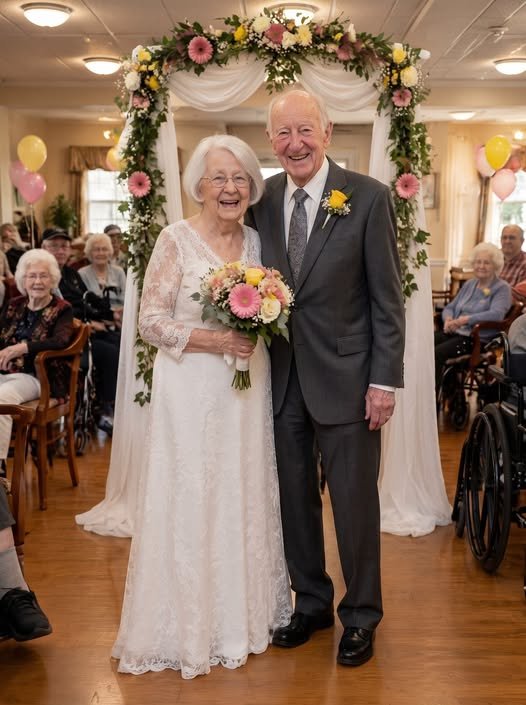
At seventy-eight, I married the wealthy widower who lived six floors above me — not for his money, but to keep his grown children from deciding how he’d spend his last days. We had two good years together before he died holding my hand. At his funeral, his children looked at me like I’d robbed a grave. Seven days later, his lawyer laid a sealed envelope on the table between us. Inside was a photograph I hadn’t seen since I was seven years old — and a secret that undid everything I thought I knew about the man I married.
The Envelope
“Sit down, Margaret,” Mr. Grant said. “Please. Before you open this.”
I didn’t sit. I’d spent two years learning to read Walter’s lawyer’s face, and I didn’t like what I saw on it now.
Between us, on the polished table of his office, sat a cream envelope sealed with a disk of red wax. My name was written across the front in handwriting I would have known anywhere.
Walter’s handwriting.
Walter had been dead for eight days.
“Is this about the estate?” I asked. “Because I already told his children — they can have the money, the furniture, the cars, all of it. I never married him for any of that.”
“All three of them have filed suit to void your marriage,” he said. “They’re claiming their father was incompetent when he married you. That you manipulated a dying man.”
I almost laughed. “He beat me at chess three nights before he died.”
“I have four independent evaluations proving he was lucid to the end. That’s not what worries me.” He nudged the envelope an inch closer to me. “This is.”
To understand why my hands were shaking before I’d even touched it, you have to go back two years — to a chessboard under an oak tree, and a man I thought I finally understood.
I had lived in the east wing of Cedarbrook for six years before I met him. State-funded. Two women to a room, a cafeteria that served the same gray chicken on rotation, a pension that stretched exactly as far as the rent and not one dollar further.
Walter Bennett lived six floors above me, in the penthouse suite, with a private chef and nurses who came whether he rang for them or not. Eighty-two years old. A widower, like most of us. Shipping money, people said. Old money that had gotten older.
We met over a chessboard in the courtyard, under the same oak tree every Tuesday and Thursday. He brought imported tea in a thermos shaped like nothing I’d ever owned. I brought a folding chair with a torn seat cushion. Neither of us mentioned the difference.
“They aren’t interested in me,” he told me once, watching his three children’s names light up his phone and go unanswered. “They’re waiting for what I’ll leave behind.”
When his heart started failing that spring, they showed up with lawyers instead of flowers. They wanted power of attorney. They wanted to decide which treatments he’d get and which he wouldn’t.
He was terrified they’d shorten what time he had left to save what they’d inherit.
“Marry me,” he said, one Thursday, with the chessboard between us and his queen already in danger. “Not for love, if you don’t want to call it that. So they can’t touch me. So they can’t touch my choices.”
I said yes because I wanted him protected. I told myself that was the whole truth, and for two years, it was.
He brought me upstairs, into the penthouse, into the six-floor view he’d had all along. We read to each other in the evenings. We watched the sun go down from his balcony more times than I could count, and every single time, he reached for my hand before it finished setting.
When he died, I was still holding it.
At the funeral, his children stood on the other side of the grave and didn’t speak to me once. I caught them whispering. I caught Celia’s eyes moving over my coat, my shoes, doing arithmetic.
A week later, I was sitting across from his lawyer, staring at an envelope with my name in a dead man’s handwriting, and being told to sit down before I opened it.
“What is it?” I asked.
“A confession,” Mr. Grant said. “And instructions. I’d read it now, if I were you. His children have filed for an emergency injunction. They’ll be here with it by five o’clock.”
I broke the wax.
The Photograph
Two things were inside. A folded letter in Walter’s hand, and a photograph so old its corners had gone soft as cloth.
The photograph came first, and it made no sense.
It showed a much younger Walter — thirty, maybe — standing outside a municipal building somewhere with brick the color of rust. A dark-haired woman stood beside him. A little girl, no older than three, stood in front of them both in a yellow raincoat, clutching a small red doll against her chest.
The woman was not Diana. I had seen enough photographs of Diana, Walter’s wife of forty years, to know that much on sight.
The doll was the part that stopped my breath.
I had owned a doll exactly like it. Red yarn hair, a chipped painted smile, a dress my grandmother had sewn from a flour sack. I had buried it under a willow tree when I was seven years old, the week after my mother disappeared and never came home.
“This has to be someone else’s photo,” I said. “This has to be a mistake.”
“Read the letter, Margaret.”
My name, in his hand, at the top of the page. I had seen this handwriting on grocery lists and love notes and the margins of library books he underlined too much. I had never once seen it shake the way it shook on this page.
My dearest Margaret,
I told you the truth about how I made my fortune — commercial shipping, forty years of it. I never told you what it cost me to start.
Your mother’s name was Rose. You were three years old when I left.
I stopped there.
I had to stop there.
My grandmother told me my father died in a factory accident before I could walk. That was the whole story I’d been given, and I had built seventy-eight years of a life on top of it — foster placements, then state care, then thirty years shelving returns at the county library on a salary that never once cracked forty thousand dollars, then this room, this pension, this cafeteria chicken.
While six floors above me, the man in that story had been alive the entire time.
Eating dinner cooked by a private chef.
Playing chess with me on Tuesdays.
I made myself keep reading.

What the Letter Said
Diana’s father offered me a place in his shipping company. The condition was that I sever every connection to my past — completely, permanently. I chose the money. I chose Diana. I left you and your mother behind, and I told myself it was the only way either of us would survive.
I set aside a trust for you before I left. Your grandmother’s attorney emptied it within six months. I didn’t learn that until decades later, and by then I’d convinced myself finding you would only hurt you worse.
I spent forty years with Diana. We raised Adrian, Celia, and Thomas together, and I gave all three of them everything money could purchase. I never once taught them to want anything else. That failure is mine.
After Diana died, and my own health started failing, I hired someone to trace your pension records. That’s how I found this building. I chose Cedarbrook because you were already living in it.
I set the letter down. Picked it back up.
Even the courtyard had been a plan. Even the chessboard, the thermos, the Thursday afternoons.
I was afraid that if I told you the truth outright, you’d walk away from me — and I couldn’t survive that twice. So I waited under that oak tree with a chessboard and the tea I remembered your mother liking. I told myself I only wanted a few afternoons with my daughter before I died. I didn’t expect to fall in love with the woman she’d become.
Asking you to marry me wasn’t only about the courts. It was the only way I knew to make sure that when I was gone, what should have always belonged to you couldn’t be taken by the people I’d raised to expect it instead.
The shipping interests. The properties. The private accounts. Seventy-four million dollars, Margaret. Every cent of it grew out of the life I walked away from. I want it to go back to where it started.
Forgive me.
Your father,
Walter
I read it twice more before I trusted myself to speak.
“He knew the whole time,” I said. “From the beginning. He knew exactly who I was before he ever sat down across that chessboard.”
Mr. Grant nodded once. “His investigators spent almost six months confirming it before he approached you. He watched you from that balcony for weeks before he found the nerve to come down.”
Grief and fury don’t usually arrive in the same body at the same moment. I can tell you now that they do.
He had wanted forgiveness. And he had built an entire architecture — a marriage, a fortune, two years of sunsets — specifically so he’d never have to survive the conversation where I might have said no.
They Came at Five
The doors to the suite opened before I’d folded the letter back into thirds.
Adrian came in first. Fifty years old, his father’s jaw, none of his patience. Celia was a step behind him, and two attorneys trailed both of them like they were being paid by the pound of paperwork they carried.
Celia looked around the room the way you’d look at something you’d stepped in.
“Still enjoying the penthouse,” she said. “Didn’t waste any time settling in, did you.”
Adrian stopped a foot from me.
“We filed an emergency motion with Judge Kessler this morning,” he said. “We’re challenging the marriage. We’re demanding a psychiatric competency review. You have thirty minutes to vacate this suite. Anything our father purchased stays exactly where it is.”
I thought about the last two years.
Adrian, visiting once every three months. Eight minutes at a time. Always with a question about tax shelters loaded and ready before he’d even sat down.
Celia, complaining about the smell of the antiseptic while her father struggled to sit upright in his own bed.
I folded Walter’s letter and set it in my lap.
“You could try showing your father some respect,” I said. “He’s been dead eight days.”
Adrian laughed. It wasn’t a real laugh.
“He was a confused old man, and you took advantage of that. A few chess games under a tree don’t buy you our inheritance.”
Mr. Grant opened his briefcase without hurrying.
“Your attorneys should read what I filed at eight o’clock this morning,” he said, “before anyone says the word ‘inheritance’ again.”

The Trust
“We already have an injunction against the primary trust,” one of the attorneys said.
“That trust was dissolved eighteen months ago,” Mr. Grant said. “Your father restructured his holdings while three independent neurologists documented his full mental competence, every step of the way.”
He set a stamped, bound document on the table.
“Seventy percent of Walter’s liquid assets. His shipping shares. His entire property portfolio. All of it moved into an irrevocable living trust eighteen months before his death.”
He looked at me when he said the next part.
“Margaret is its sole beneficiary.”
The attorney nearest Adrian flipped through the binder fast enough to tear a page. Then he leaned in and said something low against Adrian’s ear. I watched the color climb Adrian’s neck in real time.
“These assets never pass through the will,” Mr. Grant continued. “Your challenge to the marriage doesn’t touch a single dollar of them.”
“You stole what belonged to us.” Adrian’s voice cracked on the word stole.
“I took nothing from you,” I said. “Your father did every bit of this himself, with three doctors and a lawyer watching him sign it.”
I lifted the photograph so both of them could see it.
“And there’s something else he never told either of you. Before he was your father — he was mine.”
Before He Was Your Father
Celia went still.
She was staring at the girl in the yellow raincoat like she was trying to make the photograph say something different than what it said.
“That’s not possible,” she said. “Our mother was his only family. There was never anyone before her.”
“He left my mother and me so he could marry into yours,” I said. “I found out this afternoon. Same as you.”
One of the attorneys took Adrian by the elbow and pulled him half a step back, murmuring something about needing to review new evidence before either of them said another word that could be used against them later.
Adrian didn’t move right away.
He was looking at me now the way you look at a stranger’s face when you’ve suddenly noticed whose nose they have.
His father’s nose. My father’s nose.
He turned and walked out without answering. Celia followed him, and the attorneys followed her, and the suite doors closed on all four of them at once.
Mr. Grant let out a breath I hadn’t realized he was holding either.
“They may keep fighting this for a long time,” he said. “But the trust should hold against anything they file.”
I sat there, newly and unmistakably rich, and grieving a father I had not known existed until an hour ago.
Both of those things were true. I didn’t know yet how to hold them in the same two hands.

What I Chose to Keep
From the window, I could see the courtyard. Our table, under the oak tree. The chessboard was still out there, exactly where we’d left it two Thursdays ago, one of his rooks still standing where I’d left it mid-game.
I thought about the women two floors below me right now, eating the same gray chicken I used to eat, sharing rooms the way I used to share one, going to sleep in beds that weren’t quite theirs.
I had been one of them until eighteen months ago. I knew exactly how easily this world forgets a woman once her money runs out and her children stop calling.
Walter’s fortune couldn’t give me back a childhood, or a mother who came home, or thirty years of library shelves instead of a father six floors up. But it was mine now to decide what happened to it.
“Mr. Grant,” I said. “I want to start a foundation tomorrow morning. Call it the Walter and Rose Bennett Endowment.”
He got out his notes.
“Put fifty million dollars into a permanent trust,” I said. “Residential care, medical treatment, private nursing — for people living in the state-funded wings of this city’s nursing homes. People like I was.”
He looked up from the page. “Fifty million, Margaret. You could live anywhere on earth. Buy a house in the south of France and never think about a shared bathroom again.”
“I’m seventy-eight years old,” I said. “I don’t need another mansion. I need to know some other woman isn’t going to spend the last years of her life in a cold room, thinking nobody in the world remembers she exists.”
“And the rest of it?”
I touched the letter, still folded in my lap.
“Keep this suite open,” I said. “For residents who’ve never had a balcony to watch the sun go down from. Let them have it. Let them have that much, at least.”
The Game Is Over
That evening, I sat in Walter’s chair on the balcony and pulled his wool blanket over my knees. The air smelled like wet leaves and a rain that hadn’t started falling yet.
I read the letter one more time, all the way through, without stopping in the middle.
He had been a coward. He had spent forty years choosing a fortune over a daughter, and then he’d spent his last two years engineering a version of forgiveness that never once required him to survive my saying no to his face. I understood that clearly now, and understanding it didn’t make it hurt less.
But for two years, he had also listened to me the way almost no one ever had. He had learned exactly how I took my tea. He had read to me on nights when my hands ached too much to hold a book myself. He had reached for my hand every single evening before the sun finished going down, right up until the last one.
Forgiveness wasn’t going to make any of his choices right. I’m not sure, even now, that it’s supposed to.
But I found I could hold both afternoons — the ones I’d loved, and the ones I now knew had been staged — without one canceling out the other.
The sky over the courtyard was turning gold, then violet, the same as it had a hundred times before, with his hand in mine.
I folded the letter one last time and set it on the small table beside his empty chair.
“I forgive you, Walter,” I said, out loud, to no one. “Rest now.”
Six floors below, in the courtyard, his rook was still standing exactly where I’d left it, mid-game, waiting for a move that was never going to come.
I decided to let it stand there.
Some games, I’ve learned, you don’t have to finish. You just have to know, finally, who you were really playing against.