
Part 1 — The First Night I Found Him There
My eight-year-old son, Tyler, had always adored my mother.
When I was raising him alone and trying to hold together work, bills, school schedules, and everything else that came with being the only parent in the house, Mom quietly filled the spaces I couldn’t.
She packed Tyler’s lunch when my shifts started before sunrise.
She helped him study spelling words at the kitchen table.
She sat through school concerts that seemed to last forever and applauded as though Tyler were performing at Carnegie Hall.
Most importantly, she remembered things.
The name of the dinosaur he was obsessed with that month.
Which cereal he suddenly hated.
Which superhero had become his favorite.
The exact promise she had made him three weeks earlier about baking cookies on Saturday.
To Tyler, Grandma wasn’t simply my mother.
She was one of the safest people in his world.
So when her heart condition suddenly worsened, he took it harder than I expected.
The surgery itself went well, but recovery was slow.
The woman who had once carried three grocery bags in each hand now needed help getting down the stairs.
She tired after walking from one room to another.
Her medications made her groggy, and some days she slept through most of the afternoon.
I brought her home to stay with us while she recovered.
From the moment she arrived, Tyler appointed himself her personal assistant.
“Grandma, drink some water.”
Mom would lift the glass beside her bed.
“I have water.”
“You haven’t drunk any.”
She would look at me helplessly.
“Your child is bossier than you.”
Tyler would grin.
“I learned from the best.”
He brought her blankets before she asked.
Found her glasses when she misplaced them.
Reminded me when her medication alarm sounded.
Sometimes I would walk past her room and see him sitting on the edge of the bed, reading one of his comic books aloud while she rested with her eyes closed.
It warmed my heart.
After everything he had watched her go through, I thought helping her made him feel useful.
Then, one morning, I nearly tripped over him in the hallway.
“Tyler?”
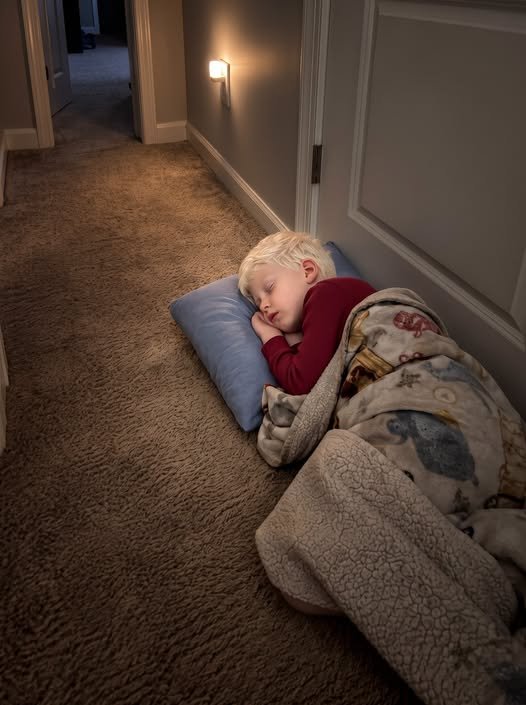
He was curled on the floor directly outside Mom’s bedroom.
His dinosaur blanket was twisted around his legs, and his pillow had been pushed against the wall beneath his head.
He blinked awake.
“What are you doing out here?”
He rubbed one eye.
“Nothing.”
“Nothing?”
I crouched beside him.
“You brought your pillow and blanket into the hallway.”
He looked toward Grandma’s closed door.
“I just wanted to be close.”
That answer made sense.
At least, I thought it did.
Tyler had seen someone he believed was indestructible become suddenly fragile.
Maybe he was afraid something would happen to her during the night.
I pulled him into a hug.
“Grandma is okay, sweetheart. I’m right across the hall.”
“I know.”
“You don’t need to guard her.”
He didn’t answer.
“Sleep in your own bed tonight, okay?”
After a moment, he nodded.
“Okay.”
The next morning, he was lying outside her door again.
That should have made me ask more questions.
Instead, I told myself I already knew the answer.
I thought my son was scared of losing his grandmother.
I had no idea he was scared of something else entirely.
Part 2 — Uncle Jason Starts Visiting
Around the same time, my younger brother, Jason, began coming over almost every day.
Jason was four years younger than me.
He owned a small contracting business and had always been the kind of person who believed there was almost nothing he couldn’t fix with enough confidence, tools, and charm.
He was impulsive.
Funny.
Sometimes irresponsible.
But family was family.
And after Mom’s surgery, he seemed genuinely determined to help.
He brought groceries.
Repaired the loose railing on our stairs.
Changed a light fixture I had been ignoring for months.
If I mentioned needing to run an errand, he immediately volunteered.
“Go. I’ve got Mom.”
At the time, I was grateful.
Exhaustion has a way of making help feel like a miracle.
I was caring for my mother, raising Tyler, working, managing medications, preparing meals, and trying to pretend I wasn’t terrified that one wrong thing could send Mom back to the hospital.
So when Jason offered to take some weight off my shoulders, I let him.
I even gave him a spare key.
With Mom recovering in my house, having another family member who could get inside in an emergency seemed sensible.
One afternoon, I grabbed my purse.
“I’ll only be gone twenty minutes.”
Jason waved me toward the door.
“Stop worrying. I’ve got her.”
“You know where her medication is?”
“Yes.”
“And if she gets dizzy—”
“I call you.”
“And—”
He laughed.
“Go, Mom Number Two.”
I rolled my eyes and left.
It wasn’t until several days later that I started noticing Tyler’s behavior around him.
Whenever Jason went upstairs, Tyler somehow found a reason to go upstairs too.
If Jason sat beside Mom’s bed, Tyler suddenly appeared holding a drawing Grandma absolutely needed to see at that exact moment.
If Jason offered to stay with Mom while I ran to the store, Tyler—who normally loved errands with me—announced that he wanted to stay home.
At first, I thought he was being possessive.
Grandma had always been his person.
Maybe he didn’t like sharing her attention.
Then one Saturday afternoon, Jason picked up a cup of tea and started toward the stairs.
Tyler stood immediately.
Jason stopped halfway up.
“You coming too?”
Tyler nodded.
Jason laughed.
“What are you now, her personal bodyguard?”
He reached down and ruffled Tyler’s hair.
Tyler didn’t smile.
Not even a little.
Something about his face bothered me.
Later, I found him alone in the living room.
“Tyler.”
He looked up.
“Uncle Jason is helping Grandma.”
“I know.”
“You don’t have to follow him every time he goes near her.”
His eyes dropped to the carpet.
“I’m not.”
“You are.”
Silence.
I crouched in front of him.
“If Grandma needs anything, she can call me. Uncle Jason loves her too.”
Tyler’s lips pressed together.
“He isn’t bothering her.”
Finally, he looked at me.
“Okay, Mom.”
There was something strange in his voice.
But I was tired.
I had already decided what his problem was.
So instead of asking what he was trying to tell me, I asked him to stop.
That night, he slept outside Grandma’s door again.
Around midnight, I found him there and carried him back to bed.
At two in the morning, I checked again.
He had returned to the hallway.
That was the first time I wondered whether his fear had become serious enough that I needed to find him a counselor.
Then Thursday night came.
And everything I thought I understood changed.

Part 3 — The Whisper at 4 A.M.
A little after four in the morning, I woke to the sound of someone talking.
At first, I assumed it was Mom.
Sometimes her medication made her restless.
I stayed still for a moment.
Then I heard another whisper.
It came from the hallway.
I slipped out of bed and opened my door.
Tyler was lying outside Grandma’s room beneath his dinosaur blanket.
But he wasn’t asleep.
His eyes were wide open.
He was staring directly at the bedroom door handle as though waiting for it to move.
One hand gripped his pillow.
I was about to speak when he whispered,
“I won’t fall asleep tonight.”
I froze.
Then, so quietly I almost thought I had imagined it, he added:
“I won’t let Uncle Jason do it to Grandma again.”
Every trace of sleep disappeared from my body.
“Tyler?”
He jumped.
His blanket slid to the floor.
I hurried toward him.
“What did you just say?”
His eyes filled with tears so quickly that terror shot through me.
“Nothing.”
“Tyler.”
He shook his head.
I sat beside him.
“Look at me.”
He wouldn’t.
“What won’t you let Uncle Jason do again?”
His mouth began trembling.
“Mom, promise you won’t tell anyone.”
Every terrible possibility a parent can imagine seemed to enter my mind at the same time.
My heart started pounding so hard I could hear it.
I forced my voice to remain calm.
“What did he do?”
Tyler covered his face with both hands.
Then he leaned toward me and whispered something I never would have guessed.
“Uncle Jason keeps making Grandma sign things when you’re not home.”
For a few seconds, I simply stared at him.
“Sign things?”
He nodded.
“What things?”
“I don’t know.”
“Tyler, what does he make her sign?”
“Papers.”
My stomach tightened.
“What kind of papers?”
“I don’t know, Mom.”
He wiped his cheeks.
“He brings them in a folder.”
“How do you know?”
Tyler hesitated.
Then he whispered,
“Because I saw him.”
Part 4 — What Tyler Had Been Trying to Tell Me
The first time it happened, Tyler said, he had been sitting in Grandma’s room reading.
Jason came upstairs carrying a folder.
When he saw Tyler, he told him to go downstairs.
“So I went,” Tyler said.
I nodded.
“But then I came back.”
“Why?”
His face crumpled with guilt.
“I didn’t like the way he told me to leave.”
That sentence made my chest tighten.
My eight-year-old had noticed something I had completely missed.
Tyler hadn’t gone back into Grandma’s room.
Instead, he hid near the landing where he could hear them without being seen.
Jason had placed papers on Mom’s blanket.
Tyler even imitated his uncle’s voice.
“It’s just so I can help with everything while you recover.”
I felt cold.
“What did Grandma say?”
“She kept asking him where she was supposed to sign.”
“Was she awake?”
Tyler hesitated.
“Kind of.”
Those two words frightened me more than anything else he had said.
Mom was taking medication that sometimes left her groggy and confused.
“Did she read the papers?”
“I don’t think so.”
“What happened?”
“She signed a bunch of places. Then Uncle Jason folded everything really fast.”
I stood up without realizing I had moved.
“Was there anything else?”
Tyler suddenly started crying harder.
“He came back at night once.”
I looked down at him.
“What?”
“You were sleeping.”
“When?”
“I don’t know. Last week, maybe.”
“How did he get inside?”
Tyler looked confused by the question.
“With his key.”
Of course.
The key I had given him.
“Why didn’t you wake me?”
The second I asked, Tyler’s face changed.
And before he answered, I knew I was going to hate myself.
“Because you told me to stop following him.”
I felt as though someone had struck me.
Tyler wiped his nose against his sleeve.
“I thought you’d get mad.”
“Oh, sweetheart…”
“He went into Grandma’s room and told her she’d signed something in the wrong place.”
I looked at the pillow on the floor.
Then the blanket.
Then my little boy sitting there trying desperately to stay awake.
“Is that why you’ve been sleeping outside her door?”
Tyler nodded.
“I tried to watch.”
His voice broke.
“I thought if I stayed awake, he couldn’t do it again.”
For days, I had believed Tyler was having an irrational fear.
In reality, he had been trying to protect the adults in his life.
And every time he tried to show me, I had told him there was nothing to worry about.
The guilt was almost unbearable.
But there was no time to sit inside it.
Not yet.
I opened Mom’s bedroom door and turned on the lamp.
She startled awake.
“What happened?”
“Mom, I need to ask you something.”
She pushed herself slowly upright.
“At four in the morning?”
“Has Jason been bringing you documents?”
Her forehead creased.
“What documents?”
“Papers to sign.”
Something changed in her face.
Not recognition exactly.
Unease.
“I don’t know.”
“Please think.”
She closed her eyes.
“Maybe… some forms.”
“What forms?”
“I think something from the bank.”
My stomach dropped.
“Why would Jason bring you bank forms?”
Mom looked genuinely confused.
“He said he was helping me.”
That was the moment fear became certainty.
Something was wrong.

Part 5 — The Phone Call That Changed Everything
As soon as morning came, I called Denise.
She was our longtime family attorney and had handled my father’s estate years earlier.
I barely finished explaining before she interrupted me.
“Do not confront Jason.”
“But—”
“Not yet.”
Her voice was firm.
“Bring your mother. Bring any financial paperwork you can find. Come to my office.”
By 8:30 that morning, Mom, Tyler, and I were sitting in Denise’s conference room.
I had brought folders, bank statements, insurance documents, anything I could locate.
Tyler sat beside me with his feet not quite touching the floor.
He looked exhausted.
He should have been thinking about cartoons or breakfast.
Instead, he had spent the night guarding his grandmother from his uncle.
I reached down and squeezed his hand.
Denise sat across from Mom.
“I’m going to ask you some very specific questions.”
Mom nodded.
“Did you knowingly give Jason permission to access or manage your bank accounts?”
“No.”
“Did he explain that any documents you signed could give him authority over your money?”
Mom’s expression changed.
“No.”
“You’re certain?”
“Yes.”
Denise leaned back.
“All right. We’re calling the bank.”
The call lasted less than twenty minutes.
It felt like an hour.
Jason had submitted paperwork requesting access to more than one of Mom’s accounts.
Some requests were still pending.
One had already gone through.
He had successfully been added to an account.
Mom sat beside me staring at the speakerphone.
“Why would he do that?”
Her voice sounded smaller than I had ever heard it.
I didn’t know what to say.
I wanted to believe there was some explanation that could put our family back together.
Some misunderstanding.
Some good intention hidden beneath bad paperwork.
Deep down, I already knew better.
That afternoon, the answer walked through my front door carrying another folder.
Jason smiled when he saw me in the kitchen.
“Hey. Where’s Mom?”
“Upstairs.”
Then his eyes landed on Denise’s business card sitting on the table.
His smile disappeared.
I pointed toward a chair.
“Sit down.”
He stared at me.
“What happened?”
“Sit.”
For once, he didn’t argue.
He lowered himself into the chair.
I placed copies of the paperwork in front of him.
“Explain this.”
His face turned pale.
“It’s not what you think.”
“What do I think?”
“I was helping Mom.”
“Helping her by getting access to her bank accounts?”
He rubbed his jaw.
“Come on.”
“No. You come on.”
My voice was shaking now.
“Why did you need access to her money?”
He looked away.
And suddenly, the answer became obvious.
“How much?”
His eyes lifted.
“How much money did you need?”
Silence.
“Jason.”
He swallowed.
“Twenty.”
I stared at him.
“Twenty what?”
“Thousand.”
My hands went cold.
Part 6 — The Truth Jason Had Been Hiding
His business was failing.
That was what he finally admitted.
Two major jobs had fallen through.
Clients were late paying invoices.
Suppliers were waiting.
Equipment payments were overdue.
He was desperate.
“Mom has money sitting there,” he said quietly. “I would’ve paid it back.”
I stared at him.
“You asked her before, didn’t you?”
His face changed.
“Before the surgery.”
He looked down.
“Yes.”
A voice came from behind me.
“You did.”
We both turned.
Mom was standing near the staircase, one hand holding the railing.
“Mom—” Jason began.
She started down slowly.
I moved to help her, but she shook her head.
She wanted to do this herself.
When she reached the kitchen, she looked directly at her son.
“You asked me for money before my surgery.”
Jason stared at the table.
“And what did I tell you?”
He remained silent.
Mom waited.
Finally, he whispered,
“You said no.”
“Yes.”
Her voice was calm.
Almost painfully calm.
“I said no.”
Jason rubbed his forehead.
“I was desperate.”
“So after I said no, you waited until I was weak, medicated, and recovering in bed.”
“I didn’t plan it that way.”
“You brought papers into my bedroom.”
“I thought—”
“You told me they were so you could help me.”
“I was going to pay it back.”
Mom’s voice sharpened.
“That was not your decision.”
Jason slammed his palm onto the table.
The sound made all of us jump.
“Because I’m tired of always being the failure!”
Silence filled the kitchen.
His eyes turned toward me.
“She’s always the responsible one.”
Then toward Mom.
“When you got sick, I thought maybe I could finally do something useful.”
Mom frowned.
“You were useful.”
Jason laughed bitterly.
“You don’t understand.”
“No,” she said. “I think I do.”
His eyes filled.
“My business was collapsing. Everyone thinks I have everything under control. I didn’t know how to tell anyone.”
“So you tried to control my money instead?”
He looked down.
“I asked you for help.”
Mom didn’t move.
“Yes.”
“And you said no.”
“Yes.”
“I didn’t know what else to do.”
She stared at him for a long time.
Then she said quietly,
“When someone tells you no, Jason, their answer does not stop mattering because you are desperate.”
He had no response.
Because there wasn’t one.
He could explain fear.
He could explain embarrassment.
He could explain his failing business.
None of it changed what he had done.
He had asked.
Mom had refused.
Then he waited until she was physically vulnerable and tried to get around her answer.
That wasn’t help.
And desperation didn’t turn it into help.
Part 7 — The Person I Owed the Biggest Apology
With Denise’s help, Mom revoked every authorization she hadn’t knowingly given.
The bank opened a review.
I took Jason’s spare key.
Mom’s financial documents were moved somewhere secure.
And Jason was no longer allowed to be alone with her.
Those were the practical things.
The emotional damage was harder.
Mom spent days trying to understand how one of her own children had convinced himself that violating her trust was somehow justified.
Jason kept saying he had intended to repay everything.
Mom kept answering the same way.
“That isn’t the point.”
And she was right.
But while the adults were sorting through bank forms, attorneys, anger, and betrayal, I couldn’t stop thinking about Tyler.
That night, I went into his bedroom.
He was lying under the dinosaur blanket that had spent so many nights in the hallway.
I sat beside him.
For a moment, neither of us said anything.
Then I said,
“I owe you an apology.”
He looked at me.
“I should have listened.”
His fingers picked at the edge of the blanket.
“I tried to tell you.”
“I know.”
“I tried a lot.”
My throat tightened.
“I know.”
He looked toward the door.
Then back at me.
“I tried to tell you without telling you.”
That sentence stayed with me.
It still does.
Because adults often ask children why they didn’t speak sooner.
Why didn’t you just tell me?
Why didn’t you say exactly what happened?
Why did you act strange instead?
But children don’t always speak in adult sentences.
Sometimes they follow someone from room to room.
Sometimes they stop wanting to leave the house.
Sometimes they sleep on a hallway floor with a pillow in their hands because they don’t know how else to protect someone they love.
Sometimes they say, “I just want to be close,” because the real explanation feels too big and frightening to say out loud.
Tyler had been speaking.
I simply hadn’t understood his language.
“I need you to know something,” I told him.
He waited.
“If something ever feels wrong, even if you can’t explain why, you can tell me.”
“What if I’m wrong?”
“Then we’ll figure it out together.”
“What if you think I’m being annoying?”
My chest hurt.
“I would rather hear something ten times than miss the one time you really need me.”
He thought about that.
Then he nodded.
“Okay.”
I bent down and kissed his forehead.
That night, for the first time in what felt like forever, Tyler stayed in his own bed.

Part 8 — The Empty Hallway
A few nights later, I woke before sunrise.
For a moment, I didn’t know why.
Then I realized I was listening for something.
I opened my bedroom door.
The hallway outside Mom’s room was empty.
No dinosaur blanket.
No pillow.
No small boy trying to fight sleep.
I stood there looking at the bare floor longer than necessary.
Tyler was sleeping peacefully in his own bed.
Because for the first time in weeks, he believed someone else was watching.
An adult.
His mother.
Me.
Mom’s recovery continued slowly.
Physically, she grew stronger every week.
Emotionally, things were more complicated.
Jason eventually called.
He asked if he could come over.
Mom did not immediately say yes.
Instead, she told him something I was proud of her for saying.
“Rebuilding trust happens on my terms, not yours.”
When he eventually visited, he came without groceries.
Without tools.
Without a folder.
He sat in the living room and apologized.
Not the kind of apology that starts with I’m sorry, but…
Not the kind that demands immediate forgiveness because the person saying it feels uncomfortable.
He apologized.
Mom listened.
Then she told him she wasn’t ready to forgive him.
Jason nodded.
That was probably the first useful thing he did in the entire situation.
He accepted her answer.
No argument.
No persuasion.
No attempt to change her mind.
Just acceptance.
Months passed.
Mom became stronger.
She could walk downstairs without gripping the railing.
She started making her own tea again.
She complained when I tried to carry things for her.
In other words, she slowly became herself.
But something about all of us had changed.
We listened differently.
Especially when Tyler spoke.
Part 9 — “Ask Me First”
One Saturday afternoon, I walked into the kitchen and found Mom and Tyler sitting at the table surrounded by paperwork.
Bank statements.
Insurance forms.
Medical documents.
Tyler had the extremely serious expression of an eight-year-old who had been given an important job.
Mom pulled out a brand-new folder.
Then she took a thick black marker and wrote across the front in enormous letters:
ASK ME FIRST.
Tyler started laughing.
“Grandma!”
“What?”
“That’s huge.”
“Good.”
She capped the marker.
“I want people to be able to read it from the driveway.”
Tyler laughed again.
Then Mom handed him the marker.
“Your turn.”
“For what?”
“Add something.”
Tyler looked at the folder.
Then at Grandma.
Then at me.
For a few seconds, his face became serious.
He lowered the marker and carefully wrote beneath her words:
AND LISTEN WHEN I SAY SOMETHING.
The kitchen went quiet.
Mom looked at the sentence.
Then at Tyler.
Her eyes filled.
I felt mine do the same.
Tyler glanced up at me.
Our eyes met.
He didn’t need to explain what he meant.
The first line belonged to Grandma.
The second belonged to him.
Maybe it belonged to every child who has ever tried to tell an adult something important without knowing exactly how to say it.
I walked over and wrapped my arms around him.
This time, I didn’t tell him everything was fine.
I didn’t tell him not to worry.
I didn’t tell him he had misunderstood.
I simply held him.
And listened.