
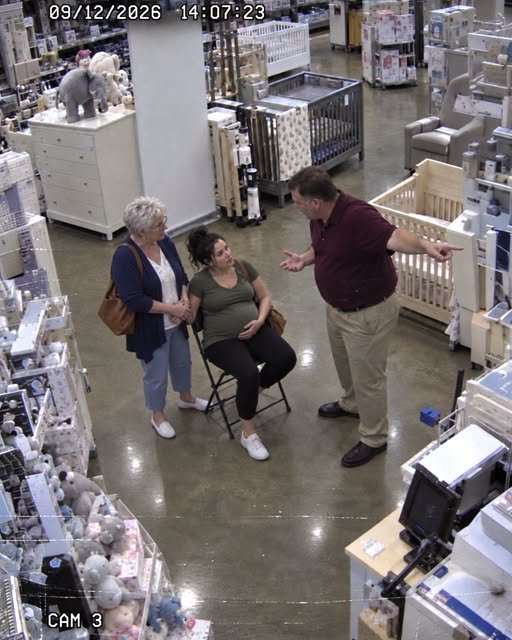
All my daughter wanted was five minutes off her feet. The manager decided the chair belonged to shoppers who looked like they’d spend more. Then the owner arrived, recognized us, and wanted to know how I’d come to be holding a receipt more than 30 years old.
Part 1: The Chair
My daughter, Isabella, was eight months pregnant the afternoon we went looking for a crib.
We’d been walking the furniture showroom for close to an hour when her hand closed around my arm.
“Mom, I have to sit.”
She said it softly, but I could hear how much it cost her.
“Of course, sweetheart.”
Just a few steps away, a padded chair sat beside a nursery display. A little card propped on the armrest read Please try me! I steered Isabella toward it.
She’d barely moved when a man in a charcoal suit stepped squarely into our path.
“That display is for customers.”
For a second, I was sure I’d misheard him.
“We are customers.”
His name tag said Store Manager. His gaze traveled down Isabella’s plain gray sweatshirt, then over my worn winter coat, and finally drifted to a polished young couple admiring a pricey bedroom suite across the aisle.
“They’re looking at the full collection,” he said.
Isabella pressed a palm beneath her belly. “I only need five minutes.”
He let out a sigh, as if she’d asked him to rearrange the entire floor.
“Customers come first.”
Isabella dropped her gaze to the carpet, and that stung more than anything he’d said.
She has never been one for scenes. As a little girl, she’d apologize when other kids bumped into her. And now she stood there looking ashamed, as though needing a chair while carrying a baby were something to be sorry for.
I stepped closer to him. “What’s your name?”
Before he could reply, an older salesman came around the corner with a folding chair tucked under his arm.
“Here you go, ma’am.”
He snapped it open and set it behind Isabella. She sank onto it with a grateful smile. “Thank you so much.”
The manager’s face went hard. “Frank, I’ve told you not to bring those out on the floor.”
Frank didn’t answer. He was looking at Isabella, and then at me, and something shifted in his expression.
He leaned in a little. “Mrs. Bennett?”
“I’m sorry, do I know you?”
Part 2: The Receipt
Before he could explain, the front doors swung open, and an elderly man in a dark wool coat came in from the cold.
The whole store changed in an instant. Shoulders squared. Conversations stopped mid-sentence. The manager took a quick step away from us.
“Mr. Callahan.”
So this was the owner. I recognized the name; it was spelled out in giant letters across the front of the building.
Mr. Callahan made his way through the showroom with a relaxed smile, nodding to staff as he passed. Then his eyes landed on Isabella perched on the folding chair.
The smile slipped. He looked at me, and he stopped walking.
For a long moment, neither of us said anything. His face tugged at something in my memory, but I couldn’t pin it down.
The manager rushed over. “Sir, just a small misunderstanding. They were blocking the—”
Mr. Callahan lifted a hand, and the manager fell silent.
His attention had dropped to the folder in my hand, where a yellowed slip of paper poked out from between the pages.
I’d brought that receipt on a whim. The cribs here had reminded me of the nursery set Thomas bought when Isabella was on the way, and I’d dug the receipt out of a box of old paperwork mostly for a laugh.
“Look at this,” I’d teased Isabella in the car. “Your father paid less for a whole nursery than you’re about to spend on a single crib.”
Thomas, my husband, had been gone six years.
Mr. Callahan reached out. “May I?”
I handed it over.
He studied the faded store name printed across the top, then the signature at the bottom. Then he turned it over, and his whole face changed.
On the back was a line of faded blue handwriting I’d hardly paid attention to. He read it without a word.
“Who gave you this?” he asked quietly.
“It was my husband’s.”
“Thomas?”
I nodded. “He passed away six years ago.”
Mr. Callahan shut his eyes. When he opened them again, he seemed to have aged a decade.
“What does it say?” I asked.
He turned the receipt so I could read it.
Thomas B. — I owe you more than furniture.
I looked from the words to his face. “Does that mean something to you?”
He nodded. Then he turned to the manager.
“Lock the front doors.”

Part 3: What Thomas Did
The showroom went dead quiet.
“Lock them?” the manager said. “Why?”
“Nobody’s being kept here,” Mr. Callahan said quickly. “I’d just like a few minutes without new customers walking in.”
He went over to the well-dressed couple himself, apologized for the interruption, and had an employee walk them to the register so they could finish their purchase.
Then he came back to me.
“Mrs. Bennett, your husband is the reason this company is still standing.”
The idea was so unexpected I nearly laughed. “Thomas?”
“Thomas.”
He gestured toward a grouping of display sofas. This time, no one objected when Isabella lowered herself onto one of them. Frank stayed close by.
Mr. Callahan held the receipt in both hands as if it might crumble.
“When I opened my first store, I thought sheer stubbornness would carry me through. It didn’t.” He gave a small, sheepish smile. “Inventory bills, rent, delivery trucks, payroll. The sales weren’t coming in fast enough. I was a few weeks from losing everything.”
I didn’t say a word.
“Your husband was in charge of furnishing a new housing development,” he went on.
That part I knew. Thomas had spent most of his career coordinating construction projects.
“Dozens of units. He could’ve spread the order around to several suppliers. Instead, he brought most of it to me.”
My husband had a gift for schedules, contractors, and spreadsheets. But he had never once mentioned any of this.
“It was a big order,” Mr. Callahan said. “Big enough to matter. But that isn’t what saved me.”
“Then what did?”
“He paid early.”
“Why would he do that?”
“The contract didn’t require payment for weeks. But Thomas could see I was drowning, so he had the first payment released right away.”
That sounded like him. Thomas always had a soft spot for small businesses.
Frank spoke up for the first time. “I remember that week.”
Mr. Callahan glanced over at him.
Frank gave a faint smile. “We were all wondering if our paychecks were going to clear.”
“Thomas’s money covered payroll, the rent, and a supplier bill that was long overdue,” Mr. Callahan said. “It bought me enough time for other orders to start coming in.”
I looked down at the receipt again. “He never said a thing.”
“I don’t think he did it to be thanked,” Frank said. “He did it because he was kind.”
I turned to him. “How did you know Thomas?”
“I worked at the original store. I met the two of you a few times.” He chuckled. “You probably don’t remember me. I had a lot more hair back then.”
In spite of everything, I smiled.
And then a memory floated up: a skinny young salesman helping Thomas load furniture samples into our old station wagon while baby Isabella fussed in her car seat. He’d shaken Thomas’s hand like they were old friends, and Thomas had insisted on buying him a coffee for his trouble.
“I think I do remember you.”
His grin widened. “It’s been over 30 years. It took me a minute, but I knew you.”
Mr. Callahan traced Thomas’s name with his thumb.
“I tried to pay him back. More than once.”
“That doesn’t surprise me.”
“He wouldn’t accept a thing. Kept telling me it was just business, that the project was moving ahead anyway, so why not pay early.”
A lump rose in my throat. It meant more than I could say to hear how quietly my husband had changed these people’s lives.
Mr. Callahan set the receipt gently on the table.
“I wrote those words on the back because it was the only thanks he’d let me give him.”
Part 4: The Reckoning
Then Mr. Callahan’s eyes moved to Isabella, and his voice hardened.
“Now would someone please explain why Thomas’s daughter was sitting on a folding chair in my showroom?”
The manager stepped forward. “It was a misunderstanding.”
“No,” I said. “It wasn’t.”
Every head turned toward me.
I told Mr. Callahan exactly what had happened. How Isabella had asked to sit. How the chair had a card inviting customers to try it. How the manager had planted himself between us and the display. How, when I told him we were customers, he’d looked us up and down and then glanced at the better-dressed couple.
And I repeated his words. “Customers come first.”
Mr. Callahan’s jaw tightened. He turned to Frank. “Is that what happened?”
Frank hesitated for only a second. “Yes, sir.”
The manager shook his head. “I was protecting a likely sale.”
“By keeping a pregnant woman out of a chair?”
“They were interested in the entire set.”
“And Mrs. Bennett and her daughter?”
The manager’s eyes flicked to my folder. “I had no idea what they planned to buy.”
“So you decided to treat them differently.”
His face flushed red. “I made a sales judgment.”
Mr. Callahan was quiet for several seconds. Then he looked around the showroom.
“We’re closing for an hour.”
The manager blinked. “Sir?”
“I want to talk to my staff.”
An employee went to hang a temporary closure sign on the door. Mr. Callahan turned back to us. “You’re welcome to go. You don’t have to stay for this.”
I looked at Isabella. She was tired, but there was a stubborn set to her chin now.
“I’d like to know if this happens to other people,” she said.
So we stayed.
At first, nobody wanted to talk. Mr. Callahan gathered everyone in the middle of the showroom and asked one simple question.
“Has this happened before?”
A young saleswoman lifted her hand halfway. “Not exactly like this.”
The manager shot her a look. Mr. Callahan caught it.
“Look at me when you answer,” he told her gently.
She swallowed. “He tells us to focus on customers who look ready to spend.”
Another employee nodded. “He calls them high-value customers.”
“Every retail business prioritizes strong leads,” the manager cut in.
Mr. Callahan didn’t even look at him. “What does ‘ready to spend’ look like?”
Silence. Then Frank answered.
“Designer clothes. Nice watches. Fancy cars in the parking lot.”
I felt Isabella shift beside me.
“He tells us not to waste time on people who ask a lot of questions about price,” someone else said.
“Or financing,” another voice added.
After that, the stories came one by one. An older couple who’d wandered the floor for 20 minutes before anyone approached them. A young father the manager had decided couldn’t afford a bedroom set. A woman in work clothes who’d been steered away from an expensive sofa, only to come back later and buy it from a different salesperson.
The pattern was impossible to ignore.
The manager kept trying. “I’m responsible for the sales numbers.”
Mr. Callahan faced him. “You’re responsible for the people who walk into this store.”
“I was trying to improve performance.”
“By deciding what a customer is worth before you’ve said a word to them?”
The manager looked at me. “I already apologized for the misunderstanding.”
“No,” Isabella said quietly. “You never apologized. You just explained why you thought you were right.”
I have rarely been prouder of her.
Part 5: A New Floor Manager
Mr. Callahan turned to Frank. “Why did you bring out that folding chair when you knew he’d forbidden it?”
Frank shrugged. “She looked like she needed to sit down.”
“You knew you’d get in trouble.”
“I’ve been in trouble before.”
A few of the employees grinned.
Frank looked straight at the manager. “I wasn’t about to leave a pregnant woman on her feet because somebody thought the chair looked nicer empty.”
Mr. Callahan nodded slowly. “That’s how every customer here should be treated.” He let his gaze rest on the manager. “We ought to know what our furniture is worth. But we’d better understand what it’s worth to treat every person who comes through that door with respect.”
He didn’t fire the manager in front of us. He simply asked him to wait in the office.
For the next 40 minutes, Mr. Callahan met privately with several employees. He went through written complaints that had apparently been piling up for months and asked pointed questions about the instructions his staff had been given.
Meanwhile, Frank walked Isabella and me through the nursery section. Eventually, she stopped in front of a simple wooden crib.
“This is the one.”
Frank smiled. “Good choice.”
When Mr. Callahan came back, he was alone, and he looked worn out.
“I’ve let him go.”
I didn’t know what to say. He seemed to understand.
“This isn’t because you’re Thomas’s widow,” he said. “What happened to you today just dragged a problem into the light. He was dismissed because of how he’s been running this store and treating customers and staff alike.”
I nodded. It seemed fair.
Then Mr. Callahan turned to Frank. “I need a floor manager.”
Frank actually laughed. “Me?”
“I’m completely serious.”
“I’m 67 years old.”
“And?”
“And people my age are supposed to be cutting back, not taking on more.”
“You’ve shown better judgment than the man who was running this floor. As far as I’m concerned, you’re already qualified.”
That got a laugh from everyone.
Frank shook his head. “I still want to work with customers.”
“Then work with customers.”
Frank thought it over. Finally, he pointed at the folding chair.
“Rule number one. Those stay out where people can reach them.”
Mr. Callahan smiled. “Deal.”
Frank held out his hand. “Then I’ll give it a shot.”

Part 6: The Rocking Chair
Afterward, Mr. Callahan joined Isabella and me beside the crib.
“So you’ve found the one?”
Isabella nodded.
“I’d like to give it to you.”
I shook my head right away. “No.”
He blinked. “Why not?”
I held up the old receipt. “We’re not taking it without paying. Thomas would hate that.”
“I’m not so sure he would.”
“I am.”
Mr. Callahan smiled in spite of himself. “He did love a good argument.”
“He treated it like a hobby.”
Isabella laughed.
I passed the receipt back to him. “Thomas helped you because he wanted to. Not so his family could cash it in 30 years later.”
He looked down at the note. “I’ve owed him all this time.”
“Then keep his kindness in everything you do. That’s all he would have wanted.”
For a moment, he looked crestfallen. Then Isabella touched my arm.
“Mom, look at that chair.”
Beside the crib stood a matching wooden rocking chair.
Mr. Callahan glanced at it, then at me. “Please. Let me give her that.”
I opened my mouth to protest.
“A gift,” he said softly. “From an old man who remembers her father.”
Isabella looked at me with such hope. Thomas would have been impossible about this.
I sighed. “The crib gets paid for like any other purchase.”
“Agreed.”
“And the chair is a gift.”
“In Thomas’s memory.”
“All right.”
Frank started writing up the order, then paused over the manufacturer’s label.
“Well, would you look at that.”
“What is it?” I asked.
He picked up the old receipt and held it beside the tag. “Same maker.”
It was true. The nursery furniture Thomas had bought for Isabella decades earlier had come from the very same company, and Isabella had chosen their crib without having any idea.
She ran her fingers along the arm of the rocking chair. “Dad would’ve loved that.”
I swallowed hard. “Yes, he would have.”
The chair was delivered to Isabella’s house two weeks before her due date. I went over to help her finish setting up the nursery, and when we were done, she went to put the kettle on.
I sat down alone in the rocking chair. The wood creaked softly beneath me.
And suddenly I could see Thomas as clearly as if he were leaning in the doorway. Thirty-two again, bone-tired after a long day, rocking baby Isabella against his chest because she flatly refused to sleep.
I had known that man for most of my life. Yet one old receipt had shown me there were still parts of him I’d never seen.
A struggling store had survived, in part, because Thomas decided someone deserved a little breathing room. Frank had remembered him all these years for treating a young salesman like an equal. Mr. Callahan had carried his gratitude for decades.
And none of us had known the whole story.
Isabella came back with two mugs of tea and saw my hand resting on the arm of the chair.
“You okay?”
I nodded. “Your father would’ve said this was all way too much fuss.”
She smiled. “Oh, definitely.”
I looked around the nursery. At the crib Isabella had paid for herself. At the rocking chair an old friend had given in Thomas’s memory. At my daughter, just days from becoming a mother.
Thomas never believed kindness needed an announcement. Maybe that’s why I was so surprised by how far it had traveled.
He’d helped save a business and never breathed a word about it. And decades later, that same quiet kindness had found its way back to his daughter.
Not as charity. Not as a debt repaid.
Just as a chair waiting beside a crib, ready for the next tired parent who needed to sit down.