
Part 1 — The Photograph That Made No Sense
For most of our marriage, I believed Dorothy and I told each other everything.
Maybe that sounds naïve now.
At the time, it simply felt like marriage.
We had been together long enough to know each other’s routines, silences, and moods. We had a nine-year-old daughter, Nancy, whose school projects somehow took over the dining room every other week, whose socks appeared in impossible places, and whose bedtime questions could turn a ten-minute conversation into forty-five.
Our life wasn’t glamorous.
It was ordinary.
Work.
School pickups.
Groceries.
Bills.
Saturday errands.
Sunday pancakes.
But it was ours, and I trusted it.
The only subject Dorothy consistently refused to discuss was her mother.
Whenever her mother’s name appeared on Dorothy’s phone, something changed in her face.
Once, years earlier, I had watched her silence a call without answering.
“Everything okay?” I asked.
Dorothy turned the phone over on the table.
“Please don’t ask me about her.”
There was enough pain in her voice that I didn’t push.
I assumed they had the kind of complicated mother-daughter history that was better left alone until Dorothy wanted to talk about it.
Then her mother suffered a severe stroke.
Suddenly, the woman Dorothy had avoided for years became someone she visited several times a week.
Hospital parking receipts appeared in her coat pockets. She took phone calls in the hallway. Some evenings, she came home exhausted and barely touched dinner.
I never questioned it.
If almost losing her mother had made Dorothy want to repair their relationship, I wasn’t going to stand in the way.
So when she came downstairs one Saturday afternoon with Nancy beside her, I thought nothing of it.
“Mom’s asking to see Nancy,” Dorothy told me. “I thought bringing her might cheer her up.”
Nancy proudly held up a folded piece of construction paper.
“I made Grandma a card.”
I kissed the top of her head.
“She’s going to love it.”
Then I kissed Dorothy.
“Drive carefully.”
She gave me a tired little smile.
“We won’t stay too late.”
I watched them leave.
That smile stayed with me later.
Because around nine that evening, my cousin Jason sent me a photograph that made me question everything Dorothy had told me.
His message appeared first.
Mark, is this Nancy?
A photograph followed.
I opened it.
Then enlarged it.
Then stared.
There was no mistaking my daughter.
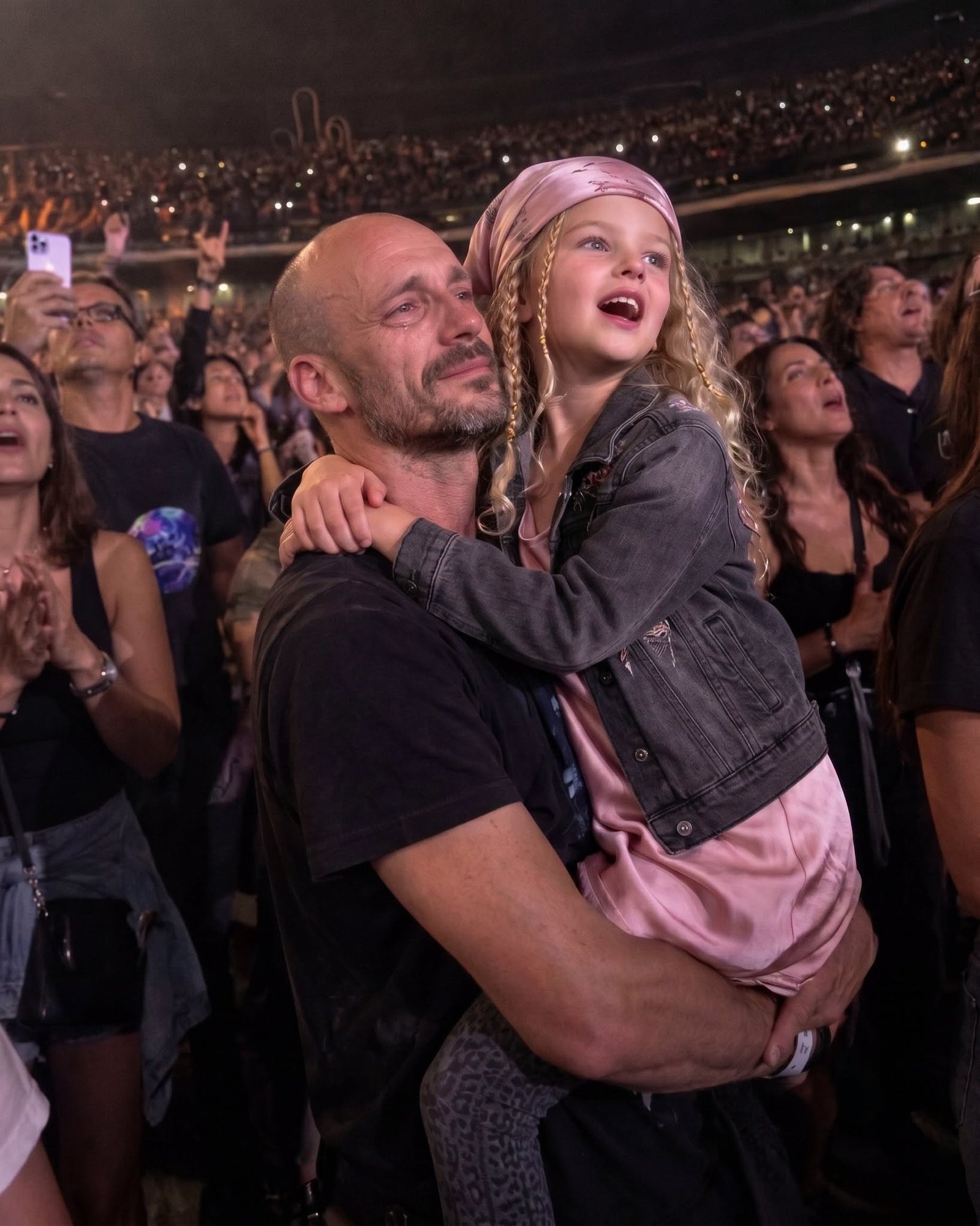
Nancy was at a concert.
Colored stage lights glowed behind her. A crowd filled the seats around her.
And her arms were wrapped tightly around the neck of a bearded man I had never seen before.
He was holding her as if he’d known her for years.
Jason sent another message.
That’s definitely her. She’s been with that guy most of the night.
My stomach dropped.
Nancy wasn’t the kind of child who hugged strangers.
At birthday parties, she sometimes stayed beside me for twenty minutes before warming up enough to play with children she already knew.
Yet in that photograph, she looked completely comfortable.
Happy, even.
I immediately called Dorothy.
No answer.
I called again.
Nothing.
By the third attempt, I was already reaching for my car keys.
Twenty minutes later, she finally answered.
“Mark?”
“Where are you?”
Silence.
That silence frightened me more than any answer could have.
“Jason just sent me a picture of Nancy at a concert,” I said. “She’s hugging some man I’ve never seen before. You told me you were visiting your mother.”
Dorothy exhaled shakily.
“Mark, please don’t assume the worst.”
“Then tell me who he is.”
“I can’t explain this properly on the phone.”
“Try.”
Another pause.
“We’re coming home.”
“Dorothy—”
“You’ll meet him. We’ll tell you everything.”
Him.
Not I’ll explain.
Not there’s been a misunderstanding.
She already knew exactly which man I meant.
“We’ll be there around ten,” she said. “Please just wait until then.”
The call ended.
I sat alone with that photograph for nearly an hour.
And the longer I stared at Nancy’s face, the worse I felt.
Because my wife hadn’t simply gone somewhere other than the hospital.
She had taken our daughter to meet someone Nancy apparently trusted.
Someone I knew nothing about.
At 10:06, I heard a key turn in the front door.
Nancy walked in first.
She was holding the stranger’s hand.
Part 2 — “Dad, Please Don’t Be Angry”
The man looked younger than he had in Jason’s photograph.
Mid-twenties, maybe.
His beard made him appear older from a distance, but standing in my entryway, I could see how young he really was.
His eyes were red.
Not tired.
Red from crying.
Nancy immediately released his hand when she saw me.
“Dad…”
I stood.
Her face crumpled.
“Please don’t be mad at Mom.”
That wasn’t what I wanted to hear.
I looked at Dorothy.
“What did you involve her in?”
“Mark—”
The young man stepped forward.
“I’m sorry you had to learn about me this way.”
Something about that sentence hit me hard.
Learn about me.
As though his existence was something everyone in the room understood except me.
I opened the front door.
“Leave.”
His expression fell.
Dorothy grabbed my arm.
“Mark, don’t.”
“He doesn’t belong in our house.”
“Yes,” she whispered. “He does.”
I looked at her.
The stranger looked down.
Nancy pressed herself against Dorothy’s side.
Dorothy took a breath.
“Before you make him leave, you need to hear what happened.”
“I’ve heard enough.”
“No.”
Her fingers tightened around my arm.
“You haven’t heard any of it.”
There was something in her face I had never seen before.
Fear.
Shame.
And grief so old it seemed woven into her.
“Please,” she said. “This story started twenty-five years ago.”
Nancy looked between us.
Dorothy immediately crouched beside her.
“Sweetheart, none of this is your fault. Go upstairs and get ready for bed.”
Nancy hesitated.
“Are you going to fight?”
Dorothy swallowed.
“We’re going to talk.”
Nancy looked at me.
I forced myself to soften my voice.
“Go ahead, sweetheart.”
Only when I heard her bedroom door close upstairs did I shut our front door.
Dorothy sat on the edge of the couch.
Her thumb moved nervously over her wedding ring.
The stranger sat several feet away.
I remained standing.
“Start talking.”
Dorothy looked at me.
Then she said something I could never have expected.
“I was sixteen when I got pregnant.”

Part 3 — The Baby Dorothy Never Told Me About
For a second, I genuinely thought I had misunderstood her.
“What?”
Dorothy closed her eyes.
“When I was sixteen, I got pregnant.”
Then she began telling me about a version of her life that existed before the woman I knew.
A teenage girl working shifts at a diner.
A boy who waited outside beneath a streetlight so she wouldn’t walk home alone.
A boy who did homework while waiting for her shift to finish.
A boy who bought one sandwich when neither of them had much money and always handed her the larger half.
I slowly realized she was talking about me.
We had dated when we were teenagers.
I remembered those nights.
I remembered the diner.
I remembered thinking I would marry her someday.
And I remembered how abruptly she disappeared.
One week, we had been planning our weekend.
The next, her mother told me Dorothy wanted nothing more to do with me.
They moved out of state almost immediately.
I had written letters.
I had called.
I had begged her mother to let me speak to Dorothy once.
Eventually, I convinced myself Dorothy had made her choice.
Now she looked at me with tears in her eyes.
“My mother found the pregnancy test before I had a chance to tell you.”
I couldn’t speak.
“She took my phone. She told you I didn’t want to see you.”
My hands went cold.
“She told me the opposite.”
“What?”
Dorothy’s voice broke.
“She told me she’d told you about the baby.”
The room seemed to shrink.
“What exactly did she say?”
“That you didn’t want either of us.”
I stared at her.
“No.”
“She said you wanted nothing to do with a pregnant sixteen-year-old.”
“No.”
“I believed her.”
“I never knew.”
“I know that now.”
My eyes moved toward the young man sitting across the room.
He was staring at the floor.
Suddenly, I didn’t want to look at him.
Because a possibility had entered my mind that I wasn’t ready to face.
Dorothy continued.
She told me how she had written letters to me anyway.
How she had handed those letters to her mother because her mother drove past the post office every day.
How she had waited for replies that never arrived.
“Anything for me?” she would ask.
At first, her mother made excuses.
Eventually, she simply shook her head.
Then, as Dorothy’s pregnancy became impossible to hide, adoption brochures appeared beside her breakfast plate.
Dorothy refused.
Her mother pushed.
“You’re sixteen,” she told her. “How will you support a baby? Who will watch him while you finish school? What kind of life can you give him?”
Dorothy kept insisting she would find a way.
Until months of isolation wore her down.
Until she believed the baby’s father had abandoned her.
Until every adult around her made keeping her son sound like an act of selfishness.
“When he was born,” Dorothy whispered, “he grabbed my hospital gown.”
Her voice disappeared for several seconds.
“I remember his fingers.”
The young man finally looked up.
Dorothy covered her mouth.
“I had to pull them away one at a time before I gave him to his adoptive mother.”
The room blurred for me.
Because I knew.
Even before Dorothy said the words, I knew.
She looked toward the young man.
Then back at me.
“That baby was Ethan.”
I couldn’t breathe.
“And, Mark…”
Tears spilled down her face.
“He was your son too.”
Part 4 — The Secret That Followed Us Into Our Marriage
I looked at Ethan.
Twenty-five years old.
A grown man.
My son.
I tried to find myself in his face.
For a moment, I couldn’t.
Then I noticed his eyes.
The shape of his jaw.
Something around his mouth when he pressed his lips together.
Tiny pieces that suddenly felt devastating.
“You never told me,” I said.
Dorothy nodded.
“No.”
“Not when we found each other again?”
Her face tightened.
That reunion happened almost ten years after she’d disappeared.
I remembered it vividly.
A grocery store.
I had heard someone behind me say my name.
When I turned, Dorothy was standing near the produce section.
Older.
Different.
Still immediately recognizable.
We went for coffee.
Coffee became dinner.
Dinner became another date.
One evening, I apologized.
“I should have fought harder for you.”
I had carried that guilt for years.
Dorothy had looked down at our joined hands.
“We were kids.”
Neither of us realized we were apologizing for two completely different versions of the same tragedy.
I thought she had left me.
She thought I had abandoned her and our child.
Neither of us asked the question that would have exposed the truth.
We married the following spring.
Years later, Nancy was born.
Dorothy now told me that when the nurse laid Nancy against her chest, our daughter’s little hand caught the fabric of her hospital gown.
Exactly as Ethan’s had.
“I almost told you that day,” she whispered.
“But you didn’t.”
“No.”
“There were years, Dorothy.”
“I know.”
“Our wedding. Nancy’s birth. Every birthday. Every quiet evening after she went to bed.”
“I know.”
“You could have told me.”
“I know.”
Her repeated answer made my anger rise.
“Then why didn’t you?”
“Because every year I waited made it harder.”
She wiped her face.
“At first I was afraid you’d hate the girl I had been. Then I was afraid you’d hate me for waiting. Then I convinced myself there was no point because our son was living another life and neither of us could change what had happened.”
She looked at Ethan.
“I told myself silence protected everyone.”
Her voice cracked.
“But really, I was afraid.”
I wanted to be furious.
Part of me was.
But something else was happening beneath the anger.
I was mourning a child I had only learned existed minutes earlier.
First steps I hadn’t seen.
Birthdays I hadn’t celebrated.
School photographs I had never received.
A first bike.
A first broken heart.
Graduation.
Twenty-five years of ordinary moments that were suddenly missing from my life.
“How did you find him?” I asked.
Dorothy looked toward me.
“My mother’s stroke.”
Part 5 — The Letters Hidden for Twenty-Five Years
While helping sort through her mother’s house after the stroke, Dorothy opened a drawer looking for medical paperwork.
She found adoption documents instead.
Beneath them was a shoebox.
Inside were two bundles of letters.
The first bundle was old.
Yellowed.
All addressed to Dorothy.
She opened one.
It was from me.
Your mother says you don’t want me contacting you. Please tell me yourself. I thought we were happy.
Another had been written weeks later.
Another months after that.
In one, I had begged her to let me know she was safe.
I remembered writing those letters.
I remembered checking our mailbox like an idiot even though I was the one sending them.
I remembered calling her house until her mother threatened to contact mine.
Dorothy had never seen a single letter.
She carried them to the hospital the following morning.
Her mother was awake when Dorothy laid them on the tray.
“You told me Mark knew I was pregnant.”
Her mother stared at the envelopes.
Then asked the one question that exposed everything.
“Did you tell him?”
Dorothy said the answer had almost knocked the breath from her.
Because in that instant she understood.
I had never known.
Her mother had lied to both of us.
She had separated us, intercepted the letters, moved Dorothy away, then allowed her frightened teenage daughter to believe she had been abandoned.
“You would have gone back to him,” her mother finally admitted.
Dorothy left the hospital before she said something she could never take back.
At home, she returned to the shoebox.
That was when she opened the second bundle.
Those letters were newer.
They weren’t addressed to Dorothy.
They were addressed to her mother.
The most recent had arrived only three months earlier.
The first line read:
My name is Ethan. I believe Dorothy may be my biological mother.
Ethan had been searching.
He had traced the only family address he could find.
He included his birthday.
The date matched.
Then he wrote:
Please give Dorothy my phone number. She doesn’t have to contact me. I just want her to know I had a good childhood, and if she ever wants to speak to me, I’d like that.
Dorothy called immediately.
“Ethan?”
There was a pause.
“Speaking.”
“My name is Dorothy.”
Silence.
Neither knew what to say.
Then Ethan asked:
“Did you get my letters?”
Dorothy started crying.
“Only today.”
They met at a café.
When Dorothy arrived, Ethan stood.
He didn’t hug her immediately.
Instead, he asked:
“Would that be okay?”
Dorothy nodded.
He held her while she cried.
And for the first time in twenty-five years, she held the child she had spent every birthday remembering.
Eventually, Ethan asked about her life.
Dorothy told him about Nancy.
Then she told him about me.
His reaction was immediate.
“You married my father?”
“Yes.”
“Does he know about me?”
Dorothy shook her head.
“No.”
Ethan had every right to be angry.
Instead, he looked at a photograph of Nancy on Dorothy’s phone.
Then he quietly asked:
“Could I meet my sister?”
That question was how my daughter ended up at the concert.

Part 6 — The Concert
Ethan worked with the organizers of the event and had arranged three seats near the stage, along with a brief backstage visit.
Dorothy still hadn’t told Nancy when they left our house.
Our daughter sat in the car holding the card she believed she was taking to her grandmother.
When Dorothy parked outside the arena, Nancy looked through the window.
“This isn’t Grandma’s hospital.”
“No.”
“Where are we?”
Dorothy turned around in her seat.
“There is someone I need you to meet.”
Then, as gently as she could, she told our nine-year-old daughter that she had an older brother.
Nancy listened with the solemn concentration children sometimes have when adults expect them not to understand.
“So you were his mommy first?”
“Yes.”
“But another family raised him?”
“Yes.”
“Does Dad know?”
Dorothy said that question nearly broke her.
“Not yet.”
Nancy frowned.
“Why?”
“Because I’ve been afraid to tell him.”
Nancy thought for a moment.
Then asked:
“Does Ethan know about me?”
Dorothy smiled through tears.
“He does.”
That seemed to settle the matter for Nancy.
“Okay. Where is he?”
Within an hour, she was asking Ethan whether he personally knew every musician backstage.
By the time the concert began, the awkwardness was gone.
Then one of Nancy’s favorite songs started.
She screamed with excitement and threw her arms around Ethan’s neck.
“Thank you for bringing me!”
Ethan hugged her.
And began to cry.
That was the moment Jason took the photograph.
Nancy noticed the tears.
“Did I hurt you?”
Ethan laughed and wiped his cheeks.
“No.”
“Then why are you crying?”
“Because I’m happy.”
Dorothy was sitting beside them.
My calls vibrated inside her bag.
She ignored the first.
Then the second.
Not because she planned to keep lying.
Because she was trying to find a way to tell me a truth that should have been told years earlier.
By the time she answered, Jason’s photograph was already on my phone.
Afterward, Dorothy told Ethan there would be no more hiding.
“Mark deserves to know everything.”
Ethan asked:
“Do you want me to come?”
“Yes.”
On the drive home, Nancy eventually fell silent.
Ethan stared out the window.
Then he asked the question no twenty-five-year-old should have to ask about his own father.
“What if he doesn’t want me there?”
Part 7 — My Son
When Dorothy finished, nobody spoke.
I heard the refrigerator humming in the kitchen.
A car passed outside.
Upstairs, one of Nancy’s floorboards creaked.
Everything around me remained painfully normal.
But my life no longer was.
Ethan sat with his hands clasped between his knees.
He couldn’t look at me.
“I didn’t know,” I finally said.
My voice sounded strange.
“I swear to you, Ethan. I didn’t know.”
He nodded once.
“I know.”
But he still wouldn’t lift his eyes.
“I would have come.”
His jaw tightened.
“If Dorothy had told me…”
I looked at her, then stopped.
This wasn’t the moment.
Whatever anger existed between my wife and me could wait.
I looked back at Ethan.
“If I had known you existed, I would have come for you.”
His chin trembled.
“For both of you,” I added.
That was when he finally looked at me.
Something in his expression broke me.
Because underneath the beard and the grown man’s face, I suddenly saw the boy I had missed.
A child wondering whether his father would have wanted him.
I crossed the room.
Ethan stood quickly, almost as though he wasn’t sure what I intended to do.
I wrapped my arms around him.
For the first second, he didn’t move.
Then both of his hands grabbed the back of my shirt.
Hard.
“I wasn’t sure you’d want me,” he whispered.
I tried to answer.
Nothing came out.
So I held him tighter.
Dorothy covered her mouth and began crying.
I couldn’t look at her.
Not yet.
Because I loved her.
And I was furious with her.
Both things could be true.
Her mother had created this tragedy.
But Dorothy had carried the secret into our marriage.
There would be questions.
Hard ones.
There would be anger.
There would probably be nights when I wasn’t sure what forgiveness was supposed to look like.
But none of that belonged between Ethan and me.
Not that night.
When we finally stepped apart, he wiped his face with his sleeve.
I did the same.
There were a thousand things I wanted to ask.
Only one came out.
“Were you happy?”
Ethan seemed surprised.
“Growing up?”
I nodded.
“My parents are good people,” he said. “Really good people. I had a good childhood.”
The relief that went through me almost dropped me into the chair.
“Good.”
My voice broke.
“That’s… good.”
And I meant it.
I could grieve every year I had missed while still being grateful that someone else had loved my son when I hadn’t even known he needed me.
Ethan looked toward Dorothy.
“I should probably go. You two need to talk.”
He reached for his jacket.
Something inside me panicked.
Twenty-five years.
I had already lost twenty-five years.
I wasn’t prepared to lose another evening.
“No.”
Ethan stopped.
I pulled out the chair beside mine.
“Don’t go yet.”
He hesitated.
“I don’t want to make things harder.”
“You’re not.”
I placed my hand on the back of the chair.
“There are things Dorothy and I need to deal with. But you’re not one of those things.”
His eyes filled again.
“You’re my son.”
Saying it aloud nearly destroyed me.
My son.
A person who had existed for twenty-five years without me knowing his name.
There were birthday candles I hadn’t seen.
Christmas mornings I hadn’t shared.
School photographs that had never sat on my desk.
Questions he had asked other people because I wasn’t there to answer them.
I couldn’t get those years back.
But for the first time since Dorothy began speaking, I understood that grief wasn’t the only thing sitting in that room.
We had time now.
However much came next, we had it.
So I sat down.
After a moment, Ethan joined me.
I studied his face again.
This time, I wasn’t looking for proof that he belonged to me.
I was simply trying to learn him.
“What do you do when you’re not arranging concerts?”
A small smile appeared.
“That’s a long story.”
I leaned back.
For the first time that night, I smiled too.
“Good.”
He looked confused.
“Good?”
I nodded.
“Because I’ve missed twenty-five years.”
Then I pulled my chair a little closer.
“Stay awhile.”
My voice shook, but I didn’t care.
“Tell me everything.”