
I thought the worst part was over the moment I opened my eyes.
I was wrong. The worst part was still walking down the hallway toward my room, wearing my daughter’s face.
My grandson knew it. He was nine years old, and he had been guarding my bed for eleven days because he knew it.
So I closed my eyes, kept perfectly still, and listened.
Part One: Eleven Days
The first thing I knew was a sound. A steady, patient beeping somewhere to my left.
The second thing was that my body didn’t feel like mine. My arm was heavy with tape and tubes. My mouth tasted like metal. The ceiling above me was the wrong color, the light was the wrong kind of white, and for a long, frightening moment I had no idea where I was or how I’d gotten there.
Later, a doctor would explain it gently. A car accident. A head injury. Eleven days of unconsciousness.
Eleven days of my life, simply gone.
But in that first minute, I didn’t know any of that. All I knew was that something warm was pressed against my side.
I turned my head, slowly, because everything hurt.
And there he was.
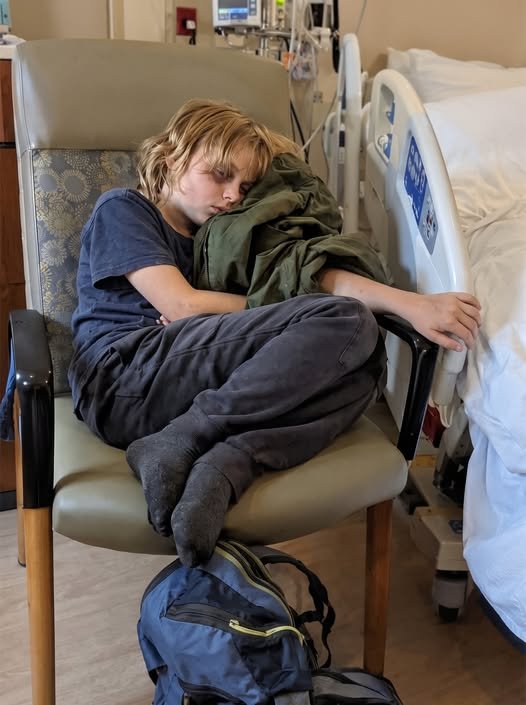
My grandson, Walter. Nine years old, curled up in a chair that had been dragged right up against my bed, his head resting on the edge of my mattress. One small hand was still wrapped around a fistful of my blanket, like he’d fallen asleep holding on and refused to let go even in his dreams.
Something in my chest cracked open.
Walter had lived with me since he was five, since the day we buried my son, Daniel. His mother had left long before that. So it had been the two of us, in my little house, for four years. I packed his lunches. I walked him to school. I knew that he liked the crusts cut off on Mondays but not on Fridays, for reasons he’d never explain. I knew which night-light stayed on when the bad dreams came.
I knew him the way you know your own heartbeat.
“Walter?” My voice came out as barely a scrape.
His eyes flew open.
For one long second, he just stared at me, like he didn’t trust what he was seeing. Like he’d imagined this so many times that he couldn’t tell anymore whether it was real.
Then he launched himself at me.
“Granny!“
He buried his face in my chest and sobbed so hard his whole body shook. I couldn’t understand a word he was saying. I didn’t need to. I wrapped my weak, heavy arm around him and held on as tightly as I could.
A nurse hurried in, took one look at us, and smiled. “Well. He’s been waiting a long time for this.” She checked the monitor and shook her head softly. “That boy has barely left your side. We’ve practically had to pry him off you to change the sheets.”
I stroked Walter’s hair. It needed a wash. His shirt was wrinkled, like he’d slept in it more than once.
“Sweetheart,” I whispered, “have you been sleeping here?”
He nodded against me.
“Why aren’t you at home with Aunt Lisa?”
The moment I said my daughter’s name, his whole body went stiff.
Not a flinch. Something worse. He went still, the way a small animal goes still when it hears something moving in the grass.
He didn’t answer me. Instead, his eyes slid toward the door.
And his face changed.
He climbed closer, put his mouth right against my ear, and whispered so quietly I almost didn’t catch it.
“Granny. Next time Aunt Lisa comes, pretend you’re still asleep.”
I pulled back to look at him. “What? Why?”
He grabbed my hand and squeezed it so hard it hurt. His eyes were wide and pleading and far too old for his face.
“Please. Just do it. Then you’ll understand why I wouldn’t leave you.” His voice wobbled. “You need to hear what she says when she thinks you can’t hear her.”
Before I could ask him a single thing more, footsteps stopped right outside my door.
Walter’s face went white.
“Granny,” he breathed. “She’s here.”
I barely had time to close my eyes.
Part Two: What She Said in the Dark
The door opened. I heard the click of heels I’d recognize anywhere.
My daughter. My Lisa.
For one foolish second, I nearly opened my eyes. I nearly said her name. Whatever Walter was afraid of, surely it was a misunderstanding. Surely a child had gotten confused.
Then she spoke.
“Still sitting here waiting for her to wake up?” Her voice was flat and bored. “Honestly, Walter, it’s getting pathetic. You don’t know when to give up, do you?”
Walter didn’t say a word.
I heard her step closer to the bed. I could smell her perfume. The same one I’d bought her three Christmases in a row.
“Fine,” she said. “Since you’re so determined to camp out here, let me tell you a little secret about your grandma.”
I forced every muscle in my face to stay soft. I made my breathing slow and even. It was the hardest thing I have ever done.
“She already had her chance with you,” Lisa said. “And that accident proved she can’t keep you safe.”
“What does that mean?” Walter’s voice was small.
“It means you won’t be living with her much longer.”
Beneath the blanket, my fingers twitched. I pressed them flat against the mattress.
“I’m going home with Granny,” Walter said.
“No, you’re not.”
“Yes, I am.”
Lisa sighed, the long, put-upon sigh she’d been using since she was a teenager. “Walter. She’s getting old. She can barely see. She never should’ve been behind the wheel in the first place.”
“She has glasses.”
“Well, they obviously didn’t help much, did they?”
My heart slammed against my ribs so hard I was sure the monitor would give me away.
When Lisa spoke again, her voice had dropped. Quieter. Almost satisfied.
“Soon everything will be the way it should’ve been years ago.”
“What does that mean?”
“You’ll understand later.”
“Why can’t you just tell me?”
“Because you’re nine.”
“So?”
“So stop asking questions.”
I heard the sharp zip of her handbag. Then her footsteps, moving away.
At the door, she paused.
“You should start getting used to the idea of living with me.”
The door clicked shut.
I lay there in the dark behind my own eyelids, not moving, not breathing properly, while the monitor beeped on as if nothing in the world had changed.
Then I felt a small hand touch my arm.
“She’s gone, Granny.”
Part Three: “A Lot”
My eyes snapped open. “What on earth was that?”
Walter looked down at his sneakers. “That wasn’t the first time.”
“How many times?”
“I don’t know.” He picked at a thread on the blanket. “A lot.”
“Walter.”
“Maybe four? Five?”
“While I was unconscious?”
He nodded.
I swallowed hard. “What exactly did she say to you?”
He took a shaky breath. “That you might not wake up. And that even if you did, I probably couldn’t live with you anymore.”
“Why?”
“She said because you’re old.”
“I’m sixty-one!”
“That’s what I told her.”
Despite everything, despite the tubes and the pain and the ice spreading through my stomach, I almost laughed. That was my boy. Nine years old and defending my honor from a hospital chair.
But his face didn’t match my smile.
“She said your eyes were bad, too,” he went on quietly. “And that the accident proved you couldn’t take care of me. She said it every time. Like she wanted me to remember it.”
And I thought about what that must have been like for him.
Eleven days. Eleven days of watching his grandmother lie motionless in a bed, not knowing if she’d ever open her eyes. Eleven days of being the only one in the room who loved her. And every few days, the one adult who was supposed to comfort him walked in and told him, over and over, that his home was already gone.
No wonder he wouldn’t leave.
He wasn’t just keeping me company. He was keeping watch.
“Oh, baby,” I whispered, and pulled him close again. “I’m so sorry you had to hear that alone.”
He didn’t cry this time. He just held on.
And as I lay there with his head on my shoulder, an old memory came crawling back. One I’d spent four years trying not to look at too closely.
Part Four: The Argument I Tried to Forget
It was three days after Daniel’s funeral.
The casseroles were still stacked in my refrigerator. The flowers were starting to wilt. I was standing at the kitchen sink, trying to remember how to be a person, when Lisa walked in and didn’t bother with hello.
“I need Walter to live with me.”
I turned around slowly. “Last week you needed money.”
“This isn’t about money.”
“Then what is it about?”
“He’s my brother’s son.”
“And I’m his grandmother.”
Her mouth tightened. “You’re not exactly young, Mom.”
“And you are. You go out every night. You chase that business of yours. You worry about money constantly. Since when do you want to raise a five-year-old?”
“Maybe I’m ready for something more.”
“You barely call him, Lisa. You missed his birthday.”
“That doesn’t mean I don’t care.”
“You didn’t care enough to show up. So why, all of a sudden, do you want him in your house?”
Her face went hard in a way I’d never seen before. “I’m going to fight for my nephew.”
“Lisa…”
“I’ll see you in court.”
She grabbed her purse and walked out, and the door rattled in its frame behind her.
In the end, the court gave guardianship to me. Lisa didn’t speak to me for months afterward. When she finally came back around, she acted as if none of it had ever happened. And I let her.
I told myself she’d been grieving. That she’d lost her only brother and grabbed for the last piece of him she could reach. That grief makes people say terrible things.
It was a kind story. A mother’s story.
I needed it to be true, because the alternative meant admitting there were things about my own daughter I didn’t want to see.
Now, lying in that hospital bed, with my grandson’s words still ringing in my ears, I started to wonder if I’d understood that argument at all.

Part Five: The Glasses
“Walter,” I said softly, “did Aunt Lisa say anything else?”
He hesitated.
“What is it?”
“There was something weird.”
My stomach tightened. “Tell me.”
“She asked me about your glasses.”
“My glasses?”
“Before the accident.”
“When, sweetheart?”
He frowned, concentrating hard. “A few days before. She asked me, ‘Does your grandma always drive in those old glasses?’”
And just like that, a door in my memory swung open.
The morning of the crash.
I was rushing. I had an eye appointment across town, of all things, and I was running late. I remembered standing in the kitchen, tearing through my purse, the counters, the pockets of my coat.
Lisa had stopped by. She did that sometimes. She was leaning against the doorframe, watching me.
“Mom, what are you doing?”
“I’m late, and I can’t find my driving glasses. I know I put them in my purse last night.”
“So use the old pair.”
“They’re too weak. Everything goes fuzzy past the end of the block.”
She rolled her eyes. “Oh, just wear them. You can see fine in those.”
I remembered hesitating. I remembered the clock on the stove.
And then I remembered putting them on.
After that, there were only fragments. A road sign that wouldn’t come into focus. A horn, much too close. The scream of metal.
Then nothing, for eleven days.
The memory dissolved, and I was back in that bed, staring at the ceiling, my heart pounding.
For the first time, I let myself think the unthinkable.
What if the worst mistake I made that morning hadn’t actually been mine?
“Why didn’t you tell me she asked about my glasses?” I asked Walter gently.
He shrugged, miserable. “I didn’t know it mattered.”
I squeezed his hand. “Neither did I, baby. Until right now.”
Part Six: Not Proof, But Enough
The next morning, I asked to speak with the hospital social worker.
She was a kind woman with reading glasses on a beaded chain. She sat down beside my bed with a clipboard and a careful expression.
“Has my daughter tried to get custody of Walter?”
She paused. “She’s asked about temporary guardianship.”
“Already?”
“She’s consulted about it, yes,” she said carefully. “Your medical situation raised some questions about Walter’s immediate care.”
“What kind of questions?”
“Whether you’d be physically able to resume full responsibility for him.”
“Because of the crash.”
“Among other things.”
I looked at her. “My eyesight.”
She hesitated a moment too long. “That was mentioned.”
Of course it was.
That afternoon, when Walter came back with a juice box and a coloring book he had no intention of using, I asked him one more question.
“The morning of the accident. Did you see Aunt Lisa anywhere near my glasses?”
He scrunched up his face. “Maybe.”
“Maybe?”
“She was by your purse. On the table by the door. I think she had something in her hand.” He shook his head. “But I don’t know what. I wasn’t really watching. I was looking for my shoe.”
It wasn’t proof. A nine-year-old half-remembering a morning while he hunted for a sneaker would never hold up anywhere that mattered.
But it was enough to make me stop telling myself stories.
So I did the only thing I could do. I got stronger. I ate the terrible hospital food. I walked the hallway with the physical therapist until my legs stopped shaking. I smiled at Lisa when she visited, and I said nothing at all.
And I waited.
Part Seven: The Camera by the Door
The day I was discharged, Lisa offered to drive me home.
I thanked her and called a cab.
The moment Walter and I were back inside my house, I went straight to the table by the front door and searched. Then the kitchen. Then my bedroom, my coat pockets, the car’s glove box that the insurance company had returned to me in a plastic bag.
My driving glasses were nowhere.
Walter watched me pull a couch cushion off for the third time. “You know you once put your phone in the freezer.”
“Once.”
“Twice.”
“Traitor.”
He grinned, and for a second we both felt almost normal.
Then I stopped, cushion in hand, and looked up at the ceiling above the front door.
At the little camera Daniel had installed years ago, back when he worried about me living alone. The one I’d forgotten about the way you forget about the smoke detector.
The table where I always left my purse sat directly in its view.
My hands were shaking as I found the old app on my phone and scrolled back through the weeks. Back and back, to the morning of the crash.
Walter pressed against my side, watching the screen.
There I was, rushing past in my coat. There was Lisa, coming in behind me.
“Oh,” Walter whispered. “There she goes.”
“Shh.”
On the tiny screen, my daughter glanced toward the kitchen, where I was banging around looking for my keys.
Then she opened my purse.
“Granny,” Walter breathed. “That’s your glasses case.”
We watched her slide it out, turn it over once in her hand, and slip it into her own handbag. Then she zipped the bag closed, smoothed her hair, and walked into the kitchen to tell me I could see just fine in my old pair.
I set the phone down on the table very carefully, as if it might break.
My stomach turned over.
For years I had called it love, the way I refused to see the worst in Lisa. I had called it loyalty, and patience, and being a good mother.
I couldn’t call it that anymore.
Walter’s voice was barely a whisper. “Why would she do that?”
“I don’t know, sweetheart.”
“Is it because she wants me?”
I looked at him. At his worried eyes, and the too-short sleeves of the sweater he’d outgrown while I was asleep.
“She’s wanted you for four years.”
“But why?”
That was the question. And I realized, with a terrible, sinking certainty, that I’d never really asked it.
Part Eight: Daniel’s Papers
That night, after Walter was asleep, I went into the back closet and pulled out the boxes I’d been avoiding since the funeral.
Daniel’s papers.
Insurance forms. Old tax returns. Medical bills I couldn’t look at for long.
And then, near the bottom, a thick envelope from a law firm with a name I didn’t recognize.
I read the first page three times.
Then I read it a fourth time, because I couldn’t believe my son had done this and never said a word.
“Granny?”
I jumped. Walter was standing in the doorway in his pajamas, rubbing his eyes.
I turned the papers face down on my lap. “What are you doing up?”
“I had a dream. Are you okay?”
“I think I just figured something out.”
“About Aunt Lisa?”
“Yes.”
“What?”
“Something I should’ve seen a long time ago.”
“What is it?”
“I’ll explain when you’re older.”
He narrowed his eyes at me. “That’s exactly what Aunt Lisa says when she doesn’t want to answer.”
I winced. “Please don’t compare me to your aunt today.”
After I’d tucked him back in and left the night-light on, I sat alone at the kitchen table with that envelope, and four years of Lisa’s behavior finally rearranged themselves into a shape that made sense.
The sudden interest in a nephew she’d barely called. The fight over guardianship three days after the funeral. The questions about my eyesight. The glasses. The papers she’d already started while I was unconscious.
I’d been asking the wrong question all along.
I’d been asking why Lisa wanted Walter.
I should have been asking what came with him.
Part Nine: The Invitation
In the morning, I called her.
“Could you come by tonight?”
She sounded surprised. “Is everything okay? Are you feeling alright?”
“I need help with some paperwork.”
“What kind of paperwork?”
“For Walter.”
There was the briefest pause. Then her voice brightened in a way that made my skin crawl.
“Of course. I’ll be there tonight.”
No questions. No hesitation. Just eagerness.
That reaction told me almost as much as the envelope had.

Part Ten: The Kitchen Table
Lisa arrived at seven o’clock sharp.
Walter was upstairs. I’d told him to stay in his room with the door closed.
I sat at the kitchen table in my brand-new glasses, the envelope in front of me, my hands folded on top of it so they wouldn’t shake.
She noticed the glasses right away. “Oh, new pair?”
“Yes.”
“Good.” She started shrugging off her coat. “Still, maybe no driving for a while, Mom.”
I smiled. “Funny you should mention driving.”
Her hands stopped halfway out of her sleeves. “What?”
“Why did you take my glasses, Lisa?”
Her face went perfectly blank. “I didn’t.”
“I have a video.”
The color drained out of her so fast I thought she might faint. “A video of what?”
“Of you opening my purse the morning of the accident. Taking out my glasses case. And putting it in your bag.”
She stared at me.
Then, slowly, she sat down across from me. “Mom…”
“Why?”
“It’s not what you think.”
“Then tell me what it is.”
I thought I knew exactly where this conversation was going.
I was wrong.
“I was worried about you,” she said.
“So you stole the glasses I needed to drive?”
“You shouldn’t have been driving at all!”
“Then why did you tell me to wear the old pair?”
Silence.
I leaned forward. “Why were you already filing guardianship papers while I was lying in a coma?”
“Because somebody had to think about Walter!”
“I was alive.”
“You were unconscious!”
“For eleven days, Lisa. Not eleven years.”
Her jaw clenched.
“And why did you want him four years ago?”
“He’s my nephew.”
“Try again.”
“What do you want me to say?”
“The truth. For once.”
“I loved my brother.”
“So did I.”
“He trusted me.”
That sentence snagged on something. “Did he?”
She looked away.
I slid the envelope across the table and let the law firm’s letterhead face her.
Her whole expression changed.
“You recognize it,” I said.
She said nothing.
“You knew what Daniel arranged. Didn’t you?”
Her eyes dropped to the envelope and stayed there.
That was answer enough.
Part Eleven: The Trust
I opened the envelope.
“When your brother died,” I said quietly, “he left a trust for Walter. For his schooling. His future. Everything Daniel wanted to give him and didn’t get the chance to.”
Lisa closed her eyes.
There it was. The missing piece I’d been walking past for four years.
“Daniel told you about it.”
She didn’t answer.
“Didn’t he?”
“A few weeks before he died,” she whispered.
“He never told me.”
“Apparently not.”
“And you knew that whoever was raising Walter could request money from it for his expenses.”
“With oversight,” she said, too quickly.
“And that’s why you wanted guardianship.”
“It isn’t that simple.”
“Then make it complicated. I’ll wait.”
Her face crumpled, and she started to cry.
“I needed money, Mom.”
“For what?”
“My business was falling apart.” She wiped her face with the back of her hand. “Before Daniel died, he told me about the trust. I’d already come to you for help, and you said no.”
“So?”
Her voice broke. “So I thought the trust could save everything.”
I stared at her. At my daughter. The little girl I’d rocked through fevers, whose scraped knees I’d kissed, whose prom dress I’d hemmed by hand at two in the morning.
“And all you needed,” I said, “was Walter.”
She sobbed harder. “I was desperate! I wasn’t going to steal it!”
“Then what were you going to do?”
“Manage it.”
“For yourself.”
“I would’ve put it back!”
I laughed once, a short, ugly sound, because I couldn’t believe what I was hearing. “Of course you would.”
Her head snapped up, and the tears turned to anger.
“He’s nine! What does a nine-year-old need with that kind of money? It was just sitting there!”
“It’s his.”
“I know that!”
“No,” I said. “You don’t. You never have.”
She went silent.
I let those words sit on the table between us, right next to the envelope.
But the worst of her confession was still coming. I could feel it.
Part Twelve: “I Never Thought You’d Drive That Far”
“And now?” I asked.
She didn’t answer. Her silence answered for her.
“You saw my accident as another chance.”
“Mom…”
“Another chance to get Walter. And another chance to get your hands on his money.”
Her eyes filled again. “I never thought you’d actually drive that far.”
“You told me to wear the old pair.”
“I thought you’d get behind the wheel and realize you couldn’t see! That you’d turn around, or call me, or miss the appointment. Anything.”
“And then what?”
“Then I’d have proof.”
“Proof of what?”
“That you weren’t safe anymore!” Her voice cracked in half. “That your eyes were getting worse. That you couldn’t keep raising Walter on your own.”
I felt something inside me go very, very quiet.
“So you took my glasses to make me look incapable.”
“I needed something people couldn’t brush off.”
“And instead, I nearly died.”
“I didn’t know you’d crash!”
“But you knew I couldn’t see.”
She opened her mouth. Nothing came out.
“So this was never about keeping me safe,” I said.
“It was about Walter.”
“And the trust.”
“I would’ve taken care of him!”
“Taking care of him isn’t the same thing as wanting him, Lisa. He knew the difference. He’s nine, and he knew the difference. He sat by my bed for eleven days because of it.”
“Mom, please…”
“Leave.”
“Please.”
“Leave.”
She stood, clutching her coat. At the door, she turned back one last time.
“What about Walter?”
I looked at her for a long moment.
“For once in your life,” I said, “don’t put his name next to something you want.”
Part Thirteen: Not That Easily
The front door had barely closed when I heard feet pounding down the stairs.
Walter hadn’t stayed in his room. Of course he hadn’t. He’d been standing just behind the hallway wall, listening to every word.
He ran straight into my arms.
“Is she coming back?”
“Not tonight.”
He hesitated, pulling back just enough to look up at me. His voice got very small.
“So… am I still going to live with you?”
It was the question he’d been carrying for eleven days. Maybe for four years. Maybe since the day he’d stood at his father’s grave and understood that the people you love can simply disappear.
My chest ached so badly I could hardly breathe.
“Oh, sweetheart.” I cupped his face in both hands. “You are not getting rid of me that easily.”
He threw his arms around my neck and held on, and I held on right back. And I thought about how hard he’d fought for me while I couldn’t fight for myself. A nine-year-old boy in a hospital chair, keeping watch, refusing to leave, guarding the one person who had never let him go.
Now it was my turn to guard him.
A few days later, I sat in my attorney’s office with the video, the envelope, and the social worker’s notes.
“Lisa’s guardianship attempt is finished,” she told me. “No court is going to look at that footage and hand her anything.”
“And the trust?”
“Moved to independent management. She’ll never be able to touch it.”
“Good,” I said.
It was the only word I had. But I meant it with every bone in my body.
Lisa would never again have any say over his safety or his future.
Part Fourteen: What I Couldn’t See
A few weeks later, Walter found me tearing the kitchen apart on a school morning.
“You’re doing it again,” he announced from the doorway.
He held up my glasses. “Next to the toaster.”
“I knew that.”
“You checked the refrigerator.”
“I was looking for the milk.”
“We don’t need milk.”
I snatched the glasses out of his hand. “Go get your backpack before you’re late.”
He grinned, that gap-toothed grin I’d have given anything to see during those eleven dark days.
“One day you’re going to lose me like you lose your glasses.”
I slid them on and pulled him into my arms, right there in the middle of the kitchen.
“Not a chance,” I said. “Not ever.”
And as I held him, his face came into perfect focus.
My eyesight has been bad for years. I’ll admit that to anyone.
But the thing I refused to see was never blurry. It was right in front of me the whole time, clear as day. I just kept looking away from it, because she was my daughter, and I loved her, and I wanted so badly to believe the best.
I made excuses for Lisa for a very long time.
I will never make them again at the cost of the little boy who stayed by my side when I couldn’t open my eyes.
He watched over me when I was asleep.
Now I’m wide awake, and I’ll be watching over him for the rest of my life.