
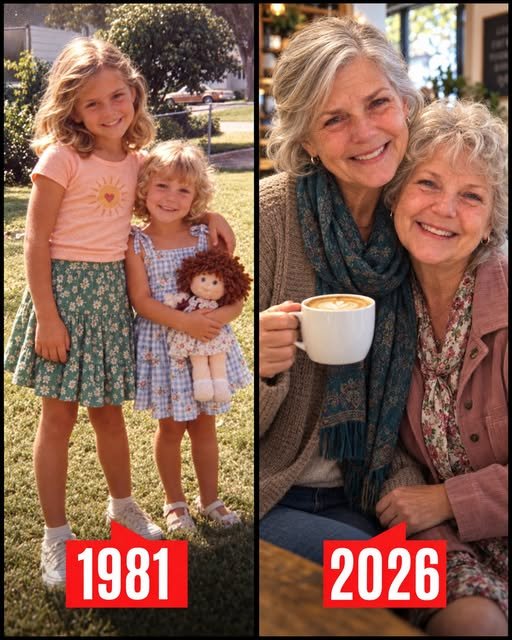
I was seven when foster care tore my four-year-old sister out of my arms. I promised her I would find her, and I spent the next 45 years keeping that promise: agencies, registries, private investigators, endless posts in Facebook groups. When a stranger finally messaged me saying she knew exactly who Grace was, I went alone to meet her. I never imagined Grace would be the one walking through that café door, or that she’d been hiding something far bigger than where she’d been.
Part 1: The Promise on the Porch Steps
I was seven when our mother died. Grace was four.
Our father was already gone by then. Mom told us he had died, and we were too small to ask questions. There were no grandparents, no aunts, no kind neighbor willing to take in two little girls. So one gray afternoon, a woman with a clipboard put us in the back seat of her car, and just like that, we belonged to the foster care system.
At least we still had each other. For a while.
Families came and went. They smiled at Grace, with her wild curls and her crooked little grin, and then their eyes slid over to me. A four-year-old was easy to love. A seven-year-old with a shadow on her face and a fierce grip on her sister’s hand was a package deal nobody wanted.
Then one family did want Grace. Only Grace.
I remember the morning she left better than I remember most of my own wedding. She was wearing a yellow sweater two sizes too big. I knelt down on the linoleum floor of the group home and pulled her into my arms so tightly she squeaked.
“Grace, listen to me,” I whispered into her hair. “I will find you. I don’t know when, but I promise. You remember that, okay? Don’t you ever forget it.”
She nodded against my shoulder. Then a stranger took her hand and led her out to a car, and I stood at the window watching her go. It took every ounce of strength in my small body not to run after her.
A year later, I was adopted too. My new parents took me clear across the country and gave me a warm, loving home. They were good people. I was grateful, and I still am.
But every birthday, every Christmas, every first day of school, there was an empty space beside me shaped exactly like my little sister.
Was she safe? Was she happy? Did she still remember me?
As an adult, I never stopped looking.
I contacted adoption agencies. I signed up for every registry I could find. When I could afford it, I paid private investigators, and when I couldn’t, I spent my evenings combing through records myself. Eventually, I started posting in those Facebook groups where people search for long-lost relatives, attaching the same faded photograph every time.
Every lead ended in the same place. Grace’s name had almost certainly been changed after her adoption, and the trail went cold right there, at the edge of a sealed file.
But the dead ends weren’t what hurt the most.
What kept me awake at night was not knowing whether Grace was still alive. Or worse, whether she was out there somewhere believing her big sister had simply forgotten her. That I’d broken my promise.
Then, one evening after a long, exhausting day at work, my phone lit up with a message.
A woman had replied to one of my old posts, a post so old I’d forgotten I’d written it.
I know exactly who Grace is. I won’t share details online, but we can meet in person. Just the two of us.
I read it four times.
Meeting a stranger alone was risky. I knew that. At fifty-two, I’d heard enough stories to be cautious. But I’d also gone years without a single real lead, and if there was even a sliver of a chance this would bring me to Grace, I had to take it.
I picked a busy café downtown and told a friend exactly where I’d be and when.
I arrived twenty minutes early, clutching the worn folder I had carried through decades of searching. Inside were copies of old records, letters from agencies, and the one thing I’d never let out of my sight: a photograph of Grace and me sitting together on the porch steps of our childhood home. Two little girls squinting into the sun.
I ordered a coffee I didn’t drink and watched the door.
Every woman who walked in made my heart jump. A young mother with a stroller. Two college girls laughing over their phones. An older lady in a red raincoat who glanced my way, then sat down with a friend by the window. Each time, I felt foolish for hoping.
What if it was a scam? What if this stranger wanted money, or worse, just wanted to toy with a woman who had made her heartbreak public for anyone to see? I’d been burned before. Once, an investigator had taken three months of my savings and handed me a file on the wrong Grace entirely.
I slid the photograph out of the folder and set it on the table in front of me, the way I always did when my courage started to slip. Two little girls. My arm around her shoulders. Her chin tipped up toward me as if I had all the answers in the world.
I promised you, I thought. I’m still trying.
I was staring at it when someone pulled out the chair across from me and sat down.
I looked up, and my whole body went cold. Then hot.
Gray hair. Fine lines around her eyes, the same ones I saw in my own mirror every morning.
But those curls. That crooked smile. Those eyes.
I would have known her in a crowd of a thousand.
“It’s me,” she said, and her voice trembled. “Grace.”
I couldn’t breathe. I reached across the table and grabbed her hand, as if she might vanish into thin air if I let go. She let me hold on.
“Grace,” I whispered. “Oh, Grace.”
Forty-five years. Forty-five years of searching, and she was right here, close enough to touch.
Then she opened her mouth and said the last thing I ever expected to hear.
“I’ve known where you lived. For years.”
Part 2: The Woman Who Kept Us Apart
I let go of her hand.
“What?”
“Years,” she repeated, dropping her eyes to the table. “I knew, and I didn’t come. There was a reason I couldn’t reach out.”
The floor seemed to tilt under my chair. “What reason could you possibly have?”
She twisted her paper napkin into a tight rope. That was Grace, even now. Quiet. Always the one who believed that if she stayed perfectly still, the storm might pass her by.
“I was afraid,” she said. “Someone worked very hard to keep us apart. I thought if I contacted you, I’d lose the only connection I had left to our family.”
“Who?”
She shook her head. “That’s not why I came. There’s something more important you need to know.” She took a breath. “He’s alive.”
“Who’s alive?”
“Dad.”
I stared at her. “Mom told us Dad was dead. Are you saying she was wrong?”
“He’s alive. But he’s dying.” Her eyes filled with tears. “He’s in the hospital, and I’m scared we’re running out of time. His wife, Evelyn, will try to stop us. She’s the reason I stayed away.”
I should have thrown my coffee in her face.
Forty-five years, and she had saved the biggest news for last.
I was furious. And yet somehow I was already on my feet, my folder clutched against my chest.
“Where’s the hospital?”
“My car’s outside.”
“Then let’s go.”
She hesitated. “I don’t deserve your forgiveness.”
“No,” I said. “You don’t. Not yet. Move.”
In the car, her phone buzzed again and again in the cupholder. She kept glancing at it like it might bite her.
“You haven’t told Evelyn about me,” I said.
“No.”
It buzzed once more. Grace read the screen at a red light, and every drop of color drained from her face.
“She wants to know where I am,” she whispered. “We may already be out of time.”
We drove through gray streets while I watched my sister’s knuckles whiten on the steering wheel. I turned toward the window, then back to her.
“Tell me about Evelyn. All of it.”
Grace kept her eyes on the road. “Mom and Dad separated before she died. She told us he was dead, but he was alive, living in another state. His name wasn’t on our birth certificates, and nobody contacted him when we went into foster care. By the time he found out Mom had died and tried to find us, we’d both been adopted. He had no idea what names we were living under.”
“And you knew all this?”
“I found him when I was in my twenties. By then he’d married Evelyn. She let me visit, but she always arranged the calls, and she made herself part of every single conversation.” Grace swallowed. “She told me Dad couldn’t bear to talk about you. I thought he was ashamed that he’d lost us.”
“So you knew where I was, and you said nothing.”
“Yes. Years ago, I found your address through an old adoption search notice. I kept it. When you moved, I looked you up again. I knew you were still searching for me.”
“One letter, Grace. You could have written me one private letter.”
“I could have,” she said. “But Evelyn told me that if I ever contacted you, she would make sure I never saw Dad again. She said he couldn’t handle reopening the past. That it was safer for everyone. I was terrified of losing him, so I let her make the decision for me.”
I pressed my forehead against the cold window.
Safer for everyone. Funny how I had never been included in that “everyone.”
“Do you know what I did for forty-five years?” My voice cracked. “I lay awake wondering if you were dead. And you could have ended that with one phone call.”
“I know.” She didn’t cry, and she didn’t beg. “I’m sorry. I won’t ask you to forgive me today.”

Evelyn had threatened her. I understood that. But Grace had still chosen silence, year after year, while I searched for a sister who knew exactly how to reach me.
Her phone rang. It was the hospital, returning her call about Dad’s room, and I watched her face fall.
“He’s been moved to another unit,” she said after hanging up. “They told Evelyn. They didn’t tell me.”
She dialed Evelyn on speaker. A sharp voice cut through the car before Grace could say a word.
“Are you with her? Is she with you?”
Grace’s mouth opened and closed.
“He’s too weak for visitors,” Evelyn snapped. “Don’t come.”
The line went dead. Grace stared straight ahead through the windshield.
“Maybe we should turn around.”
“No.” It came out hard as stone. “Evelyn doesn’t get to decide this for everyone. Not anymore.”
I made her call the hospital back, and this time we asked for the proper steps to request a visit. The nurse couldn’t promise anything until they’d checked his condition and his own wishes. Fine. I pulled out my ID and every scrap of family information I’d collected over a lifetime.
“Will you tell them I’m your sister?” I asked.
“Yes.”
“And when Evelyn starts raising her voice, you won’t fold. Promise me.”
Grace swallowed hard. “I promise.”
Evelyn was waiting for us outside the unit. Tall, silver-haired, pearls at her throat, arms crossed like a locked door.
Her eyes landed on me, and I swear the temperature in that hallway dropped ten degrees.
“You brought her here,” she said to Grace.
“Evelyn, please—”
“You’ve betrayed this family.” Then she turned to me, her voice sharp as broken glass. “He’s far too ill for the shock of a daughter he hasn’t seen in decades. Why have you suddenly appeared?”
“I found out he was alive this morning,” I said.
“Leave.”
Grace’s shoulders curled inward, and my heart lurched. I knew that posture. I had last seen it on a four-year-old in a yellow sweater.
I didn’t argue in the hallway. I turned and walked toward the nurses’ station.
Behind me, Evelyn’s voice dropped, low and deadly.
“Grace, if you do this, you are no longer welcome in this family. Ever.”
I kept walking. But I didn’t hear footsteps behind me.
My sister wasn’t moving.
Part 3: The Daughter He Thought Was Dead
I told myself not to look back. If Grace stayed frozen in that hallway, I would go on alone. I’d done it for forty-five years. I could do it for another forty feet.
“Grace,” Evelyn said, softer now, almost sweet. “Come with me, and we’ll fix this.”
For one heartbeat, there was nothing.
Then footsteps.
Grace came up beside me at the nurses’ station, trembling from head to toe.
“We’re both his biological daughters,” she told the nurse. “We want to know if he wants to see us.”
“He has no relationship with her,” Evelyn cut in, appearing at our shoulders.
The nurse didn’t even blink.
“His condition and his own wishes are what matter here, ma’am. Not just yours.”
I could have kissed that woman.
While the staff checked on him, Evelyn drifted toward me, her voice low and venomous so no one else could hear.
“You’re selfish. He spent years grieving you. Showing up now could destroy him.”
I went completely still.
“Grieving me?”
Something crossed her face. Just a flicker, gone in an instant, but I caught it.
“What do you mean, grieving me? Why would he grieve me?”
“There was some confusion,” she said stiffly. “Decades ago.”
Behind me, Grace gasped.
“He thought my sister was dead?” Her voice rose. “You told me he just couldn’t bear to talk about her!”
My knees nearly gave out.
I had spent my entire life believing my father was dead. And all that time, he had believed the very same thing about me.
I wanted to tear every lie out of that woman with my bare hands.
But Grace touched my arm.
“He’s still waiting,” she said quietly. “Right now, he is.”
She was right, and I hated how right she was.
Evelyn pounced anyway. “Telling a dying man something like this would be cruel.”
Was she right about that? I made myself stop and think. And then I asked the medical team, not her.

They told us he was weak and sometimes confused, but he had clear stretches. They could carefully ask him whether he wanted visitors.
A nurse went into his room.
Grace and I sat side by side in two hard plastic chairs against the wall. Evelyn stood across the corridor, phone in hand, typing furiously and glaring at us between messages.
“How long have you known him?” I asked Grace quietly. “Really known him?”
“Almost thirty years.” She stared at her hands. “He taught me how to fix a leaky faucet. He came to my wedding. He held my son the day he was born.” Her voice wavered. “And every one of those days, you should have been there too.”
I didn’t know what to say to that. Thirty years of birthdays and holidays and ordinary Sunday dinners with a father I’d believed was in the ground. Grace had gotten all of them. I’d gotten none.
But she hadn’t stolen them. Not really. Someone else had.
I looked across the hallway at Evelyn, at the pearls and the perfect silver hair, and I wondered how a person could look at two sisters and decide, so calmly, that they were better off apart.
Minutes crawled by. When she came back, her face was gentle and careful, and I knew before she spoke that it wasn’t good news.
“He’s upset,” she said. “When we mentioned two daughters, he asked about Grace. But he said his older girl died a long time ago.”
“You see?” Evelyn said, almost triumphant. “This proves it.”
I felt something inside my chest crack.
All those years. And he might look straight at me and see nothing but a stranger.
Then I looked down at the folder in my arms.
“The photograph,” I said. “I’ve kept it my whole life. Two little girls on a porch step. Could you show it to him first? Before we go in?”
The nurse hesitated, then nodded. “If he’s willing.”
“It will only confuse him,” Evelyn snapped.
“He deserves to decide whether he wants to see his daughters,” Grace said. Her voice shook, but underneath the shaking, it was solid. “Let him decide.”
Evelyn stared at her as if she’d sprouted a second head.
The nurse took the photo and disappeared through the door. I watched that door like it was the edge of a cliff.
When she came back out, her eyes were bright.
“He looked at the picture,” she said. “He asked where it came from. When I told him there were two women out here who believe they’re his daughters, he said he wants to speak with you.”
The breath rushed out of me. I clapped a hand over my mouth.
“He doesn’t understand what he’s asking,” Evelyn said, stepping forward.
“He’s able to express his wishes right now,” the nurse said firmly. “We’ll supervise as needed.”
Evelyn whirled on Grace. “Stop this.”
“No,” Grace said.
One word. The bravest I’d ever heard her say.
We walked down the corridor to his room, with Evelyn right behind us like a shadow that refused to quit.
At the doorway, I stopped.
And there he was.
Forty-five years, and there he was, small and gray against the white hospital sheets. His eyes found Grace first, and they softened with warmth.
Then they moved to me.
Nothing. Not a flicker.
I stepped inside, one slow foot at a time, like someone crossing ice.
“Dad?” The word felt strange in my mouth, like a language I’d forgotten how to speak. “It’s me. I’m here. I’m alive.”
He shook his head, slowly and sadly, and looked right through me.
“My older daughter died,” he said.
Part 4: The Fierce Little Pirate
My throat closed like a fist.
Behind me, I heard Evelyn let out a breath. Relief.
That sound did something to me. I wasn’t going to walk out of that room a stranger. Not after everything.
So I opened my folder, took out the photograph the nurse had returned, and sat down on the edge of his bed.
“That’s me,” I whispered, touching the taller girl. “And that’s Grace, right there beside me. You took this picture on our porch. I had a scab on my knee, and you told me I looked like a fierce little pirate.”
His eyes widened.
He stared at the photo. Then at my face. Then back at the photo. Slowly, his fingers, thin as paper, reached up and touched my cheek.
“Are you really my girl?”
“I am, Dad.”
His face crumpled, and he began to cry. And so did I, great heaving sobs I’d been holding in since I was seven years old.
“This is upsetting him,” Evelyn said from the foot of the bed, quick and sharp. “We need to end this. Now.”
My father didn’t even look at her. “Why didn’t you ever come see me?” he asked me, his voice breaking.
“I was told you were gone,” I said. “I spent my whole life looking for Grace. I never knew you were alive.”
“The past doesn’t matter,” Evelyn said briskly. “Let’s focus on—”
“Why did he believe I was dead?” I asked her.
“I was given incorrect information.”
“No,” Grace said. “You knew my sister was alive. You told me Dad didn’t want to hear about her. And you told him she was dead. You made sure neither of us ever asked the other the truth.”
Silence filled the room. Then Evelyn’s composure finally slipped.
“When he started looking for the girls again, he talked about moving, spending money, doing whatever it took,” she said. “We had finally built a life together. I wasn’t going to lose it.”
I watched my father’s face.
He looked at his wife, truly looked at her, and something dawned in him slowly, like a light switching on in a faraway house.
Evelyn saw it too. She spun toward Grace.
“After everything I’ve done for you. I’ll cut you off. You’ll have nothing.”
I held my breath.
“I was afraid you’d keep me from him,” Grace said quietly. “So I stayed silent while my sister spent her life searching for me. I’m not doing that again.”
“Leave with me. Now.”

Grace reached over and took my hand.
“No,” she said. “You already took my sister away from me once. I’m not leaving her again.”
I squeezed her fingers so hard I probably bruised them.
“Evelyn.” Dad’s voice was thin but perfectly clear. “Did you know she was alive?”
“I thought if you knew, you’d leave everything to go find her. I did it for our marriage.”
“That isn’t what I asked.”
She didn’t answer. She didn’t have to.
“You had no right,” my father said, “to decide whether I could know my own children.”
“I’m your wife,” she said, and her voice finally broke.
“I want to spend time with my daughters,” he said. “Please go.”
She refused to move. So the nurse stepped forward and gently asked her to wait outside. Evelyn looked at the three of us, furious and shaking and somehow much smaller than she had seemed in that hallway.
Then she walked out.
The door clicked shut behind her, and the whole room seemed to exhale.
“Tell me about your life,” Dad said.
So I did. I told him about the family who raised me, about my work, about the years of searching. Grace filled in pieces of her own story, and for the first time since we were small, the three of us were in the same room, talking.
There was one question I couldn’t leave without asking.
“Did you ever try to find us?”
“I learned about the adoptions too late,” he said. “I went to the agencies, but they wouldn’t give me your new names. When Grace found me years later, Evelyn told me you’d died before Grace could reach you.” His hand found mine on the blanket. “I should have kept asking questions. I’m so sorry, sweetheart.”
“You don’t have to be sorry,” I said. “She made sure none of us could find each other. That isn’t on you.”
He closed his eyes for a moment. When he opened them, he was looking at the photograph, still resting on the blanket between us.
“Your mother hated that porch,” he said, and a faint smile tugged at his mouth. “Said the steps were crooked. But you two sat there every evening waiting for the ice cream truck. Every single evening.”
Grace laughed through her tears. “I don’t remember that.”
“I do,” I said softly. And suddenly I did. The jingle coming down the street. Grace’s sticky fingers. My father’s voice from the doorway telling us not to run into the road.
A memory I hadn’t known I still had, handed back to me after forty-five years.
I looked down at his hand, frail and spotted, wrapped around mine. Then at Grace, sitting on his other side, her cheeks wet, her crooked smile finally back.
There were still so many questions. About Mom. About the years we’d lost. About whether I could ever fully forgive my sister for her silence.
But Dad’s eyes were growing heavy, and Grace was right here beside me.
At seven years old, kneeling on a cold linoleum floor, I had promised my little sister I would find her.
It took me forty-five years. But I kept that promise.
And the rest, I hoped, we would have time to answer together.
What This Story Taught Me
Fear can steal more from a family than death ever could. Evelyn built her whole life on a wall of lies, but that wall only stood for so long because Grace was too frightened to push against it. The moment she finally said “no,” it came down in minutes.
Some promises take a lifetime to keep. But a promise made with your whole heart doesn’t expire. It simply waits for you.
Could you forgive a sister who knew where you were for years and stayed silent? And what would you have said to Evelyn in that hospital room?