
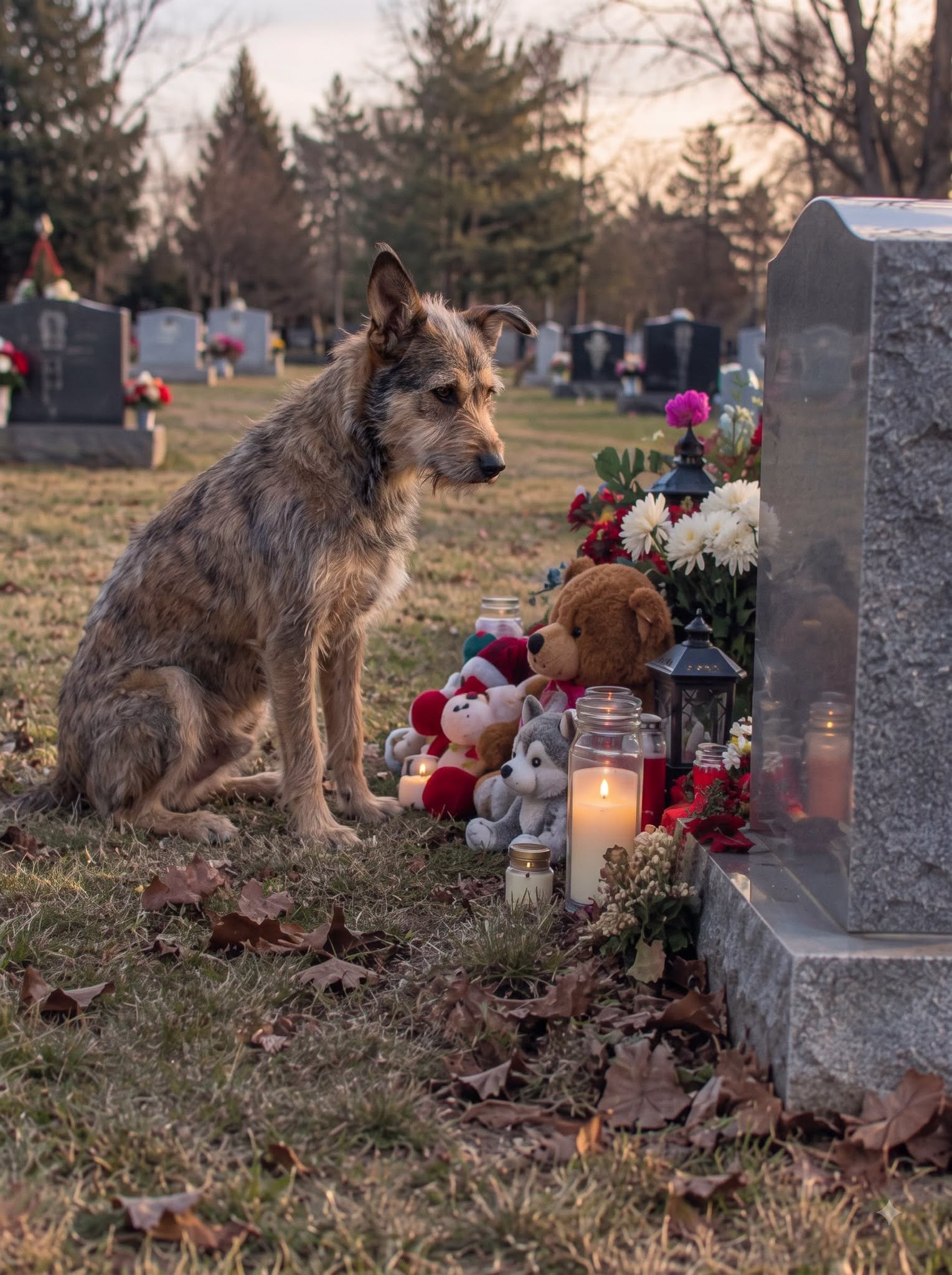
For months, a scruffy stray lay beside my son’s grave every Sunday—then vanished before I could see where he went. Last week, I followed him across town to a dead-end street. When the door opened, a little boy with my son’s crooked eyebrow looked up at me and asked, “Who’s that?”
Part 1: The Dog by the Headstone
My name is Diane. Three years ago, my son Caleb died in a car accident, and most mornings it still doesn’t feel real.
People think three years is long enough to understand something like that.
It isn’t.
Some mornings, I open my eyes and reach for my phone before my mind catches up. For one soft, stupid second, I’m waiting for him.
A late-night question.
A blurry photo of some awful meal he was proud of cooking.
A text that says, Mom, can you send me $20? I don’t know where my money went.
Then I remember.
Caleb is gone.
Some days that truth settles over me quietly, like a blanket. Other days it hits like it’s brand new, and I have to sit on the edge of the bed until my hands stop shaking.
He was nineteen.
Young enough that half his life was still in my house. His old sneakers sat by the garage door for months because I couldn’t make myself move them. His hoodie hung behind his bedroom door, and for a long time it still smelled like his detergent. I used to open the door just to breathe it in, then close it fast, as if the smell might run out.
Eventually, I packed some things away.
Not everything.
Grief makes you strange about objects. A chipped coffee mug becomes sacred. A crumpled grocery receipt becomes impossible to throw away because your child scribbled something on the back of it.
The cemetery became the only place where I stopped pretending I was doing better than I was.
I went every Sunday.
At first, I went because staying home felt worse. Then it became the shape of my week. Same coffee from the same little shop near my house. Same drive across town. Same parking spot under the row of old oaks. Same path to Caleb’s grave.
Sometimes I brought flowers. Sometimes I just talked.
“I ran into your old friend Marcus at the grocery store.”
“Your aunt still makes enough food for forty people at Thanksgiving.”
Once, after my car battery died, I stood beside his headstone and said, “You would’ve laughed so hard at me. I spent twenty minutes looking for the hood release.”
Talking to a grave sounds strange until someone you love is inside one.
Then it’s the most natural thing in the world.
That’s where I first saw the dog.
I assumed he belonged to another visitor. He was medium-sized, with patchy brown-and-gray fur that looked like someone had trimmed it with kitchen scissors. One ear stood straight up. The other folded over at the tip, like it had given up halfway. He wasn’t starving, but he was thin enough to make me wonder when he’d last had a real meal.
He didn’t bark when I came up the path.
He just lifted his head and watched me.
“Hey there, buddy,” I said.
His dark eyes followed me all the way to Caleb’s grave, and that’s when I realized where he’d been lying.
Right beside Caleb’s headstone.
Not near it. Beside it. Pressed against the stone the way a dog lies against someone’s leg.
When I knelt down, he moved a few feet away. But he didn’t leave.
I set the flowers down and glanced at him.
“Did you know him?” I asked quietly.
He tilted his head.
And I laughed. Out loud. In a cemetery.
It was the first time in months anything in that place had made me want to smile.
After that, I saw him almost every Sunday. Sometimes curled up in the grass. Sometimes sitting upright like a guard. Sometimes asleep with his nose tucked between his paws, right where Caleb’s name was carved.
He never begged. He never followed me. He never asked for anything.
He simply stayed with my son.
I started carrying dog treats in my purse. He took them carefully, the way a polite child accepts candy from a stranger.
“You’re getting expensive, you know,” I told him one morning.
His tail thumped the grass once.
Just once.
I thought about that tiny tail thump for the rest of the day.
But underneath the comfort, something bothered me, and I couldn’t name it.
The cemetery was huge. Hundreds of graves. Families came and went with balloons and photographs and little solar lights. There were a dozen places a stray could have chosen to nap.
And yet he always chose Caleb.
One morning, I stopped the groundskeeper, an older man named Edwin who’d worked there long enough to know most of the regulars by face.
I nodded toward the dog. “Does he belong to anyone?”
Edwin squinted across the grass and shrugged. “He’s been coming around a while now. Nobody seems to know where he’s from.”
“Nobody feeds him?”
“Not that I’ve seen.”
“He doesn’t sleep here?”
Edwin shook his head. “Shows up, stays a while, then he’s gone.”
That only made it worse.
I started watching him more closely. He always seemed calm. But every so often, he’d lift his head and stare toward the cemetery gates, as though he were waiting for someone who was running late.
And every single time, before I left, he disappeared.
I never once saw where he went.
One Sunday, I walked back to my car, put my hand on the door handle, and just stood there. I turned around.
He was still lying beside Caleb.
I drove home, and I couldn’t stop thinking about him all week. Where did he go? Who did he go to? Why my son?
So last Sunday, I didn’t leave when I usually did.
I sat on a bench two rows back, coffee going cold in my hands, and I waited.
Just after noon, the dog stood up. He stretched, long and slow. He pressed his nose against Caleb’s headstone for one quiet second, almost like a goodbye.
Then he turned and trotted toward the gates.
I set my coffee down on the bench and followed him.
I didn’t know it yet, but that dog was about to lead me straight to a secret that had been kept from me for three long years.
Part 2: The House at the End of the Street
I kept my distance. Far enough that he wouldn’t notice me. At least, I hoped so.
He crossed the road outside the cemetery and kept going down the sidewalk. I expected him to wander, the way strays do. To sniff at a trash can or stop to scratch.
He didn’t.
He moved like he had somewhere to be. No hesitation at the corners. No looking around. He cut through streets I didn’t recognize, past a shuttered gas station, down a narrow alley behind a row of houses I’d never once had a reason to drive past.
More than once, I almost turned around.
“This is ridiculous,” I muttered under my breath.
I was a fifty-one-year-old woman in church shoes, following a stray dog through strange neighborhoods on a Sunday afternoon. If anyone I knew had seen me, they’d have called my sister.
But every time I slowed down, he kept going. And there was something in the certainty of his steps that pulled me after him like a thread.
The neighborhood changed as we walked. The lawns got smaller. Paint peeled from porch railings. A couple of cars sat under faded tarps. A bicycle with no front wheel leaned against a chain-link fence.
The dog crossed another street without even checking for traffic. My heart jumped into my throat, and I hurried after him.
“Where are you going?” I whispered.
He didn’t answer, of course.
Almost twenty minutes later, he stopped.
It was a small, tired-looking house at the very end of a dead-end street. One shutter hung crooked. The porch steps were cracked at the edges. A plastic tricycle lay on its side in the patchy yard.
The dog walked up the steps, scratched twice at the front door, and sat down to wait.
Like he’d done it a thousand times.
I stopped at the edge of the sidewalk. My heart was pounding, and I honestly couldn’t have told you why.
Suddenly the whole thing felt foolish. Intrusive, even. Whatever mystery I’d built up in my head all week probably had a perfectly ordinary answer. Maybe he belonged to an elderly man who let him roam. Maybe some family just didn’t believe in leashes.
Maybe there was nothing here for me at all.
I had actually started to turn away when I heard it.
A floorboard creaked inside.
The dog stood up, tail swinging.
And for no reason I could explain, my stomach tightened into a knot.
The door opened a few inches.
I froze in the middle of the sidewalk.
Standing in that doorway was the last person on earth I ever expected to see.
“Ms. Diane?”
It took me several seconds to place the face. Older. Thinner. Dark hair pulled back in a loose knot.
“…Sadie?”
Her eyes went wide.
Sadie had dated Caleb his senior year of high school. She was seventeen then, and he was eighteen, and for almost a year she was everywhere. At my dinner table. On my couch for movie nights, stealing the blanket. On the back steps with Caleb, whispering about whatever teenagers are so sure adults could never understand.
Then they broke up.
Caleb barely talked about it. A few months later, Sadie disappeared from our lives completely. She didn’t come to the funeral. I remember looking for her face in the crowd and not finding it, and being too numb to wonder why.
Now here she was, three years older, gripping the edge of a door.
The dog pushed past her legs and trotted inside like he owned the place.
Sadie looked after him. Then back at me.
“What are you doing here?”
I swallowed. “I followed your dog.”
Something changed in her face. She glanced over her shoulder, into the house. Then back at me.
“You followed Jasper?”
“Is that his name?”
She nodded slowly.
I almost laughed, I was so confused. “Sadie, he’s been lying on Caleb’s grave. Every Sunday. For months.”
The color drained out of her face.
She didn’t say anything for a long moment. Then she opened the door wider.
“You should come inside.”
Every instinct in my body told me something was wrong.
I stepped onto the porch anyway.
The front room was small but clean. A worn couch against one wall. A television. And near it, a plastic crate stuffed with picture books.
I noticed the books right away.
Then I noticed the tiny blue sneakers by the hallway. Velcro straps. A dinosaur on each heel.
My chest went tight.
“Sadie… do you have a child?”
She went completely still.
Before she could answer, a small voice called from the back of the house.
“Mommy?”
Sadie closed her eyes.
And a little boy came around the corner.
He was maybe three, in dinosaur pajamas even though it was the middle of the afternoon. His brown hair stuck straight up on one side, like he’d just woken from a nap.
He stopped short when he saw me.
And I forgot how to breathe.
Because I knew that face.
The shape of his mouth. The color of his eyes. And the way his left eyebrow lifted just a little higher than the right when he was confused.
Caleb used to make that exact face. From the time he was a baby until the last week of his life.
The little boy pointed straight at me.
“Mommy,” he said. “Who’s that?”
Part 3: Three Years of Silence
Sadie’s voice shook. “This is Diane, baby.”
The boy grinned. “Hi.”
I couldn’t answer him. I couldn’t do anything. I just looked at Sadie.
“No,” I said.
Her eyes filled. “Diane—”
“No.”
“I wanted to tell you.”
My hands had started to tremble. “Tell me what?”
She looked down at the little boy. “Beau, sweetheart, can you go play with Jasper for a minute?”
He hesitated. “Can I have crackers?”
“Yes.”
“Two?“
Sadie managed a weak smile. “Two.”
He padded off toward the kitchen, and Jasper followed right at his heels, the way a dog follows someone he’s decided to keep safe.
I waited until they were gone. Then I turned to her.
“Tell me.”
Sadie sat down slowly on the couch. I stayed standing. I don’t think my legs would have let me bend.
“Beau is Caleb’s son.”
The room tilted.
I grabbed the back of a kitchen chair so hard my knuckles went white.
“What?“
Sadie wiped her face with the heel of her hand. “I found out I was pregnant after the accident.”
Every sound in that house went far away and sharp at the same time. The refrigerator humming. A dog collar jingling in the kitchen. A cabinet door opening. A little voice counting, one… two…
I could hear all of it.
But I could barely understand the young woman sitting five feet in front of me.
“You’ve known,” I said, “for three years.”
“I didn’t know before he died. I swear to you, I didn’t.”
“But you knew after.”
She dropped her eyes. “Yes.”
“And you never told me.”
Her face crumpled. “I was scared.”
“Scared of what?”
“Everything.” Her voice cracked right down the middle. “My parents were furious. Caleb and I weren’t even together anymore. I was eighteen and pregnant, and then he was just… gone.” She pressed both hands over her face. “I didn’t know what to do.”
I wanted to be angry.
And I was. God, I was.
Three years.
Three birthdays. Three Christmases. Three years of sitting beside a cold stone and begging the universe for just one more piece of my son.
And all that time, a piece of him was living twenty minutes across town. Eating crackers. Wearing dinosaur pajamas. Growing.
“Why didn’t you come to me?” I asked.
She looked up at me with wet, frightened eyes. “Because I thought you’d hate me.”
“Why would I hate you?”
“Because Caleb and I ended badly.”
I shook my head. “That had nothing to do with me.”
“It felt like it did back then.” She glanced toward the kitchen. “And my parents told me not to contact you. They said you’d already suffered enough.”
A sound came out of me that was almost a laugh, but it broke in half.
“Suffered enough?“
“I know—”
“No, Sadie. You don’t know.”
She flinched like I’d slapped her.
I hated that I’d hurt her. I hated it. But I couldn’t stop, because three years of grief had nowhere else to go.
“Do you understand how many Sundays I sat by my son’s grave wishing I had one more piece of him?”
Tears slid down her cheeks. “Yes.”
“While his son was here?”
“I almost called you a hundred times,” she whispered. “I had your number written on a sticky note on the fridge for a whole year.”
“Then why didn’t you?”
She looked toward the hallway, where the little sneakers sat.
“Because every month I waited made it harder. And then it had been so long that I didn’t know how to explain the waiting.”
That answer hurt more than anything else she’d said.
Because I understood it.
Grief does exactly that. One impossible day turns into a week. A week turns into a month. And before you know it, you’re three years into a silence that started with one moment you couldn’t face.
I sank into the chair across from her.
My anger hadn’t gone anywhere. It was still sitting right there in my chest, hot and heavy.
But something else had come into the room with it. Something fragile I was almost afraid to look at directly.
Wonder.
“Does he know?” I asked quietly. “Does Beau know about Caleb?”
Sadie nodded. “I tell him about his daddy all the time.” She reached for her phone. “I have pictures. I show him.”
My throat closed up. “Pictures?”
“Of Caleb. Of us. Some from school.”
She opened a folder and handed me the phone.
There was Caleb at eighteen, grinning so wide his eyes nearly disappeared. There was Sadie, leaning into his shoulder.
And then there was Beau, at a birthday party, frosting on his chin.
Same grin.
Same crooked eyebrow.
I covered my mouth with my hand.
“Oh, Caleb,” I whispered. “Oh, sweetheart.”
Sadie was crying openly now. “I’m so sorry, Diane. I’m so, so sorry.”
I handed the phone back very carefully, as though it might break. I needed something else to hold on to, something that wasn’t this, because if I kept looking at that little face I was going to fall apart on her living room floor.
So I asked the only other question I had.
“And the dog? How does Jasper fit into any of this?”
Sadie wiped her eyes and looked toward the kitchen, where Jasper was lying on the linoleum with his head on Beau’s foot.
For the first time since I’d walked in, something close to a smile crossed her face.
“Diane,” she said softly, “you really don’t recognize him, do you?”
Part 4: The Sunday I Didn’t Go Alone
I stared at her. “Recognize him? I’ve never seen that dog in my life before this year.”
“You’ve never seen him,” Sadie said. “But you’ve been feeding him.”
I blinked.
“Jasper was Caleb’s,” she said. “Not officially. Caleb found him behind the grocery store the summer before senior year. Skin and bones. Wouldn’t let anyone near him except Caleb.”
And just like that, a memory rose up out of nowhere.
That summer. Caleb coming home late, again and again, with grass stains on his jeans and a look on his face like he was hiding a joke.
The big bag of dog food in our garage that kept mysteriously getting lighter.
I’d assumed he was feeding a neighbor’s dog. I’d even teased him about it. You know the Hendersons can afford their own kibble, right?
He’d just smiled and said, “Yeah, Mom. I know.”
“He kept Jasper behind my parents’ shed for weeks,” Sadie went on. “He snuck out every night to sit with him. Then my dad finally gave in and let me keep him.” She laughed through her tears. “Caleb said Jasper was ours. Like a test run.”
I looked toward the kitchen.
At that scruffy, mismatched dog with the folded ear, lying protectively at my grandson’s feet.
“That’s why he goes to the cemetery,” I whispered.
Sadie nodded. “I took him once, right after the funeral. I stood at the back where you couldn’t see me. He must have remembered the way. A few months ago, he just started disappearing every Sunday. I never knew where.”
Suddenly, every single Sunday made sense.
Jasper hadn’t picked a random grave.
He hadn’t been wandering.
He’d been visiting someone he loved and missed.
Just like I had.
All those months, the two of us had been sitting at the same headstone, grieving the same boy, never knowing we were family.
Beau wandered back into the room holding two crackers, one in each fist. He climbed up onto the couch beside his mother and studied me with Caleb’s serious, curious eyes.
“Mommy says my daddy was funny.”
I laughed, and it came out wet. “He was. He was so funny.”
Beau smiled. “Did you know him?”
I looked at Sadie. She nodded, tears still running down her face.
I got down on my knees in front of him, so we were eye to eye.
“I knew him very well.”
“How?”
My voice cracked right in half.
“Because he was my little boy.”
Beau thought about that very seriously, the way small children think about big things. I watched his eyebrow go up, then come back down.
Then his whole face lit up.
“So you’re my grandma?”
I couldn’t speak.
I could only nod.
He leaned forward and threw his arms around my neck. It was clumsy and sticky and immediate. One small arm wrapped tight around me while the other hand still clutched a cracker against my shoulder.
I closed my eyes and held on.
For three years, I’d believed that accident took every future version of Caleb away from me. His wedding. His children. The man he would have grown into. The gray hairs I’d never get to tease him about.
I’d been wrong.
Not about everything. But about that.
Sadie and I talked that evening until the light outside the window went gold, then gray. Nothing was fixed in a single afternoon. There was still anger to work through, on both sides. There were questions she couldn’t answer, and three years that neither of us could ever get back.
But before I left, she wrote her number on the back of an old envelope and pressed it into my hand.
And Beau, standing in the doorway in his dinosaur pajamas, asked if I would come back.
“Yes,” I told him. “As soon as your mommy will let me.”
Jasper walked me to the end of the porch steps and sat down, watching me go, the same way he’d watched me walk away from Caleb’s grave all those Sundays.
Only this time, I knew where to find him.
The next Sunday, I went to the cemetery like always.
Same coffee. Same drive. Same row of old oaks.
But this time, I didn’t walk that path alone.
Sadie walked beside me, quiet and nervous. Beau held my hand, swinging it and asking about every stone angel we passed. And Jasper ran ahead and settled into his usual spot, right beside the headstone, as if he were saving us a seat.
I knelt down and touched my son’s name. And I smiled through my tears.
“You know, Caleb,” I said, “you really could’ve found an easier way to introduce us.”
Jasper lifted his head.
Beau giggled, like he was in on the joke.
And for the first Sunday in three years, I didn’t leave that cemetery carrying only grief.
I left holding my grandson’s hand.