
PART 1: FOUR DAYS WITHOUT DADDY
Seven-year-old Emma Bennett had been alone inside a small rental house on Willow Lane for days when she finally called emergency services. Rain hammered the outskirts of Tulsa, Oklahoma, while her exhausted voice reached dispatcher Ethan Brooks with a sentence that immediately made him realize something was seriously wrong.
“Daddy said he’d only be gone for half an hour.”
“What’s your name, sweetheart?”
“Emma.”
“And how old are you, Emma?”
“Seven.”
Ethan checked the address on his monitor and gently asked whether there was another adult with her. After several seconds of silence, Emma admitted she was completely alone and explained that her father had left to buy medicine and food but had never returned.
“Where’s your dad?”
“He went to get my medicine and some food. He said he’d come right back.”
“But he never came home.”
Emma couldn’t remember exactly when her father had left or the last time she’d eaten a proper meal. There had been soup in the kitchen, but it smelled strange, so she had survived mostly on tap water while waiting for him to come through the door.
“There was soup in the kitchen. But it smelled funny. So I didn’t eat it.”
“I drank water from the sink.”
“Anything else?”
“I shared some with Mr. Teddy.”
“Who’s Mr. Teddy?”
“My bear.”
Ethan immediately sent Officer Rachel Morgan to the house while keeping Emma on the line. Despite being hungry and exhausted, the little girl’s biggest concern was whether her father would be angry that she had called someone for help.
“Emma, listen carefully. Someone is coming to help you right now. Her name is Officer Rachel Morgan. Can you stay on the phone with me until she gets there?”
“Okay.”
“Will Daddy be mad that I called?”
“No. I think your dad would be proud of you.”
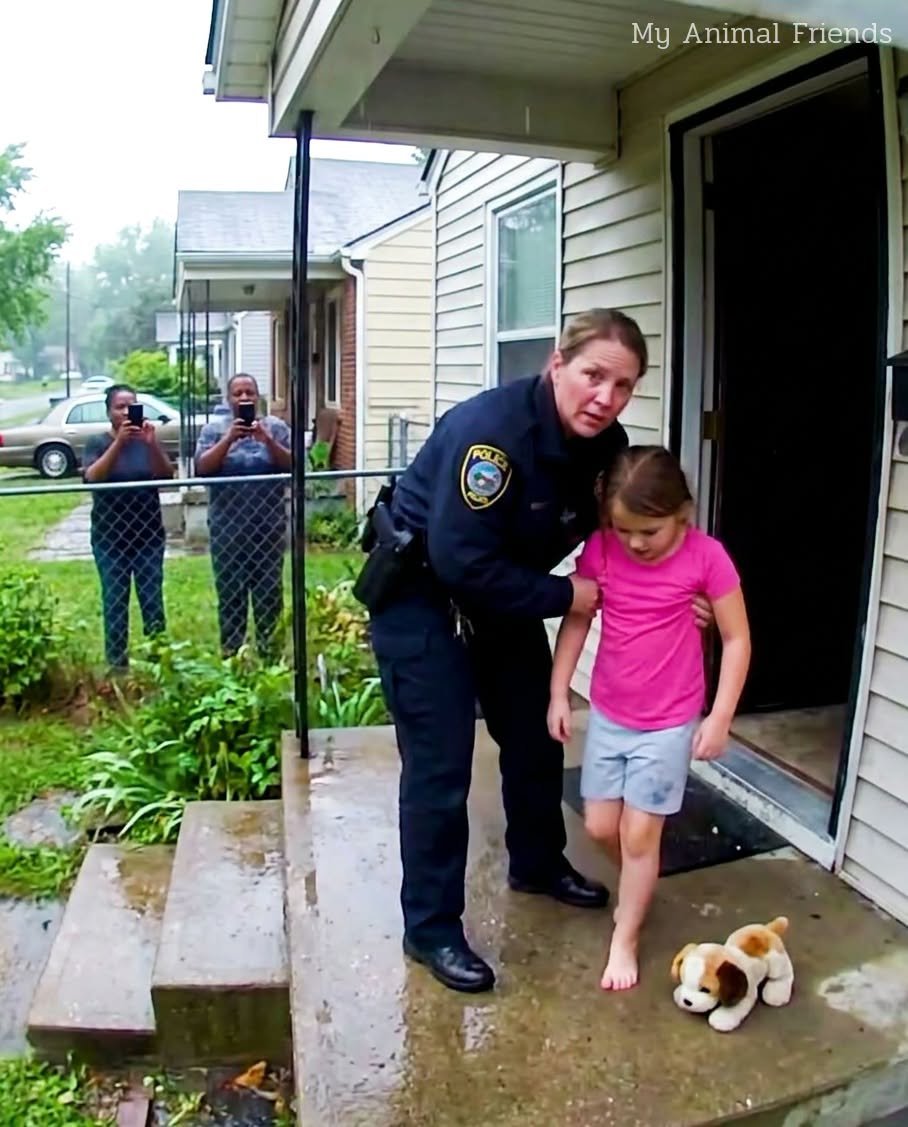
Twenty minutes later, Rachel arrived at the aging white house as the storm worsened. After several knocks, the door finally opened a few inches and one frightened eye appeared through the gap, followed by a question that immediately revealed how scared Emma had become.
“You’re not gonna yell at me, are you?”
“No, sweetheart. Nobody’s going to yell at you.”
When Emma finally opened the door, Rachel saw a barefoot seven-year-old wearing an oversized adult T-shirt. Her lips were dry, dark circles surrounded her eyes, and her thin, exhausted appearance made her look much younger than she really was.
“Can I come in?”
Emma nodded.
Inside, Rachel found almost nothing in the refrigerator, but the rest of the house complicated the obvious assumption that Tyler Bennett had deliberately abandoned his daughter. A grocery list on the kitchen table included rice, chicken soup, electrolyte drinks, and Emma’s medicine, while another note reminded Tyler about an urgent appointment with Dr. Parker.
The evidence didn’t resemble a father preparing to disappear. Instead, it looked as though Tyler had been interrupted in the middle of trying to care for his sick daughter, leaving ordinary plans unfinished because something unexpected had happened.
Outside, however, neighbors had already begun gathering and forming their own conclusions. Some watched from windows while others stood beneath umbrellas, and it took only minutes before sympathy for Emma turned into judgment of a father whose whereabouts nobody actually knew.
“I knew that man couldn’t handle raising a kid alone.”
“Poor child.”
Rachel ignored the speculation and asked Emma whether she had spoken with anyone since Tyler disappeared. Emma repeated that her father had only gone to buy medicine and had promised to return quickly, words she seemed to have told herself countless times while waiting alone.
“Did he tell you where he was going?”
“To get medicine.”
“Anything else?”
“He said he’d be right back.”
Rachel carefully picked Emma up and was alarmed by how little she weighed. Before they could leave for the hospital, the child’s body suddenly went limp in her arms and her eyes closed, forcing Rachel to call urgently for paramedics.
“Emma?”
“Emma!”
“Dispatch, this is Officer Morgan. I need medical assistance immediately. Possible dehydration. Child is unresponsive.”
As paramedics treated Emma, Rachel took another look around the house. The grocery list, medical appointment, empty refrigerator, and unfinished household tasks all suggested Tyler expected to return, yet by the time the ambulance left Willow Lane, neighbors were already posting photographs and accusations online.
By sunrise, Emma’s story had spread far beyond the neighborhood. Thousands of strangers saw photographs of the frightened girl and her small house and quickly settled on the simplest explanation: a father had walked away and left his daughter to suffer alone.
At Children’s Mercy Hospital, Emma eventually regained consciousness with Mr. Teddy tucked beneath her arm. Nurse Jessica Reed was sitting nearby, but Emma immediately asked the only question that mattered to her.
“Where’s Daddy?”
“We haven’t found him yet.”
“Oh.”
Officer Rachel later arrived with social worker Denise Harper and pediatric specialist Dr. Matthew Parker. When Dr. Parker saw the appointment note recovered from Tyler’s house, he revealed that Tyler had contacted him three times during the previous week because Emma had been experiencing stomach problems.
“She’d been having stomach problems for weeks. He sounded exhausted. Worried. Desperate.”
“Desperate enough to abandon her?”
“No.”
“That man wasn’t trying to leave his daughter.”
Investigators returned to Willow Lane and found more evidence that Tyler’s life had been interrupted rather than abandoned. Damp laundry remained inside the washing machine, Emma’s backpack was already packed for school, Tyler’s wallet and house keys were still in his bedroom, and his calendar contained reminders about work, groceries, medicine, and Emma’s medical appointments.
Then Walter Greene, an elderly neighbor, approached investigators and admitted he had seen Tyler on the night he disappeared. Tyler had been running toward the highway because he needed to get Emma’s medicine, and shortly afterward Walter heard tires followed by a crash, but he never went outside to investigate.
“Why didn’t you tell anyone?”
“Because around here people don’t like getting involved. I figured somebody else would’ve called.”
Walter lowered his eyes.
“Maybe if I’d gone to check…”
That evening, Emma sat in her hospital bed drawing pictures of herself, Mr. Teddy, and Tyler together. When Jessica commented on how much she seemed to trust her father, Emma answered with complete certainty.
“Because he always comes back.”
Minutes later, Jessica received a strange telephone call filled with static. A weak male voice struggled through the connection and asked only about a little girl named Emma.
“Please tell me… Tell me if my little girl is okay.”
“Who is this?”
“My daughter. Emma…”
“Sir, what’s your name?”
The connection began failing.
“Is Emma alive?”
The line disconnected before Jessica could learn anything else. When she rushed into the hallway and told Rachel and Denise what had happened, Emma appeared in the doorway clutching her teddy bear and insisted she already knew who had called.
“That was Daddy.”
“Sweetheart, we don’t know that yet.”
“Yes, we do. No one says my name like that.”
“Daddy always calls me Sunshine. If it’s him, ask him.”
Moments later, Rachel received a call from a medical center nearly fifty miles away. An unidentified man had been admitted unconscious after a serious traffic accident during the storm, and after finally regaining consciousness, he had begun repeating the same desperate message.
“We believe we may have someone you’re looking for.”
“My daughter is alone.”
“I need to get back to Emma.”
After four days of accusations, the evidence was finally pointing toward a very different explanation for Tyler’s disappearance. Investigators were only minutes away from confirming whether the unidentified injured man was Emma’s father when the hospital-room door suddenly opened and someone rushed inside with the answer they had all been waiting for.
PART 2: THE FATHER EVERYONE BLAMED WAS FIGHTING TO GET HOME
The person who rushed into Emma’s hospital room was Melissa Bennett, Tyler’s younger sister. Her hair was disheveled and her face was streaked with tears, making it obvious she had driven a long distance without stopping after learning what had happened.
“Aunt Melissa?”
Melissa hurried across the room and carefully embraced her niece.
“Oh, Emma… I’m so sorry.”
Emma immediately pulled back and searched her aunt’s face for the only answer she cared about.
“Did you find Daddy?”
“Yes.”
Emma tightened her arms around Mr. Teddy while everyone in the room waited for Melissa to continue.
“Where is he?”
Melissa swallowed before answering.
“He’s alive.”
Emma immediately began crying with relief. She had spent four days waiting while strangers accused Tyler of abandoning her, yet she had never accepted that explanation herself.
“I knew it. I knew he didn’t leave me.”
“No, sweetheart. He never left you.”
Over the next several minutes, investigators finally reconstructed what had happened. On the night Tyler disappeared, he had left during the storm because Emma needed medicine and he wanted to reach the pharmacy before it closed, despite having little money, almost no gas, and terrible weather outside.
Near the highway, Tyler had been hurrying across an intersection when a pickup truck lost control in the heavy rain and struck him. Emergency crews found him quickly, but because he had rushed out without his wallet or identification and his phone had been badly damaged, nobody knew who he was.
Tyler was transported unconscious to a regional hospital almost fifty miles from home. While Emma remained alone waiting for him, her father spent days unconscious with no way to tell anyone that his seven-year-old daughter was by herself.
When Tyler finally regained consciousness, doctors discovered that he had suffered a concussion, a fractured arm, and other injuries that left his memory confused. He couldn’t clearly remember everything surrounding the accident, but three things remained fixed in his mind: Emma, the medicine he had gone to buy, and his promise to return home.
Even before his memory fully returned, hospital workers repeatedly heard him saying the same things.
“My daughter is alone.”
“I need to get home.”
“My daughter is waiting.”
As soon as Tyler became coherent enough to communicate, he began contacting hospitals, shelters, emergency dispatch centers, and any public service that might know where Emma had been taken. He didn’t know that she was already safe at Children’s Mercy Hospital; he only knew that every hour he remained away was another hour his daughter might believe he wasn’t coming back.
Eventually, one of those desperate calls reached the correct hospital. Once Tyler’s identity was confirmed and his condition allowed it, arrangements were made to transfer him so father and daughter could finally see each other again.
For the next two hours, Emma sat on the edge of her hospital bed holding Mr. Teddy. Every time footsteps approached the room, she looked toward the door, and every time they continued down the hallway, she quietly returned to waiting.
Late that evening, another set of footsteps finally stopped outside.
The door opened and a wheelchair entered the room. Tyler looked very different from the father Emma remembered leaving home days earlier, with his face pale, injuries visible around his forehead, one arm supported in a sling, and exhaustion showing across his features.
Emma recognized his eyes immediately.
“Daddy!”
Tyler’s composure disappeared the instant he saw her.
“My Sunshine…”
Emma climbed from the bed and wrapped her arms around him while Tyler held her tightly with his uninjured arm. Neither wanted to let go, and for several moments the adults in the room simply watched them cry together.
“I’m sorry. I tried to come back.”
“I know.”
“I really tried.”
“I know.”
“Every day.”
“I know.”
Tyler buried his face against his daughter’s hair. For four days, he had been trapped in a hospital without knowing whether Emma was safe, while Emma had been trapped inside a house believing that something terrible must have prevented the father who always kept his promises from returning.
“I thought you’d be scared.”
“I was.”
Tyler’s voice weakened as he finally admitted the fear that had haunted him since regaining consciousness.
“I thought you might think I left.”
Emma pulled away enough to look directly into his face.
“I never thought that.”
“You didn’t?”
“You always come back.”
There was no uncertainty in her answer. While neighbors, strangers online, and even some adults involved in the case had been willing to believe Tyler had abandoned his daughter, Emma had held onto the one thing she knew about her father better than anyone else did.
Tyler hadn’t walked away from her. He had nearly lost his life trying to bring home the medicine she needed.
In the days that followed, the same people who had condemned Tyler began learning what had actually happened. The father they had called irresponsible had left home for his sick daughter, been struck during a storm, spent days unconscious without identification, and awakened with one thought dominating everything else.
“My daughter is alone.”
But surviving the accident was only the beginning. Tyler still had injuries to recover from, Emma had spent four frightening days alone, and the small neighborhood that had judged him so quickly would soon have to face the father it had already convicted without ever knowing the truth.

PART 3: THE WAY HOME
After Tyler and Emma were finally reunited, the people who had spent days judging him began to understand how badly they had misread the situation. Neighbors from Willow Lane, hospital staff, and officers stood outside the room watching a father cling to the daughter he had been desperately trying to reach, and the accusations that once felt certain suddenly looked embarrassingly fragile.
Walter Greene, the neighbor who had heard the crash but never checked what happened, stood quietly near the doorway with his cap in his hands. He looked toward the others and admitted what nobody wanted to say first.
“We got it wrong.”
After a pause, he added the part that mattered more.
“We all got it wrong.”
The community had built an entire story before learning the facts. Tyler had been turned into a negligent father, Emma became a headline, and a terrible accident was reduced to gossip by people who had never asked what might have actually happened.
Over the following days, many of those same neighbors deleted their social-media posts and began apologizing. The accusations disappeared quickly, but the damage they revealed remained because Tyler had now seen how easily people could decide who he was without ever knowing his story.
A week later, Emma was finally cleared to leave the hospital. Tyler still needed follow-up treatment and physical therapy for his injuries, but doctors were optimistic about his recovery, and most importantly, father and daughter were finally going home together.
When their car turned onto Willow Lane, both of them were stunned by what they saw. Residents lined the street, children held handmade welcome-home signs, and several neighbors had spent days cleaning the yard, repairing the damaged porch steps, stocking the refrigerator, hanging fresh curtains, and repainting the front porch.
“Daddy…”
Tyler looked around but couldn’t immediately find the words to answer. He had spent days fighting to return to that house, yet now the same neighborhood that had condemned him was trying, however imperfectly, to repair some of the harm it had caused.
As Tyler and Emma walked toward the front door, apologies came from every direction. Some neighbors spoke quietly, others cried, and a few struggled awkwardly through words they clearly hadn’t prepared.
Tyler accepted the apologies without turning the moment into another confrontation. He had every reason to be angry, but bitterness required energy he would rather spend rebuilding a normal life with Emma.
That evening, after everyone finally left, Emma sat at the kitchen table drawing. When she finished, she carefully taped the picture above the front door where Tyler would see it every time he walked into the house.
The drawing showed three figures: a little girl, a teddy bear, and a father with one arm in a sling. Across the top, Emma had written in oversized crayon letters:
Daddy, your Sunshine is home.
Tyler stood beneath the picture for a long time, struggling to keep his emotions under control. Denise, who had stopped by one final time, gently touched his shoulder and looked toward Emma.
“You know, a lot of people think kindness has to be earned.”
Tyler turned toward her.
“But sometimes people simply need it.”
He nodded and looked across the room at his daughter. She had been the reason he left home during the storm, the reason he fought his way back to consciousness, and the reason he refused to stop calling until someone finally helped him find her.
A few minutes later, Emma approached carrying a small wooden flashlight keychain Melissa had bought at the hospital gift shop. She placed it carefully into Tyler’s hand.
“What’s this for?”
Emma smiled.
“So you never get lost again.”
The answer nearly made Tyler cry all over again. He pulled her into another hug and held her close.
“No matter what happens, I will always find my way back to you.”
Emma rested against his shoulder.
“I know.”
In the months that followed, Willow Lane changed in ways nobody had expected. Neighbors became more willing to check on struggling families, ask questions when something seemed wrong, and offer help before turning uncertainty into judgment.
If someone seemed overwhelmed, people knocked on the door instead of watching from across the street. If a child unexpectedly disappeared from school, somebody checked whether the family needed help rather than immediately inventing an explanation.
Emma’s story had reminded them that absence did not always mean abandonment and silence did not always have an obvious explanation. Sometimes the person everyone assumes has walked away is actually fighting harder than anyone realizes to come back.
For Emma, however, the lesson was much simpler. She had never needed the neighborhood, social media, or investigators to tell her what kind of father Tyler was.
She had known it all along.
No matter how long the storm lasted or how frightening the waiting became, Emma never stopped believing the promise hidden inside the words she had repeated from the beginning.
Her father always came back.
And in the end, he did.