
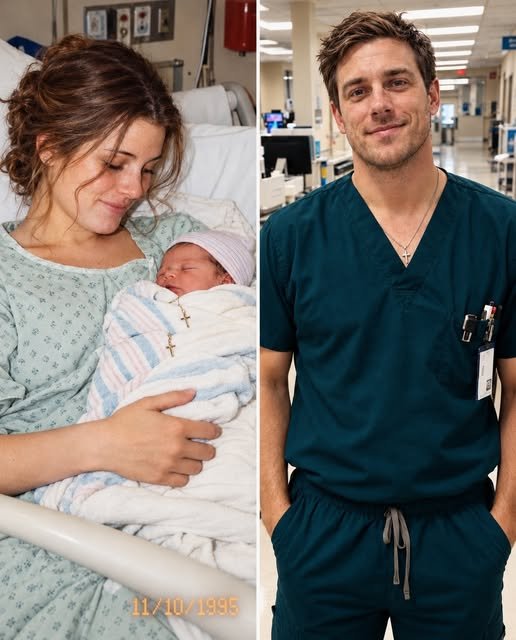
I was 18 when I tucked my grandmother’s silver cross into my newborn son’s blanket. An hour later, my parents walked in with a folder and said, “Sign them or don’t come home.” For 31 years, I searched for him. Then, the day after emergency surgery, my surgeon bent over my chart—and that same cross slipped out of his collar.
Part 1: The Yellow Room We Never Painted
The day I told my parents I was pregnant, my mother dropped the dish towel into the sink and didn’t pick it up.
My father pushed back from the kitchen table so hard his chair hit the wall and left a mark in the paint. That mark stayed there for years. Every time I passed it, I remembered the sound.
“Who did this to you?” he shouted. “Give me his name, Rachel. I want his name.”
My hand went straight to my throat, to the silver cross I’d worn every day since my grandmother died. It had been hers first. Her initials were engraved on the back—E.M., for Eleanor Mae—and the M had been cut a little crooked, so the last leg nearly ran off the edge.
“No,” I said. “I’m not telling you.”
I had never said no to my father like that. Not once in eighteen years.
My mother pointed a wet finger at me. “Don’t you dare speak to your father that way. After everything we’ve done for you.”
Dad leaned over the table on both palms. “I’ll talk to his parents myself. We’ll clean up this mess.”
This mess. That was what they called my baby.
I laid my hand flat over my stomach. “I’m keeping it.”
“With what?” Dad said. “You have no money. You have no home except this one. Think about that before you start making demands.”
But he was wrong about one thing. I wasn’t alone. I had Daniel.
A week earlier, in the cab of his old Ford Ranger behind the Dairy Queen, I’d told him. He’d gone quiet first, worried. Then he’d laughed out loud and pulled me across the bench seat into a hug that knocked my head against the window.
“I’m going to be a dad,” he kept saying, like he was trying the words on.
We’d talked until the parking lot lights clicked off. We’d make a plan. He was working nights stocking shelves at a hardware store, and he’d been saving.
“A one-bedroom,” he said. “Something small. I’ll paint the baby’s corner yellow.”
“What if I hate yellow?”
“Then you pick. I’ll still paint it.”
“Your parents are going to hate this.”
“So are yours. But they won’t be paying our rent.”
Then he’d put his hand over mine on my stomach.
“I’ll come for both of you. I promise.”
That night, after Dad finally gave up and sent me to my room, I waited until the TV came on downstairs. Then I slid my window open and climbed down onto the garage roof the way I’d done a dozen times.
Daniel had been hard to reach that week. I told myself it was the night shifts.
I ran the six blocks to his house on Maple Court and stopped on the sidewalk.
There was a FOR SALE sign stuck in the front lawn.
I knocked. Nobody came. I walked around the side and cupped my hands against the living room window. The plaid couch where we’d watched movies was gone. So were the curtains. The room was nothing but carpet and the pale squares where pictures used to hang.
Next door, Mrs. Kowalski was watering her rosebushes.
“They’re gone, hon,” she called. “Moved out. Didn’t leave an address.”
“When?”
“Saturday. Three days ago.”
I sat down on Daniel’s front step after she went inside.
He knew about the baby. Whatever he’d decided about me, how could he leave without one word?
I called his number from the pay phone outside the Marathon station. A recording told me it had been disconnected.
I didn’t know it then, but that disconnected number was the first piece of a lie that would take thirty-one years to come apart.
Part 2: The Kindest Trick
There was no one else to call. I couldn’t exactly ask my parents to help me find the boy they wanted to run out of town.
So I started looking for a way out on my own.
I circled ads in the Toledo Blade with a red pen. A room above a laundromat on Dorr Street was $275 a month. The woman on the phone sounded warm until I mentioned a baby was coming. Then she remembered the room was already taken.
I crossed it out.
I had $612 in my savings account from three summers of babysitting. First month, deposit, a crib, diapers. I wrote the numbers on the back of an envelope and kept adding them up, hoping they’d come out different.
Dad glanced over my shoulder at the kitchen table.
“That won’t buy you a roof and diapers,” he said, and walked away.
I turned the envelope over and kept going.
Then, about a month later, my parents changed.
It happened slowly enough that I believed it. Mom drove me to my ultrasound appointment and held my hand while the technician moved the wand around. Dad stopped leaving the room whenever I mentioned the baby.
One Sunday night, they sat me down at the table. The same table.
“We’ve been talking,” Mom said. “We’ll figure this out together. You won’t have to do it alone.”
“We’ll help you,” Dad said.
I looked from one to the other. “You mean I can bring him home? Here?”
Mom nodded.
I started crying before I could ask a single question. For weeks I’d been adding up money that never added up. Now somebody was telling me we’d manage.
I got a part-time job boxing doughnuts at Meyer’s Bakery, five mornings a week. Mom emptied the bottom drawer of the dresser in my room and lined it with a clean pillowcase. Dad asked, out of nowhere, whether we needed a crib or if a bassinet would do.
At night, I taught myself to crochet from a library book with a cracked spine. My first bootie came out lopsided, the heel bunched like a fist. I pulled it apart and started over. The second try was better. The third try, I finally kept.
When Mom helped me fold the tiny undershirts into the drawer, I scooted over on the carpet to make room for her.
I wanted this new version of us to last so badly that I never stopped to ask why it had arrived so suddenly.
I picked his name myself. Fabian. At night, lying on my side, I whispered it to my stomach.
“Hi, Fabian. It’s me.”
I stopped thinking about Daniel. He’d made his choice. I would make mine.
Fabian came in the middle of a February night, three weeks after I finished a pair of booties I wasn’t ashamed of. He was seven pounds, two ounces, red-faced, and furious about all of it.
When the nurse laid him on my chest, I forgot to be afraid.
She said she needed to take him down the hall for his newborn checkup. Before she lifted him, I reached up and undid the clasp of my grandmother’s cross. I tucked it into the fold of his striped hospital blanket.
“So you always have something from me,” I whispered into his hair.
It was a routine checkup. I leaned back on the pillow and listened for the squeak of his bassinet wheels coming back.
Instead, the door opened, and my parents walked in.
Dad was carrying a manila folder.
Part 3: Sign Them or Don’t Come Home
“What’s that?” I asked.
“Adoption papers,” Dad said.
I actually laughed. It made no sense. “You said you’d help me.”
“This is helping you,” Mom said.
I looked at her face, then his, and something cold settled in my stomach.
“You never changed your minds,” I said slowly. “The drawer. The crib. It was all so I wouldn’t run.”
Dad set the folder on my lap. He didn’t raise his voice. Somehow that was worse.
“Sign them, or don’t come home.”
I turned to my mother. “You lined his drawer. We folded his clothes together. On the floor. You and me.”
“You have to think about your future, Rachel.” She tapped the folder. “Sign.”
“I was thinking about it. That’s all I’ve been doing for nine months.”
I twisted the hospital sheet in my fists. And for one stupid second, I looked at the door, like Daniel might walk through it and say, I’m here, I came for both of you.
The door stayed shut.
“Give me one month,” I begged. “I’ll work double shifts. I’ll pay you rent.”
“And who watches the baby while you’re working doubles?” Mom said.
“Please. Just until I can arrange something.”
Dad uncapped a pen and held it out.
“You sign, or you’re out on the street. Tonight.”
I was eighteen. I had stitches. I had $612 and nowhere to go.
I signed.
My signature didn’t even look like mine. It looked like a stranger’s—someone who’d wanted this. That was the part I couldn’t stand. Anyone who ever read that page would believe I chose it.
They never brought him back to my room. Mom told me the next day that he’d been placed with a family. She wouldn’t say who, or where.
Nobody had taken a single photo of me holding him. It was as if he’d never existed.
I went home to an empty drawer. The booties were still in my hospital bag. I put one in my purse. The other one I laid in the drawer, on top of the little shirts, because I couldn’t stand for the drawer to have nothing of him in it.
Six weeks after my nineteenth birthday, I moved out with two trash bags and a box of dishes and started looking for my son.
I wrote to agencies. I called the county. I spent Saturdays in records offices that smelled like toner and floor wax. Over the years, I paid three different private investigators, the last one $1,800 I didn’t really have. He was the only one who told me something new.
“It’s strange,” he said, sliding the file back across his desk. “I can find your relinquishment. What I can’t find is an adoption that matches it. No placement. No agency. It’s like the paperwork stops.”
I thought it meant my parents had hidden him better than I could dig.
For thirty-one years, I kept digging anyway.
My parents never changed their story. Eventually, I stopped calling them. When my father died four years ago, I sent flowers to the funeral home and sat in the last pew.
The bootie moved from purse to purse with me. Once, a bottle of red nail polish shattered in my bag and soaked the heel. After that, I kept it sealed in a sandwich bag. On hard days, I’d hold it before I picked up a phone call about another lead that went nowhere.
Then, at forty-nine, I doubled over behind the front desk at the dental office where I’d worked for nineteen years. The pain was like someone had pulled a drawstring tight inside my stomach.
By that evening, I was in emergency surgery at St. Brendan’s.
The next afternoon, my surgeon came to check on me. He was young, tall, with tired eyes and a hospital badge clipped upside down. He leaned over to read my chart.
A silver cross slid out from under his collar and swung on its chain.
I saw a tiny nick on one arm of it.
On the monitor beside me, my heart rate jumped from 78 to 131, and the machine started to beep.
Part 4: The Man in the Doorway
The doctor glanced at the monitor, then at me. “Ms. Dawson? Are you in pain?”
I lifted one finger and pointed at his chest.
“Where did you get that cross?” My voice cracked. “I put that cross in my son’s blanket the day he was born.”
His hand closed over it. He didn’t answer right away. He looked at me the way doctors look at an X-ray they don’t like.
“What was your son’s name?” he asked.
“Fabian.”
He went completely still.
“What day was he born?”
“February ninth. 1995. Toledo General.”
He swallowed. Then, very carefully, as if he were afraid of the answer, he said:
“Did they ever tell you what really happened to him?”
“They told me he was adopted. That’s all they ever said.”
His thumb moved over the back of the cross. “What’s engraved on it?”
“My grandmother’s initials. E.M. And the M is crooked. It almost runs off the edge.”
All the color left his face. He pulled the visitor’s chair to the bed and sat down hard.
“I was that baby,” he said. “I wasn’t adopted. My father raised me.”
“Your father?” I tried to push myself up and the incision pulled. “Daniel? That’s impossible. Daniel left. He abandoned us.”
Fabian’s eyebrows rose. He leaned back, away from me.
“He’s not the parent who left me.”
It landed like a slap.
“I didn’t have a choice,” I said. “Whatever Daniel told you, it isn’t what happened.”
“You signed papers giving me up. I’ve seen them. What’s there to get wrong?”
“I had no choice!”
“There’s always a choice,” he said quietly.
“My father told me if I signed, I could come home. If I didn’t, I was on the street. With stitches. With a newborn. Daniel was gone. I was eighteen.”
He nodded slowly, but I couldn’t tell if he believed me or was just being polite to a patient.
“I searched for you,” I said. “I paid people to search for you. I thought they’d changed your name. I never imagined your father had you.”
Fabian stood up so fast the chair scraped.
“None of this makes sense. I need a minute. I need to make a call.”
“Wait—could you hand me my purse? Please.”
He found it in the narrow closet, set it on the tray table, and stepped into the hall, already dialing.
My boxes of records were at home: letters, receipts, investigator reports. Useless now. But there was one thing I always carried.
I found the sandwich bag and slid the bootie out.
It looked terrible. The yarn had faded from cream to the color of weak tea. The heel was stiff with old red polish. One loop had come undone near the cuff. I’d never washed it properly, afraid it would fall apart in the water.
I held it between my palms and finally cried.
Daniel had fed him. Daniel had driven him to school and sat up with him through fevers and signed his permission slips. And all I had to show for thirty-one years was a stained baby shoe in a plastic bag.
The door opened. Fabian came back in.
“What is that?”
“Something I made before you were born.” I held it out on my open hands. “I wasn’t very good yet.”
He picked up the bag and looked at it for a long time.
“You’ve carried this the whole time?”
I nodded.
Something moved across his face that I couldn’t read. He swallowed hard.
Then someone knocked.
Fabian opened the door. “Thanks for coming so fast, Dad. You need to hear this.”
He stepped aside, and an older man came in—gray at the temples, broader through the shoulders, reading glasses folded in his shirt pocket.
Thirty-one years, and I knew him before he’d taken two steps.
“Daniel.”
He looked at me. Then at the bootie in our son’s hand. His fingers tightened on the doorframe until his knuckles whitened.
“You came back,” I said. “You came back for him and left me behind?”
“Rachel,” he said. “I came for both of you.”
Part 5: The Other Bootie
“Then why did you disappear?” My voice was shaking. “Not a call. Not a note. Your house was empty.”
Daniel came in and stood at the foot of the bed.
“I told my parents about the baby. About our plan. They had a cousin in Fort Wayne. They sold the house, packed the truck in two days, and drove me out of state so you and the baby wouldn’t ‘ruin my life.’ My dad took my truck keys until we crossed the Indiana line.”
He glanced at Fabian.
“I kept working. I saved the deposit. By February, I had $700 and a room lined up. I drove back to Toledo.”
“Then you should have come to me.”
“I did. I went to your house.” His jaw tightened. “Your father met me in the driveway. Your mother came out with a folder. They told me you’d already signed. That you called the baby a mistake. That you wanted to forget it happened—and forget me.”
“I never said that.”
“They showed me your signature. They said I could take responsibility for him that day, or the adoption would go ahead and I’d never find him. They even told me the name you’d picked. Fabian. I kept it because it was the only thing of yours they gave me.”
“You knew my parents,” I said. “You knew them. Why would you believe them?”
Fabian was watching his father now, not me. He’d spent his whole life hearing one side of this. I could see him laying the two halves next to each other.
“You knew I wanted a home with you,” I said. “Did you really think I’d stop wanting both of you because my parents told you so?”
I waited. I wasn’t going to fill the silence for him this time.
“I thought you’d changed your mind,” he said finally. “Your name was on the page. I was nineteen and terrified they’d send him away before I could stop it.”
“So you took him. I understand that part. I’d have done the same. But after?”
He looked at the floor.
“I should have come back.”
“I was waiting. Even after they told me he was gone, I thought you might show up and help me find him.”
He pressed his hand over his mouth.
“I believed you’d rejected us,” he said. “I was hurt. Raising him alone was hard. I let the hurt become my reason not to ask twice.”
“They threatened to put me out on the street,” I said. “After helping me fold his clothes. After promising I could bring him home.”
The tears came faster than I could wipe them.
Daniel sat down when the backs of his knees hit the chair.
“I wanted him,” I said. “I searched for him. Whatever you thought of me, you should have let me tell you that myself.”
Daniel looked at our son. Then at me. “I hear you now.”
It wasn’t enough. But it was true. And it was the first true thing between us in thirty-one years.
My parents had made a threat to me and told a lie to him, and then they’d kept both halves apart so neither of us could ever check the other’s story. That was why my investigator found a relinquishment but no adoption. There had never been one. My son’s name had been sitting on a birth certificate under his father’s name the whole time.
I took the bootie from the bag and put it in Fabian’s hand.
“You were never a mistake,” I said. “Not for one minute.”
“Neither was bringing you home,” Daniel told him. “But I was wrong about your mother.”
Fabian knelt beside the bed. When I reached for him, he leaned in and put his arms around me, careful of the IV line.
I held the son I had last held for eleven minutes in a striped blanket.
“You don’t have to call me anything,” I told him. “I don’t expect you to feel what I feel. Not yet.”
He squeezed my fingers. “Could we start with you staying in touch after you’re discharged?”
“Yes,” I said, before he’d finished. “Yes. We can do that.”
When he stepped back, Daniel cleared his throat. “Can you ever forgive me?”
“I don’t know yet,” I said. “But you can stay. Tell me what he was like.”
Three weeks later, they came to my apartment for chicken noodle soup.
Daniel brought a shoebox of photographs. Fabian dug out one of a gap-toothed boy holding up a bluegill on a dock.
“Dad claims he caught it. I caught it.”
“I held the net,” Daniel said.
Somewhere between the second bowl and the dishes, Fabian asked the question I’d been dreading.
“You said there were two booties. Where’s the other one?”
“I left it in the drawer,” I said. “At my mother’s house. The day I came home without you.”
My mother was seventy-six now and living in an assisted-living apartment on the west side. I hadn’t spoken to her in twelve years.
I drove there alone the following Saturday. I’d decided that much. This was mine to do.
She was smaller than I remembered, in a cardigan buttoned wrong. When I told her I’d found Fabian, and that Daniel had raised him, her hands stopped moving on the armrest.
“We thought we were saving your life,” she said.
“You told me he went to strangers. You let me search for thirty-one years. You knew where he was the whole time.”
She didn’t argue. After a long minute, she pointed to the bottom drawer of her dresser.
“It’s in there. I couldn’t throw it out. Not when we moved. Not after your father died.”
Inside, wrapped in the same pillowcase she’d once used to line his drawer, was the other bootie. Clean. Cream-colored. Not a single stain. My mother had kept it better than I’d kept anything.
“Your father told me to throw it out the week you left,” she said, barely above a whisper. “I put it in my own drawer instead. Every time we moved, I packed it myself.”
I sat on the edge of her bed holding both.
“I’m not here to forgive you today,” I said. “Maybe someday. If that happens, it’ll be because you tell Fabian the truth yourself. To his face. Not because you’re sorry I found out.”
She nodded. “If he’ll come.”
“That’s his choice,” I said. “Not yours. Not mine.”
He did come—once, in November, on his own terms. He stayed forty minutes. He didn’t tell her it was okay. He told me afterward that she’d cried and said my name more than his, and that he believed her when she said she’d been wrong.
That was enough for now.
It’s spring.
On the bookshelf in Fabian’s apartment, between his medical textbooks and a photo of a boy with a bluegill, there’s a small glass box. Inside are two booties. One faded and stained red at the heel. One still cream.
They don’t match anymore. They never will.
Last week, I went in for my follow-up at St. Brendan’s. On the way out, Fabian walked me down to the lobby, his badge still clipped upside down. A nurse at the front desk smiled and asked who his visitor was.
He didn’t pause.
“This is my mother,” he said.
I kept walking, because if I’d stopped, I would have cried in front of the gift shop.
But I didn’t take his arm away. And he didn’t let go.