
Uncle Richard had always been known as the most difficult
person in our family. He criticized others, rarely smiled, and kept even
his own children at a distance. So when my mother told me he was seriously
ill, I wasn’t sure whether I should visit him. Eventually, I went to the hospital
and was surprised to find a much gentler man than I remembered. We talked
for nearly an hour, and before leaving, I promised to return. Over the following
weeks, I visited regularly, listening to stories about his childhood, his work, and
the mistakes he believed he had made as a father. Sometimes we talked, while
other times we simply enjoyed each other’s company.
One morning, my mother called to tell me that Richard had passed away. Although
we had never been particularly close, I felt a deep sadness because those final
weeks had allowed me to discover a side of him our family rarely saw. Several
days later, we gathered at his attorney’s office to hear the will. His children each
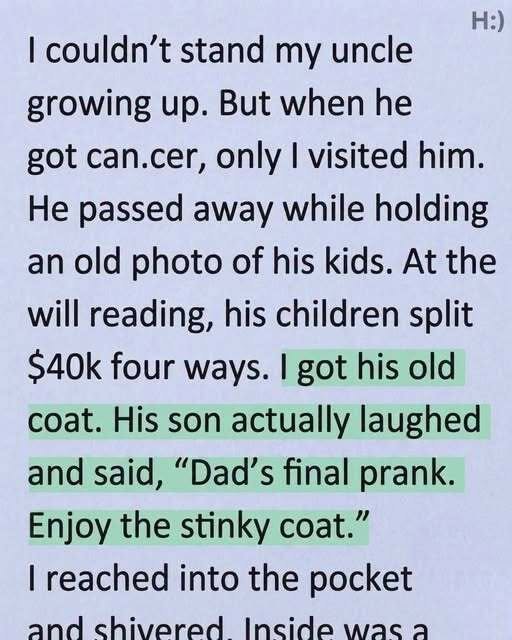
received $40,000 and personal belongings, while I was left his old, damaged
brown coat. My cousins laughed and joked that even in death, Richard had found
a way to criticize me. I accepted the coat quietly, wondering why he had chosen
such an unusual gift when everyone else had received something more valuable.
When I got home, I noticed the coat felt unusually heavy. After carefully examining
its lining and pockets, I discovered a hidden compartment containing a sealed
envelope addressed to me. Inside was a handwritten letter explaining how much
my hospital visits had meant to him. He also included instructions about something
he had kept hidden for years and wanted me to discover privately. Suddenly, the old
coat no longer seemed like an insult or an ordinary inheritance. It was Richard’s final
way of expressing gratitude and perhaps offering the apology he had never known how to say aloud.