
Part 1: The Red Notice
Rent was $1,150, and I had $412 to my name. The necklace was the only thing left that anyone would pay for. “I’m sorry, Nana,” I whispered into the dark. Then a stranger behind a pawn shop counter looked at it, lost all the color in his face, and reached for the phone.
The notice was bright red, which felt almost rude. It was taped across the middle of my apartment door at a slant, as if the landlord had slapped it up in a hurry, and the word FINAL was printed bigger than the word WARNING.
I stood in the hallway with my work apron still tied around my waist, smelling of fryer oil and burnt coffee. I read it twice. Then I read it a third time, as though the numbers might rearrange themselves into something kinder.
They didn’t. Seven hundred and forty dollars short, due in five days.
Inside, the apartment was one room and a half. A mattress on the floor, a card table, two trash bags of clothes I hadn’t bothered to put in the dresser I didn’t own. Six weeks earlier I had been living in a three-bedroom house in a Columbus suburb with a mortgage, a porch swing and a husband.
I’d also been living with a nursery I had painted pale yellow, in the room at the end of the hall. The paint was still fresh when the doctor told me, in a voice so gentle it hurt, that there was no heartbeat anymore.
I don’t remember the drive home. I remember my husband, Grant, standing in the kitchen with his car keys already in his hand, saying he needed some air. He needed it for nine days, and then he needed it permanently.
He moved in with a woman from his office who was twenty-six and laughed at everything he said. He took the savings account and drained the joint card on his way out the door. Our lawyer called it ‘an unfortunate imbalance.’ I called it Tuesday.
So I did what people do. I picked up every extra shift Rosie’s Diner would give me, doubles on Fridays, the dead Monday mornings no one else wanted. I counted my tips in the walk-in cooler, a fold of ones and fives and the occasional miracle twenty, and I counted them again at home like they might multiply overnight.
Stubbornness is a real resource, but it’s not a bank. It runs out on a schedule, and mine ran out standing in front of that red paper.
I peeled it off the door, went inside, and sat on the floor for a while. Then I knew, before I let myself admit I knew, what was in the closet.
The shoebox was at the very back, behind the winter boots. Inside, wrapped in a faded blue scarf, was my grandmother’s necklace.
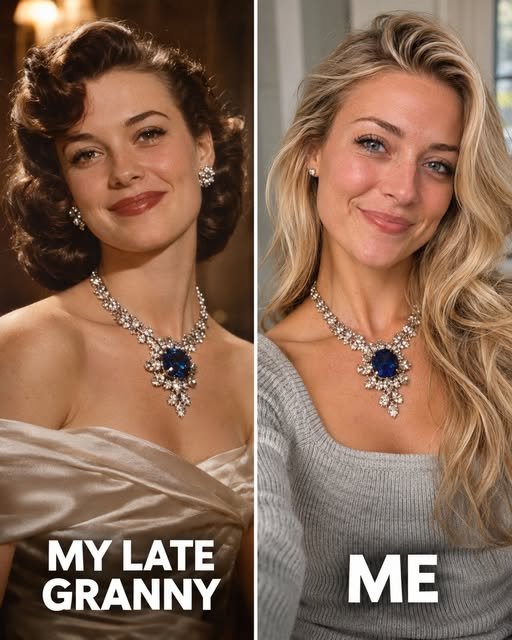
I unwrapped it slowly. It was a wide collar of tiny stones set in tarnished silver, five tight rows that dropped into little scalloped loops along the edges. Under the bare ceiling bulb it threw cold sparks across the wall.
Nana Ellen had put it in my hands when I was fourteen, in a hospital room that smelled of lemon cleaner. She was too weak to sit up straight, but she closed my fingers around it with a grip that surprised me.
“This one’s yours,” she’d said. “Don’t let anyone tell you it’s just pretty.”
I had never understood what she meant. Twenty years later I still didn’t, but I had moved that box through four apartments, one marriage and one funeral, and never once worn it out of the house. It felt wrong to wear it. It felt like borrowing something.
Tonight it felt heavier than it should have. Warmer, too, like it had been sitting in a sunny window instead of a dark closet.
“I just need a little time,” I told it, which was a ridiculous thing to say to a necklace. “One more month. That’s all. Maybe two. Then I’ll buy you back, I swear.”
I didn’t sleep. I took it out of the scarf, put it back, took it out again. Around three in the morning I thought of the other options, and I counted those too. A payday loan with a forty percent fee. My sister in Tucson, who hadn’t returned a call since the funeral. Grant.
I’d rather have eaten the necklace.
Morning came with a gray sky and a bus that was eleven minutes late. I rode downtown with the shoebox on my lap and my forehead against the cold window.
Marsh and Whitlock Pawn sat between a shuttered shoe repair and a tax office, with a hand-painted sign and bars on the windows. It was the kind of place you walk into only when you have run out of doors. I stood outside for a full minute watching my breath fog the glass.
Then I pushed. A small brass bell rang over my head, too cheerful for the occasion.
An older man stood behind the counter with his glasses sliding down his nose, polishing a tray of watches with a yellow cloth. He looked up with the patient face of someone who has heard every sad story at least twice.
“Morning, ma’am. What can I do for you?”
I put the box on the glass and unwrapped the scarf. I laid the necklace down like it might bite me.
“I need to sell this.”
He glanced at it the way you glance at a clock. Then his hands stopped moving.
The yellow cloth slid out of his fingers and onto the floor. He leaned in until his nose nearly touched the glass, and I watched the color leave his face in a slow, awful wave, from the forehead down, until even his lips were pale.
Part 2: The Man They Called the Master
“Where did you get this?”
His voice had dropped to almost nothing. It wasn’t the voice of a man about to haggle.
“It was my grandmother’s,” I said, and I’ll admit I was irritated. I had a bus to catch and a shift at two. “Look, I just need enough for rent. If it’s not worth much, tell me and I’ll go.”
“What was her name?”
“Ellen Marsh. Why does that matter?”
He grabbed the edge of the counter with both hands. For a second I thought he might actually go down, and I half stood to catch him over the display case.
“Miss,” he said, “I think you’d better sit.”
“Is it fake?” My stomach was already sinking. “Just say it. I can take it.”
“No.” He let out a shaky breath. “No, it’s real. It’s very real.”
Then he reached for the cordless phone under the register and punched a single speed-dial button, and his fingers were trembling so hard he missed it the first time.
“It’s me,” he said when someone answered. His eyes never left the necklace. “I have it. Yes. The necklace. She walked in with it. She’s standing right here.”
A cold finger traced up my spine. I picked up the scarf and took a step back toward the door.
“Who are you talking to?”
He covered the receiver with his palm. He looked younger and older at the same time, like a man who had been waiting for a bus for decades and had just seen headlights.
“Miss… the master has been searching for you for 20 years!”
My pulse jumped. “The what?”
“I’ll explain, or she will. Please don’t leave. Please.”
Before I could decide whether to run, a lock clicked somewhere behind the showroom. A steel door swung open at the back, and footsteps crossed the stockroom, unhurried, sure.
A woman stepped through the curtain of hanging keys, and I gasped so loud it embarrassed me.
“Desiree?”
She was older, of course. Time had softened the lines of her jaw and dusted her hair in silver, and she wore a charcoal blazer instead of the floral dresses I remembered. But she carried herself the same, spine straight as a ruler, elegant without trying.
She had been my grandmother’s best friend. When I was small she used to come to Nana’s kitchen on Sunday afternoons with a white bakery box tied in string, and the two of them would sit with the coffee going cold and laugh in low voices about things that stopped when I came in the room.
I hadn’t seen her since the funeral. I realized with a pang that I hadn’t even called her.
The moment her eyes found mine, her whole composure cracked, like something she had been holding shut for a very long time had finally given way.
“Claire,” she said. “Oh, Claire. I’ve been looking for you.”
She crossed the floor in four steps and put her arms around me. I stood stiff, with the scarf bunched in one fist, and then slowly the stiffness went out of me, and I leaned in. She smelled of vanilla and wool. She smelled like Sunday.
“What is going on?” I asked when she finally let go. My voice came out smaller than I intended.
She held me at arm’s length and studied my face. “You look so much like her.”
“Like Nana?”
Desiree gave a small, careful nod. Then she looked past me at the clerk. “It’s all right, Samuel. I’ll take it from here.”
He nodded fast, and the relief on his face was almost comical. He bent to pick up the yellow cloth, then seemed to forget what he’d bent for.
“Why did he call you ‘the master’?” I asked.
Desiree’s mouth twitched. “Because I own this shop and three others like it across the city, and Samuel says I stand like a master instead of a boss. He’s been saying it for twelve years. I’ve given up arguing.”
That alone would have been enough for one morning. The woman who brought pastries to my grandmother’s kitchen owned a small empire of pawn shops, and I’d never known.
But then her gaze dropped to the necklace on the glass, and her expression changed. It went quiet and heavy, the way a room changes when somebody turns off the music.
“That,” she said, “is why I’ve been searching for you.”
“Me? I came here to sell it.”
“I know.” She pulled a chair out from behind the counter, a worn wooden one with a cushion tied to the seat. “Please. Sit. What I’m going to say, Ellen never got the chance to say herself.”
Something in her voice made me obey. I sat with the box in my lap while she took the chair opposite and folded her hands, and her wedding ring clicked softly against her knuckle.
The shop clock ticked. Out on the street a bus hissed at the stop, probably the bus I should have been on.
“Claire,” Desiree said, very gently, “Ellen wasn’t your biological grandmother.”
Part 3: What Nana Found on the Path
“No.”
The word was out of my mouth before I’d thought it. I shook my head so hard my hair swung against my cheeks.
“No, that’s not right. She raised me. She taught me to ride a bike. She sat up with me through chicken pox and prom and every bad boyfriend. She was my grandmother.”
“She was,” Desiree said. “In every way that counts, she was. Please hear that part first. The love was real, every bit of it.”
“Then what are you telling me?”
Desiree drew a breath, the way you do before stepping into cold water.
“A long time ago, on an October evening, Ellen was walking home along the old creek path behind the rail yard. It was a shortcut she took after her shift at the laundry. She heard something that she thought was a cat.”
My throat had gone dry.
“It was you,” she said. “A baby, maybe four months old, tucked in the brush at the edge of the path. Wrapped in a good wool blanket and sleeping in the cold. And around your neck, on a chain too big for you, was that necklace.”
I looked down at the silver in my lap. I couldn’t speak.
“She brought you straight to my kitchen,” Desiree went on. “I’d just signed the lease on my first little shop, and I had a hot plate and a kettle and nothing else. We sat up all night. No note. No bag. No name on the blanket. Just a baby and a necklace.”
“That’s not possible,” I whispered. It was the only sentence I seemed to own.
“It is.” She said it kindly. “We went to the police the next morning. We called hospitals. We read every missing-child notice we could find in three counties. Nothing matched. Nobody came forward.”
“So she just kept me?”
The question came out sharper than I meant. Desiree didn’t flinch.
“She did it properly. A social worker, a judge, a mountain of forms, nearly two years of waiting. Ellen never cut a corner in her life. And when the papers were signed, you were hers. Legally, and in her heart, from that first night on.”
I pressed the back of my hand to my mouth. Fourteen years of birthday cakes with my name in blue icing. Fourteen years of her humming in the kitchen. And all of it laid over something she had never told me.
“Why didn’t she say anything?”
Desiree’s eyes were wet now, though her voice stayed steady. “Because you asked her once, when you were seven, whether she was your real grandmother. Do you remember?”
I didn’t. I shook my head.
“You’d been teased at school. A girl said you didn’t look like anyone in your family. And Ellen got down on her knees on the kitchen floor and told you that you belonged to her more than anyone had ever belonged to anybody. She was terrified that the truth would make you feel like a guest in your own life.”
The room had gone quiet except for the clock. I stared at the little loops of silver along the edge of the collar, and for the first time I wondered who had fastened them around a baby’s neck.
“And the necklace?” I managed.
“That’s where it got complicated.” Desiree leaned forward. “Ellen wasn’t a woman who knew about jewelry. But I was building a business on knowing what things are worth. The moment I saw it under a proper light, I knew it wasn’t costume. The cut of the stones, the setting, the clasp. It was old, and it had been made for someone.”
“Made for whom?”
“That’s what we tried to find out. We showed it to a restorer in Cleveland and then to an estate appraiser in Pittsburgh. Nobody could name the piece, but all of them said the same thing. It came out of a very particular circle of families. People who don’t lose heirlooms like that, unless something has gone badly wrong.”
A chill ran through me, a slow one.
“Ellen asked me to keep looking, quietly, in case someone came forward. And she helped me open this first shop, you know. She cleaned the floors on Saturdays and wouldn’t take a dime. That’s how all of this started.”
“You kept looking,” I said slowly. “For me?”
“For the necklace,” Desiree corrected, softly. “Because we always knew it might lead us back to your family. Every dealer and appraiser in the region has my card, and I told them all the same thing. If a collar like this ever turns up, call me before you do anything else.”
She smiled, a small, tired smile.
“After your grandmother passed, I made it my business to finish what we started. Twenty years, Claire. I wasn’t going to let her story end unfinished.”
I sat very still. Behind me, I could hear Samuel pretending to dust something.
“What happens now?” I asked.
“That depends on you.”
I looked at the necklace, the one I’d walked in here ready to trade for seven hundred and forty dollars.
“You said you were searching for my family,” I said. “Did you ever find them?”
“I did.”
My head snapped up. “What?”
“It took years of cross-referencing. Old auction records, a jeweler’s ledger in Philadelphia, a private registry that doesn’t exist online. About eight months ago, I found a match. I’d have come to you then, but I had no idea where you were.” She paused. “Grant didn’t leave a forwarding address.”
“You went to the house?”
“I went to the house. A young woman answered, and she said you no longer lived there.”
I almost laughed. Almost.
“And you’re sure?” I asked. “Absolutely sure?”
“I wouldn’t be sitting here if I weren’t.”
My hands were shaking, so I tucked them under my thighs. I thought of the nursery with its yellow walls. I thought of all the things I had lost in a single season, and how strange it was that a pawn shop might hand something back.
“What do we do?” I whispered.
“With your permission, I call them.”
The shop seemed to shrink around me. A person has a few moments in life where the road splits, and you can feel it under your feet before you can see it.
“Do it,” I said.
The call was short and calm. She spoke in the careful voice of a woman who had rehearsed this for two decades and still wasn’t ready. When she hung up, she folded her hands again to hide that they were not quite steady.
“They want to meet you,” she said. “Tomorrow, here, at noon.”
I was scared. Honestly, I was terrified. But I wanted answers, no, I needed them.
“All right,” I said. “Tomorrow.”
She walked me to the door. At the threshold she pressed something into my palm, and I looked down and found an envelope, thick and sealed.
“For the rent,” she said. “It’s not a loan, and it’s not payment. Don’t sell that necklace, Claire.”
I opened my mouth to refuse. She shook her head, and for the first time all afternoon, I didn’t argue.
Part 4: Noon at the Shop
I didn’t sleep that night, but not because I couldn’t. My mind simply wouldn’t stop working in the background, like a machine somebody forgot to switch off.
I paid the landlord at seven in the morning, in person, with Desiree’s cash and a tight smile. He took the envelope without meeting my eyes and slid the red notice off his clipboard. I watched it go into the trash can and felt strangely nothing at all.
I wore my one good blouse and brushed my hair twice. Then I stood in front of the bathroom mirror with the necklace in my palm and didn’t put it on. It wasn’t a decoration. It was a question I was about to find out the answer to.
At 11:40 the bell rang over the pawn shop door, and I was already there, sitting beside Desiree with my knees pressed together like a girl waiting outside a principal’s office.
Samuel had put a pot of coffee on and set out four mugs. I noticed that the mugs didn’t match, and for some reason that steadied me.
At 11:58 the bell rang again.
A man and a woman stepped inside, and everything in me went still.
They were somewhere near sixty. He was tall, with short gray hair and a navy overcoat he hadn’t unbuttoned. She was small, with auburn hair pinned back loosely and pearl studs in her ears, and she had one gloved hand pressed flat against her chest like she was holding her ribs together.
But it was their eyes. They had come through the door already looking at me.
The woman took one step forward. Her hand lifted halfway, then dropped, as if she didn’t trust herself to touch me.
“Oh my God,” she breathed.
The man didn’t say anything. He just stared, with his jaw working and his eyes bright, as though he were afraid that if he blinked, I’d vanish.
Desiree rose. “This is her.”
The woman’s eyes filled right away, and the tears slid down without any effort to hide them. “You’re alive,” she said. “You’re really alive.”
I couldn’t find a single word. I had spent the whole night imagining what I’d say, and every line had evaporated.
They sat across from me, and nobody touched their coffee. The man cleared his throat twice before he managed it.
“I’m Michael Hale. This is my wife, Danielle.” His voice cracked on the second word. “We are your parents.”
I think I gasped, and then I swallowed hard, because the alternative was crying in front of a stranger who owned four pawn shops.
“Thirty-four years ago,” Michael said, “we employed a man at our home. A driver, then a household manager. We trusted him with our house keys and with you. He took you from your crib on a night we were in New York at a funeral.”
“We think he meant to ask for money,” Danielle added quietly. “But something went wrong. He vanished, and so did you. The police found his car abandoned two states away, and nothing else. No note, no call.”
“He took you,” Michael repeated, as if the sentence still hurt his mouth.
I felt my hands go cold. I thought of the baby on the creek path, wrapped in good wool, in October. Somebody who had meant to ask for ransom and lost his nerve, maybe. Somebody who had put a stranger’s necklace around the neck of a child and left her in the hedge, hoping someone kinder would walk by.
Someone kinder had.
“We searched everywhere,” Danielle said. “For years. We hired people. We put your photograph on milk cartons, on posters, in every newspaper that would run it. Michael flew to Phoenix once because someone swore they’d seen a girl with your eyes.”
Her husband let out a slow breath. “And now we’ve found you.”
Silence stretched across the little table. Then Danielle leaned forward, and her voice broke into pieces.
“We never stopped hoping. Not for one day.”
Something inside me shifted. Not all at once, and not all the way, but enough.
I asked the question I’d been afraid to ask. “The necklace. Was it yours?”
Danielle laughed, wet and astonished. “It was my mother’s. I put it on you myself the day you were born, because she’d asked me to. She said it was for the first girl in the family.”
I looked down at the silver in my hands. All those years in a shoebox, and I’d thought it was only mine.
“Will you please come home with us?” Danielle asked, her eyes brimming.
I wasn’t sure what to say. I glanced at Desiree, and she gave me the smallest nod, the same nod Nana would have given me.
“I’d like to see it,” I said finally. “Just see it. That’s all I’m promising.”
“That’s more than we deserve,” Michael said.
That afternoon I followed their car in Desiree’s driver’s sedan. I had my shoebox on my lap and my seatbelt buckled against a heartbeat that wouldn’t slow down.
It wasn’t a house. It was an estate, with a long drive lined with maples and a lawn that rolled out farther than I could see from the gate. The stone was warm and quiet, and everything about it spoke of wealth that had never needed to prove anything.
Inside, it was calm and deliberate. Wide halls, high windows, flowers on a table that nobody had bothered to arrange for show.
“This is your home,” Danielle said softly.
I stood in the foyer, overwhelmed, with my plain flats on the marble. They showed me a hallway, then a door, then another.
“This entire wing is yours,” Michael said.
I turned to them. “All of it?”
They smiled, nervous and hopeful at once. “Stay as long as you like,” Danielle said. “We have a lot of time to make up for.”
In the last room, at the end of the hall, a window looked out over a garden. The walls were painted a pale, buttery yellow, and I stood there with my hand against my mouth for a long, long time.
“Danielle chose it,” Michael said quietly. “Years ago. She said a girl should have a sunny room in case she ever came back.”
I didn’t tell them about the other yellow room. Not yet. There would be time.
For the first time in months, maybe years, I felt something I hadn’t expected. Relief. Not because everything was suddenly perfect, because it wasn’t. There was grief in that house, and thirty-four years of it, and a stranger’s face in every photograph. But I wasn’t struggling to survive anymore.
I lifted the necklace from the shoebox and held it up to the window. The light caught every little stone, and for the first time, I understood what Nana had meant. It wasn’t just pretty. It was a road, and she had kept it safe until I was ready to walk it.
The thing I’d almost sold had changed everything.
And for the first time in a long time, I wasn’t looking for a way out. I was standing at the beginning of something new.
If you found out the family you lost was alive and looking for you, would you walk through their door?