
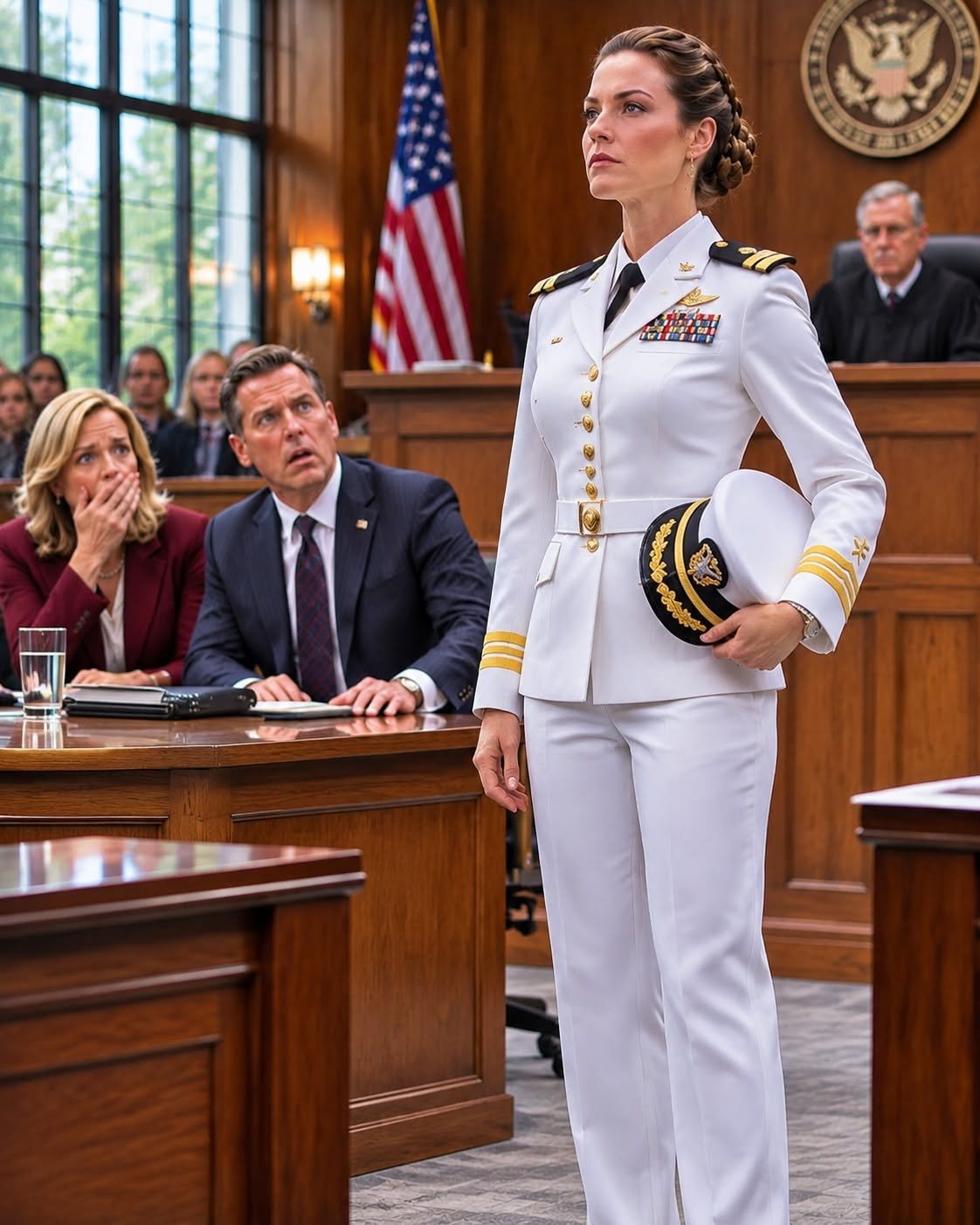
My father burst out laughing when I walked into Portsmouth Family Court wearing my Navy dress uniform. My mother stared at me with embarrassment, as though my military service were something disgraceful. Neither understood what the daughter they had rejected twelve years earlier had become. Then Judge Bennett examined the cream-colored folder beside him and quietly whispered, “My goodness… could that actually be her?”
My name is Natalie Brooks, and I never imagined my own parents would become the people I needed to defend myself against in court.
Two days earlier, a summons had arrived at my modest home near Norfolk, Virginia. The case number was 4238B. Brooks versus Brooks. The plaintiffs were Richard and Helen Brooks—my father and mother. They accused me of abandoning my grandfather’s farmhouse, neglecting its maintenance, and forcing them to cover every expense associated with the property.
They wanted the court to hold me financially responsible.
I sat at my kitchen table, with my German Shepherd, Knox, resting his head against my knee. I read the complaint repeatedly, struggling to understand how my parents could make such accusations while knowing the truth.
Before his death, my grandfather had transferred ownership of the farmhouse to me. Since 2013, I had personally paid the property taxes every year, even throughout my overseas deployments. I had also arranged and covered the costs of every necessary repair.
My parents knew I owned the property. They knew I had been handling its expenses. Yet they had signed a legal complaint claiming they had paid everything themselves.
This wasn’t a misunderstanding. They had deliberately accused me.
Twelve years earlier, when I completed my Navy training, my father couldn’t even be bothered to attend the ceremony. My mother sent me a single message.
“We raised you to be our daughter, not some woman serving in the military.”
I never forgot those words.
I stopped calling, stopped seeking their approval, and built a life they knew almost nothing about. I served in dangerous operations, accepted enormous responsibilities, and eventually suffered a devastating injury overseas.
An explosive device struck our convoy during a deployment. My knee required surgery, and I returned home with a permanent limp. The scars on my body became reminders of everything I had survived.
My parents never once asked what had happened.
The night before the hearing, I opened my old Navy storage trunk. Inside lay my dress uniform, military decorations, and a folded American flag belonging to Daniel, my closest friend. I carefully lifted my uniform jacket and ran my fingers across its fabric.
“So they really want to face me in court?” I whispered.
The following morning, I drove past Grandpa’s farmhouse. The old oak tree was slowly dying, the exterior paint was peeling, and part of the porch was beginning to sag. But the house was still standing. Grandpa had built it with his own hands, and I intended to protect everything he had entrusted to me.
At the courthouse, my father laughed when he saw my uniform. My mother whispered that I had embarrassed her. I ignored their remarks and placed my carefully organized property records on the table.
Judge Bennett turned toward my father.
“Mr. Brooks, did you personally pay every expense associated with the property?”
“Yes, Your Honor. Every single one,” Dad answered confidently.
Then the judge turned toward me.
“Commander Brooks, would you like to respond?”
Before I could speak, he reached for the cream-colored folder beside him.
“Before you continue, there’s something in these records that I believe your parents don’t realize I’ve already uncovered.”
He removed a document bearing my grandfather’s unmistakable handwriting.
Suddenly, my father’s confident smile began to fade.
Judge Bennett held up the document and asked my father whether he recognized it. Dad leaned forward, studied the handwriting, and reluctantly admitted it belonged to his own father, Walter Brooks.
The judge then asked whether he knew Grandpa had transferred the farmhouse to me.
“I knew he wanted her to have the property,” Dad admitted.
His answer surprised me. For years, my father had acted as though Grandpa’s decision meant absolutely nothing. Now, however, he couldn’t deny knowing about it.
Judge Bennett continued questioning him. Had Dad ever challenged the transfer? Had he disputed the recorded deed? Had he obtained any legal order granting him ownership?
The answer to every question was no.
My mother stopped looking at me and lowered her eyes toward the table. My father shifted uncomfortably in his chair.
Then the judge turned another page.
“Mr. Brooks, your complaint states that you personally paid the property taxes. Is that correct?”
“Absolutely,” Dad answered.
Judge Bennett nodded slowly.
“Then perhaps you can explain why the official tax payment records identify someone else as the person who made those payments.”
My father suddenly stopped moving.
For several seconds, nobody spoke.
I could hear the ventilation system humming above the courtroom. Somewhere behind me, a chair creaked against the floor. My mother’s fingers tightened around the edge of her handbag.
My father finally cleared his throat.
“Your Honor, I think there’s been some confusion.”
Judge Bennett didn’t look away from the folder.
“Then this should be relatively easy to clarify, Mr. Brooks.”
He removed another sheet.
The document showed twelve years of property tax payments. Every annual payment carried the same identifying name.
Natalie Brooks.
My name appeared beside the transaction references, payment dates, and confirmation numbers. Some payments had been made online. Others had been processed through my bank.
There were no payments recorded under Richard Brooks.
Dad leaned closer.
“That can’t be right.”
Judge Bennett raised his eyebrows.
“Are you suggesting the city treasurer’s records are inaccurate?”
“No, sir. I’m saying I remember paying those bills.”
“Then perhaps you have receipts.”
My father opened the leather folder in front of him. He removed several loose sheets and began sorting through them.
I recognized the familiar expression on his face. It was the expression he wore whenever he expected someone else to solve a problem.
He looked toward my mother.
She didn’t help him.
“Richard,” Judge Bennett said, “do you have documentation supporting your statement?”
Dad shuffled the papers again.
“I’ll have to locate some older records.”
“How convenient,” I said quietly.
My father snapped his head toward me.
“Don’t start.”
Judge Bennett lifted one hand.
“Commander Brooks, you’ll have your opportunity to speak. For now, allow me to establish the facts.”
I nodded.
My father sat back, visibly irritated.
The judge examined the payment records again.
“Ms. Brooks, are these your banking records?”
“Yes, Your Honor.”
“Did you authorize these payments?”
“Yes.”
“Did anyone reimburse you?”
“No.”
“Did you ever ask your parents to assume responsibility for the taxes?”
“No, Your Honor. The property belongs to me.”
Judge Bennett made a note.
“Then we’ll need to examine the plaintiffs’ claims carefully.”
My father shifted again.
“Your Honor, taxes aren’t the only expense. I’ve maintained that house for years. I’ve paid contractors, purchased materials, and kept the place from falling apart.”
That statement was different.
I turned toward him.
“What contractors?”
He stared at me.
“The people who worked on the property.”
“Which people?”
“Several people. I don’t remember every name.”
“Dad, the last contractor I hired was Mr. Harlan. He replaced the rear steps in 2022.”
My father gave a dismissive wave.
“That’s not what I’m talking about.”
“Then what are you talking about?”
“Your grandfather’s property has needed constant attention.”
“I know. I’ve paid for it.”
He leaned forward.
“You weren’t always there, Natalie.”
“I was deployed.”
“That doesn’t mean somebody else didn’t have to handle things.”
I felt my jaw tighten.
“Who handled them?”
My father opened his mouth.
Then he closed it.
Judge Bennett looked at him.
“Mr. Brooks, your complaint includes a specific financial demand. You are requesting reimbursement for expenses exceeding forty thousand dollars.”
“That’s correct.”
“Do you have an itemized statement?”
“We submitted one.”
“Do you have the original invoices?”
My father pointed toward his folder.
“They’re included.”
The judge removed the submitted expense list.
He studied it carefully, turning several pages.
I recognized the total immediately.
Forty-three thousand, eight hundred and sixty dollars.
My father had claimed that he spent nearly forty-four thousand dollars maintaining a property he never owned.
I had never received a single invoice from him.
I had never approved a contractor.
I had never authorized anyone to perform major work without consulting me.
Yet the complaint suggested I had neglected my obligations while my parents sacrificed their own money to protect the farmhouse.
The judge tapped one line with his pen.
“Mr. Brooks, this invoice lists roof replacement.”
“Yes.”
“When was that work performed?”
“Several years ago.”
“Which year?”
Dad hesitated.
“I believe it was 2021.”
I looked at the document.
“That roof wasn’t replaced in 2021.”
He frowned.
“What would you know about it?”
“I paid for the repairs myself in 2019.”
My mother suddenly looked up.
My father turned toward her.
“Don’t.”
That single word caught my attention.
He hadn’t looked at her because he wanted her support. He had looked at her because he feared what she might say.
Judge Bennett noticed it too.
“Mrs. Brooks, do you have any knowledge of these claimed expenses?”
My mother swallowed.
“I know some of them were discussed.”
“Were they paid?”
She looked at her husband.
“I don’t know.”
Dad’s face hardened.
“You know perfectly well what happened.”
“I know what you told me.”
“That’s enough.”
Judge Bennett set down his pen.
“Mr. Brooks, I will not permit you to answer questions directed at your wife.”
My mother looked toward the judge.
For the first time that morning, she seemed to realize she could speak without asking my father for permission.
“I didn’t pay anything for that house,” she said.
My father stared at her.
She continued, her voice trembling.
“I never paid the property taxes. I never hired the roof contractor. I never purchased materials.”
The courtroom became noticeably quieter.
My father leaned toward her.
“Helen, stop talking.”
She looked down again.
Judge Bennett addressed her gently.
“Mrs. Brooks, are you saying your husband’s expense claims are inaccurate?”
“I don’t know what he submitted, Your Honor.”
“But you know what you personally paid.”
“Yes.”
“And you paid nothing?”
“Nothing.”
My father pushed his chair backward.
“This is ridiculous.”
The judge remained calm.
“Please remain seated.”
I watched my parents carefully.
Something about their disagreement felt larger than the tax payments. My mother wasn’t simply embarrassed. She looked frightened.
My father wasn’t merely angry about losing an argument. He seemed worried about something waiting beyond the courtroom.
I had spent years believing their hostility toward me came from disappointment. My father wanted a traditional daughter. My mother wanted a quiet household. My military career had disrupted the picture they wanted.
But the tension between them suggested another problem.
Judge Bennett returned to the expense list.
“Commander Brooks, you mentioned paying for repairs in 2019. Do you have those records?”
“Yes, Your Honor.”
I opened my binder.
I had organized everything by year, starting with the first property tax payment. Each section included bank statements, receipts, contractor agreements, and photographs.
My father looked at the binder as though I had placed something offensive on the table.
I handed the judge the 2019 section.
He examined the receipt for the roof work.
“Fourteen thousand, six hundred dollars.”
“Yes.”
“Paid directly by you?”
“Yes.”
“Contractor?”
“Coastal Roofing and Restoration.”
Judge Bennett examined the signature.
“Did the contractor complete the work?”
“Yes. I have photographs showing the finished roof.”
He nodded.
Then he compared my receipt against the invoice submitted by my father.
The dates were different.
The contractor names were different.
Most importantly, the invoice my father submitted described work that had never been performed.
“Mr. Brooks,” the judge said, “have you ever heard of this company?”
Dad glanced at the paper.
“Not specifically.”
“Yet you claim to have paid them.”
“I said I handled the maintenance. I didn’t necessarily sign every check.”
“Who did?”
My father didn’t answer.
Judge Bennett turned toward the court clerk.
“Please mark these documents as exhibits.”
The clerk approached the bench.
My mother pressed her lips together.
I felt a strange mixture of relief and exhaustion.
For twelve years, I had kept my distance from my parents because I believed nothing I said would change their minds. Now, the truth was sitting between us in neatly organized folders.
But the hearing was only beginning.
Judge Bennett examined several more entries.
There were charges for plumbing, electrical work, landscaping, pest control, and structural repairs.
Some dates overlapped with my deployments.
Others matched payments I had personally made.
Several invoices carried addresses that weren’t even associated with Grandpa’s farmhouse.
I recognized one company.
It belonged to a contractor who had worked on my parents’ home.
I looked at the invoice again.
“Your Honor, this address is not the farmhouse.”
The judge examined it.
“Where is it?”
“My parents’ residence.”
My father immediately interrupted.
“That was a mistake in the paperwork.”
I stared at him.
“Why is your home address listed on a farmhouse repair invoice?”
He looked toward Judge Bennett.
“The contractor must have used the wrong address.”
I checked another page.
“Then why does this one list the same address?”
Dad’s mouth tightened.
Judge Bennett placed both documents side by side.
“Mr. Brooks, we are developing a pattern.”
My father rubbed his forehead.
“Your Honor, I think we’re getting distracted from the actual issue.”
“What do you believe the actual issue is?”
“My daughter has neglected a property that should have remained a family responsibility.”
“Your complaint doesn’t request shared responsibility. It requests reimbursement.”
“Because I’ve spent money.”
“Then the evidence should establish that.”
My father glanced toward the gallery.
Several people were watching him.
He lowered his voice.
“Your Honor, I don’t think this needs to become a public spectacle.”
The judge’s expression remained unchanged.
“This is a public hearing.”
I looked at my mother.
She was staring at the folded papers in her lap.
I remembered her message from twelve years earlier. I remembered the empty seats at my graduation. I remembered returning from surgery and receiving no calls.
I had never expected an apology.
But I had also never imagined standing in court while my parents tried to make me pay for expenses they invented.
Judge Bennett turned toward me.
“Commander Brooks, how often have you visited the farmhouse?”
“Whenever my assignments allowed, Your Honor.”
“And when you were overseas?”
“I arranged for routine inspections.”
“Who conducted them?”
“Mr. Harlan, the local contractor. He has maintained the property for several years.”
“Was he paid?”
“Yes. I paid him directly.”
“Do you have those records?”
“Yes.”
I handed over another section.
The judge examined the inspection reports.
Each report included a date, photographs, a description of the work, and the amount paid.
The reports showed that the property had been inspected regularly.
They also documented several repairs.
The porch had been stabilized once. The heating system had received maintenance. The plumbing had been checked before winter.
The work wasn’t extravagant.
It was necessary.
I had never intended to turn Grandpa’s farmhouse into a luxury property. I wanted to preserve the place where I had learned to ride a bicycle, read my first book, and listen to his stories.
Judge Bennett looked at the latest inspection report.
“Mr. Harlan indicates that he contacted the property owner about additional repairs.”
“That would be me.”
“Did you authorize those repairs?”
“Yes, Your Honor.”
My father shook his head.
“You weren’t even living there.”
“I didn’t need to live there to maintain it.”
“It’s a farmhouse. These places need constant work.”
“Then why did you claim you paid for work that I already completed?”
He stared at me.
“Because you never appreciated what your family did for you.”
I felt the words settle between us.
There it was again.
Family.
He had used that word whenever he wanted something from me. He had used it when asking for money. He had used it when demanding that I visit during leave. He had used it when reminding me that my grandfather’s property was supposedly a shared family responsibility.
But family had never meant equal treatment.
Family had meant obedience.
Judge Bennett interrupted before I could answer.
“Mr. Brooks, emotional disagreements are not evidence of financial liability.”
My father sat back.
The judge continued.
“Now, I would like to understand why this lawsuit was filed when the deed was never disputed.”
Dad folded his arms.
“Because she abandoned the house.”
“Your complaint does not establish abandonment.”
“She lives elsewhere.”
“Ownership does not require permanent residence.”
“She doesn’t even use the property.”
“That is not the question before this court.”
My father looked increasingly uncomfortable.
Then Judge Bennett opened another section of the folder.
“There’s one additional matter I would like to clarify.”
He removed a printed document.
It contained a letter addressed to the city treasurer.
The letter requested a change in the mailing address for property tax notices.
I recognized the farmhouse address.
I also recognized the signature at the bottom.
Richard Brooks.
My father went pale.
The judge placed the letter beside the tax records.
“Mr. Brooks, did you submit this request?”
Dad looked at it.
“I don’t remember.”
“It carries your signature.”
“I handled some correspondence for my father.”
“Your father died several years before this letter was submitted.”
My father said nothing.
I leaned forward.
“What was that letter for?”
Judge Bennett raised his hand.
“Please allow me to finish.”
He examined the date.
The request had been submitted four years earlier.
The mailing address had been changed from my Norfolk residence to my parents’ home.
The letter also requested that future correspondence be directed to Richard Brooks.
I looked at my father.
“You changed the tax mailing address?”
“I was helping.”
“Helping with what?”
“You were always away.”
“I paid the taxes.”
“You weren’t available.”
“You never contacted me.”
He shrugged.
“I didn’t have to explain every little thing.”
Judge Bennett looked toward him.
“Mr. Brooks, did you receive the tax notices?”
“Yes.”
“Did you forward them to your daughter?”
Dad hesitated.
“I don’t recall.”
I knew the answer.
He had never forwarded a single notice.
I had received electronic payment confirmations through my own account. I had not realized that the physical correspondence had been redirected.
“Your Honor,” I said, “I never authorized that address change.”
The judge nodded.
“Do you have documentation showing your original correspondence address?”
“Yes.”
I opened the earliest tax statement.
The address matched my home.
Judge Bennett compared the dates.
Then he looked toward my father.
“Why would you redirect official notices from the recorded owner’s address?”
Dad’s answer came quickly.
“I was trying to make sure nothing got missed.”
The judge paused.
“Yet you never informed the owner.”
My father looked toward the floor.
I began to understand that the tax records were only part of the problem.
He hadn’t simply claimed to pay the bills.
He had deliberately inserted himself into the property’s administration.
And he had done so without telling me.
Judge Bennett closed the document.
“Mr. Brooks, I believe we need to examine the circumstances surrounding that decision.”
My father swallowed.
“There’s nothing unusual about it.”
“Then you should have no difficulty explaining it.”
He didn’t respond.
My mother finally lifted her head.
Her eyes met mine.
There was something in them I couldn’t identify.
Regret, perhaps.
Fear, certainly.
But beneath both, I saw a quiet determination.
She looked toward the judge and then toward the cream-colored folder.
For one brief moment, I thought she might speak.
Instead, she reached into her handbag and removed a small envelope.
She placed it on the table.
My father immediately turned toward her.
“What are you doing?”
My mother kept her hand on the envelope.
“I’m tired, Richard.”
He stared at her.
“You promised.”
“I promised too many things.”
The judge looked at the envelope.
“Mrs. Brooks, what is that?”
She drew a shaky breath.
“Something I should have given my daughter a long time ago.”
My father stood halfway out of his chair.
“Your Honor, this has nothing to do with the case.”
Judge Bennett looked at him.
“Please sit down, Mr. Brooks.”
My father slowly lowered himself.
My mother pushed the envelope toward the clerk.
The clerk carried it to the bench.
Judge Bennett examined the handwriting on its front.
His expression changed.
He looked at my mother.
“Is this from Walter Brooks?”
“Yes.”
My heart began beating faster.
I recognized Grandpa’s handwriting.
I had seen it on birthday cards, old recipes, and the deed transferring the farmhouse.
But I had never seen that envelope.
Judge Bennett opened it carefully.
He removed several folded pages.
The first contained a short handwritten note.
The second contained a list of dates.
The third contained a series of names and financial amounts.
The judge read the first page silently.
Then he looked at my mother.
“Mrs. Brooks, do you understand what you’re submitting?”
“Yes, Your Honor.”
“Do you understand that this may have consequences beyond today’s reimbursement dispute?”
My mother nodded.
“I understand.”
My father turned toward her.
“You have no idea what you’re doing.”
She finally looked directly at him.
“For once, I do.”
The judge examined the remaining pages.
He stopped at a particular entry.
Then he looked at me.
“Commander Brooks, did your grandfather ever tell you that he wanted the farmhouse to remain available to other people?”
I frowned.
“He told me he wanted me to protect it.”
“That isn’t quite what I asked.”
I thought back to our conversations.
Grandpa had often spoken about the house as a place where people could recover. He had welcomed neighbors who needed somewhere quiet to stay. He had helped former service members find temporary accommodation after difficult deployments.
He never called it a program.
He simply called it helping people.
“He said nobody should feel alone there,” I answered.
Judge Bennett nodded slowly.
He looked again at the pages.
Then he asked my mother to confirm something.
“Is it your understanding that your husband has been negotiating with another party concerning this property?”
My mother closed her eyes.
“Yes.”
My father suddenly stood.
“That’s enough!”
The judge’s voice became firm.
“Sit down immediately.”
Dad remained standing for another second.
Then he lowered himself into his chair.
My hands had become cold.
“What negotiations?” I asked.
Judge Bennett didn’t answer immediately.
He examined the last page in the envelope.
Then he looked toward my father.
“Mr. Brooks, I believe your reimbursement claim may be connected to an agreement that you have not disclosed.”
My father stared at him.
There was no confidence left in his expression.
The judge placed the envelope beside the tax records.
“Before we proceed, I want a complete explanation of the proposed transaction involving this farmhouse.”
My mother covered her mouth.
I looked at my father.
For the first time in twelve years, he appeared genuinely afraid of what I might discover.
And I suddenly understood that this hearing had never been only about property taxes.
The man who claimed he had spent forty-four thousand dollars protecting my grandfather’s farmhouse might have been preparing to take it away from me entirely.
My father stared at the judge as though he had been asked to explain something that should never have been discovered.
“There’s no transaction,” he said.
Judge Bennett didn’t move.
“Mrs. Brooks has just testified that negotiations occurred.”
“She doesn’t understand the situation.”
“Then explain it.”
My father glanced toward the envelope.
“I was exploring possibilities.”
“Possibilities involving property you do not own?”
“I was trying to help the family.”
I felt my fingers tighten around the edge of the table.
“What family?”
He ignored me.
Judge Bennett looked toward my mother.
“Mrs. Brooks, do you have personal knowledge of the negotiations?”
“Yes.”
“Were you present when an agreement was discussed?”
“Yes.”
“Did you sign anything?”
“No.”
“Did your husband?”
My mother hesitated.
“I believe he signed a preliminary agreement.”
Dad shook his head.
“It wasn’t a sale.”
The judge turned toward him.
“Then what was it?”
“A proposal.”
“Was money exchanged?”
Silence.
My mother looked at the envelope.
Dad stared at the floor.
Judge Bennett waited.
Finally, my father answered.
“A small amount.”
“How much?”
“Ten thousand dollars.”
My stomach tightened.
“Who gave you ten thousand dollars?”
He turned toward me.
“It’s none of your business.”
Judge Bennett’s expression hardened.
“It concerns a property involved in litigation. It is very much within the scope of this hearing.”
My father rubbed his hands together.
“A development company approached me.”
“What company?”
“Harbor Ridge Properties.”
I had never heard the name.
“What did they want?” I asked.
Dad looked irritated.
“They were interested in the land.”
“Why would they approach you?”
“Because I know the area.”
“You don’t own the property.”
“I was the one dealing with the farmhouse.”
“No. I was.”
He leaned toward me.
“You were never there.”
“I paid for everything.”
“You sent money from overseas. That’s not the same as taking responsibility.”
I looked at Judge Bennett.
“Your Honor, may I ask him something?”
“Go ahead.”
“Did Harbor Ridge Properties know Grandpa transferred the farmhouse to me?”
My father hesitated.
“They knew there was a family arrangement.”
“That isn’t what I asked.”
“They knew the property had belonged to my father.”
“And did you tell them the deed was in my name?”
He looked away.
I felt the answer before he gave it.
“I told them the ownership situation was complicated.”
The judge made another note.
“Mr. Brooks, did you provide the company with a copy of the deed?”
“No.”
“Did you provide a title report?”
“No.”
“Did you identify yourself as the legal owner?”
“I never said that.”
“Did you allow them to believe you could negotiate the property?”
My father remained silent.
The judge waited.
“Yes,” Dad finally admitted.
My mother began crying quietly.
I looked at her.
She pressed a tissue against her cheek.
“Why?” I asked.
She didn’t answer.
My father leaned forward.
“Because somebody needed to make decisions.”
“You could have called me.”
“You wouldn’t have listened.”
“You never called.”
He looked at me with open hostility.
“You made yourself impossible to reach.”
I felt the old anger rising.
“I spent years answering your calls. You stopped calling after I joined the Navy.”
“That was different.”
“How?”
“You chose that life.”
“Yes. I did.”
“You chose strangers over your family.”
I looked down at my uniform.
Then I looked back at him.
“No, Dad. I chose a life where my work mattered.”
He opened his mouth.
Judge Bennett interrupted.
“Mr. Brooks, we are not here to debate your daughter’s career.”
My father sat back.
The judge examined the envelope again.
“Mrs. Brooks, you indicated that this agreement involved a payment. Do you know where the money went?”
My mother nodded.
“Into our joint account.”
“Did you know what your husband intended to do with it?”
“Not initially.”
“When did you learn?”
“About three weeks later.”
“What happened then?”
My mother wiped her eyes.
“Richard told me he intended to sell the farmhouse.”
I turned toward her.
“He told you he could sell it?”
“He said the company was willing to purchase it.”
“But he wasn’t the owner.”
“I know.”
“Did you tell him that?”
“Yes.”
“What did he say?”
My mother looked at my father.
“He said nobody would challenge him.”
A bitter laugh escaped my throat.
“Because he thought I wouldn’t find out?”
My mother nodded.
Dad pushed his papers away.
“This is being exaggerated.”
Judge Bennett looked at him.
“Did you tell the development company that your daughter had abandoned the property?”
Dad didn’t answer.
The judge repeated the question.
“Yes or no, Mr. Brooks.”
“Yes.”
“Was that accurate?”
“She was living in Norfolk.”
“Was the property abandoned?”
“I believed it was.”
“Did you inspect the house?”
“Several times.”
“Did you know the owner was paying for regular inspections?”
My father stared at the table.
“No.”
“Did you know she had paid the taxes every year?”
“No.”
I looked at him.
“You received the tax notices.”
He didn’t respond.
“You changed the mailing address.”
He rubbed his forehead.
“You don’t understand.”
“Then explain it.”
He turned toward the judge.
“I believed I was protecting the property.”
Judge Bennett placed the documents down.
“Protecting it from whom?”
My father had no answer.
I thought about the dying oak tree. The peeling paint. The sagging porch.
I had seen the condition of the farmhouse myself.
It needed repairs.
But it wasn’t abandoned.
I had never stopped caring for it.
My father had used its condition to create a story that suited him.
The judge asked the clerk to retrieve the original complaint and compare its allegations against the newly submitted documents.
While the clerk worked, my mother quietly moved her handbag beneath her chair.
She seemed determined to disappear.
I recognized that posture.
It was the same posture she had adopted whenever my father became angry at home.
I had spent years thinking she simply agreed with him.
Now I wasn’t certain.
But uncertainty wasn’t forgiveness.
She had signed the complaint.
She had allowed me to receive a summons accusing me of abandoning a property I had maintained for twelve years.
Whatever her reasons, she had participated.
Judge Bennett looked at the pages again.
“Mr. Brooks, when did you receive the initial payment from Harbor Ridge Properties?”
“About two months ago.”
“And when did you file this complaint?”
“Six weeks ago.”
“So the agreement came first?”
“Yes.”
“Then the lawsuit followed.”
Dad shifted.
“I filed because I needed to establish my expenses.”
“Were those expenses actually incurred?”
“Some were.”
“Which ones?”
“I’ll have to review everything.”
The judge closed the folder.
“Your complaint states that you paid forty-three thousand, eight hundred and sixty dollars. Yet you have not established a single verified payment.”
My father raised his voice.
“I’ve supported this family for decades!”
Judge Bennett remained calm.
“That may be true. It does not establish a legal claim against your daughter.”
My father looked toward me.
His eyes were filled with resentment.
“You think you’re better than us because you wear that uniform?”
I didn’t answer.
He continued.
“You think a few medals make you untouchable?”
“No.”
“Then why are you doing this?”
I took a breath.
“Because Grandpa trusted me.”
His expression changed.
“Your grandfather trusted me too.”
“Then why did he leave the farmhouse to me?”
That question silenced him.
Judge Bennett examined the deed again.
“Mr. Brooks, did your father explain why he selected his granddaughter?”
My father looked away.
“He had his reasons.”
“Did you disagree with those reasons?”
“Yes.”
“Did you tell him?”
“Yes.”
“What did he say?”
My father’s jaw tightened.
“He said the house needed someone who understood what it meant.”
I felt a painful memory surface.
I was twenty-two when Grandpa first discussed the deed with me.
He had been sitting on the porch, wrapped in an old cardigan, watching rain fall across the fields.
He had asked whether I remembered the names carved into the wooden beam above the kitchen door.
I remembered them.
They belonged to relatives, neighbors, and several young service members who had stayed there over the years.
Grandpa had explained that the farmhouse had never been just a building.
It had been a place where people could recover.
He had told me that a home could become valuable without becoming expensive.
I had thought he was simply sharing an old man’s memories.
I hadn’t understood how seriously he meant them.
Judge Bennett turned another page.
“Commander Brooks, did your grandfather ever give you a written explanation of his wishes?”
“No, Your Honor.”
“Did he discuss them with you?”
“Yes.”
“What did he say?”
I looked at the judge.
“He said he wanted the house to remain useful. He didn’t want someone turning it into something nobody could afford to enter.”
Judge Bennett nodded.
My father scoffed.
“That was just something he said.”
The judge looked toward him.
“Was it?”
Dad didn’t answer.
My mother lifted her head.
“No,” she whispered.
My father turned sharply.
“What?”
“He meant it.”
“Stay out of this.”
My mother looked toward the judge.
“Walter talked about that house constantly.”
“Mrs. Brooks,” the judge said, “please explain.”
She took a breath.
“My father-in-law had a habit of keeping a small notebook. He wrote down repairs, visitors, and things he wanted done.”
I looked at her.
“I’ve never seen that notebook.”
My mother nodded.
“Because Richard took it.”
My father became completely still.
Judge Bennett looked at him.
“Do you have such a notebook?”
Dad stared at his wife.
“That’s not relevant.”
“It may be relevant,” the judge replied.
My mother continued.
“Walter kept it in the kitchen drawer. He wrote in it almost every evening.”
I remembered the drawer.
Grandpa had always kept pencils, rubber bands, and old receipts inside it.
I had never thought about what else might have been there.
“Where is it now?” I asked.
My mother looked at my father.
“He has it.”
Dad shook his head.
“I don’t know what she’s talking about.”
My mother began to cry again.
“You know exactly what I’m talking about.”
Judge Bennett leaned back.
“Mr. Brooks, do you have possession of your father’s notebook?”
My father rubbed his face.
“I might have some old papers.”
“Have you reviewed them?”
“Yes.”
“Did they influence your decision to contact Harbor Ridge Properties?”
“No.”
My mother spoke again.
“They did.”
Dad turned toward her.
“Enough!”
She flinched.
I felt something inside me shift.
For the first time, I saw the difference between my parents’ behavior.
My father was trying to control the evidence.
My mother was trying to release it.
That didn’t make her innocent.
It did make her part of a much larger story.
Judge Bennett requested a brief recess.
The clerk instructed everyone to remain available.
I stood slowly.
My knee stiffened as I shifted my weight.
The pain was familiar.
It reminded me of the deployment when the explosive device struck our convoy.
I had been thrown against the interior wall. My knee had twisted beneath me. The sound of metal tearing had drowned out everything else.
Daniel had been beside me.
He had dragged me away from the damaged vehicle while smoke filled the road.
He never made it back to the base.
The folded flag in my trunk had been presented to me because Daniel’s family had asked me to receive it on their behalf.
I carried it because he had once told me something that I had never forgotten.
He said people needed somewhere safe to return.
Grandpa’s farmhouse had been that place for both of us during earlier visits.
My father knew Daniel had stayed there once.
He had even complained about it.
He called the house a charity shelter and accused Grandpa of wasting money on strangers.
Now, standing in the courthouse, I wondered whether Grandpa had intended something more permanent.
My mother approached me during the recess.
“Natalie.”
I turned.
She held a tissue in one hand.
“What?”
“I need to explain something.”
“Then explain.”
She glanced toward my father.
He was speaking with his attorney near the courtroom doors.
“Not here.”
“Why not?”
“Because he can hear us.”
I stared at her.
“You signed the complaint.”
“I know.”
“You accused me of abandoning Grandpa’s property.”
“I know.”
“You allowed him to claim he paid expenses I covered.”
She lowered her eyes.
“I know.”
“Then what do you want from me?”
She looked at my uniform.
“I want you to understand why I signed.”
I felt my anger rise.
“Don’t tell me you did it for my own good.”
“No.”
“Then what?”
She struggled to speak.
“Your father told me he had already made an agreement. He said the company would sue us if the sale didn’t proceed.”
“Why would they sue you?”
“He told them he had authority to negotiate.”
“He didn’t.”
“I know that now.”
“You knew it then.”
She nodded.
“I did.”
I stepped back.
“Then you helped him.”
“I was afraid.”
I looked at her.
“Of what?”
She glanced toward the hallway.
“Of losing the house.”
I let out a slow breath.
“You helped him take it from me because you were afraid of losing it?”
She shook her head.
“No. I thought I could stop him after the papers were filed.”
I stared at her.
“That makes no sense.”
She opened her handbag.
Inside was a small photograph.
It showed Grandpa standing on the farmhouse porch beside several young men wearing civilian clothes.
My mother handed it to me.
I recognized Grandpa immediately.
He was younger, perhaps in his late sixties. His hair was still dark around the temples.
The men beside him were smiling.
One held a toolbox.
Another carried a grocery bag.
The photograph was dated 1998.
On the back, Grandpa had written a short sentence.
Everyone deserves a place to begin again.
I looked at my mother.
“Why are you showing me this?”
“Because your grandfather asked me to remember something.”
“What?”
She took a shaky breath.
“He told me that one day Richard might try to sell the house.”
I stared at her.
“When?”
“Several years before he died.”
“Why would he think that?”
“Because he knew your father wanted the land.”
My mother’s eyes filled again.
“He told me to protect the notebook. He said it contained the truth about the house.”
“Then why didn’t you give it to me?”
“Because Richard found out.”
She looked toward the courtroom.
“He threatened to leave me if I helped you.”
I felt a wave of disbelief.
“So you stayed quiet.”
“Yes.”
“For years?”
“Yes.”
“And now?”
She looked at the envelope.
“Now he has gone too far.”
I handed the photograph back.
“You should have told me before.”
“I know.”
“You should have called me when he contacted the company.”
“I know.”
“You should have refused to sign that complaint.”
“I know.”
She didn’t defend herself.
That made the conversation harder.
I had prepared myself for another argument.
I had not prepared myself for a mother who finally admitted what she had done.
Judge Bennett called everyone back.
As I returned to my seat, I noticed my father’s attorney had left the courtroom.
My father looked furious.
I sat down.
The judge addressed the clerk.
“Please confirm whether the court received the original deed and the supporting title records.”
The clerk nodded.
“Yes, Your Honor.”
“Please confirm whether the complaint includes a recorded ownership claim from either plaintiff.”
“No, Your Honor.”
“Does it include a court order authorizing the defendant’s parents to manage the property?”
“No.”
“Does it include verified proof of the claimed expenses?”
“No, Your Honor.”
Judge Bennett looked toward my father.
“Mr. Brooks, I am concerned that your complaint may have been filed to establish leverage over a property you knew belonged to your daughter.”
My father leaned forward.
“That is not true.”
“Then help me understand the timing.”
Dad looked toward his attorney’s empty chair.
He had no answer.
The judge turned toward my mother.
“Mrs. Brooks, you indicated that a company paid your husband ten thousand dollars. Do you have evidence of that payment?”
She nodded.
“I brought the bank statement.”
She removed another document from her handbag.
The clerk carried it to the bench.
Judge Bennett studied the statement.
He examined the transaction date and amount.
Then he turned toward my father.
“Was this payment refundable?”
Dad swallowed.
“It was a deposit.”
“Was it refundable?”
“Under certain conditions.”
“What conditions?”
“The agreement had to proceed.”
“And if the property owner refused?”
My father looked down.
“Then the money could be disputed.”
“Could you return it?”
“I don’t have it anymore.”
My stomach dropped.
“What did you do with it?” I asked.
Judge Bennett looked toward me.
“Commander Brooks, please.”
Dad stared at the table.
“I had obligations.”
“What obligations?”
“Business expenses.”
My mother closed her eyes.
I remembered my father’s small construction business.
He had operated it for years. It had employed several workers and handled local renovation projects.
He had once been proud of it.
But the business had struggled after several contracts fell through.
I hadn’t known how serious the situation had become.
Judge Bennett asked another question.
“Was the money used to pay outstanding debts?”
“Yes.”
“Were those debts secured against the farmhouse?”
“No.”
“Did you tell Harbor Ridge Properties that the deposit would be used for your business?”
“No.”
“Did you tell your daughter?”
“No.”
I felt my stomach tighten.
My father had taken money from a company that believed it was negotiating for land he didn’t own.
He had used that money to support his business.
Then he had filed a lawsuit claiming he had spent money maintaining the same property.
The connection was becoming clearer.
The judge examined the agreement.
“Mr. Brooks, this document identifies you as the authorized representative of the property owner.”
Dad’s face changed.
“I was representing the family.”
“The property owner is your daughter.”
“We’re family.”
“That doesn’t establish authority.”
My father rubbed his forehead.
The judge continued reading.
“This agreement also states that the property is available for transfer after the resolution of outstanding maintenance claims.”
I looked at him.
“What does that mean?”
Judge Bennett placed the paper down.
“It appears the company expected the property to become available once your father’s reimbursement claim was resolved.”
I felt cold.
My father had created a financial dispute designed to make it appear that he held a legitimate claim against the farmhouse.
If the court accepted his demand, the company might have believed it could negotiate with him.
If I had been ordered to reimburse him, the resulting agreement might have created pressure to sell.
I looked at my father.
“You were going to sell Grandpa’s house.”
He shook his head.
“I was trying to save my business.”
“By selling property you don’t own?”
“I had debts.”
“So you used my grandfather’s house to solve them?”
“You have no idea what I was dealing with.”
I stared at him.
“You could have asked me for help.”
He laughed bitterly.
“You wouldn’t have given me anything.”
“You never asked.”
“You were always too busy being a commander.”
The words struck harder than I expected.
He still saw my service as an excuse.
He still couldn’t separate my career from his resentment.
Judge Bennett interrupted.
“Mr. Brooks, your financial difficulties do not grant you ownership rights.”
My father looked toward him.
“Your Honor, I was trying to keep my employees from losing their jobs.”
The judge paused.
That was the first explanation that sounded human rather than defensive.
But it didn’t change the documents.
“How many employees?” he asked.
“Four.”
“Are they currently employed?”
“Two.”
“Was the company in financial distress when you received the deposit?”
“Yes.”
“Did you disclose that to the development company?”
“No.”
“Did you disclose it to your daughter?”
“No.”
The judge made another note.
Then he looked toward my mother.
“Mrs. Brooks, why did you sign the complaint?”
My mother looked down.
“I thought it would force Natalie to come here.”
I felt my heart sink.
“What?”
She turned toward me.
“Your father said you would never answer his calls. He said you wouldn’t come back unless the court ordered you.”
“That was the plan?”
She nodded.
“He told me the lawsuit would make you respond.”
“You signed a false complaint to make me appear?”
“I thought I could stop the sale once you were here.”
I stared at her.
“You could have called me.”
“I know.”
“You could have sent me a letter.”
“I know.”
“You could have told the company the truth.”
“I know.”
Her voice broke.
“I was wrong.”
Judge Bennett watched her carefully.
“Mrs. Brooks, are you saying you participated in this lawsuit despite knowing its claims were not accurate?”
“Yes.”
“Why?”
“Because I wanted the court to examine the property records. I thought Richard would have to show everything.”
I looked at her.
“You knew he had the notebook?”
“Yes.”
“Did you know what was inside?”
“Some of it.”
“Why didn’t you bring it?”
She hesitated.
“Because I didn’t have it.”
My father suddenly looked up.
I turned toward him.
“Where is Grandpa’s notebook?”
He said nothing.
Judge Bennett repeated the question.
“Mr. Brooks, where is the notebook?”
My father stared at the judge.
“It’s at home.”
“Do you have it with you?”
“No.”
“Can you produce it?”
Dad looked toward my mother.
She nodded.
He slowly reached into his briefcase.
He removed a small brown notebook.
Its cover was worn.
The corners were frayed.
A narrow elastic band held it closed.
I recognized it immediately.
Grandpa’s notebook.
My father placed it on the table.
I felt my throat tighten.
Judge Bennett looked at the cover.
“Is this the notebook referenced by Mrs. Brooks?”
“Yes,” Dad answered.
“Did you bring it voluntarily?”
“I did.”
“Why?”
My father looked at me.
“Because I don’t want people misunderstanding what happened.”
The judge opened the notebook.
He examined several pages.
The handwriting was familiar.
Dates appeared beside small descriptions of repairs, visitors, and payments.
There were names I recognized.
Some belonged to neighbors.
Others belonged to former service members.
Several entries described young people who had stayed at the farmhouse after returning from difficult assignments.
I leaned forward.
One page contained a date from 2009.
Beside it was a name.
Daniel Mercer.
My breath caught.
I recognized my friend’s full name.
The entry described how Daniel had spent several days at the farmhouse during leave. Grandpa had written that he helped repair a fence and shared dinner with the family.
I remembered that visit.
Daniel had laughed with Grandpa in the kitchen. He had helped me carry boxes into the spare room.
He had said the farmhouse felt like the kind of place where people could breathe again.
I touched the edge of the table.
Judge Bennett noticed my reaction.
“Do you recognize this name?”
“Yes, Your Honor.”
“Who is he?”
“My closest friend. He served with me.”
I swallowed.
“He died overseas.”
The judge nodded.
He turned another page.
The notebook contained another entry.
This one was dated several months before Grandpa transferred the deed.
The handwriting was slower.
The words were carefully spaced.
The house must remain a place where people can come home, especially those who have spent too long believing they have nowhere to go.
I felt tears gather in my eyes.
Grandpa had written that before I was injured.
Before Daniel died.
Before I understood how much a safe place could matter.
Judge Bennett continued reading.
Then he reached a page with a different heading.
It read:
My instructions concerning the farmhouse.
He stopped.
He looked toward my father.
“Mr. Brooks, have you read this section?”
Dad nodded.
“Yes.”
“Did you understand it?”
“Yes.”
“Did you agree with it?”
“No.”
Judge Bennett turned the notebook toward me.
I read the first lines.
My grandfather had written that the farmhouse was to remain my property. He had also described his hope that I would preserve it as a place of rest and practical support for people recovering from hardship.
He had not demanded that I operate a charity.
He had not required me to spend my own money indefinitely.
He had simply asked me to remember why the house mattered.
The next paragraph mentioned my father.
It was only one sentence.
Richard may disagree because he sees the land as something to sell, but the house is worth more than its price.
I looked up.
My father was staring at the notebook.
For the first time, I understood why he had kept it hidden.
The notebook did not merely confirm my ownership.
It explained the purpose behind Grandpa’s decision.
It exposed the difference between what my father wanted and what Grandpa had intended.
But there was another page.
Judge Bennett turned to it.
The date was six months after the deed transfer.
My grandfather had written a list of names.
Each name had a short note beside it.
Some entries described temporary stays.
Others described help with transportation, meals, or finding work.
At the bottom, Grandpa had written:
If Natalie cannot continue this alone, the responsibility should never become a burden. Find people who understand the purpose. Let them help.
I looked at the judge.
“What does that mean?”
He studied the page.
“I believe your grandfather was documenting an informal support network.”
My mother nodded.
“He had people who helped him.”
“Who?”
“Neighbors. Former service members. A few local families.”
“Did they contribute money?”
“Sometimes.”
“Did your father know?”
She looked toward him.
“Yes.”
Dad shifted.
I turned toward him.
“You knew Grandpa had help?”
He looked away.
“He never needed it.”
“That isn’t what the notebook says.”
“He liked making people feel useful.”
I stared at him.
“You knew what the house meant.”
He didn’t answer.
Judge Bennett closed the notebook.
The courtroom remained quiet.
Then he addressed the clerk.
“Please make a record of the notebook’s production and preserve the submitted pages.”
He looked toward both parties.
“This court is not prepared to accept the reimbursement claim as presented.”
My father began to speak.
The judge raised his hand.
“However, there are additional matters that require clarification.”
He turned toward me.
“Commander Brooks, I want to ask whether you intend to continue maintaining this property.”
“Yes.”
“Do you intend to sell it?”
“No.”
“Do you intend to operate it as your grandfather described?”
I looked at the notebook.
“I want to understand exactly what he built before making any promises.”
Judge Bennett nodded.
“That is a reasonable answer.”
Then he turned toward my parents.
“Neither plaintiff has established ownership or verified expenses. The court will require additional documentation before deciding the reimbursement request.”
My father leaned forward.
“Your Honor, what about the agreement?”
“That is a separate matter requiring examination.”
“But I received money.”
“That does not create ownership.”
“I’m going to lose my business.”
Judge Bennett’s expression softened slightly.
“I understand that you may be facing serious financial problems. They do not justify misrepresenting another person’s property.”
My father looked at me.
His eyes were wet.
For a moment, I thought he might finally apologize.
Instead, he said something I would remember for a long time.
“You could help me fix this.”
I stared at him.
“You want me to pay back money you took from a company?”
“I want you to help your father.”
“You filed a lawsuit against me.”
“I made a mistake.”
“You claimed I abandoned Grandpa’s house.”
“I was under pressure.”
“You claimed you paid expenses I covered.”
He lowered his voice.
“I didn’t know how else to keep everything together.”
I felt the familiar urge to rescue him.
It was the same feeling I had experienced as a child whenever he became angry or disappointed.
But I had spent twelve years learning that love did not require surrendering every boundary.
“I won’t pay for a false claim,” I said.
He looked at me.
“I won’t let you lose the house either.”
My mother began crying again.
Judge Bennett called for another recess.
The hearing would continue after the court received additional financial records and clarification about the development agreement.
I gathered my binder.
My father remained seated.
As I stood, my mother approached.
“Natalie, please.”
I looked at her.
“Not now.”
She nodded.
I walked toward the hallway.
A few minutes later, the clerk approached me.
“Commander Brooks?”
“Yes?”
“The judge asked whether you would be willing to review one additional document before leaving.”
“What document?”
The clerk handed me a sealed envelope.
My name was written across the front.
The handwriting was Grandpa’s.
I stared at it.
It was dated three months before his death.
I had never received it.
My mother stood several feet away.
She was watching me.
My father was still inside the courtroom.
I carefully opened the envelope.
Inside was a letter.
The first line made my knees feel suddenly weak.
My dearest Natalie, if you are reading this, someone has finally brought the farmhouse records into the light.
I read the next paragraph.
Then I looked up at my mother.
She began to cry.
The letter explained that Grandpa had anticipated a disagreement over the property. He had instructed someone he trusted to preserve the original records and ensure they could be produced if anyone challenged the deed.
But the most important sentence appeared near the bottom.
There is something your father never understood. The farmhouse was never meant to belong to one person alone, even though the deed belongs to you.
I read it twice.
Then I continued.
Grandpa had written about the people who helped maintain the farmhouse. He had described the neighbors who donated supplies and the former service members who repaired the porch.
He had also mentioned a small fund.
A fund established years earlier to cover essential maintenance and temporary assistance.
I looked toward the clerk.
“Does the court have the remaining records?”
The clerk nodded.
“They were included in the materials submitted by your mother.”
I turned toward her.
“You knew about this fund?”
She nodded slowly.
“I helped your grandfather organize it.”
“Why didn’t you tell me?”
“Because Richard took the records after Walter died.”
“Did he take the money too?”
She looked toward the courtroom.
“I don’t know.”
I felt my stomach tighten.
The letter described a separate account.
It was not an inheritance.
It was not a personal bank account.
It was a small community fund established for the farmhouse’s maintenance and the temporary needs of people staying there.
Grandpa had entrusted its administration to a local attorney.
The name was written at the bottom.
Margaret Ellis.
I recognized it.
She had been Grandpa’s attorney for years.
I had met her several times as a child.
She had witnessed the deed transfer.
She had also attended Grandpa’s funeral.
I looked at the clerk.
“Is Ms. Ellis still practicing?”
“Yes.”
“Was she involved in these proceedings?”
“She submitted a statement with the original property documents.”
I looked back at my mother’s envelope.
There was another page.
It contained a short note.
If Richard claims he paid for the house, ask him what happened to the maintenance account. The records will answer that question better than I ever could.
I felt the room tilt slightly.
My father had claimed he spent forty-four thousand dollars maintaining the farmhouse.
But Grandpa had left a fund specifically for that purpose.
I looked toward the courtroom doors.
My father had been trying to establish that he personally paid expenses.
If the fund had already covered some of those expenses, his claim might be more than inaccurate.
It might involve money that never belonged to him.
I returned to the courtroom.
Judge Bennett was reviewing the documents.
He looked up when I entered.
“Commander Brooks, did you receive the letter?”
“Yes, Your Honor.”
“Have you read it?”
“Yes.”
“Then I believe we need to examine the financial records attached to your mother’s submission.”
My father turned toward me.
His face had lost what little color remained.
The judge opened the next document.
It was a statement from a local bank.
The account belonged to the Walter Brooks Farmhouse Preservation Fund.
The balance had been recorded for several years.
Then, four years earlier, withdrawals had begun.
They were not large at first.
A few hundred dollars.
Then several thousand.
The withdrawals continued over time.
Some were marked as maintenance.
Others were listed as contractor payments.
But the receiving account was not associated with the farmhouse.
It belonged to Richard Brooks.
My father stared at the page.
I couldn’t speak.
Judge Bennett looked toward him.
“Mr. Brooks, did you have authorization to withdraw money from this account?”
My father swallowed.
“No.”
The judge examined the signature on the authorization form.
“Then whose signature is this?”
Dad looked at the paper.
He said nothing.
My mother pressed her hands together.
The judge continued.
“Mr. Brooks, I believe we have discovered a much more serious issue than the reimbursement claim.”
My father finally looked at me.
For the first time, his expression held no anger.
Only fear.
And I realized the lawsuit had exposed something neither of my parents could easily explain away.
The money my father claimed to have spent maintaining Grandpa’s farmhouse might never have belonged to him in the first place.