
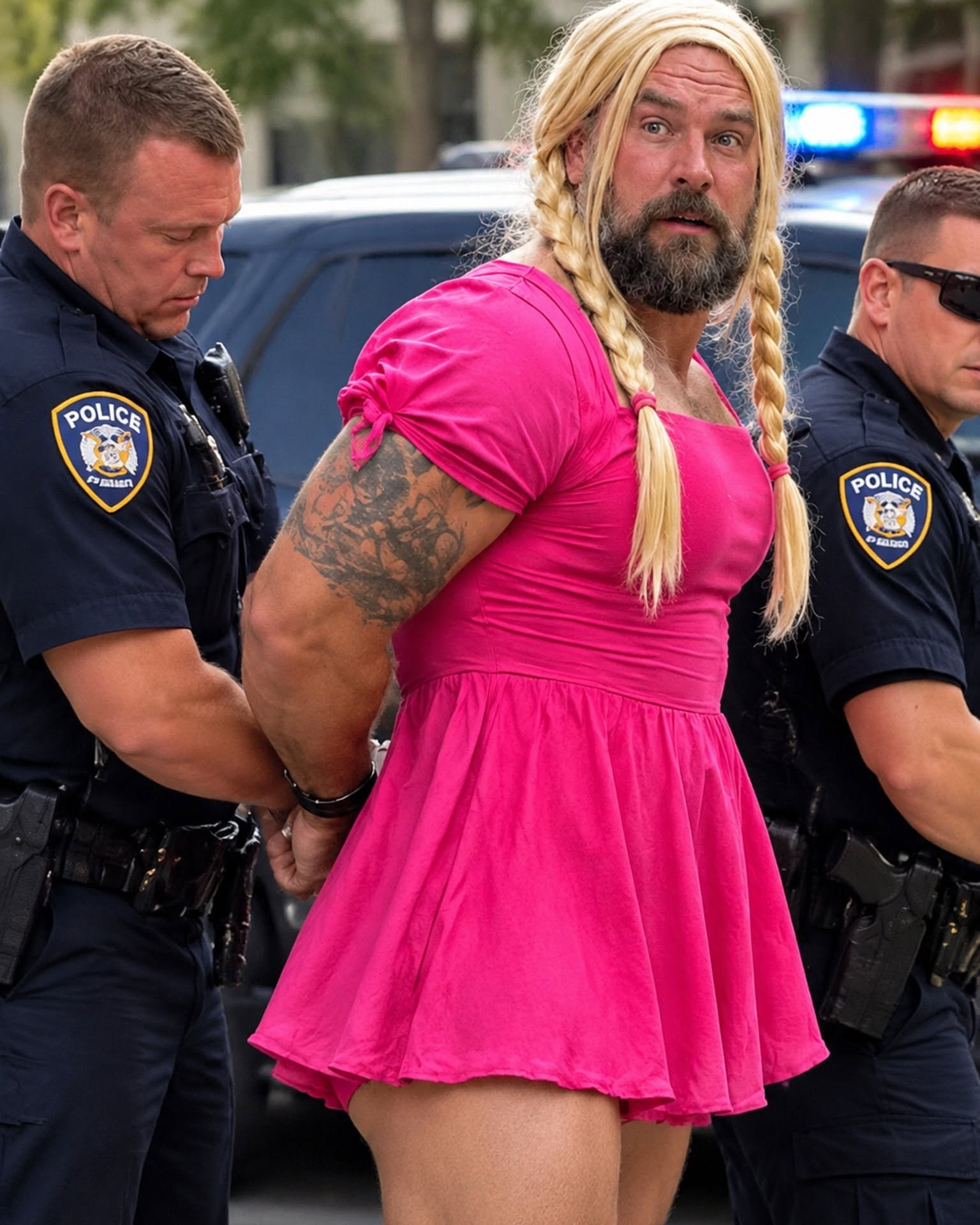
Part 1: The Door Beside the Cupcakes
“Mom, there’s a grown-up in the girls’ bathroom, and I don’t think he’s supposed to be there.”
Sophie said it quietly enough that the woman buying our last chocolate cupcake kept searching her purse for change. My daughter stood beside the bake-sale table with both hands tucked beneath her arms, although the school cafeteria was warm.
Then she added something that made the ordinary sounds around me seem very far away.
“He’s wearing a dress and a wig. I don’t know him.”
I put the change box down. Sophie was eight, old enough to use the restroom down the hall by herself, young enough that she still wanted me to check under her bed after a frightening movie.
“Did he speak to you?” I asked.
She shook her head, then hesitated.
“I don’t know. Maybe. I left fast.”
I asked whether he had followed her. She said no. Whether anyone had touched her. Again, no.
Those answers mattered, but they did not tell me why an unfamiliar adult was alone in a restroom used by elementary-school girls during a public event.
I asked the mother beside me to watch our table, took Sophie’s hand, and walked toward the hall. On the way, I stopped a teacher carrying a stack of construction-paper crowns.
“My daughter found an adult in the girls’ restroom. Please get Mrs. Harris. We’ll be right here.”
The teacher set the crowns on a windowsill and immediately turned toward the office. I kept Sophie beside me until we reached the restroom entrance, then positioned her against the opposite wall, where I could see her.
“Stay there. Don’t come in.”
I called through the open doorway before stepping just far enough inside to see the sinks.
“Is there an adult in here?”
A man turned from the mirror.
He was broad through the shoulders, with a dark beard, an auburn wig falling over one shoulder, and an emerald velvet dress that looked as though it had come from a community theater costume rack. A makeup bag lay open beside the sink.
For a second, neither of us moved.
I had my phone in my hand. I raised it and recorded several seconds, keeping the camera directed at the man and the sink rather than the stalls, then backed into the hall.
He said, “I can explain.”
I answered, “Please stay there.”
I did not know whether I was looking at a harmless mistake or something worse. I knew only that Sophie had come to me frightened, that I had found the adult she described, and that I wanted someone responsible for assessing danger to come.
I called the police.
I gave the dispatcher the school’s name, described what I had seen, and said there had been no reported touching, threats, or pursuit. My voice sounded strangely formal, as if accuracy were a railing I could hold.
The dispatcher told me to remain with my daughter and not confront the man further. I stepped back from the doorway.
Sophie pressed against my side.
“Did I do something bad?” she asked.
I crouched so we were looking directly at each other.
“You never have to stay somewhere uncomfortable to protect a grown-up’s feelings.”
She nodded, but she did not let go of my sleeve.
Our school’s autumn fair had started less than an hour earlier. That morning, Sophie had arranged the candy stars on our cupcakes into constellations, rejecting any with broken points.
She had planned the whole afternoon: cupcakes first, used books second, then the craft room where children could make paper lanterns. The little envelope containing her spending money was still in my bag.
Now she watched the restroom door instead.
Mrs. Harris arrived before the officers. Her navy jacket was unbuttoned, and her glasses hung from a chain against her blouse.
“Rachel, what happened?”
I told her. When I said I had called the police, her eyes shifted from my face to my phone.
“You called already?”
“Yes.”
She looked toward the restroom.
“Daniel?” she called.
The man stepped into the doorway, his makeup bag closed now. He kept his hands visible.
“I’m sorry,” he said. “I thought—”
Mrs. Harris cut across him.
“He’s one of our parent volunteers.”
That was information I needed. It was not an answer to the question I had asked.
“Why was he in there?”
“Let’s not discuss this in the hallway.”
Behind her, the teacher who had fetched her began gently directing children toward the cafeteria. I was grateful for that. A few parents had already slowed down to look.
Daniel stayed near the wall. He looked at Sophie, then lowered his eyes.
“I scared her?”
I tightened my arm around my daughter.
“She found an unfamiliar adult in a children’s restroom. Yes.”
He nodded once, accepting it without argument.
Two officers arrived through the main entrance several minutes later. One spoke to me while the other spoke to Daniel, keeping the conversations separate.
I repeated exactly what Sophie had told me and what I had personally seen. When the officer asked whether Daniel had approached her, I said I had not witnessed her first encounter.
“She says he didn’t follow her,” I added. “I don’t want to guess about anything else.”
The officer crouched a little, leaving several feet between himself and Sophie.
“You don’t have to tell me a long story. Did someone stop you from leaving?”
“No.”
“Did anybody touch you?”
“No.”
“All right. Thank you for telling your mom.”
That simple response loosened something in her shoulders.
The other officer asked Daniel for his full name. He gave it: Daniel Reyes.
Mrs. Harris stepped closer.
“His wife is running the fairy-tale photo booth. He’s helping her.”
I stared at her.
“The what?”
She explained that the kindergarten classrooms had been turned into fairy-tale scenes. Children could sit in a cardboard carriage or stand beside a painted castle and have their picture taken.
The volunteer scheduled to play the fairy godmother had become ill that morning. Daniel had offered to take the role so the booth would not have to close.
That explained the costume.
It did not explain the room.
The officer asked whether Daniel was authorized to be in the building.
“Yes,” Mrs. Harris said quickly.
“Was he authorized to use that restroom?”
This time, she did not answer immediately.
Daniel did.
“No.”
I looked at him. So did the officer.
“Then why were you there?” the officer asked.
Daniel shifted the cosmetic bag from one hand to the other.
“I spilled some makeup on the front of the dress. The adult restroom downstairs had people waiting. I came up here because I knew there were sinks.”
He looked toward the doorway he had just left.
“I thought it was empty. I was trying to fix the stain and get back before the next pictures.”
“Did you check which restroom it was?”
“I saw the sign.”
There was no attempt to pretend it had been confusing. Somehow, that made the decision both easier to understand and harder to excuse.
“So you knew,” I said.
“Yes. I made a bad decision.”
Mrs. Harris explained that the faculty restroom on that floor was closed for plumbing repairs. A temporary notice had directed adults downstairs.
I remembered passing the notice earlier. It had been taped to the faculty door, not displayed beside the stairs or included on the fair map.
It was a small detail. Later, small details would turn out to matter very much.
The officer asked where Daniel’s visitor badge was. Daniel looked down at the dress, then closed his eyes briefly.
“On my shirt. My regular shirt. It’s in the costume room.”
Mrs. Harris rubbed the edge of her glasses with her thumb.
The officer asked her to identify the staff member supervising volunteers in that hallway.
“We have teachers circulating,” she said.
“Who was assigned here?”
She glanced toward the teacher moving children away, but the teacher shook her head.
“I was bringing supplies from the art room,” she said. “My assignment is downstairs.”
The hallway seemed suddenly quieter, although the fair was still going on around us.
I had expected a simple explanation followed by a simple decision. Instead, every answer uncovered another gap.
Daniel was approved to volunteer, but his identification was somewhere else. He knew where he should have gone, but had chosen not to. A student hallway was open during a public event, but nobody could name the adult responsible for watching it.
The costume had drawn my eye. The missing safeguards were beginning to hold it.
Mrs. Harris lowered her voice.
“Can we please move this somewhere private before more parents misunderstand?”
One officer said they could use the office once the immediate situation was clear.
“I need to contact district security,” she said.
“That’s fine.”
She took out her phone, fumbled it, and caught it against her jacket. Then she said something so softly that I almost missed it.
“This will trigger another report.”
The officer stopped writing.
“Another report about what?”
Mrs. Harris looked at Sophie, then at me. The fear on her face no longer seemed to be about an embarrassed volunteer in the wrong restroom.
The word that frightened her was “another.”
Part 2: What the Badge Couldn’t Prove
In the principal’s office, Sophie chose the chair closest to the door. I noticed because she usually chose the one beside the small aquarium, where a striped fish hid beneath a plastic bridge.
I asked whether she wanted to wait with her teacher instead. She shook her head and pulled her chair closer to mine.
Before sitting, I texted Adam.
Rachel: Something happened at the fair. Sophie is physically okay and with me. Please call when you can.
He was covering a Saturday shift across town. When he called, I stepped just outside the open office door, keeping Sophie in sight, and gave him the facts without trying to explain what I did not yet understand.
“Do you want me to leave work?” he asked.
“Not yet. I want to know what happened first.”
“Then don’t let anybody hurry you past that.”
When I returned, Daniel was sitting across the room. Someone had brought him his volunteer badge, but he had placed it on the desk rather than clipping it to the costume.
The badge identified him as a registered parent volunteer assigned to the fairy-tale booth. It did not explain why he had left that assignment or entered the restroom.
About twenty minutes later, a district security supervisor named Marcus Foster arrived. He introduced himself to Sophie before opening his notebook.
“I’m going to ask the grown-ups some questions,” he said. “If you need a break, tell your mom.”
Then he asked Mrs. Harris for the event’s volunteer roster and access plan.
She opened a folder on her desk.
Mr. Foster looked at Daniel first.
“Did you complete the required volunteer screening?”
“Yes.”
“Did you sign in this morning?”
“Yes.”
Mrs. Harris supplied the sign-in sheet. His name was there, along with an arrival time and his classroom assignment.
Mr. Foster asked who had briefed him about restroom locations and the boundaries of his assignment.
Daniel glanced at the roster.
“Marisol told me where the downstairs adult restroom was. I don’t remember anyone discussing the hallways.”
“Your wife?”
“Yes. She’s the booth coordinator.”
Mrs. Harris said volunteers had received an email before the event. Mr. Foster asked for a copy rather than accepting her summary.
While she searched, he turned to me.
“Please tell me what Sophie reported, and then tell me what you saw. Keep those separate if you can.”
I appreciated the distinction. Fear had a way of stitching separate moments into one certainty.
I repeated Sophie’s words. Then I described entering the doorway, seeing Daniel at the sinks, recording briefly, and leaving.
“Did you see anyone else?”
“No. I didn’t walk through the room or inspect the stalls.”
“Did he move toward you?”
“No.”
“Did he threaten you?”
“No.”
He asked to see the recording. I handed him my phone.
The video was eight seconds long. Daniel stood by the sink with the makeup bag open. When he noticed me, he stopped moving and lowered the hand holding a cosmetic sponge.
There was nothing in it that established a criminal purpose. There was also nothing in it that changed the fact that he should not have been there.
One of the officers asked whether I would preserve the original recording in case they needed it for the call documentation. I agreed.
I did not send it to a parent group. I did not want a recording made near a school restroom circulating beyond the people reviewing what had happened.
Mr. Foster asked Daniel to describe Sophie’s arrival.
“I saw her in the mirror,” Daniel said. “I stepped away from the sink. I said, ‘Sorry, wrong place.’ She left before I could say anything else.”
Sophie lifted her head.
“He did say sorry.”
I looked down at her.
“Thank you for remembering. It’s okay to add something later.”
She had not lied before. She had been frightened and uncertain about a few seconds. I wanted everyone in that room, especially Sophie, to understand the difference.
The officer who had spoken with me closed his notebook.
“Based on what we have so far, we’re not seeing evidence of a criminal offense. We’ll document the call. The school still needs to address the policy issues.”
Daniel exhaled slowly.
Mrs. Harris did not look relieved.
Mr. Foster noticed too.
“When was the last corrective-action review?” he asked her.
“October.”
The fair was in November. The review had been only weeks earlier.
I looked from one to the other.
“What corrective action?”
Mrs. Harris pressed her palms together on the desk.
“We’ve had problems with visitor procedures.”
“What kind of problems?”
She explained that the previous spring, a parent had entered through a side door to bring a forgotten lunch. He had not signed in and had spent nearly fifteen minutes inside before a staff member stopped him.
In September, a grandfather collecting a child from an after-school program had wandered into an instructional hallway while looking for the gym. Again, nobody had checked him in.
Neither incident had involved a threat. Both had shown that adults could move through the building without staff knowing who they were or where they belonged.
The district had reviewed the procedures. Doors had been propped open during events. Badges were inconsistently worn. Volunteers were sometimes treated as if familiarity were a substitute for an assigned location.
The school had been placed on a corrective plan, and Mrs. Harris had been warned that another significant failure could lead to a broader district investigation and restrictions on public events.
I looked at the folder on her desk.
“Were parents told all of that?”
“A general safety reminder went out.”
“That isn’t what I asked.”
She looked down.
“Not in that level of detail.”
Mr. Foster said the district would address what information should have been shared. He did not promise me access to other families’ private details, and I did not ask for them.
I wanted to know whether a problem affecting every child had been treated as a paperwork concern.
“When you heard I’d called the police,” I asked Mrs. Harris, “were you worried about Sophie, or about another report?”
For several seconds, nobody spoke.
“The report was my first thought,” she said finally.
There it was, plain enough that she could not hide behind administrative language.
“I was afraid we’d lose the fair,” she continued. “Our volunteer program. I was afraid of what this would mean for the school.”
“Sophie is part of the school,” I said.
Mrs. Harris nodded, but I was not ready to make that easier for her.
She glanced toward Daniel.
“And I knew how the costume might make this look. I didn’t want people drawing the wrong conclusion.”
Daniel sat forward.
“The costume didn’t make the decision. I did.”
His voice was quiet, but Mrs. Harris stopped speaking.
“If I’d been wearing jeans, I still would have used a restroom I knew wasn’t for me. Please don’t make the dress the explanation.”
I had been holding so tightly to my anger that I had almost forgotten an apology could contain something useful: a person naming precisely what they had done.
Daniel did not ask me to feel foolish for being alarmed. He did not say Sophie had overreacted. He did not suggest that volunteering earned him an exemption from a clear boundary.
Mr. Foster asked whether he understood that his volunteer assignment was ending for the day pending review.
“Yes.”
“You’ll need to give us a written account.”
“I will.”
Then Daniel looked at me.
“May I apologize to Sophie? I can stay right here.”
I checked my daughter’s face. She gave a small nod.
“From there,” I said.
Daniel kept his chair where it was.
“Sophie, I was supposed to use the grown-up restroom. I got impatient and used the wrong one. You did the right thing by leaving and finding your mom.”
She looked at his wig.
“Why were you the fairy godmother?”
He blinked, then answered seriously.
“The person who was supposed to do it got sick. My wife needed help.”
“Did she know you had a beard?”
For the first time all afternoon, the corners of his mouth moved.
“She’s had quite a few years to notice.”
Sophie made a small sound that was almost a laugh.
It did not erase what had happened. It did make him a person again instead of an unanswered shape in a doorway.
Marisol arrived after a teacher found her in the kindergarten wing. She carried Daniel’s folded clothes and a canvas supply bag.
Mr. Foster explained why Daniel would not be returning to the booth. Marisol listened without interrupting, then looked at her husband.
“You knew where the adult restroom was.”
“I know.”
She turned to me.
“I’m sorry your afternoon became this. I’m glad Sophie came to you.”
There was disappointment in her face, but she did not ask me to comfort either of them.
The officers left after explaining how I could obtain the call number. Mr. Foster stayed to collect statements and review the fair’s staffing arrangements.
Sophie and I went back to the cafeteria only to collect our things. The remaining cupcakes were gone, sold by the mother who had watched our table.
She handed me the cash box and asked whether Sophie was all right.
“We’re going home,” I said.
Sophie did not ask about the book sale or her lantern. On the way to the parking lot, she took the little spending envelope from my bag and pushed it into her coat pocket without opening it.
That evening, after Adam came home, I wrote a short factual post in the parents’ group because people had already seen the police arrive.
I stated that Sophie had found an adult volunteer in the girls’ restroom, that he had not approached or threatened her, that the costume was for a school booth, and that police had found no apparent criminal conduct. The school was reviewing a serious safety-policy violation.
I asked parents not to identify children or circulate speculation. Then I muted the group and sat beside Sophie while she drew at the kitchen table.
Ten minutes later, my neighbor sent me a screenshot from another discussion.
Someone had reduced the whole afternoon to a sentence about an intruder being caught at the school. Below it, a parent was asking whether there had been other incidents involving children.
My careful account was already being replaced.
The facts were clear; the story spreading wasn’t.
Part 3: The Things We Put in Writing
By Sunday morning, three people had asked me to send them the video. One said parents deserved to judge for themselves. Another said it could protect other families.
The third wrote that if I refused, people might assume I was helping the school hide something.
I read that message twice before setting my phone facedown.
Adam was washing the cupcake containers. Sophie was in the living room arranging her colored pencils by length, a task that required far more attention than it usually did.
“You don’t owe the internet evidence from a school bathroom,” Adam said.
“I know.”
But knowing did not stop the unpleasant feeling that I was being asked to prove my concern by making a stranger’s worst decision permanently searchable.
I had called for help because I lacked information. Now that I had more information, refusing to correct the record would have been another kind of choice.
I contacted the group administrators and asked them to remove claims of an arrest or an assault unless someone could substantiate them. Neither had happened in the incident I reported.
I also posted one clarification.
Rachel: I will not share the recording publicly. It is preserved for the authorities and district review. Please do not turn a documented policy violation into allegations the evidence does not support.
Several parents thanked me. One accused me of changing my story.
I did not argue through the afternoon. I took screenshots of the false claims, sent the administrators what they needed, and put the phone away.
That afternoon, Sophie asked whether Daniel was going to jail.
I stopped folding the dish towel in my hands.
“No. The officers didn’t find evidence that he committed a crime.”
“But you called them.”
“I did. I needed help finding out whether there was danger. Calling for help doesn’t mean we already know the answer.”
She considered that.
“Is he in trouble with Mrs. Harris?”
“He broke a school rule. The school is deciding what needs to happen about that.”
Her fingers moved over the edge of her drawing paper.
“Did I get him in trouble?”
“Telling the truth didn’t create his decision,” I said. “He made the decision before you walked in.”
She nodded, but children sometimes need to hear an answer more than once before they believe adults mean it.
I expected the next question to be about him. Instead, she asked about the principal.
“Why did Mrs. Harris look upset when you said police?”
I chose my words carefully.
“She was worried about consequences for the school.”
“Before she asked if I was okay?”
I could not honestly tell her she had imagined the order of events.
“Yes. She got that wrong.”
On Monday morning, Sophie wanted me to walk her to her classroom. She had not asked for that since the first week of school.
I emailed her teacher before we left, explaining only what was needed: Sophie had been frightened, the police had found no apparent criminal conduct, and she might need a little extra support.
Her teacher met us at the classroom door without making an announcement. She showed Sophie which staff member she could ask for help if she felt uncomfortable using the restroom.
“You won’t be in trouble for asking,” she said.
Sophie went inside, then came back for one more hug.
I did not tell her there was nothing to worry about. I told her I would be there at pickup.
Mrs. Harris had requested a meeting for that morning. Adam arranged to attend, and we sat across from her, Mr. Foster, and the district’s assistant superintendent.
The assistant superintendent began by drawing a boundary I appreciated.
“This is an initial review, not a completed investigation. We can tell you what we have verified and what we are doing next.”
They had confirmed that Daniel was properly registered, had completed the required screening, and had signed in. They had also confirmed that his badge had remained with his regular clothes after he changed into the costume.
The volunteer instructions identified an adult restroom downstairs, but the event briefing had not reinforced that children’s restrooms were off-limits to adult volunteers except in a genuine emergency.
No one suggested that an omitted reminder made Daniel’s choice acceptable. It did explain why a safety system should not rely on every busy volunteer remembering a single email.
The upstairs faculty restroom had been closed for repairs. The fair map had not been updated to show that closure, and the signs directing adults downstairs were not visible from every route.
Most significantly, the hallway-monitoring plan existed on paper, but the staff member originally assigned there had been moved to cover an absent volunteer at the entrance. Nobody had formally reassigned the hallway.
Adam leaned forward.
“So the school knew it had visitor-control problems, made a plan, and then left part of that plan uncovered?”
“Yes,” Mr. Foster said.
He did not hide behind the word miscommunication.
The assistant superintendent explained that the district would review the prior corrective plan alongside Saturday’s incident. Future public events would require an approved staffing and access plan, followed by a physical walkthrough.
“Will parents receive the findings?” I asked.
“A summary of the safety findings and required changes, yes. Not private personnel information or other families’ identifying details.”
That seemed reasonable. I wanted accountability, not access to every confidential file in the building.
Then Mrs. Harris put a single sheet of paper on the table.
“I wrote down what I need to apologize for because I don’t want to leave anything out.”
She did not read it immediately. She looked at me.
“My first response should have been to ask whether Sophie was safe and what she needed. Instead, I focused on the district finding out.”
Her voice caught, but she continued.
“I was afraid of restrictions on events, complaints from parents, and consequences for my position. Those fears were mine to manage. I made you deal with them while you were trying to protect your child.”
I let the silence remain for a moment.
“I don’t need you to tell me you care about children,” I said. “I need to know what happens when caring becomes inconvenient.”
She folded her hands over the paper.
“You’re right.”
I had heard enough agreement for one morning. I wanted decisions.
“Who owns each change?” I asked. “When is it due? And who checks that it actually happened?”
Mr. Foster turned his notebook around. He had already begun a list with columns for responsibility, deadlines, and verification.
For the first time since Saturday, I felt we were discussing something that could be tested.
Volunteer badges would be worn on breakaway lanyards so costume changes would not separate a person from identification. Every public event would have clearly marked adult restrooms.
Student-only corridors would either be closed to public traffic or staffed by specifically assigned adults. Moving an assigned staff member would require a named replacement, not an assumption that someone else was watching.
Exterior doors would remain secured according to the event plan. Staff would be instructed not to wave familiar faces through without sign-in.
And a concern involving an adult in a student restroom would be documented promptly rather than informally resolved in a hallway.
“Those rules sound obvious,” Adam said.
“Some were already policy,” Mr. Foster answered. “The failure was in carrying them out and checking them.”
Mrs. Harris asked what Sophie needed from her.
I thought about the question my daughter had asked at the kitchen table.
“She needs to know she didn’t cause this by telling me.”
The principal nodded.
“I can tell her that.”
“With her permission,” I said.
“Of course.”
That afternoon, I asked Sophie whether she wanted to speak with Mrs. Harris. She said yes, provided I stayed.
We met briefly in a small conference room, not the principal’s office. Mrs. Harris left the chair nearest the door open for Sophie without commenting on it.
“You did exactly what we ask children to do,” she told her. “You left a situation that worried you and found your mom.”
Sophie looked at the table.
“Are you mad she called?”
“No. Your mom asked for help. I should have helped her sooner.”
“Are you mad at me?”
“No.”
That answer came without qualifications, and Sophie finally looked up.
Over the next ten days, the district interviewed the people responsible for the fair, reviewed the instructions sent to volunteers, and completed the safety summary. I received a request to confirm my written account, which I did after correcting one detail about where I had stood.
The correction mattered to me. If I expected the school to be precise, I could not treat my own memory as beyond checking.
A parent information meeting was scheduled for the following Thursday. I nearly stayed home.
By then, the worst false claims had been removed from the groups I could see, but their echoes remained. One parent had suggested that the school was minimizing danger. Another had suggested I had created a scandal out of an innocent costume.
Both versions left out the actual decision that needed addressing.
At the meeting, Mr. Foster presented the verified sequence without naming Sophie. He distinguished the police assessment from the district’s policy findings and explained why a lack of criminal evidence did not mean a lack of institutional failure.
A father near the back asked whether costumes would be banned at future fairs.
Before I could stop myself, I raised my hand.
“A costume wasn’t the access-control problem,” I said when called on. “An adult left his assigned area, removed his visible identification, and used a student restroom. That needs correcting regardless of what he wore.”
Another parent asked whether I regretted calling the police.
I could feel people turning toward me.
“I regret that my daughter was frightened. I’m glad the investigation found an explanation less frightening than what I feared. Those can both be true.”
Mrs. Harris then acknowledged the earlier visitor incidents in general terms and the shortcomings in carrying out the corrective plan. She did not claim that nothing serious had happened because nobody had been harmed.
I watched parents listen differently once she stopped defending the school and began describing its obligations.
Near the end, Mr. Foster explained that the spring carnival would not receive automatic approval. The district would inspect its access and staffing arrangements before the doors opened.
“What if something isn’t ready?” I asked.
“Then that area stays closed,” he said. “If the remaining plan can’t operate safely, the event waits.”
It was the clearest answer I had heard in almost two weeks.
But an answer in a meeting was still only an answer. In March, hundreds of families would arrive expecting the school to keep its promises.
The next test would happen with families waiting outside.
Part 4: The Door They Kept Closed
A week after the parent meeting, Mrs. Harris handed me a sealed envelope at pickup. Daniel had asked whether she would pass it along, and she had told him the decision to share it with Sophie would be mine.
I opened it at home, away from my daughter, before deciding what to do.
Dear Sophie,
There was no request for forgiveness, no explanation about how much he loved volunteering, and no suggestion that Sophie should help repair his reputation.
I asked whether she wanted to read it. She did, sitting beside me at the kitchen table.
At the last line, she laughed.
Then she went back to the beginning and read it again.
“Can I keep it?”
“Yes.”
She tucked it into the drawer where she kept birthday cards and particularly good stickers. I did not tell her what keeping it meant. It was hers to decide.
The following weeks were ordinary in the uneven way recovery often is. Sophie went to school, lost a mitten, argued with Adam about bedtime, and brought home a spelling test she wanted taped to the refrigerator.
For a while, she asked a friend to walk with her to the restroom. Her teacher accommodated that without making her explain herself to the class.
One evening, Sophie told me she had gone alone that day.
“How did that feel?” I asked.
“Fine. I needed to wash paint off before lunch.”
Then she asked whether we had any crackers.
I got them for her and did not turn the moment into a speech.
Mrs. Harris sent the promised safety summary before winter break. It named the failures, listed the corrective measures, and explained how the district would verify them.
It did not include confidential discipline details. When someone in the parents’ group demanded to know whether she had been formally reprimanded, I did not join in.
I had asked for a safer school. The plan gave me concrete things to watch for.
At the winter concert, I saw a parent who was well known to the office staff stopped at the entrance because he had not signed in. He looked irritated, then accepted a badge.
At a classroom celebration, a volunteer was told to return to her assigned room rather than wander upstairs to find her niece.
Neither incident was dramatic. Both mattered more to me than a polished letter saying safety was a priority.
I also noticed how quickly people grew impatient with the changes. A line at sign-in became evidence that the school was overreacting. A closed corridor became an inconvenience someone ought to waive just this once.
I understood the temptation. Before November, I might have been the parent asking whether the office really needed to check me when everyone knew whose mother I was.
Now I waited my turn.
Daniel did not return to volunteering immediately. Mr. Foster later confirmed, with Daniel’s permission, that he had completed the incident review and additional orientation before being considered for another assignment.
The school did not ask me to approve him as a person. It asked whether there were any ongoing concerns or contact restrictions involving Sophie that staff should consider.
I said I did not want him approaching her to discuss the incident or seeking reassurance from her. Any necessary communication should come through me.
Those boundaries were accepted without argument.
In February, the spring carnival notice came home in Sophie’s backpack. She flattened it on the table beside her homework.
“Are we going?”
“Would you like to?”
She ran her finger down the list of activities.
“There’s ring toss.”
“There is.”
“And the lantern craft. They’re doing it again.”
I looked at her for a moment. She had remembered the thing she never got to make.
“Then let’s plan on it,” I said.
On the Saturday of the carnival, Adam came with us. Sophie brought the same little spending envelope, now softened at the corners.
We arrived just before opening and found a line outside the main entrance. A staff member was explaining that the doors would open a little late.
A few parents groaned. One checked his watch and said the school had sent three reminders about arriving on time.
Through the glass, I saw Mrs. Harris speaking with Mr. Foster beside a folding table. She was holding a radio, not waving people in.
The old reflex stirred in me: something is wrong, and nobody is telling us.
Then Mrs. Harris stepped outside.
“Thank you for waiting,” she said. “During our final check, we found that a door separating the upstairs student corridor wasn’t latching reliably.”
She explained that the upstairs craft rooms would remain closed. Their activities were being moved to two spaces downstairs so the carnival could operate within the approved staffed area.
There would be a short delay while the new room assignments and signs were checked.
A parent near the front said, “Can’t somebody just stand by the door?”
Mrs. Harris did not sound offended.
“Not without leaving another assigned position uncovered. We’re not going to solve one gap by creating another.”
I looked at Adam. He gave the smallest nod.
Months earlier, that had been exactly how a monitored hallway became an unmonitored one: someone was needed elsewhere, and no one stopped to account for what had been left behind.
This time, people were waiting outside while the school dealt with it.
The inconvenience was visible. So was the choice.
Sophie leaned against my arm.
“Is the carnival canceled?”
“No. They’re moving a few things so they can open safely.”
She thought about that, then opened her envelope to count her money.
About twenty minutes later, the doors opened. Every family entered through the check-in area. Volunteers wore badges on breakaway lanyards, and large signs pointed toward the adult restrooms.
A staff member stood beside the closed stairwell, answering questions without letting people slip past.
Mrs. Harris saw me studying the sign.
“The lantern craft is in the music room now,” she said. “I remembered Sophie wanted to do it.”
“Thank you.”
She glanced toward the entrance, where the last of the waiting families were coming inside.
“I’m sorry about the delay.”
“I’m not,” I said.
Her face changed slightly. She understood what I meant.
We made it as far as the gym before Sophie stopped and pulled my hand.
Daniel was behind the ring-toss table.
He wore jeans, a school volunteer shirt, and a badge that was plainly visible against his chest. Marisol was restocking prizes beside him, and a teacher supervised the games along that side of the gym.
Daniel saw us. He did not leave the table or call Sophie over.
He gave a small wave.
Sophie waved back.
For a moment, I watched her assess the scene in front of her: the table, the other children, the familiar adults, the clear activity. She was not being asked to ignore discomfort or prove that she was brave.
She looked up at me.
“Can I play?”
“Yes.”
Adam stayed beside the prize display while I walked with her to the table.
“Hi, Sophie,” Daniel said.
“Hi.”
He set three rings in front of her. His movements were unhurried, the same as they had been for the child ahead of us.
Sophie looked at his badge.
“You remembered it.”
“Yes,” he said. “And I went to the volunteer briefing.”
She nodded with the solemn approval children sometimes give adults who have finally followed straightforward instructions.
The first ring bounced off the table. The second struck a bottle and fell.
Sophie frowned, adjusted her feet, and threw the last one. It settled around the neck of a bottle near the middle.
Daniel pointed toward the small prizes.
“Your choice.”
She selected a stuffed fox with one ear folded forward. Marisol handed it to her.
“Good throw,” she said.
“I changed how I held it,” Sophie explained.
Marisol nodded as if that were important information, because to Sophie it was.
We moved on without discussing November. There was no public reconciliation, no photograph of forgiveness, and no moment in which my daughter had to reassure an adult that everything was all right.
She had played a game. He had run it appropriately. That was enough.
Later, while Sophie and Adam worked on a paper lantern, I bought four cupcakes from the bake-sale table. None had candy stars, but Sophie inspected them anyway and selected the one with the most uneven frosting.
“That one looks homemade,” she said.
We sat together in the cafeteria, close to where our afternoon had ended months earlier.
I thought about how badly I had wanted a simple answer that day. Dangerous or harmless. Right or wrong. A person to condemn, or a reason to feel foolish for being afraid.
What we had found required more work.
Daniel had made a choice he should not have made. The school had failed to maintain safeguards it already knew were necessary. I had asked for help before I knew the whole explanation, then had a responsibility to speak accurately once I did.
Sophie had done the simplest and most important thing available to her: she had left and told someone she trusted.
None of those truths canceled the others.
Before we went home, she asked to show me her lantern. The paper had been folded into panels, and she had drawn a different constellation on each side.
One panel was crooked. She held it carefully rather than trying to hide it.
At the gym doorway, she paused.
“Mom?”
“Yes?”
“If something feels wrong another time, I can still tell you, even if it turns out okay?”
I set down the cupcake box so I could answer without doing anything else.
“You don’t have to prove danger to ask for help.”
She nodded, satisfied, and took my free hand.
At the school entrance, a staff member held the door while families left. Sophie walked through carrying her fox and her crooked lantern, already telling Adam where she wanted to hang it.
I followed her outside, grateful that the last thing she carried from the school that day was something she had made.
How can adults protect a child’s right to speak while remaining fair to everyone involved?