
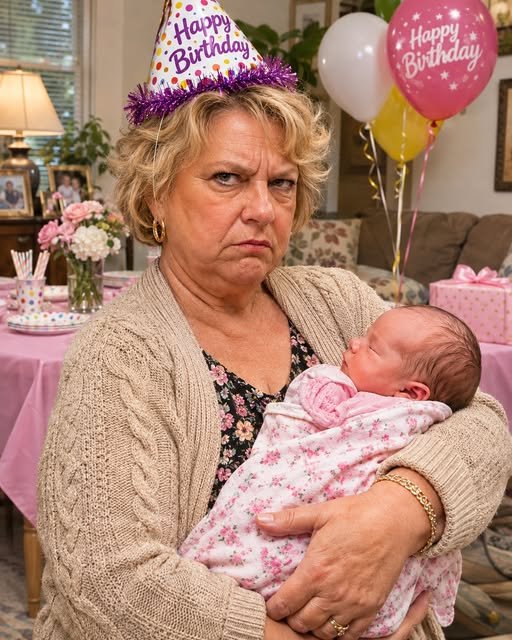
Part 1: The Birthday She Lost
Nine days after my emergency C-section, my mother-in-law looked across our kitchen table and told me I should have waited until after her birthday dinner to have my baby. My husband stopped rocking our son. I kept both hands around a mug of coffee I had reheated twice, wondering whether I was too tired to have understood her correctly.
“At least until the evening,” Barbara added. “I’d been planning that celebration for months.”
I looked at the sleeping baby against Daniel’s chest.
“Next time I’ll ask him to check your calendar.”
She didn’t smile.
Our son, Noah, was still so new that I checked his breathing whenever the room became quiet. I was learning how to stand without pulling at my incision, how to feed him without hunching over, and how to accept help without apologizing for needing it.
Barbara had arrived that Saturday carrying flowers and a bakery box. I had mistaken both for a peace offering, although I hadn’t known we were fighting.
“There were twenty people invited,” she said. “A proper dinner. Not something I threw together.”
“Mom,” Daniel said, “we were at the hospital.”
“I know where you were.” She folded the paper napkin beside her plate. “I’m simply saying the timing was unfortunate.”
The flowers stood between us in a pitcher because neither Daniel nor I had found a vase. Barbara moved them aside so she could look directly at me.
“Women used to be stronger about these things. You couldn’t even give birth naturally, Sarah, and somehow the whole family was supposed to forget my sixtieth.”
I put down my cup before I spilled it.
“Are you reviewing my delivery or asking for a refund for your birthday?”
“There’s no need to be unpleasant.”
Daniel stood, keeping one hand behind Noah’s head.
“You don’t get to call my wife weak.”
Barbara’s expression shifted into something wounded and familiar. I had seen it when we spent Thanksgiving with my parents and when Daniel asked her to call before coming over.
“Apparently I’m not allowed to have feelings.”
“You can be disappointed about a canceled dinner,” he said. “You cannot blame Sarah for needing surgery.”
Until that moment, I had thought this was about the restaurant. An expensive reservation, a milestone birthday, attention diverted at the last minute—I could understand disappointment, even if I couldn’t understand bringing it to a recovering mother’s kitchen.
Then Daniel looked at her in a way I hadn’t seen before.
“Actually, since we’re talking about that day, I need to ask you something.”
Barbara stopped folding the napkin.
“What?”
“About Thursday morning. Before we left for the hospital.”
Her eyes went to me, then back to him.
“Daniel, not now.”
“I heard something yesterday. I wanted to give you a chance to explain it.”
He settled Noah carefully into my arms. I adjusted the small pillow across my lap, feeling the sudden, uncomfortable awareness that a conversation about my own life had been happening somewhere without me.
Barbara stood so quickly her chair scraped the floor.
“We can discuss this outside.”
“Sarah deserves to know.”
She grabbed his forearm.
“Please, don’t tell her!”
For a second, nobody moved.
“Tell me what?” I asked.
Nine days earlier, I had been thirty-seven weeks pregnant when Noah’s usual morning movements became noticeably quieter. I ate breakfast, lay on my side, and called the maternity unit when the change continued to worry me.
The nurse told us to come in for assessment. Daniel was helping me find my shoes when his phone rang.
I remembered him stepping into the hallway. I remembered his voice getting lower, then firmer. At the time, I had assumed he was telling work he wouldn’t be in.
At the hospital, the team monitored Noah and explained that his heart-rate pattern was concerning. After further assessment, the obstetrician recommended an emergency C-section.
I hadn’t argued about the delivery I had imagined. I had asked whether my baby would be all right.
Daniel had held my hand while the doctor explained what would happen next. By that afternoon, Noah was here, warm and indignant, and I was crying too hard to see his face clearly.
That was what Barbara’s birthday had been to me: fear, a decision made with the medical team, and the astonishing sound of my son.
Now she was standing in our kitchen as though Daniel were about to disclose something I had done wrong.
“Mom called while we were getting ready to leave,” he said. “She wanted to know whether I’d still make dinner.”
I looked at Barbara.
“You knew we were going to the hospital?”
“I didn’t know there would be surgery.”
“Neither did we,” Daniel said. “I told you Sarah needed to be checked and I wasn’t coming.”
“You could have called later.”
“I did. After Noah was born.”
Barbara released his arm.
Daniel looked at me now.
“I invited her to come once you were out of recovery and ready for visitors. She said she was too upset.”
I stared at the empty place beside the bakery box.
In the hospital, I had asked twice whether Barbara was coming. My own mother lived several states away and couldn’t arrive until the following week; I had wanted someone who knew Daniel as a baby to look at our son and tell me whose chin he had.
Daniel had said his mother needed a little time.
I had assumed he meant she was overwhelmed.
“You knew she refused?” I asked.
He nodded.
“I didn’t want to upset you while you were recovering.”
Barbara reached for her purse.
“Well, now you’ve made me sound dreadful. I had one bad reaction.”
“That isn’t all,” Daniel said.
His mother went still.
I tightened my hand around Noah’s blanket.
“What else?”
“Yesterday, Aunt Helen asked why you’d banned Mom from meeting the baby.”
The room seemed to contract around the table.
“Banned her?”
“Helen misunderstood,” Barbara said immediately.
I looked from her to Daniel, waiting for one of them to explain how an invitation could become a ban.
Then I remembered the message from his cousin two days earlier, the one I’d been too tired to answer: a reminder that babies needed their grandmothers.
The lie had already left our house.
Part 2: The Story Without Me
“What exactly did you tell Helen?” I asked.
Barbara adjusted the strap of her purse.
“That things were difficult. Which they clearly are.”
“You told her Sarah wouldn’t let you visit,” Daniel said. “Those aren’t the same thing.”
Noah stirred at the sound of his voice. I lowered my chin to his soft hair and waited until his small body relaxed against mine.
“I was invited after everyone had already made their fuss,” Barbara said. “I suppose I was expected to arrive smiling, as though my plans hadn’t mattered at all.”
“You were invited to meet your grandson,” I said.
“You don’t understand.”
For once, I didn’t rush to prove that I could.
“You’re right. I don’t.”
Daniel opened the front door.
“This visit is over, Mom.”
She stared at him, then at me, as though waiting for the more reasonable person to intervene. I had been that person often enough: reminding Daniel to call, suggesting flowers for Mother’s Day, making room for an extra lunch when she said she missed him.
That morning, I stayed in my chair.
“I need to rest,” I said. “And this isn’t good for any of us.”
Barbara left without taking a pastry. Daniel closed the door quietly, which somehow made the whole visit feel worse.
He came back to the table.
“I’m sorry.”
“For which part?”
He pulled out the chair opposite me but didn’t sit.
“For not telling you she refused to come. For letting this happen today.”
“And for deciding to confront her about a rumor involving me without telling me first.”
He looked down.
“I wanted to find out whether Helen had understood her correctly.”
“You knew I hadn’t banned your mother.”
“Yes.”
“Then you already knew the important part.”
He sat at last. On the table between us lay the napkin Barbara had folded into smaller and smaller squares.
“I thought I was keeping one more problem off your shoulders,” he said.
“You kept the problem. You only kept the information from me.”
He opened his mouth, then closed it.
I wasn’t asking him to make me relive every unpleasant word his mother had spoken while I was in recovery. I was asking him not to leave me smiling at people who believed I had used my newborn to settle a grudge.
“I kept wondering what I’d done,” I said. “She didn’t come. A few relatives sent strange messages. I thought maybe I’d missed a thank-you or offended someone while I was exhausted.”
“You didn’t do anything.”
“I know that now.”
Noah began rooting against my shirt. Daniel brought my water, the feeding pillow, and the little notebook where we had been recording feeds.
Usually, those small acts made me feel cared for. That day, I needed something harder from him.
“Please give me Helen’s number.”
He sent it without arguing.
The next afternoon, I called while Noah slept in his bassinet and Daniel changed our sheets. Helen answered with such ordinary warmth that I nearly lost my nerve.
“Sarah, sweetheart. How are you feeling?”
“A little better each day. Can I ask you something uncomfortable?”
There was a pause.
“Is this about yesterday?”
“Did Barbara tell you I wouldn’t let her visit Noah?”
I heard a cup being set down.
“I don’t want to get caught in the middle.”
“I understand. But I’m already there, and I don’t know what people have been told.”
Helen let out a long breath.
She said Barbara had called the morning after Noah’s birth. Several relatives had been checking on the canceled dinner, and Helen had asked whether she had met her grandson yet.
“She said you were angry about the party,” Helen told me. “That you thought she’d made too much of it.”
“I was in the hospital. I wasn’t thinking about her party.”
“I know that now.”
“What else did she say?”
Helen hesitated long enough that I reached for the edge of the couch.
“She said you’d threatened to keep Noah away until she apologized for wanting a celebration.”
For a moment, all I could hear was the washing machine in the next room.
“That conversation never happened.”
“Daniel told me you hadn’t banned her. I thought perhaps there had been something said between you and Barbara that he didn’t know about.”
“There wasn’t.”
My voice sounded flat even to me.
I had been trying to work out how to shower before the next feed while people pictured me issuing ultimatums from a hospital bed.
“Who heard this?” I asked.
Helen named relatives who had been invited to the dinner. Not every guest, she said, but enough that the story had traveled through the family’s ordinary calls and messages.
“Why didn’t anyone ask me?”
“We should have,” she said. “I should have.”
It wasn’t a complete repair, but it was the first answer that didn’t make me responsible for someone else’s decision.
Before we ended the call, I asked Helen not to turn our conversation into another round of family speculation. I wanted Barbara to have the opportunity to correct her own words.
Then I sent Barbara a message.
Sarah: Helen told me you said I threatened to keep Noah from you. That never happened. We need to talk.
Her reply arrived two minutes later.
Barbara: I won’t discuss private family matters over the phone.
Apparently, they had only become private when I joined the conversation.
Daniel found me staring at the screen. When I told him what Helen had said, he reached for his phone.
“I’m calling her.”
“Not yet.”
He stopped.
“She’s lying about you.”
“I know. I’d like you to let me finish deciding what I want to do about it.”
He put the phone down.
That evening, after Noah was asleep again, Daniel showed me the message he had sent his mother from the hospital. It included a picture I remembered asking him to take, Noah tucked beside my shoulder.
Daniel: Sarah’s out of recovery and we’re both ready for a short visit if you’d like to meet Noah. Call first so I can come get you.
Below it was Barbara’s answer.
Barbara: Not tonight. I’m too upset about how today went.
There it was, plain and small on a screen.
I hadn’t been imagining the invitation.
Part 3: The Price of Silence
Four days later, Barbara came back with a bag of baby clothes. Noah was two weeks old, and I could move around the house more easily, although sitting down still required care.
I had arranged the visit for the afternoon, after lunch and a feed. Daniel knew I wanted to speak to her myself; he would stay in the next room with Noah, close enough if I needed him but not between us.
Barbara held up the bag as soon as I opened the door.
“A few things he can grow into.”
“Thank you.”
She glanced past me.
“May I see him?”
“We’ll talk first.”
Her smile faded, but she followed me to the table.
For a few seconds, she busied herself taking tiny sleepers from the bag. One had little sailboats across the front. I could imagine her choosing it, rubbing the fabric between her fingers, thinking of a baby she wanted to love.
That was part of what made everything so difficult. I didn’t believe she felt nothing for Noah. I believed she had hurt us while wanting to remain the sort of person who never would.
“Why did you tell people I threatened to keep him away?” I asked.
“People misunderstood what I meant.”
“Then tell me what you meant.”
She smoothed the sailboat sleeper.
“Helen has a way of making things sound dramatic.”
“Did Helen invent the conversation?”
Barbara looked toward the next room.
“Daniel spoke to me very harshly that morning.”
“He told you he was taking me to the hospital.”
“You weren’t there for the whole call.”
“No. I was putting on my shoes because I was frightened about my baby.”
She lowered her eyes. I let the silence remain instead of rescuing her from it.
Finally, she said, “You don’t know what it’s been like since he got married.”
I sat back.
“Then explain it.”
Her gaze settled on a photograph from our wedding on the sideboard.
“We used to speak every evening. He’d call on his way home from work. Sometimes he’d come over for dinner without making an appointment.”
“And now he comes home here.”
“I know how that sounds.”
“I’m trying to understand what you’re asking me to do with it.”
She twisted her ring around her finger.
Barbara had been widowed for six years. Daniel called regularly and visited, but he no longer filled all the empty places in her week.
I knew loneliness could make a quiet house feel enormous. I also knew she had friends she rarely invited over because she was waiting to see whether Daniel might be free.
“You have your own routines,” she said. “Your own holidays. Then you got pregnant, and every conversation was about appointments and furniture and names.”
“A lot was changing.”
“For me, too.”
For the first time that afternoon, she looked directly at me.
“I wanted one evening when I wasn’t waiting to be fitted in. Sixty felt important. I wanted my son at the table.”
“Then Noah came early.”
Her mouth tightened.
“When Daniel called after the birth, all I could think was that it would always be Noah’s birthday now. Every year.”
I looked at the little sleeper between us.
There it was: not just a canceled meal, but a future she had already imagined losing.
“He didn’t take your birthday,” I said quietly. “He was born.”
She wiped beneath one eye.
“I know.”
“Why didn’t you come to the hospital later?”
“Because I was angry. And then I knew how ugly that anger was, and I couldn’t bear to walk in and have everyone see it.”
“There wasn’t a room full of people waiting to judge you. There was me, Daniel, and a baby.”

She pressed her lips together.
“I didn’t think of it that way.”
I almost reached across the table. Then I remembered Helen’s careful voice, asking whether there might have been a conversation Daniel hadn’t known about.
“Being lonely explains why you were hurting,” I said. “It doesn’t explain why you decided everyone should blame me.”
Barbara drew a breath that shook.
“Helen asked why I hadn’t visited. I couldn’t tell her I’d stayed home because I was upset about dinner.”
“So you told her I didn’t want you there.”
She nodded.
“And when she asked why?”
Barbara looked at the table.
“I said you wanted an apology first.”
“An apology for something I hadn’t even discussed with you.”
“Yes.”
Her admission was so quiet I might have missed it if I hadn’t been waiting for days.
She had made me the excuse.
“You need to correct it,” I said.
Barbara reached for my hand.
“Please don’t tell everyone. They’ll think I’m a terrible mother.”
I moved my hand back into my lap.
“You let them think I was a terrible one.”
“I’m trying to tell you why it happened.”
“And I’m listening. But explaining it to me doesn’t correct what they believe.”
She stood and walked to the counter, then came back without touching anything.
“They’ll talk about me for months.”
“They’ve been talking about me while I’ve been recovering from surgery.”
She stared at me, waiting for that fact to become less important than her embarrassment.
“I can’t do that, Sarah.”
“Then Daniel and I will correct it.”
Her face closed.
“You would humiliate me in front of my family?”
“I’m asking you to tell them the truth. You can choose how.”
She picked up the empty shopping bag, then put it down again.
“May I at least hold Noah before I go?”
I could hear Daniel walking slowly in the next room, murmuring to our son.
“Not today.”
Barbara’s eyes filled again.
“So now you are keeping him from me.”
“I’m ending a visit that has become upsetting. That isn’t the same as the conversation you invented.”
I stood carefully and opened the door.
“We can discuss another visit when we’ve dealt with this honestly.”
She left the clothes on the table.
That evening, I told Daniel what she had said about loneliness and about our marriage. He listened without interrupting, then sat beside me while Noah slept across his forearm.
“I can care that she’s lonely,” he said, “without asking you to absorb this.”
The next morning, he called her. Later, he told me she had accused him of taking my side.
“What did you say?”
“That there shouldn’t be sides over whether she gets to lie about you.”
Over the following days, he began doing what I had needed from the start. When a relative asked whether things were settled, he corrected the story plainly, without calling it a disagreement between two women.
He also stopped giving his mother vague answers to soften decisions we had made together.
The following Wednesday, when Noah was twenty days old, Barbara invited Daniel to her house that Saturday. She described it as a small belated birthday gathering.
She did not invite me.
“I’m not going there to pretend nothing happened,” he told me.
On Friday, Helen called to say she was relieved Barbara and I had worked everything out.
I closed my eyes.
“Is that what she told you?”
“She said it had all been a misunderstanding.”
I waited until Daniel finished settling Noah, then told him I wanted to accompany him for a short visit if Barbara would have us both. He called her in front of me; she agreed immediately, sounding pleased to have an audience for our apparent reconciliation.
I was done being absent from my own story.
Part 4: A Place for the Truth
The next afternoon, our friend Maya arrived with dinner for later and a notebook where she insisted I write down anything she needed to know about Noah.
She had visited twice since his birth and had spent enough time helping us that I trusted her with the small routines we were only beginning to learn. We planned to be away less than an hour, and she promised to call if he needed us sooner.
I fed him before we left. Then I stood beside the bassinet longer than necessary, watching his fingers open against the blanket.
“You can change your mind,” Daniel said from the doorway.
“I know.”
“I can tell them without you.”
I looked at our son.
“I don’t want to spend the next family gathering wondering who still believes it.”
He nodded.
We agreed on one thing before leaving: I did not have to stay to make anyone comfortable. If I was tired, sore, or simply finished, we would go.
Barbara lived ten minutes away. During the drive, I rested my hands in my lap and resisted the urge to rehearse every sentence.
I had spent too much of the previous week trying to find words gentle enough that the truth would not hurt the person who had hidden it.
There were eight relatives in her living room when we arrived. A few had been invited to the original restaurant dinner; the others had heard about it afterward.
Barbara was setting a cake on the dining table.
“There you are!” she said brightly. “And where’s my grandson?”
“At home with Maya,” Daniel said.
Something flickered across her face, but she leaned forward to kiss his cheek.
Helen came over and squeezed my hand.
“You look tired, sweetheart. Come sit.”
I accepted the chair she pulled out. Barbara began passing plates as though keeping everyone’s hands occupied might keep the conversation safe.
“I’m so glad we can put that little misunderstanding behind us,” she said.
I looked up.
“What misunderstanding?”
The cake knife stopped above a plate.
“Sarah, you know what I mean.”
“I know what you told people. I’m asking whether you’ve corrected it.”
One of Daniel’s cousins set down her cup. Across the room, an uncle who had been asking about parking went quiet.
Barbara gave a small, strained laugh.
“Must we do this right now?”
“I asked you privately first.”
Daniel stood beside my chair, not touching me or speaking for me, simply there.
Helen looked at her sister.
“Barbara, you said Sarah refused to let you visit Noah.”
“It was an emotional time.”
“I didn’t refuse,” I said. “Daniel invited her after I came out of recovery and was ready for visitors. I had asked him to send her a photograph.”
Barbara turned toward him.
“You know I was upset.”
“I do,” he said. “But Sarah didn’t stop you coming. Neither did I.”
“There was so much going on.”
I took my phone from my bag, then left it facedown on my knee.
“We still have the messages if anyone needs to see them. I would rather you simply tell the truth.”
I had thought producing proof would make me feel powerful. Instead, I felt tired that a photograph of my newborn and an invitation to meet him might have to serve as evidence.
Helen folded her arms.
“And the part about Sarah demanding an apology? You said she threatened to keep the baby away.”
Barbara looked at me.
For the first time since we arrived, she wasn’t looking for Daniel to intervene.
“Things were said when everyone was upset,” she said.
“Not by me,” I said. “That conversation never happened.”
Nobody reached for the cake.
Her cousin Ruth leaned forward, looking genuinely confused.
“Then why did you tell us it did, Barbara?”
Barbara set the knife on the serving plate. Her hand stayed beside it.
“Because I was ashamed.”
The room became very still.
“Of what?” Helen asked.
Barbara swallowed.
“Of not going to the hospital.”
She looked down at the cake, at the neat ring of candles someone had already removed.
“I’d been looking forward to my birthday. When Daniel said he wasn’t coming, I got upset. After Noah was born, I was still upset, and then I knew how selfish that was.”
Her voice shook, but nobody interrupted.
“When Helen asked why I hadn’t visited, I said Sarah didn’t want me there. Then I had to explain why she wouldn’t, and I made it worse.”
“You let us send her messages about being kinder,” Ruth said quietly.
Barbara closed her eyes.
“I know.”
That hurt more than I expected: hearing someone else acknowledge those little messages, each one mild enough to make me doubt whether I had a right to object.
Helen turned to me.
“I’m sorry, Sarah. I should have asked you directly before I believed it.”
“Thank you.”
Ruth nodded.
“Me too.”
I didn’t need a procession of apologies. I needed the room to stop treating a story about me as more trustworthy than my own account.
Barbara wiped her cheek with a napkin.
“I was frightened of losing my son.”
I waited until she looked at me.
“Barbara, I wanted you at the hospital.”
Her face changed.
“I didn’t know that.”
“I had just had surgery. My mother couldn’t get here yet. Daniel was wonderful, but we were both scared and tired, and I wanted you to come meet our baby.”
My voice broke on the last word. I stopped, took a breath, and continued.
“You didn’t have to be perfectly happy about missing your dinner. You just had to come because something important had happened to your family.”
A tear slipped down her cheek.
“I’m sorry.”
I let the words stand without answering for a moment.
Then I said, “Please tell them clearly what wasn’t true.”
She nodded, looking around the room.
“Sarah never threatened to keep Noah away from me. She didn’t stop me visiting the hospital. I chose not to go, and I lied because I was embarrassed.”
She took another breath.
“And what I said at their house about the surgery was cruel. Sarah didn’t choose when Noah needed to be born.”
I felt Daniel’s hand settle lightly on the back of my chair.
No one applauded. No one tried to turn the moment into a joke or hurry us toward cake.
The truth finally had witnesses.
Barbara looked at Daniel.
“I’m sorry I put you in that position.”
“You need to apologize to Sarah for what you made people believe about her,” he said. “Not just for making things difficult for me.”
She turned back.
“I am sorry, Sarah. You should have been able to recover without this.”
“Yes,” I said. “I should have.”
It was the simplest thing I had said all afternoon, and the hardest not to soften.
Barbara nodded, holding the crumpled napkin in both hands.
Then she asked, carefully, “Could I come see Noah next weekend?”
I looked at her, at the woman who had chosen his sailboat sleeper and invented a threat in the same week.
“Not yet.”
Her mouth tightened before she caught herself.
“But I’ve apologized.”
“I heard you. And I appreciate that you corrected it.”
I put my phone back in my bag.
“But an apology doesn’t mean I’m ready for everything to go back to normal today.”
She glanced at Daniel. He stayed beside me.
“What happens now?” she asked.
“We take some time. Daniel will stay in touch with you. When we’re ready for a short visit, we’ll arrange one together.”
“You do want him to know me?”
“Yes. I want him to have a grandmother who respects his mother. Those things have to go together.”
For a moment, I thought she might argue. Her fingers tightened around the napkin, then slowly loosened.
“All right,” she said.
I couldn’t tell whether she fully understood or was simply exhausted by the consequences. For once, I didn’t make myself responsible for finding out immediately.
Daniel asked her to correct the story with anyone else she had told, including relatives who weren’t there. She agreed, and Helen offered to help make sure nobody was left believing the original account.
That was enough for that afternoon.
I stood, feeling the familiar pull in my abdomen. Daniel picked up my bag without asking whether I could manage it.
Helen walked us to the door.
“Can I bring dinner next week?” she asked.
“You can text us,” I said. “We’re taking things a day at a time.”
“Of course.”
Behind her, Barbara remained beside the table. She looked smaller without the busy work of serving cake, but she was not helpless, and I would not help her by pretending she was.
“Give Noah my love,” she said.
“We will,” Daniel answered.
Outside, he asked whether I was all right.
“I’m tired.”
“Let’s go home.”
He opened the car door, and I lowered myself into the seat. Through Barbara’s front window, I could see Helen sit down beside her, the two sisters finally having a conversation I didn’t need to manage.
I wasn’t leaving with restored trust. That would take choices Barbara had not made yet, and time none of us could hurry.
But the lie was no longer waiting for me at the next family dinner, and my husband was no longer standing between me and information he thought I couldn’t bear.
My phone lit up with a photograph from Maya: Noah asleep, one small hand resting beside his cheek.
I turned the screen toward Daniel. He smiled, then reached across the console for my hand.
We had a baby to go home to. For the first time since Barbara’s visit, I could think about the next hour without preparing a defense.
I looked once more at our son’s picture, at the little hand opening in sleep. He would never remember the day we brought the truth back into the family—but I would remember the quiet we brought home to him.
What does a sincere apology need to change before trust can begin to return?