
Part 1: The Photograph We Kept
Seventeen years after my two closest friends and I shaved our heads for a boy with cancer, he invited us to his thirtieth-birthday dinner. I drove four hours expecting bad jokes, too much food, and a photograph we would all complain about afterward, but the restaurant had set a table for only four. Before the evening was over, Caleb would place three envelopes between our untouched plates and tell us what he had been hiding for six months.
We were thirteen when Caleb Whitmore started treatment for Hodgkin lymphoma in our small Ohio town. A few weeks later, his mother called my mother and mentioned that he was dreading his return to school. He could manage the missed assignments, she said, but he could not stop thinking about everyone looking at his head.
That evening, I called Mason Brooks and Luke Harris over to our house and repeated what I had heard. Mason stopped bouncing a tennis ball against the garage wall. “We can’t just stand around while he’s going through this,” he said.
Luke sat on an overturned bucket, running his fingers over the close curls he usually guarded from our amateur haircutting experiments. “What if Caleb wasn’t the only kid at school without hair?” he asked.
My father made us ask our parents before he handed over the electric clippers, then supervised while we took turns in a kitchen chair. Mason’s first attempt left a crooked strip above my ear, and Luke laughed so hard that Dad had to take over. By the time we finished, the floor looked like something unfortunate had happened to three different rugs.
The next afternoon, Caleb’s mother, Elaine, opened her front door and looked from one bare head to the next. “Oh, boys,” she said, pressing her knuckles against her mouth. Then she hugged us, clippers’ tiny missed hairs and all, before leading us upstairs.
Caleb was sitting against his pillows with a game controller lying unused beside him. “Mom, I told you I don’t feel like seeing anybody,” he said, then looked up. “What happened to your hair?”
Luke rubbed the top of his head with exaggerated pride. “We heard bald heads were becoming popular,” he said. “Didn’t want to miss out.”
Caleb looked at Mason, then Luke, then me, and his uncertain smile began to shake. “You guys didn’t have to do that,” he said.
“Yeah, we did,” I said, moving beside the bed. “We’re in this together.” He reached for us, and we crowded around him, laughing through our tears while his mother lifted her camera from the dresser.
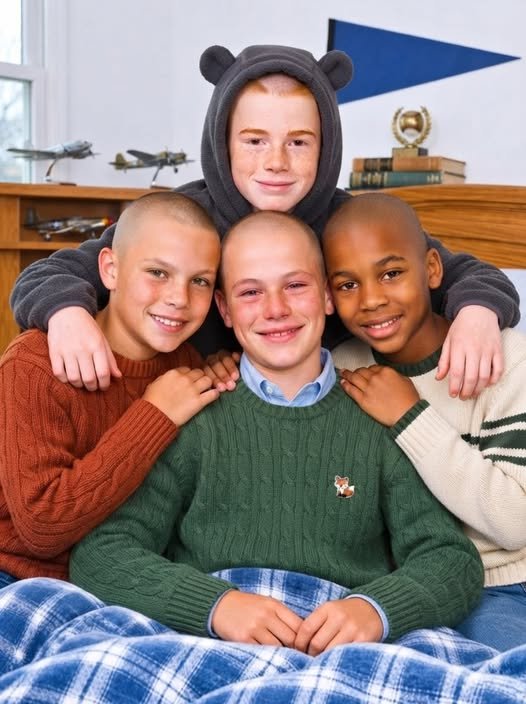
That photograph stayed in my wallet until the corners softened: Caleb in the middle beneath his blue plaid blanket, me leaning against one shoulder, Luke against the other, and Mason towering behind us in a ridiculous hood with bear ears. None of us looked particularly brave. We looked like boys trying not to cry in front of other boys.
After Elaine took the picture, Mason announced that Caleb had ruined our plan by still being the best-looking one. Caleb laughed hard enough to ask for water. It was the first ordinary sound I had heard from him in weeks.
We stayed until he got tired, which happened sooner than any of us wanted. His sentences shortened, and he stopped reaching for the controller, but Mason kept suggesting another game. Elaine came to the doorway and asked us to help her downstairs.
In the kitchen, she handed us cookies we did not especially want. “He’s happy you’re here,” she said. “He’s also worn out, and sometimes he won’t tell you because he’s afraid you’ll stop coming.”
“We won’t,” Luke said immediately.
“Then make sure he knows he can ask you to leave.”
That instruction bothered me more than the haircut had. Shaving my head had been simple: choose a good thing, do it, receive a hug. Learning when my presence might become another thing Caleb had to manage required paying attention.
The following Saturday, we went back with a borrowed movie and left after forty minutes when he began rubbing his eyes. We did not complain or ask whether he was sure. On the way out, I told him I would call the next afternoon.
“You don’t have to check on me every day,” he said.
“I know,” I told him. “Tomorrow I’m calling because Mason thinks a whale could beat a submarine, and we need somebody sensible.”
He considered that with the seriousness it deserved. “What kind of submarine?”
For a while, that was how we managed: homework, ridiculous arguments, short visits, and plans that changed depending on how he felt. His mother kept track of appointments and medications; we kept him informed about which teacher had lost patience with Mason that week.
We were not responsible for making him better. Our parents were careful about that, although I do not think I understood why until much later. What we could do was leave a space for him in the life he missed.
School was more complicated. Caleb’s treatment team and the school worked out when he could return, and Elaine explained that we had to stay away if we were sick, even if it was only a sore throat. Mason complained once about missing a visit, then began questioning everybody in his household about whether they had coughed.
The night before Caleb’s first morning back, he called me while I was pretending to finish a history assignment. He wanted to know whether we were really meeting him at the front entrance. I told him we would be there before the buses.
“What if somebody says something?” he asked.
I had been preparing a heroic answer involving several things my mother would not have approved of. Instead, I heard Elaine’s voice in my head and asked, “What do you want us to do?”
For several seconds, he said nothing. Then he answered, “Don’t make it worse.”
I promised, although at thirteen I had no clear idea how to keep that promise. The next morning, the three of us stood by the school doors with cold ears and matching knitted hats my mother had found on clearance.
Caleb stepped out of his mother’s car, saw us waiting, and managed a smile. Then he stopped at the foot of the steps, staring past my shoulder.
Behind us, the front doors had opened—and the first student to notice him was already pointing.
Part 2: The Space Between Calls
The student pointing at Caleb was a sixth grader named Ben who shared our bus route. Before Mason could turn around completely, Ben called, “You’re back! Does that mean you can help with the robot?”
Caleb blinked. He had spent the fall designing a cardboard-and-motor contraption for the science club, and apparently Ben’s first concern was whether somebody could finally make its left wheel work.
“Probably,” Caleb said. “What did you do to it?”
Ben began explaining a disaster involving glue, and Caleb followed him inside. Mason looked almost disappointed that nobody needed defending. Luke elbowed him, and we hurried after them.
Not every day went that easily. Some students stared, and others asked questions Caleb did not want to answer while standing in line for lunch. Once, a boy loudly asked whether cancer was contagious, and I began an answer with a tone that would certainly have made things worse.
Caleb touched my arm. “It isn’t,” he told the boy. “But you could ask the nurse instead of announcing it across the cafeteria.”
Later, he asked us not to answer every question for him. “Sometimes I want you to back me up,” he said. “Sometimes I just want to get through lunch.”
We learned, imperfectly. Mason carried Caleb’s backpack only after asking; Luke brought extra class notes without making an announcement about it. I stopped reporting every tired expression to Elaine as though I had discovered something she had overlooked.
There were mornings he could not come at all. On those days, we called after school, and sometimes he talked for an hour, while other times his mother said he was asleep. We learned not to make either kind of day into a prediction.
By the end of that school year, his doctors told the family he was in remission. Elaine called our house first, and I ran outside so quickly that I left the back door open. My father found me halfway down the block, shouting Mason’s name.
We celebrated in Caleb’s backyard with pizza, supermarket cake, and a game of basketball that involved almost no running. Nobody called him cured. At thirteen, however, we heard remission and allowed ourselves to plan the whole summer.
His hair grew back before our patience did. For several weeks, Luke insisted that Caleb’s new curls proved the haircut had been his idea all along. The four of us eventually stopped looking alike, but people still called us a group before they called us individuals.
In high school, Caleb became the person who could explain algebra without making you feel foolish. Mason could fix a bicycle with three tools and a piece of something he found on the ground. Luke joined the debate team, and I wrote sports reports for the school paper despite possessing no useful athletic ability.
We argued, too. Caleb once stopped speaking to me for three days because I mentioned his medical history while trying to persuade a teacher to extend his deadline. He had wanted help with an essay, not a public explanation of his childhood.
“You could have asked me first,” he said when we finally talked.
I apologized without explaining my intentions. It was not the last time I would need to remember that there was a difference between loving somebody and deciding what was best for him.
At graduation, Elaine took another photograph of us in almost the same arrangement as the bedroom picture. This time, Caleb stood in the middle wearing a cap that kept sliding backward, and Mason leaned so heavily on Luke that they nearly knocked over a flowerpot.
We went behind the gym afterward, where we had spent years waiting for rides. Mason raised a paper cup of lemonade and declared, “Whatever happens, we’re brothers forever.”
“Even if Owen becomes famous and pretends not to know us?” Luke asked.
“Especially then,” Caleb said. “I have photographs.”
We meant that promise. What we did not understand was that meaning it once would not automatically make us good at keeping it.
University sent us in different directions. I eventually settled in Pittsburgh and married Nora, who could identify which friend I was speaking to by the particular kind of idiot I became on the phone. Luke moved to Indianapolis for work, Mason stayed near our hometown, and Caleb took an accounting job outside Columbus.
Our group conversation survived longer than most of our plans. There were photographs of Mason’s renovation disasters, Luke’s terrible hotel breakfasts, and my daughter wearing a saucepan as a helmet. Caleb contributed dry observations and reminders about birthdays we would otherwise have missed.
Actual conversations became harder to arrange. A canceled weekend became another canceled weekend, and then it seemed embarrassing to acknowledge how long it had been. Whenever we finally met, the ease between us convinced me that no damage had been done.
During the year before his thirtieth birthday, Caleb missed our annual summer cookout. He said work was relentless, which sounded reasonable because my own calendar looked like a punishment. I sent him a photograph of Mason burning corn, and he replied with a laughing face.
In October, I called while driving home, but he let it go to voicemail. Later, he wrote that he was exhausted and would catch up soon. I answered, “No rush,” and congratulated myself on being considerate.
There were other small things I would remember afterward: fewer jokes, a birthday card for my daughter mailed two weeks early, a question about whether Nora had enough help when my work got busy. At the time, none seemed large enough to interrupt the life directly in front of me.
Then, one Thursday in January, Caleb’s name appeared on my phone while I was packing my daughter’s lunch.
Caleb: Turning thirty next Saturday. Dinner with you, Mason, and Luke? I’ve booked somewhere quiet in Columbus. It would mean a lot if you could come.
I smiled and began typing a complaint about the phrase “somewhere quiet.” Before I finished, another message arrived.
Caleb: Please come, brother. I really need all three of you there.
I deleted my joke. Caleb had asked us for rides, favors, and help moving a sofa, but he had never asked for our company like that.
Nora looked up when I stopped packing. I handed her the phone, and after reading it she said, “Go. We’ll work out the rest.”
That night, I called Caleb instead of texting back. It rang until voicemail, and this time I did not tell myself there was no rush.
Part 3: Four Places at Dinner
Caleb returned my call the following morning. He sounded cheerful enough to make me feel briefly foolish, but when I asked whether everything was all right, he answered a different question.
“I’m glad you can come,” he said. “I didn’t want to spend this birthday staring at a screen.”
I wanted to press him. Instead, I said I would be there, partly because he sounded tired and partly because I was afraid of turning an ordinary invitation into something frightening. For the next eight days, I checked my phone more often than I admitted.
The following Saturday, I made the four-hour drive to Columbus with an overnight bag and a bottle of bourbon Caleb would barely touch. At a rest stop, I called Mason, who answered over the sound of a turn signal.
“Does he sound strange to you?” I asked.
Mason paused long enough that I heard the turn signal click six times. “He says he’s had a rough winter,” he said. “I thought maybe something happened with work.”
“Have you seen him lately?”
“Not since spring.” His voice changed. “I kept meaning to.”
There was no accusation in my silence, although I worried he might hear one. I had not seen Caleb since the previous Christmas.
The restaurant occupied a converted brick house on a quiet street. A hostess took my coat and led me past a crowded dining room into a smaller room with a closed fireplace and one round table.
Mason and Luke were already there. Mason hugged me hard enough to lift one heel off the floor, and Luke held on a second longer than usual. On the table stood four water glasses, four folded napkins, and four place settings.
“Are we the whole birthday party?” I asked.
“Apparently,” Luke said. He had removed his glasses and was polishing lenses that already looked clean.
Mason glanced toward the doorway. “I assumed Elaine would be here.”
Before either of us answered, Caleb came in carrying a plain brown document folder beneath one arm. For a moment, the expression on his face was so guarded that I almost stepped back instead of forward.
He was thinner than I remembered. His hair was cut very short, and a shallow line beside his mouth deepened when he smiled. None of those things alone would have explained the way he looked at us, as though he needed a moment to believe we had arrived.
“My brothers,” he said.
He hugged Mason first, then Luke, then me. I felt the hard edge of the folder between us and smelled the same cedar soap he had used for years. The familiarity made the changes in him harder to ignore.
When we sat down, a server asked whether we wanted drinks. Caleb ordered ginger ale, and the rest of us suddenly discovered we did not want alcohol either. He noticed and gave us a crooked smile.
“You’re allowed to order what you want,” he said. “This isn’t a supervised field trip.”

For a few minutes, we tried. Mason told a story about installing a door backward, Luke described a disastrous work presentation, and I produced a photograph of my daughter asleep in a laundry basket. Caleb laughed in the right places, but his thumb kept rubbing the corner of the folder.
Finally, I put my phone facedown. “Caleb, is everything okay?”
He looked at the untouched bread in front of him. “First, thank you for coming. I know it wasn’t convenient.”
“You only turn thirty once,” Luke said.
“That’s true.” Caleb took a breath and let it out slowly. “But this dinner isn’t really about my birthday.”
Mason leaned back, then immediately forward again. The movement rattled his knife against his plate.
“Do you remember what you did when we were thirteen?” Caleb asked.
“The haircut?” Mason said. “I’ve spent seventeen years trying to forget the shape of Owen’s head.”
I would usually have answered him. Instead, I watched Caleb smile and then press his lips together until the smile settled.
“I thought everybody would see the illness before they saw me,” Caleb said. “I knew my mother loved me, and I knew the doctors were trying to help, but school was mine. I was afraid that would become another place where I was only a patient.”
He looked at Luke. “Then three idiots came into my room looking like badly peeled eggs.”
“Carefully peeled,” Luke said, but his voice had thinned.
Caleb nodded. “You made it possible to walk through those doors. I don’t think I ever explained that properly.”
“You don’t owe us an explanation,” I said.
“I owe you this one.”
He opened the folder and took out three cream-colored envelopes. Mason’s name was on the first, Luke’s on the second, and mine on the third, all written in the narrow, careful handwriting I remembered from borrowed homework.
He placed them beside our plates without letting go immediately. His fingers trembled against the paper.
“Something happened six months ago,” he said. “I’ve started telling you a hundred times. Then we’d talk about work or somebody’s kid, and I’d decide to wait until I knew more.”
Luke set down his glasses. “Caleb, you’re scaring us.”
“I know. I’m sorry.” He drew the envelopes back toward himself by half an inch, then stopped. “Before you open those, I need one promise.”
Mason’s jaw tightened. “Depends on what you’re asking.”
For the first time all evening, Caleb looked directly at all three of us without trying to smile.
“Promise you’ll let me finish,” he said. “Because if you interrupt me now, I don’t know whether I’ll be able to tell you the rest.”
Part 4: What the Envelopes Held
We promised. Caleb rested both hands flat on the table, as though steadying himself before standing on uncertain ground.
“The lymphoma came back,” he said. “They confirmed it in July.”
For a moment, the only sound I could separate from the restaurant beyond the door was the hum of a refrigerator somewhere nearby. I stared at his hands because looking at his face would have made the words impossible to hold at a distance.
He explained that a swollen lymph node had led to tests and a biopsy. A relapse after so many years was uncommon, his specialist had told him, but the pathology review confirmed that he had Hodgkin lymphoma again. He had begun treatment while we were sending photographs of cookouts and summer vacations.
“The first treatment hasn’t given them the response they wanted,” he said. “They’re changing the plan. If the next treatment gets it under control, they hope I can have high-dose chemotherapy and a transplant using my own stem cells.”
He stopped and took a sip of water. We kept our promise, although Mason had folded his arms so tightly that his knuckles pressed white against his sleeves.
“It’s meant to give me a chance at a lasting remission,” Caleb continued. “That’s what they’re working toward. Nobody has told me I’m out of options, and nobody can promise how it will go.”
The phrase about options loosened something in my chest without making the rest less frightening. I had already been turning the envelopes into farewell letters, inventing a future before he had finished describing the present.
“Mom knows,” he said. “My sister knows. My manager knows enough to arrange leave, and I’ve been seeing a counselor through the cancer center.”
He looked down. “You weren’t the only people I didn’t tell. But you were the people I kept wanting to call.”
He pushed the envelopes toward us again. “These aren’t instructions for after I’m gone. I wrote them because I needed you to know what you’ve meant to me before we started talking about appointments and logistics.”
For several seconds, none of us moved. Then Luke carefully opened his envelope along the sealed edge, and Mason and I followed.
My letter was two pages long. Near the beginning, Caleb had written about the afternoon I learned to leave his room without making him apologize for being tired.
Owen,
Farther down, he described our argument in high school, when I had shared his medical history without asking. My face warmed as I read it, until I reached the next line.
You listened when I told you that you had hurt me. I need to trust that we can still do that now, even when the conversation is uncomfortable.
At the bottom, his handwriting grew less even.
I have missed you while pretending I was only busy. I don’t need you to become thirteen again. I need to find out whether we can be honest with each other at thirty.
I read that last paragraph twice. Across the table, Luke covered his eyes with one hand, while Mason flattened his letter against the tablecloth as if smoothing it could help him breathe.
“Six months?” Mason finally asked.
Caleb nodded.
“You let me complain about a leaking roof for forty minutes while you were doing this?”
“For forty minutes, I got to think about your terrible roof.”
Mason pushed his chair back a little. “That isn’t fair.”
“No,” Caleb said. “It isn’t.”
I had expected him to defend himself. His agreement left the room quieter than an argument would have.
He explained that he had intended to tell us after the first scan, when he could attach reassuring news to the diagnosis. When the news was not reassuring enough, he chose another milestone, then another. Each delay made the next conversation harder.
“I also remembered what it was like to have everybody watching me,” he said. “I was afraid you’d start measuring every phone call against whether it might be the last one.”
Luke lowered his hand. “We might have done that badly,” he said. “You still didn’t have to decide for us.”
“I know.” Caleb’s eyes filled. “That’s why I asked you here. I can’t keep doing it this way.”
Mason stood so abruptly that I thought he might leave. Instead, he walked around the table, bent down, and held Caleb by the shoulders.
“I’m angry,” he said. “I’m staying, but I’m angry.”
Caleb reached up and gripped his wrist. “Okay.”
That was when I began crying properly, without any hope of disguising it as clearing my throat. Luke was crying, too, and Mason stopped pretending he was not. Caleb sat among us with tears running down his face, no longer trying to make his news easier to receive.
When the server knocked, Luke answered and asked for another few minutes. Caleb laughed shakily at the thought of our dinners arriving cold, and Mason told him he could criticize the food like any other birthday guest.
We ate eventually. Between bites, Caleb told us what the next weeks might involve and which parts were still uncertain. He did not produce a miraculous solution, and neither did we.
I offered to stay in Columbus through his next appointment before remembering to ask whether he wanted that. He looked at me, and something like our old understanding passed between us.
“I’d like you there for the consultation,” he said. “Not in every room unless I ask.”
Luke took out his phone, then paused. “Can we make a separate conversation for practical things? One you can mute without missing the stupid stuff?”
“Please,” Caleb said. “I still want the stupid stuff.”
By the time the plates were cleared, we had stopped making sweeping promises. We were asking about dates, driving distances, permission to update one another, and what support Elaine already had.
Then Caleb told us that the specialist appointment was Monday morning and that he had planned to take a car service because his mother had a medical appointment of her own.
He looked embarrassed by the silence that followed. “I haven’t booked it yet,” he admitted.
I put my overnight bag beneath my chair and took out my phone. My return route was still open on the screen, pointing toward home.
“Then let’s figure out Monday,” I said—and Caleb reached across the table before I could cancel anything.
Part 5: The Door We Opened
“Call Nora first,” Caleb said, resting his hand over mine. “Ask her what changing your plans means. Don’t turn me into a reason you stop talking to the people at home.”
I looked at him, then laughed through what remained of my tears. He had just told us the most frightening news of his adult life and was still willing to tell me when I was getting ahead of myself.
I stepped into the hallway and called my wife. Nora listened without interrupting, then asked what Monday involved and whether I wanted to stay. We worked through school pickup, a meeting I could move, and one I would have to attend remotely.
When I returned, I did not announce that I would do anything, anytime. I told Caleb I could stay through Monday afternoon, drive him to the consultation, and take notes if he wanted. He said that would help.
Luke could work remotely from Columbus for part of the following week. Mason could manage local errands and occasional rides, provided he had notice when possible. None of us could replace a medical team, a counselor, or Caleb’s own decisions, but we could stop leaving every practical burden to him and Elaine.
Before we left, Caleb asked for a photograph. We crowded together beside the table, older and less comfortable in our knees, while the server held his phone. This time, nobody needed the same haircut to prove we belonged in the picture.
On Monday morning, I sat beside him in the waiting room with a notebook balanced on one leg. When his name was called, he stood, then turned back.
“Come in for this one,” he said.
The consultation was not a scene from a film. There were questions about previous treatment, discussions of side effects and next steps, and several points the specialist repeated because neither of us had absorbed them the first time. I wrote down what Caleb asked me to write, not what I thought he ought to ask.
Afterward, we sat in his parked car and did not immediately start the engine. He stared through the windshield while I waited.
“I’m scared,” he said.
“I know.”
“You don’t have to tell me it’ll be okay.”
“Good,” I said, because my own voice was beginning to fail. “I don’t know how.”
He nodded, and after another minute he asked whether we could get breakfast. That was something I could answer without pretending.
The months that followed were neither a steady decline nor an uplifting montage. Caleb had treatment days when he joked through the whole ride and others when he asked whoever was driving not to talk. Plans changed, medications changed, and all four of us learned to distinguish an offer from an obligation.
We made mistakes. Mason arrived one Saturday determined to repair everything in Caleb’s apartment and became offended when Caleb asked him to leave. Later, Mason called back and said, “I wanted to feel useful more than I wanted to hear you. I’m sorry.”
Luke made a schedule so elaborate that Caleb said he needed administrative leave from being helped. Luke removed half the columns and added one place where Caleb could write simply, “Not today.”
My own mistake was asking how he felt at the beginning of every conversation. Eventually, he answered, “Like a man who would love to discuss literally anything else.” We spent the next twenty minutes arguing about baseball.
Elaine accepted help cautiously at first. She had spent six months protecting her son’s privacy while carrying a fear she could not put down. Once Caleb gave us permission to coordinate directly with her, she asked for specific things: groceries, a ride home, somebody to sit with him while she slept.
There were financial worries as his leave stretched on. A hospital social worker helped him understand benefits, assistance programs, and payment arrangements, and we asked before offering money. He accepted help with some everyday expenses and declined other offers without having to defend the decision.
The new treatment reduced the disease enough for his team to move ahead with the transplant plan. Caleb collected his own stem cells, then later entered the hospital for high-dose chemotherapy followed by their return through an infusion. He sent us a photograph of the equipment with a complaint that something so important ought to look less ordinary.
Recovery demanded more patience than any of us possessed naturally. There were infection precautions, profound fatigue, frequent appointments, and stretches when visiting in person was not appropriate. We followed the team’s instructions and learned that being present sometimes meant remaining on the other side of a phone.
One night, months after the birthday dinner, Caleb called me at 11:18 p.m. I had just gone to bed, and for half a second I considered whether I could call him in the morning.
Then I answered.
“Nothing’s happened,” he said quickly. “I’m just awake.”
I settled against the headboard. “What kind of submarine?” I asked.
He was quiet for a moment before he understood. Then I heard a laugh I had known since we were children, and we talked until he grew sleepy.
His first major scan after recovery showed no evidence of active lymphoma. Caleb called each of us himself, repeating the doctor’s words carefully. There would be continued monitoring, and remission was not a promise about every year ahead, but it was real news about the day we were in.
I cried in my office with the door closed. Later, our group conversation filled with incoherent messages, followed by Mason asking whether this meant Caleb was finally allowed to criticize his cooking in person again.
By autumn, Caleb was rebuilding his strength and easing back into work. He still needed rest, and there were appointments he dreaded. The difference was that he no longer had to invent a busy week when what he meant was, “I could use some company.”
We did not become inseparable again. My daughter still needed school pickups, Luke still traveled, and Mason still accepted more work than he should. Instead of treating those facts as evidence that friendship had faded, we began making plans small enough to keep.
Sometimes that meant a twenty-minute call. Sometimes it meant admitting that we had let three weeks go by and choosing a date instead of apologizing vaguely. We stopped relying on the idea that nothing changed between us and started paying attention to what had.
Near the end of the year, Caleb brought up something his cancer center’s family-support coordinator had asked him. A mother wanted help thinking through her thirteen-year-old son’s return to school, and the boy had wondered whether he could meet someone who had actually done it.
“He asked if I had any pictures,” Caleb told us. “I showed the coordinator the one from my bedroom, and his mother asked whether all four of us might come.”
Luke asked the first sensible question. “Does he want that, or does his mother?”
“He does,” Caleb said. “But I told them we’d ask again before the visit. He’s allowed to change his mind.”
The following Saturday, we met in the cancer center’s family lounge. Caleb carried two copies of the old photograph and none of us carried clippers, a speech, or an expectation that another boy should want what had helped him.
We had agreed to answer questions honestly, stay only as long as invited, and let Caleb explain that friendship had not treated his cancer. Doctors and treatment had done that work; friends had helped him remain himself while it happened.
Before the coordinator came back, Caleb reached into his coat and handed each of us another envelope. Mason looked alarmed until Caleb rolled his eyes.
“Birthday dinner,” he said. “Next month. Same place, and this time you’re buying.”
Inside mine was an invitation and a small print of the photograph taken at his thirtieth birthday. On the back, he had written a single sentence.
Thank you for letting me tell you the rest.
I slipped it into my wallet beside the worn childhood picture. For seventeen years, I had thought the first photograph showed the day we proved we would do anything for our friend; now I could see four boys who had barely begun learning how.
The coordinator returned and said the family was ready. From the room beyond her, a young voice asked whether all four of us had really come.
Caleb glanced at us, his hand resting on the door. We moved beside him, close enough to appear in the doorway together, and waited as the boy inside called, “Can I ask you something?”
What does showing up for a friend mean when you cannot fix what they are facing?