
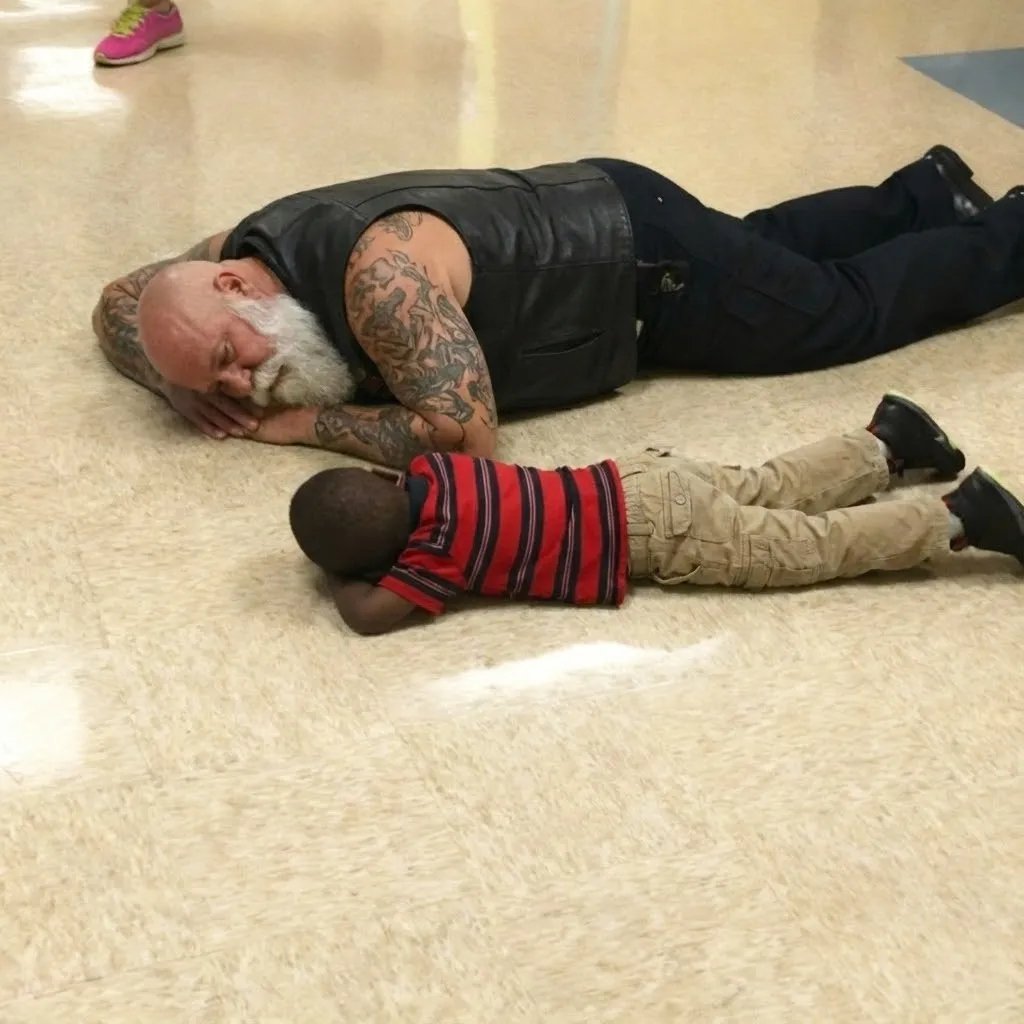
The waiting room was filled with uneasy silence, broken only by the raw screams of my six-year-old autistic son, Marcus. A fire drill had shattered the sense of order I’d tried desperately to keep, and now he was on the floor, overwhelmed and inconsolable. I was a pediatric nurse of twenty-three years, yet nothing in my training could reach him—not the weighted blanket, not his headphones, not my voice. The other patients watched with discomfort or pity as I struggled, feeling like I was failing both as a nurse and a mother. And then the clinic door opened, and a massive biker in leather and steel-toed boots stepped inside, pausing mid-stride as he took in the scene before him.
Instead of recoiling or staring, the man—who introduced himself only as “Bear”—slowly eased himself down onto the tile floor a few feet from Marcus. Without speaking, he mirrored my son’s position, lying flat and still, waiting with the kind of patience that can’t be taught. At first, Marcus kept screaming, trapped in his internal storm. But then he noticed the quiet stranger beside him. His cries softened. His breathing steadied. He crawled closer until he lay face-to-face with Bear, mirroring him the way only another autistic child had ever managed to do. And in that moment, something shifted. The biker hummed—a soft, steady vibration—and Marcus responded in kind, drawn to the calm presence of someone who instinctively understood what he needed.
Bear explained that his grandson was autistic too, and suddenly every gentle choice he made made sense. He showed Marcus pictures of his motorcycle, played the rumbling engine sound that soothed more than startled, and eventually led us outside to see the bike in person. To my astonishment, Marcus reached for Bear’s hand—a rare act of trust—and explored the chrome and leather with a joy I hadn’t seen in months. Before leaving, Bear handed me his number and said something I’ll never forget: “When someone helped my grandson during a meltdown, they told my daughter, ‘Pass it on.’ So that’s what I’m doing. Passing it on.”
Months have passed, and Bear has kept every promise. He visits with his grandson Tyler, and the boys sit together in quiet companionship only they understand. When Tyler has meltdowns, Marcus now lies down beside him and hums—recreating the moment Bear changed our lives. The rough-looking biker who walked into a waiting room has become the gentlest part of our world, showing us that compassion often wears unexpected armor. And when Marcus said his first full sentence in eight months—pointing to a picture of Bear and Tyler and saying, “My friends”—Bear cried so hard he had to pull his motorcycle over. Because sometimes heroes don’t wear capes. Sometimes they wear leather, kneel on cold floors, and teach us that the strongest people are the ones willing to meet you exactly where you are.