
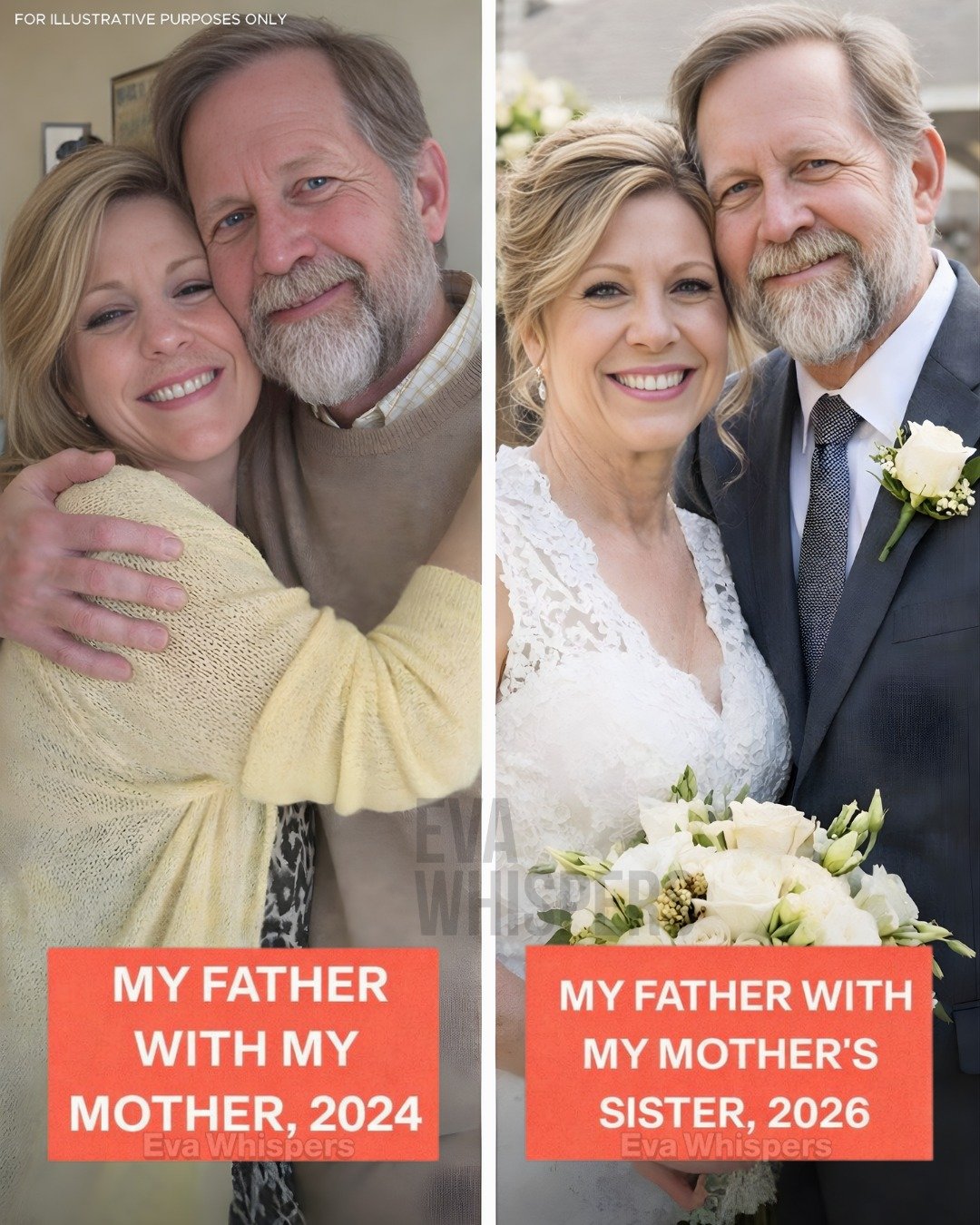
A year after my mother’s d.eath, my father announced he was marrying her identical twin. Everyone around us treated it like a happy ending. But at their wedding, my grandmother pulled me aside and whispered, “You need to know the truth about your aunt.” What she showed me left me stunned.
My mom d.ied in a car accident. One moment she was here, the next she was gone. That’s how fast your entire world can collapse.
She was the first person I called with good news, the one I sent silly memes to at two in the morning. She was the voice in my head reminding me I could handle things even when I doubted myself. And then, suddenly, she wasn’t there anymore.

A year later, Dad called me. “Just you, me, and Lena,” he said.
I didn’t think much of it. Lena was my mom’s twin sister. She’d been around a lot after Mom died—helping Dad, bringing casseroles, keeping him company. I figured Dad just didn’t want to eat alone.
When I arrived, the house smelled of lemon cleaner and roasted chicken. Lena opened the door before Dad could. “You’re early,” she said brightly.
She was wearing my mother’s apron. I tried not to think too hard about that.
Inside, everything looked perfect—throw pillows arranged just so, magazines fanned out at precise angles. It felt like Mom had just finished tidying. Strange, because Dad had never cared much about cleaning. He used to tease Mom that she cleaned like we were preparing for a magazine shoot.
We ate first. The chicken was good, the conversation polite but shallow. Yet I kept noticing things: Lena refilled Dad’s water before he realized it was empty, slid the salt toward him without looking, kept his plate full. She knew what he needed before he did.
Then Dad cleared his throat. “Sweetheart, there’s something I need to tell you,” he said.
“Lena and I are engaged. We’re getting married soon. I wanted you to be the first to know.”
I heard the words, but together they didn’t make sense.
“Oh,” I managed.
Lena reached across the table, curling her fingers around his hand like she’d done it a thousand times. “I know it’s a lot,” she said gently. “But this wasn’t sudden. We’ve been leaning on each other for a long time.”
Dad nodded. “After your mom… Lena was here every day. She kept things running when I couldn’t. I was a mess. She made sure I ate, slept, had clean laundry. She’s been living here for months.”
Months? Why hadn’t I known?
“And over time,” he continued, “we realized we cared about each other. Life’s short. I didn’t want to waste it.”
Lena squeezed his hand. “We love each other.”
I sat there, blindsided, watching my mother’s twin hold my father’s hand.
Over the next few weeks, everything moved quickly. Lena was suddenly everywhere.
“She’s been such a blessing,” my aunt whispered at one gathering. “She stepped right in,” someone else said approvingly. “Your mom would’ve wanted that.”
Would she? I wanted to ask. But I didn’t. I was 23, old enough to know real life can be stranger than fiction. And I wanted Dad to be happy. So I stayed quiet.

Dad and Lena planned a small pre-wedding celebration for family and close friends. I sat near the window, watching people laugh and talk about destiny, trying not to cry. Lena moved through the room with confidence, refilling glasses, smiling at everyone. She wore her hair the way Mom used to—pulled back in a low bun with loose strands framing her face. I noticed. I couldn’t stop noticing.
My grandmother found me halfway through the party. “You look so sad… want to talk about it?”
“I don’t understand how this is happening so fast,” I admitted.
“You mean the wedding?”
“I mean everything. It feels like Mom didn’t even get time to be gone.”
Grandma let out a long, shaky breath. Her eyes filled with tears. She took my hand. “My dear, you need to know the truth behind all of this. Your mother would have wanted me to tell you everything. We need to go to my house right now. I’ll show you.”
We slipped away unnoticed, called a taxi, and went to her house. My heart pounded. I didn’t know what she was going to show me—or if I wanted to know.
Grandma went up to the attic and returned with a box. She set it on the dining table carefully, sat across from me, and said: “I never dressed them alike.”
“What?”
“People assume twins are always matched. But your mother hated that. She was louder, more confident. She wanted to be seen as herself.”
She lifted the lid. Inside were photo albums and old notebooks. “Lena liked sameness,” Grandma explained. “But once I figured out why, I did everything I could to discourage her.”
The early photos showed two little girls with identical faces but different energy—Mom laughing, arm around Lena, while Lena smiled carefully at the camera. But as the photos aged, the differences disappeared. In their teens and early adulthood, they had the same haircut, nearly identical outfits.
“Lena copied her?” I asked.
“Yes,” Grandma said. “She liked it when people confused her for Adrienne. But it wasn’t just about looking the same.”
She pulled out a notebook. The handwriting was tight, pressed hard into the page: Everyone listens to her. She walks into a room, and it just happens. I practice what to say, and still disappear.
Another page read: People say we’re the same, but they never choose me.
My chest tightened. “Did you ever talk to her about it?”
Grandma shook her head. “I tried, but she said I was favoring your mother. I didn’t want to agitate her further.”
Then she opened her tablet. Screenshots of texts and emails with Lena filled a folder—dated after Mom’s death.
At first, they were practical: He hasn’t eaten today. I stayed so he wouldn’t be alone. I’m helping with the bills until he’s steady.
Then they shifted: He listens to me, Mom. I calm him better than anyone. Sometimes I think he needs me more than he realizes.
And then, the kicker: I know how she did things, okay? And he responds when I do them the same way. It feels natural. Like I belong here, like I’ve always belonged here. Adrienne was just a placeholder.
I felt sick. My jaw dropped. “This wasn’t comfort. Lena maneuvered herself into Mom’s place!”
Grandma’s voice broke. “I should have stopped it. I told myself grief makes people act strangely, maybe more so for twins. I told myself I couldn’t lose another daughter. Sometimes I wonder if I failed them both.”
“Dad needs to know this,” I said.
“They’re getting married in a few minutes!”
Grandma reached for my hand. “You don’t have to go back.”
“I do. Someone needs to expose the truth.”

The taxi ride back felt endless. By the time we arrived, the ceremony had already begun. Lena stood at the front in white, beaming at Dad while he said his vows.
I stepped forward before I could think. “Wait!”
The word cut through the room.
Dad turned. “What’s wrong?”
“I’m not confused, and I’m not acting out of grief. Dad, you can’t marry her.”
Lena’s smile dropped. “Why are you doing this?”
“Because this marriage isn’t about love. It’s about replacement.”
Murmurs rippled through the guests.
I held up the tablet. “Lena, you’ve been copying my mother for years—her mannerisms, her role. And when she died, you didn’t just help Dad. You stepped into her life.”
“That’s a lie!” she snapped.
I turned to my father. “She knew what you needed because she studied it. She didn’t fall in love with you. She waited until you were too broken to tell the difference.”
Silence.
Dad looked at Lena. “Is that true?”
She glanced at the guests, then back at him.
Dad stepped back. “Oh God, it is true, isn’t it?”
The officiant lowered his hands.
“I think we should pause,” Dad said. “I think… I can’t do this.”
Lena’s voice cracked. “How can you say that? This was supposed to be my chance.”
I stepped back, heart pounding but lighter than it had been in a year. For the first time since Mom died, the truth wasn’t being smoothed over. And this time, I hadn’t stayed quiet.