
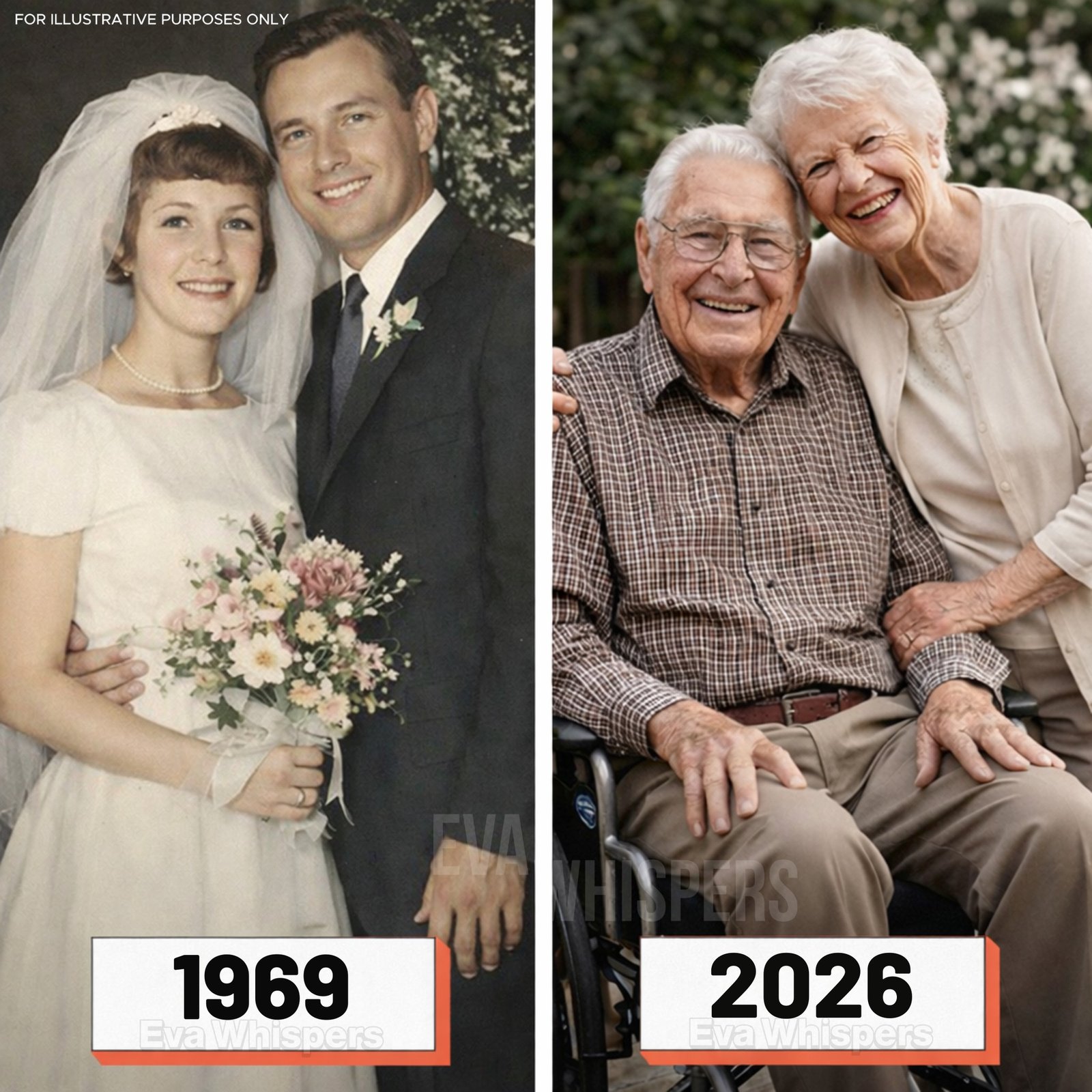
My grandparents were married for fifty-seven years, but if you asked anyone in our family what made their marriage feel almost unreal, they wouldn’t say “big gestures” or “fancy vacations.”
They’d say, “Saturday flowers.”
Every single Saturday—no exceptions—my grandfather Thomas brought my grandmother fresh flowers.
Sometimes it was a wild, joyful handful he’d picked from a roadside stand: daisies and Queen Anne’s lace spilling out like laughter. Sometimes it was neat tulips, lined up like soldiers, bright and proud. In autumn, he’d come home with deep orange chrysanthemums that made the kitchen feel warm even before the oven was on.
He had a routine that was so reliable it became part of the house’s heartbeat. He’d wake up early, when it was still dim and the world sounded softer. He’d move quietly so he wouldn’t wake her. He’d trim the stems, fill the vase, and place the bouquet on the kitchen table like a secret gift from the morning.
Then he’d sit down with his coffee and wait.

My grandmother, Evelyn, would come in a little later in her slippers, hair tousled, still half in dreams. She’d pretend to be surprised every time.
“Oh my,” she’d say, one hand on her chest like a stage actress. “Thomas. Again?”
He’d look up over his mug with the same crooked grin he’d worn in every photo of him from the last fifty years. “It’s Saturday,” he’d answer, like that explained everything.
And it did.
A week ago, he died.
There’s no dramatic way to say it. One moment, his hand was in hers, and the next, it wasn’t holding back anymore. My grandmother stayed beside him until the room felt too still, until the air itself seemed to realize he wasn’t coming back.
After the funeral, the house didn’t just feel quiet.
It felt wrong.
Like the walls had memorized his footsteps and couldn’t understand why they weren’t hearing them anymore.
I stayed with my grandmother that week—partly because I wanted to help, partly because I couldn’t stand the idea of her sitting alone in a home that echoed with a life that had ended. We sorted through his things in slow, careful pieces: his neatly folded sweaters, his reading glasses, the drawer where he kept spare batteries and rubber bands like he was guarding the world from inconvenience.
At night, my grandmother would sit in the living room with a blanket on her lap and stare at the empty recliner beside hers.
Sometimes she’d speak like he was just in the other room.
“Thomas always said the weather would turn by October,” she murmured one evening, eyes fixed on the dark window. “He could smell it.”
I didn’t know what to do with grief that looked so calm it was almost polite. So I did what I could: I made tea, I washed dishes, I stayed close.
And then Saturday came.
I woke up before my grandmother out of pure habit, my brain still expecting the quiet clink of a vase and the soft snip of scissors.
But there was no clink.
No snip.
Just silence.
I was standing in the kitchen, staring at the empty vase on the table, when a knock rattled the front door.
It wasn’t the casual neighbor kind of knock. It was firm. Deliberate. Like someone was delivering something important and had rehearsed the courage to do it.
My stomach tightened.
I opened the door, and a man stood there wearing a dark coat. He was somewhere between fifty and sixty, with graying hair and a face that looked like it knew how to hold secrets. He didn’t smile.
He didn’t even really look at me at first. His gaze slid past my shoulder, into the house, as if he was checking whether the right walls were listening.
He cleared his throat.
“Good morning,” he said. His voice sounded careful. “I’m here for Thomas. He asked me to deliver this to his wife after his death.”
My hands went cold.
“I—” I started, but my voice failed. “He’s… he passed away.”
“I know,” the man said quietly. And that quietness—like he’d already grieved in advance—made my throat sting.
Behind me, I heard my grandmother’s footsteps. Faster than they’d been all week.
“Who is it?” she called.
I stepped aside as she came into view. She was wearing her robe, hair pinned back hastily like she’d woken up in the middle of a dream and couldn’t find the edge of it.
Her eyes landed on the man and narrowed with a confusion that looked almost annoyed—like the universe was interrupting her mourning with paperwork.
The man held out a bouquet. It was simple and beautiful—white lilies and pale pink roses wrapped in brown paper, like the kind my grandfather used to bring when he wanted to say something without using words.
And in his other hand, an envelope.
No return address. Just one name, written in my grandfather’s unmistakable handwriting:
Evelyn.
My grandmother’s hand flew to her mouth.
“Thomas…” she whispered.
The man didn’t step inside. He didn’t offer condolences. He didn’t explain how he knew my grandfather.
He only said, “He wanted this delivered today. On Saturday.”
Then he placed the flowers and envelope into my grandmother’s trembling hands, gave a small nod that felt like respect, and walked away before either of us could stop him.
The door clicked shut.

For a moment, the house was so still I could hear my grandmother’s breath hitching.
She carried the bouquet to the kitchen table like it was something fragile enough to break. She set it in the empty vase. Her fingers shook so badly I reached out and steadied the glass.
Then she stared at the envelope.
“I don’t like surprises,” she said softly, but her voice cracked on the last word.
“I’m here,” I told her, even though I didn’t know what that meant.
Her thumb slid under the flap. She opened it carefully, like the paper might bite.
Inside was a folded letter.
Her eyes moved across the page, and the color drained from her face so fast it scared me.
“What?” I whispered. “Grandma… what does it say?”
She didn’t answer right away. She read it again, slower this time, as if her brain couldn’t accept the words the first time.
Then she held it out to me.
My grandfather’s handwriting leaned across the page, familiar and steady—like his hand had never trembled.
Evelyn, my love,
If you’re reading this, it means I’m gone. I’m sorry I didn’t tell you this earlier. There’s something I hid from you for most of my life, but you deserve to know the truth.
Before I met you, before our Saturdays and our children and the home we built, I made a promise to someone I didn’t know how to keep in the open. I was young and afraid. I did what I thought would protect you later, but it also meant I carried a secret beside our love.
You urgently need to go to this address. Please go. Please listen. Please forgive me—not because I’m owed it, but because you deserve peace.
And Evelyn… even if you’re angry, please know this:
Every Saturday flower was always for you.
Always.
—Thomas
At the bottom was an address.
An hour away.
My grandmother sat down hard in her chair, as if her knees had decided they didn’t work anymore.
“A secret?” she breathed. Her fingers clutched the paper. “After fifty-seven years… Thomas had a secret?”
I didn’t trust my voice. My mind ran wild with possibilities, each one worse than the last.
She looked at the flowers, then at the empty space where my grandfather should have been. Her eyes filled, but the tears didn’t fall. They just hung there, trapped behind shock.
“I held his hand,” she said, almost accusingly. “I held his hand when he died. Why wouldn’t he tell me then?”
I knelt beside her chair. “He’s telling you now,” I said gently. “In the only way he can.”
She swallowed, her jaw tightening.
“Get your jacket,” she said, voice suddenly firm. “We’re going.”
The drive felt longer than an hour.
My grandmother gripped the steering wheel like it was the only stable thing left in her world. The letter lay on the console between us, as if it might burst into flames if we ignored it too long.
Neither of us spoke much. When we did, it was only in fragments.
“What promise?” she muttered once.
“What did he hide?” I asked, and hated how small my voice sounded.
Her answer was almost too quiet to hear. “Whatever it is… it must have mattered enough that he planned this.”
When we arrived, the address led us to a small house tucked behind a row of trees. It wasn’t fancy. It wasn’t run-down either. It looked lived-in, cared for. Wind chimes hung on the porch. A child’s bicycle leaned against the railing.
My stomach twisted so tightly I thought I might be sick.
We walked up the steps and knocked.
A few seconds later, the door opened.
A woman stood there, about my mother’s age. Brown hair pulled into a loose knot. Soft face, but guarded eyes—eyes that had practiced holding back feelings for a long time.
When she saw my grandmother, she froze.
Her breath caught.
Then she nodded once, like she’d been bracing for this moment for years.
“I know who you are,” she said, voice shaking. “I’ve been waiting for you for a very long time. You need to know something Thomas was hiding from you. Come in.”

My grandmother didn’t move.
Her hand rose slowly to her chest, right where her wedding ring rested against her skin.
“What are you saying?” she managed.
The woman’s eyes shimmered with tears she refused to let fall.
“My name is Marianne,” she said. “And Thomas… Thomas was my father.”
The world tilted.
I heard my grandmother make a sound—half gasp, half wounded laugh—as if her body didn’t know which emotion to choose.
“That’s impossible,” she whispered. “Thomas and I—Thomas and I were married—”
“I know,” Marianne said quickly, stepping back to make room as if she knew my grandmother might need air. “I know you were. And I’m not here to take anything from you. I’m not here to ruin him. He loved you. He loved you more than anything.”
My grandmother’s eyes burned. “Then why?”
Marianne took a shaky breath. “Because he loved me too,” she said, pain flickering across her face. “In the only way he knew how to, without breaking the life he built with you.”
She led us into a small living room where framed photos lined the walls—kids at birthdays, graduations, messy smiling faces. A normal life.
And there, tucked near the center, was a photograph that made my throat close.
My grandfather.
Younger, yes. But unmistakably him.
His arm around a little girl with big eyes and missing front teeth.
The girl was Marianne.
My grandmother stared at the photo like it was a ghost.
“No,” she breathed. “No…”
Marianne’s voice trembled. “My mother was someone he knew when he was very young. They weren’t married. It wasn’t a life he was ready for. My mother didn’t want scandal, didn’t want pity. She moved away. She raised me on her own.”
My grandmother swayed slightly, and I reached out to steady her elbow.
Marianne’s eyes flicked to my hand, then back to my grandmother.
“He found us years later,” she continued. “Not to take me. Not to make demands. He just… wanted to know I was okay. My mother wouldn’t let him come into our lives fully, and honestly, I don’t blame her. But he never disappeared again.”
My grandmother’s voice was sharp now, raw. “So what? He had another family?”
Marianne shook her head quickly. “No. Not like that. He didn’t live with us. He didn’t replace you. He didn’t… he didn’t split his life the way people do in ugly stories.”
She swallowed hard.
“He paid for my school. He sent help when my mom got sick. He showed up at the edges—quietly. Like a shadow that only wanted to make sure the lights stayed on.”
My grandmother stared at the photo again. Her mouth trembled.
“And you,” she whispered. “You just accepted it? You just let him—visit you in secret while he came home to me?”
Marianne flinched, tears finally breaking free. “I didn’t understand when I was little,” she said. “I just knew he would appear sometimes with a book, or a winter coat, or a bag of groceries, and he’d tell me I mattered.”
She wiped her cheek. “When I got older, I hated him for not being brave. I hated him for choosing a quiet kindness instead of standing up and saying, ‘This is my daughter.’”
My grandmother’s face tightened. “And then?”
“And then I had a baby,” Marianne said softly. “And I understood fear in a way I never had before.”
She let out a breath that sounded like surrender.
“He told me about you,” she said, looking directly at my grandmother now. “Not in a vague way. In a reverent way. He called you his miracle. He said you were the home he didn’t know a person could be.”
My grandmother’s eyes squeezed shut, and for a moment I thought she might collapse.
“Why didn’t he tell me?” she whispered, and it wasn’t anger anymore. It was heartbreak—pure and childlike. “Why did he let me live in ignorance?”
Marianne’s voice was barely audible. “Because he was terrified,” she said. “Terrified you’d leave. Terrified you’d hate him. Terrified that telling the truth would turn your fifty-seven years into a lie.”
My grandmother opened her eyes. They were glossy, fierce.
“It still feels like a lie,” she said.
“I know,” Marianne whispered.
Silence stretched between them, heavy and trembling.
Then Marianne reached for a side table and picked up a small box. She held it out with both hands like an offering.
“He asked me to give you this,” she said. “And to tell you something else.”
My grandmother took the box slowly.
Marianne swallowed, voice cracking. “He said the Saturday flowers weren’t just a habit. They were his vow.”
My grandmother’s fingers paused on the lid.
“He told me,” Marianne continued, “that after he made the mistake of being afraid, he promised himself he would never again let love go unspoken. So he spent the rest of his life saying it in the most consistent way he knew how.”
My grandmother’s hand covered her mouth again, and this time the tears came—quiet, unstoppable.
She opened the box.
Inside was a pressed, dried flower—brittle with age—tied with a faded ribbon. And beneath it, a tiny note:
The first Saturday flower I ever brought you. I kept it because it reminded me I got one thing right.
My grandmother made a sound like her heart was breaking and mending at the same time.
She sat down on Marianne’s couch and held the dried flower like it was sacred.

For a long time, nobody spoke.
Finally, my grandmother looked up at Marianne, eyes red but steady.
“Did he love you?” she asked.
Marianne nodded, tears spilling again. “Yes,” she whispered. “In the best way he knew how.”
My grandmother’s jaw trembled. “And did he love me?”
Marianne’s voice didn’t hesitate. “With his whole life.”
My grandmother looked down at the dried flower and then at her wedding ring. Her shoulders shook once, like a wave passing through her.
Then, slowly—so slowly I could hardly breathe—she reached out and took Marianne’s hand.
“Come here,” she said, voice hoarse.
Marianne blinked, startled. “What?”
My grandmother tightened her grip gently. “Come here,” she repeated. “Because if I don’t do this now, I’ll spend the rest of my life wondering if I could have.”
Marianne moved closer, like a person approaching a frightened animal. My grandmother pulled her into a brief, trembling embrace.
It wasn’t warm at first.
It was messy. It was grief and shock and forty years of untold truth pressed into a single moment.
But it was real.
When they pulled apart, my grandmother wiped her face and sat back, exhausted.
“I’m angry,” she admitted. “I’m hurt. And I don’t know what I’m going to do with this.”
Marianne nodded, crying quietly. “You don’t have to do anything today,” she said. “I just… I didn’t want you to think he was a villain.”
My grandmother looked at the family photos lining Marianne’s walls—at the evidence of a life my grandfather had cared for from a distance.
Then she glanced at the small bouquet of flowers Marianne had set in a jar on the counter—fresh, simple, bright.
“Did you know?” my grandmother asked softly. “About the Saturday flowers?”
Marianne sniffed. “He told me,” she said. “He said it was the one thing he did that made him feel clean.”
My grandmother let out a broken laugh through her tears. “Thomas,” she whispered, like his name was both a complaint and a prayer.
On the drive home, the car felt different.
Not lighter—not yet. But changed.
My grandmother stared out the window for a long time.
Finally, she spoke.
“He wasn’t perfect,” she said.
“No,” I agreed quietly.
“But he was mine,” she whispered. “And I was his.”
I reached over and placed my hand on hers.
“And now,” I said, “you’re not alone with this.”
She swallowed hard and nodded, eyes fixed on the road ahead like she was choosing, one mile at a time, to keep going.
The next Saturday, I woke early.
The kitchen was still quiet, still aching with absence.
But the vase wasn’t empty anymore.
On the table sat a bouquet of wildflowers—bright and imperfect and alive—picked by my grandmother herself.
When she walked in, she saw me staring and gave a small, tired smile.
“It’s Saturday,” she said.
And for the first time since my grandfather’s death, the house didn’t feel wrong.
It felt like love was still here—different, bruised, and honest—but still here.
And on the table, in the sunlight, the flowers stood tall, as if they’d always known how this story would continue.