
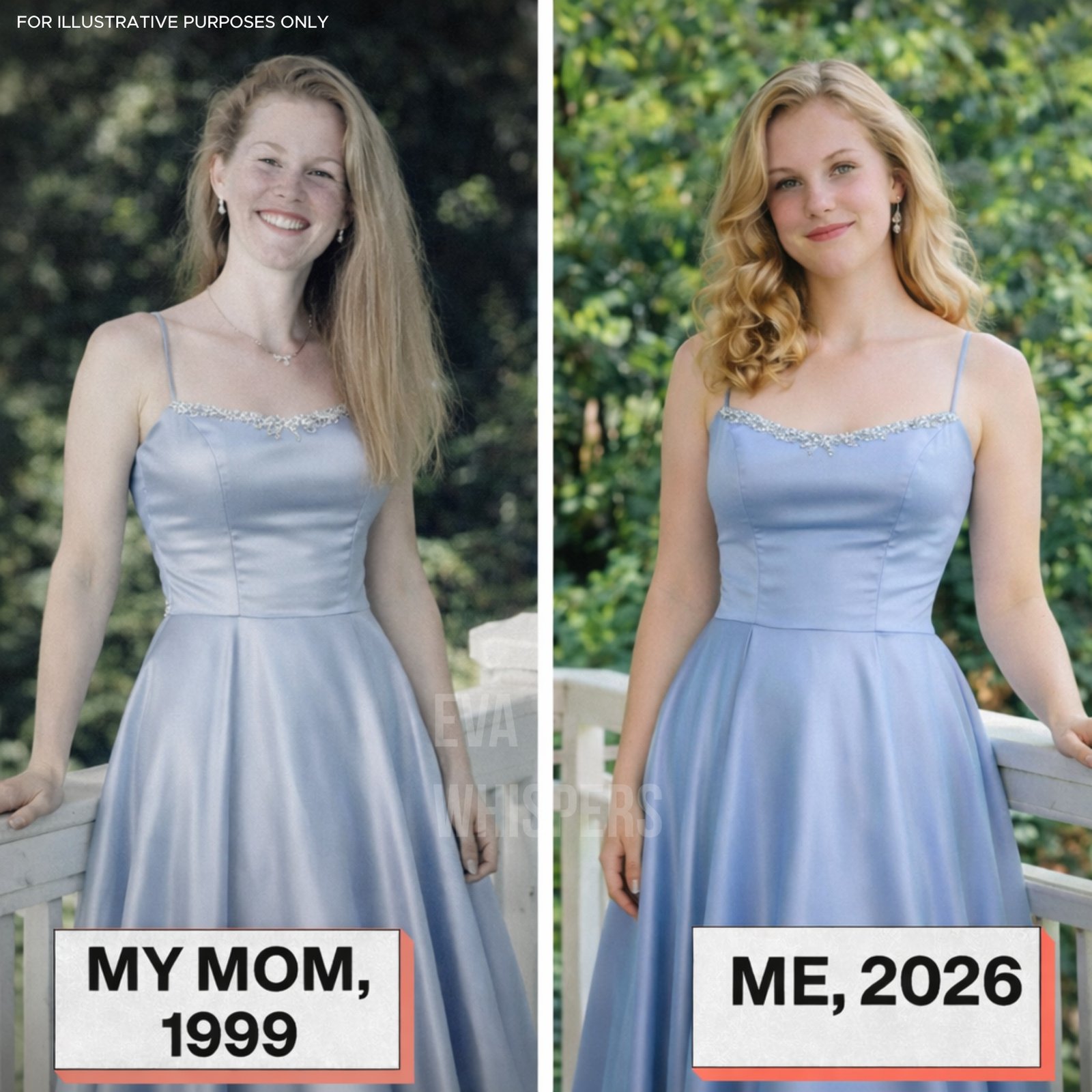
The dress had lived in the back of my closet for five years—zipped inside a clear garment bag like it was sleeping.
Even now, the sight of it made my throat tighten.
It was pale blue satin with tiny beadwork at the neckline, the kind of delicate sparkle that didn’t scream for attention. It didn’t have to. My mom had worn it to her prom. In the one photo I still kept on my dresser, she was laughing—head tilted back, hair curled, eyes bright like the world couldn’t possibly take anything from her.
But it did.
Cancer took her when I was twelve.
After the funeral, I stopped asking for things I wanted. I stopped expecting good days to stay good. I learned how to fold grief small and carry it around like a stone in my pocket. And somehow, that dress became the one thing I could hold onto without breaking.
So when prom came around, there was never any question.
I was wearing it.
The day before prom, I stood in front of my mirror and carefully slipped the dress over my head, like I was stepping into a memory. It fit better than I expected. The waist was a little snug, and the hem brushed my ankles, but it felt… right. Like something had clicked into place.
I took a shaky breath and smoothed the satin with my palms.
Behind me, the door creaked.
“Is that…” my dad’s voice was soft, like he didn’t want to scare the moment away.
I turned. He was leaning against the doorway, still in his work shirt, his tie loosened, eyes glassy. For a second he didn’t look like the man who reminded me about homework and made pasta on Thursdays. He looked like someone who had been in love once and never fully stopped missing it.
“That’s her dress,” he whispered. “You look… you look so much like her.”
I swallowed hard. “I don’t want to replace her,” I said quickly, because somehow grief always made me feel like I had to explain myself. “I just… I want to carry her with me.”
He nodded, like he understood exactly. “Your mom would’ve been proud of you,” he said, and then, as if remembering something, he straightened. “Is Stephanie okay with this?”
My stomach clenched.
As if summoned, my stepmother’s heels clicked down the hall. Stephanie appeared in the doorway in a crisp white blouse and a smile that didn’t reach her eyes.
“Oh,” she said, stopping short. Her gaze traveled over the dress like it offended her personally. “That’s what you’ve been planning.”
“It’s Mom’s,” I said. My voice was steadier than I felt. “I’m wearing it tomorrow.”
Stephanie blinked once, then laughed—small and sharp. “Sweetheart, you can’t wear that rag.”
Dad’s jaw tightened. “Stephanie—”
“No,” she cut in, turning to him with that practiced “I’m being reasonable” tone. “Look at it. It’s old. It’s… outdated. People will talk.”
“They can talk,” I said, hands curling into fists at my sides. “I don’t care.”
Stephanie’s eyes narrowed. “You should care. It reflects on this family.”
“This family?” I repeated, my heart banging against my ribs. “It reflects on me. And my mom.”
Stephanie’s smile became thin as paper. “I bought you a designer dress,” she said, as if she were doing charity work. “It cost thousands. It’s modern and elegant. You’ll wear that.”
I glanced at my dad, hoping he’d say something stronger than let’s all calm down. He didn’t speak, but the muscles in his face tightened like he was holding something back.
“I’m wearing this,” I said.
Stephanie stepped closer until she was just inches away. I could smell her perfume—sweet, expensive, suffocating.
“Listen,” she said softly, like a warning. “This obsession with your mother’s things has gone on long enough. You’re seventeen. It’s time to grow up.”
My throat burned. “Keeping her dress isn’t an obsession.”
Stephanie tilted her head. “You know what I think? I think you want to make some kind of statement. Poor little grieving daughter. It’s manipulative.”
Dad’s voice went cold. “That’s enough.”
Stephanie turned toward him with a scoff. “I’m trying to help. I’m trying to stop her from embarrassing herself.”
“I’m not embarrassed,” I said, the words trembling but true. “I’m proud.”

For a moment, Stephanie looked genuinely angry—like my pride was a personal insult. Then she stepped back, lifted her shoulders in a dramatic sigh, and said, “Fine. Wear your little costume. But don’t say I didn’t warn you.”
She walked away, heels snapping like punctuation.
Dad stayed in the doorway. His eyes were sad, and tired, and apologetic in a way that made something twist inside me.
“I’m sorry,” he said quietly.
“It’s not your fault,” I lied.
He looked like he wanted to say more, but instead he just nodded. “Prom’s tomorrow,” he said. “No matter what happens, I’m proud of you. Okay?”
I nodded back, holding onto that sentence like a lifeline.
That night, I hung the dress up carefully, zipped the garment bag all the way, and slid it into the closet. I even pushed it behind my winter coats, as if fabric could be protected by distance.
I fell asleep imagining the way the satin would catch the light, the way I’d feel walking into the gym with my chin up, carrying my mother’s story with me.
The next day flew by in a blur of nerves. I curled my hair, did my makeup with shaky hands, and tried to keep my breathing even.
When it was time to change, I carried the garment bag into my room like it was something fragile and sacred. I closed the door, turned the lock, and unzipped it.
My brain refused to understand what my eyes were seeing.
The satin was stained—dark, spreading blotches like someone had dumped coffee on it and rubbed it in. The side seam was ripped open, threads dangling. The zipper was torn halfway off like it had been yanked in anger.
I made a sound I didn’t recognize, something between a sob and a gasp.
“No,” I whispered. “No, no, no…”
I touched the fabric. It felt wrong under my fingertips—sticky in places, stiff in others.
Behind me, the door clicked.
I spun around.
Stephanie stood there, leaning against the frame like she’d been waiting for this moment. She wore a sleek black dress, her hair perfect, earrings shining. She smiled.
“Oh,” she said brightly. “You found it.”
My vision blurred. “Did you… did you do this?”
Stephanie shrugged, as if we were discussing a broken vase. “Accidents happen.”
“This isn’t an accident,” I choked out. “The seam is ripped. The stains—”
Stephanie’s smile widened. “Maybe that’s the universe telling you to move on.”
The words hit me like a slap. My knees wobbled.
“That was my mom’s,” I whispered, and suddenly I couldn’t hold it together. Tears spilled down my cheeks, hot and unstoppable. “You knew what it meant to me.”
Stephanie’s expression hardened. “I’m your mother now,” she snapped. “Enough. You should’ve thrown this dress in the trash a long time ago.”

Something in me cracked—not just sadness, but fury. Raw, shaking fury.
“You are not my mother,” I said, voice trembling. “My mother loved me. My mother wouldn’t—”
Stephanie stepped forward, eyes flashing. “Don’t you dare compare me to her.”
“I didn’t compare you,” I said, wiping my cheeks with the back of my hand. “You did. And you lost.”
For a second, I thought she might yell. But she only smirked.
“Stop being dramatic,” she said. “You’ll wear the dress I bought. It’s already laid out. And you’ll thank me later.”
She turned to leave, then paused like she remembered something. “Oh, and your father doesn’t need this stress tonight. So be smart. Don’t make a scene.”
The door shut behind her.
I stared at the ruined dress and felt like my lungs couldn’t expand. The world tilted. My hands shook so hard I had to sit on the edge of my bed to keep from falling.
I took out my phone with numb fingers and texted Dad: Can you come upstairs? Please. Now.
It took him less than a minute.
When he walked in, he was smiling—probably expecting a photo, a proud dad moment. Then he saw my face. Then he saw the dress.
The smile vanished.
He didn’t speak at first. He walked over slowly, like he was approaching an accident scene, and lifted the garment bag with careful hands. His eyes moved over the stains, the ripped seam, the torn zipper.
When he finally looked at me, something had changed in his expression. There was grief there, yes—fresh and sharp. But there was also something colder.
“Who did this?” he asked quietly.
My voice came out thin. “Stephanie.”
His jaw clenched. “Did you see her do it?”
“She basically admitted it,” I whispered. “She said accidents happen. Then she told me… she told me Mom’s dress should’ve been thrown away.”
Dad’s eyes went glossy, but his voice stayed steady. “I’m sorry,” he said, and I could tell he meant it in a way that went beyond the dress. “I’m so sorry.”
I shook my head. “I don’t want to go anymore,” I said, the words tumbling out. “I don’t want to pretend everything’s fine while she— while she—”
Dad set the garment bag down gently on the bed like it was a person he didn’t want to hurt.
“Look at me,” he said.
I met his eyes.
“You are going,” he said, firm. “If you want to.”
“I don’t have a dress,” I whispered.
He held up a hand. “We’ll handle that.” Then his voice softened. “But Stephanie? I’m handling that too.”
He left the room before I could respond.
From upstairs, I heard him call her name.
“Stephanie. Come here. Now.”
Her heels clicked up the stairs, unhurried. Confident.
“What is it?” she asked, breezy. “We’re running late.”
Dad’s voice was low. “Did you destroy her mother’s dress?”
Stephanie laughed lightly. “Destroyed? Don’t be dramatic. It was old. It got stained. Things happen.”
Dad didn’t raise his voice. Somehow, that made it worse.
“I asked you a question,” he said. “Did you do it?”
Stephanie’s eyes darted, then she lifted her chin. “Fine. Yes. I did. And I’d do it again. Because she needs to stop living in the past. She needs to accept me.”
The air seemed to thicken.
Dad stared at her for a long moment. Then he nodded slowly, like he’d just received confirmation of something he’d been hoping wasn’t true.
“You’re right,” he said quietly. “She does need to stop living in the past.”
Stephanie’s mouth lifted in victory—until he continued.
“And I need to stop pretending I can build a future with someone who’s cruel to my daughter.”
Stephanie blinked. “Excuse me?”
Dad stepped closer, voice steady as stone. “Pack a bag.”
She laughed again, but it sounded strained. “You’re being ridiculous. You can’t kick me out because of a dress.”
“It’s not because of a dress,” Dad said. “It’s because you chose to hurt her on purpose.”
Stephanie’s face flushed. “I’m your wife.”
“And she’s my child,” Dad said. “The one person in this house who never asked for any of this.”
Stephanie’s eyes narrowed. “So that’s it? You’re choosing her over me?”
Dad’s voice broke—just slightly. “I’m choosing decency.”
Stephanie opened her mouth, and for a second it looked like she might say something truly ugly. Then she noticed me standing behind Dad, tear-streaked, silent.
Her gaze flicked to the ruined dress on my bed. She swallowed, then tried a different tactic.
“I was trying to help,” she said, softer. “I didn’t think you’d react like this.”
Dad’s expression didn’t change. “Pack a bag,” he repeated. “Or I will call my lawyer tonight.”
Stephanie stared at him like she didn’t recognize him. Maybe she’d built her confidence on the assumption that he would always choose peace over principle. That he would always avoid conflict.
But there are some lines a person doesn’t get to cross twice.
Her lips pressed together. Without another word, she turned and went to their room.
Dad exhaled slowly, then looked at me. His eyes were red now.
“I should have seen it,” he said. “I should have stopped this sooner.”
I wanted to say something comforting, but my throat was too tight.
Instead, he walked over, cupped my face gently, and pressed his forehead to mine.
“Your mom’s dress didn’t deserve that,” he whispered. “And neither did you.”
That was when I finally let myself cry all the way—loud, shaking sobs that felt like years of swallowed pain coming loose.
Dad stayed with me until my breathing slowed.
Then he stood up, wiped his eyes, and said, “Okay. Here’s what we’re going to do.”
He pulled out his phone and called my Aunt Melissa—my mom’s sister. I heard him explain in a few clipped sentences. There was a pause, then Melissa’s voice rose loudly enough that I could hear her yelling through the speaker.
Dad winced. “Yes. Yes, I know,” he said. “Do you still have…?” Another pause. “Please.”
He hung up and looked at me.
“Melissa’s coming,” he said. “And she has something.”
Twenty minutes later, my aunt burst into the house like a storm—eyes fierce, arms full of a garment bag.
She took one look at my face and didn’t ask questions. She just pulled me into a hug so tight I could barely breathe.
“I am so sorry, baby,” she whispered. Then she stepped back and said, “Now. Let’s get you dressed.”
Inside her garment bag was a dress I’d never seen before—deep blue, simple and elegant, with a neckline that shimmered just enough to feel special.
“It’s not your mom’s prom dress,” Melissa said softly. “But it was your mom’s. She wore it to a wedding once. She loved it. I kept it… just in case.”
My hands trembled as I touched the fabric.
Dad’s voice was gentle. “Only if you want to,” he said.
I looked at them—my dad, my aunt, the two people who carried my mom’s memory with love instead of jealousy.
And I nodded.
When I walked into prom that night, I didn’t feel like I was pretending. I didn’t feel like I was losing something.
I felt like I was honoring what mattered.
I danced. I laughed. I let my friends take pictures. And when someone told me I looked beautiful, I believed them—because for the first time in a long time, beautiful didn’t mean perfect. It meant real.
After prom, when I came home, the house was quieter than usual.
Stephanie was gone.
A suitcase was missing from the hallway closet. Her framed photos had been taken down, leaving pale rectangles on the wall where they’d been.
Dad met me in the kitchen. He was sitting at the table with two mugs of hot chocolate like I was twelve again.
He looked up, tired but steady. “How was it?”
I smiled, small but true. “It was good,” I said. “It was… actually good.”
Dad nodded. “I’m glad.”
I hesitated, then asked the question that had been sitting heavy in my chest.
“Are you okay?”
He looked down at his mug, then back at me. “I’m angry,” he admitted. “And embarrassed that I let someone into our lives who thought cruelty was acceptable.” His throat tightened. “But mostly… I’m relieved I didn’t fail you completely.”
“You didn’t fail me,” I said, and this time I didn’t lie.
He reached across the table and squeezed my hand. “We’ll get the dress repaired,” he said quietly. “Not because it has to be worn again… but because it deserves respect.”
My eyes stung. “Thank you.”
Dad nodded, his gaze steady. “Your mom’s memory isn’t something anyone gets to throw away,” he said. “Not in this house. Not ever.”
And in that moment, I realized something I hadn’t dared to hope:
Stephanie might have destroyed a dress.
But she didn’t destroy what it stood for.
Because love—real love—doesn’t rip seams or spill stains. It protects. It shows up. It draws a line.
And that night, my father drew one for me.