
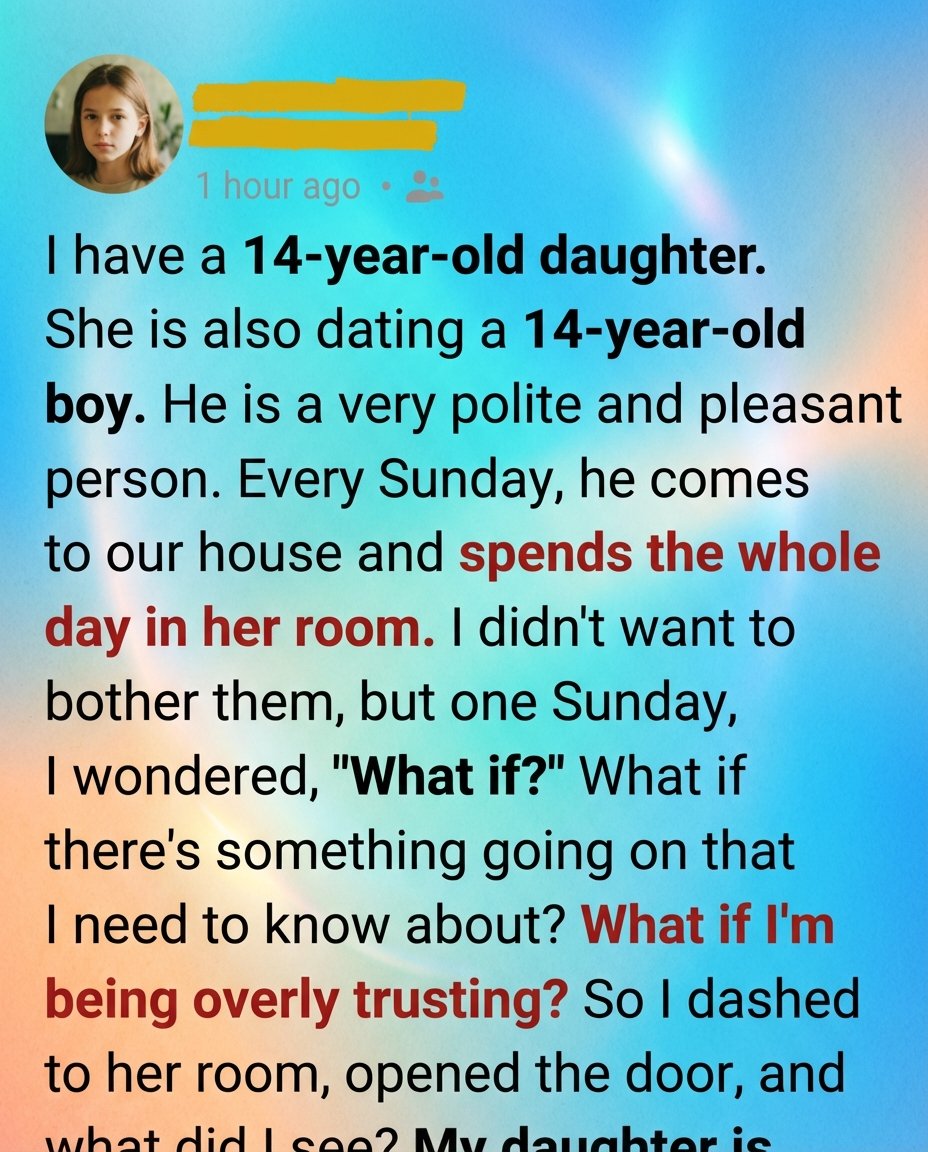
Parenting a fourteen-year-old is a delicate suspension between trust and fear, a constant state of second-guessing where every silence feels like a potential emergency. Noah seemed to be the ideal choice for a first boyfriend—respectful, observant, and genuinely kind—yet the Sunday afternoon ritual of the pair disappearing into a closed room for hours created a persistent, underlying unease. I found myself navigating a house that was “unusually still,” where the lack of laughter or chatter wasn’t a comfort, but a structural silence that my mind began to fill with the darkest assumptions of parental responsibility.
The tension reached a breaking point on an ordinary afternoon as I stood in the hallway, the warmth of a fresh towel acting as a stark contrast to the cold “what if” sinking into my chest. I convinced myself that my desire to be a “trusting parent” was actually a form of dangerous naivety, a blinding hope that left me vulnerable to the regret of not acting sooner. Driven by a surge of adrenaline that the quiet moment didn’t deserve, I crossed the threshold and opened her bedroom door, prepared to confront a problem—only to find myself standing cold before a scene that dismantled my every prejudice.
Rather than a mess of teenage rebellion, the floor was covered in the architecture of a community literacy program, a sprawling collage of handwritten notes, neighborhood maps, and photographs of a grandfather struggling to find purpose after a stroke. My daughter and Noah weren’t hiding; they were kneeling over a cardboard blueprint, coordinating with a local community center to give a former teacher a reason to feel “useful” again. It was a sanctuary of intention where they had spent their Sundays quietly drafting letters and mapping out roles, choosing to keep the project hidden until they were certain they could offer their community something more than just an idea.
“I had walked down that hallway full of worry. I walked away carrying something else entirely: Pride.”
That night, the pride I felt eclipsed the remnants of my anxiety, teaching me that not every closed door hides a secret meant to exclude or deceive. I realized that my role wasn’t just to monitor for danger, but to recognize and celebrate the profound empathy of two young people figuring out how to show up in the world. I walked away from that room with the understanding that teenagers are often far more compassionate than we give them credit for, and that a closed door is sometimes simply the space required for kindness to grow without the weight of adult expectation.