
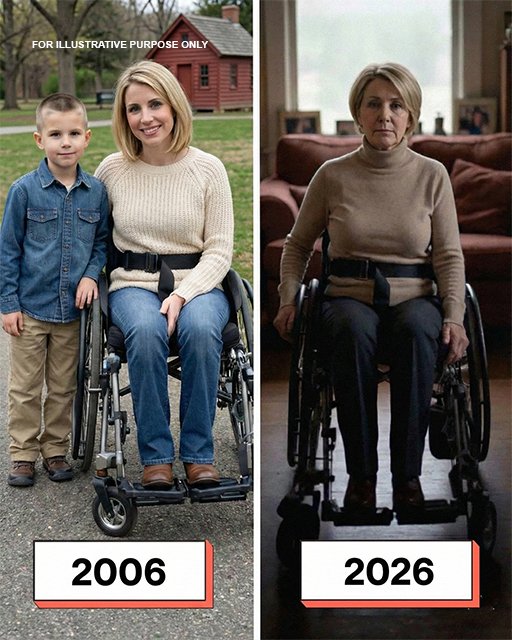
I am 54 years old, and for nearly two decades, I have lived my life seated.
The wheelchair came into my world when my son, Carter, was just days away from turning five. One moment, I was standing at the edge of a crosswalk, holding his small hand in mine. Next, there was the screech of tires, the violent shove of instinct, and then darkness.
When I woke up in the hospital, the doctors spoke in careful, measured tones. They used words like “spinal trauma” and “irreversible damage.” What it came down to was simple. I would never walk again.
Carter’s father had already left us by then. He walked out when Carter was six months old, claiming he was not ready for the responsibility of a family. I learned very quickly that there is no gentle way to become a single mother. You simply do it. You survive. You adapt.
After the accident, survival took on a new meaning.
My world shrank overnight. It narrowed to the width of doorframes and the incline of ramps. I had to relearn everything. I learned how to cook safely from a seated position. I learned how to transfer from my chair to the couch without falling. I learned how to carry a laundry basket on my lap without tipping over. I had to make peace with asking for help, even though I hated needing it.
Through all of it, Carter was extraordinary.
At five, he did not understand paralysis. He only understood that Mommy could not walk and that Mommy sometimes looked tired in a way she never had before. He would drape blankets over my shoulders without being asked. He brought me lopsided peanut butter sandwiches he had proudly assembled himself, the jelly always bleeding through the bread. He climbed onto the couch beside me, rested his head against my arm, and said with total certainty, “It’s okay, Mom. I’ll help you.”
And he did.
We became a team in a way that felt almost sacred. I worked from home as a freelance editor and content writer. It was not glamorous work. There were months when I counted every dollar twice, but it paid the bills. It meant I could be present at every school pickup, every science fair, and every feverish night when he needed a cool cloth on his forehead.
I watched him grow from that tender, wide-eyed little boy into a thoughtful young man. He was bright and ambitious, with a gift for persuasion and creativity that eventually led him into a career in marketing. The first time he pitched a campaign to a major client and called to tell me they loved it, I cried after we hung up. Not because of the job, but because he had built something for himself. A life.
Then he met Alina.
She was beautiful in the way magazine covers are beautiful. Polished. Composed. Perfectly styled down to the last detail. She came from money, the kind that cushions every fall. Her social media was a gallery of curated moments: sunlit vacations, immaculate dinner tables, designer outfits captioned with effortless charm.
When Carter told me they were engaged, I was genuinely happy. I cried when he showed me the ring. I held his face in my hands and told him how proud I was of the man he had become.
After he left that evening, I opened my laptop and searched for mother-of-the-groom dresses.
I wanted something elegant that would drape nicely while I was seated. Eventually, I chose a deep sapphire gown with delicate beading along the sleeves. When I tried it on, I felt graceful. I hung it in my closet where I could see it each morning, a quiet reminder of the celebration to come.
I practiced getting in and out of my car more efficiently so I would not delay anyone on the wedding day. I researched the venue online and called discreetly to ask about accessible parking and entrances. I added the song “What a Wonderful World” to a private playlist and imagined Carter standing beside me, swaying gently as guests smiled at us.
In my mind, it was perfect.
A week before the wedding, Carter came to see me. He arrived alone.
The moment he stepped into my living room, I sensed something was wrong. He would not meet my eyes. His shoulders were tight. His jaw was clenched.
“Mom,” he said, remaining standing instead of sitting in his usual chair. “We need to talk about the wedding.”
I set down my mug carefully. “Of course. Is everything all right? Do you need help with anything?”
He inhaled slowly. “The ceremony is at a historic chapel on the cliffs outside the city. It overlooks the ocean. It is very minimalist. Clean lines. A lot of white.”
“That sounds beautiful,” I said.
He nodded, but still would not look at me. “The problem is accessibility. The chapel does not have a ramp. The planner says installing a temporary one would disrupt the visual design.”
I felt the air leave my lungs. “Disrupt the design?”
“They have worked really hard on the aesthetic,” he continued, as though reading from a script. “It is supposed to feel timeless. Effortless.”
“I can come early,” I said quickly. “Before the other guests. Your Uncle Raymond can help me inside. I do not need special attention.”
“It is not just about getting inside,” he said.
I stared at him. “Then what is it?”
He swallowed. “Alina is worried that the chair might be distracting in the photos.”
The words seemed to echo in the room.
“Distracting?” I repeated.
“She thinks people’s eyes will go to it. That it will pull focus. The photographer mentioned that large equipment can alter the symmetry of group shots.”
Equipment.
For a moment, I could not speak. “So what are you saying, Carter?”
He finally looked at me. There was frustration in his expression and defensiveness. “It is just one day, Mom. We want it to be perfect. Can’t you understand that?”
“I have understood everything in your life,” I said quietly. “But I do not understand this.”
He exhaled sharply. “We have decided to skip the mother-son dance. Alina’s mom will step in for the traditional portion. It will look more cohesive.”
It felt as though something inside my chest cracked open.
“I am your mother,” I said.
“I know that,” he replied, his voice rising. “And I love you. But this day is about me and Alina. I just need you to support that.”
“I have supported you every day of your life,” I whispered.
He softened slightly. “I will show you all the photos. We will do something special later. Just us.”
In that moment, I understood something devastating. My presence had become an inconvenience.
“I understand,” I said finally. “I did not realize I was something you needed to hide.”
He flinched at that but said nothing more. He left soon after.
When the door closed, I sat very still. I did not cry immediately. I felt hollow, as if someone had scooped out everything inside me and left only an echo.
Eventually, I wheeled myself to my bedroom. I took the sapphire dress from the closet and laid it carefully in its box. My hands trembled as I folded the fabric. I deleted “What a Wonderful World” from my playlist.
That night, I barely slept.
By morning, clarity had replaced the numbness. Carter had grown up believing my paralysis was the result of a random car accident. I had always told him that. I never wanted him to feel responsible for what happened that day.
Perhaps in protecting him from guilt, I had hidden something more important. The truth of love.
I spent the next two days assembling a gift.
I gathered photographs from old storage boxes: Carter’s first steps, his kindergarten graduation, his missing-tooth grin. There were pictures of me pushing him on the swings before the accident, and pictures afterward of him standing beside my wheelchair, taller each year.
At the back of the album, I placed two yellowed newspaper clippings.
The headline read, “Local Mother Injured Saving Child from Oncoming Car.”
The article described how I had seen the vehicle speeding toward the crosswalk. I had pushed Carter out of the way. The impact had been mine alone.
I had never told him.
I wrapped the album in simple brown paper and wrote his name across the front in ink. I asked my brother Raymond to deliver it to Carter on the morning of the wedding, with strict instructions to ensure he opened it before the ceremony.
On the wedding day, I stayed home. I did not put on makeup. I did not turn on the television. I sat in my living room and watched the light shift across the floor.
At 2:15 in the afternoon, my phone rang.
Carter.
I answered. “Hello?”
“Mom?” His voice was fractured.
“Yes?”
“I opened it,” he said. “Why didn’t you ever tell me?”
I closed my eyes. “Because you were five.”
There was a long silence, broken only by his uneven breathing. Then he spoke again. “I stopped the ceremony. I told them I couldn’t do it.”
My heart stuttered. “Carter, you do not have to—”
“I am coming over,” he interrupted. “Please. I need to see you.”
He arrived less than twenty minutes later, still wearing his tuxedo. His hair was disheveled. His eyes were red and swollen. He clutched the photo album against his chest.
The moment I opened the door, he dropped to his knees in front of me.
“Mom,” he choked. “You gave up your legs for me.”
“I gave up nothing,” I said softly. “I did what any mother would do.”
“You told me it was just an accident.” Tears streamed down his face. “And I told you that your wheelchair would ruin my wedding pictures.”
He buried his face in his hands. “I am ashamed of myself.”
I reached down and cupped his cheek. “I did not send that album to punish you. I sent it because I needed you to understand that this chair is not ugly. It is proof that love sometimes costs something.”
He nodded, trembling. “Alina said it was about aesthetics. About the image. I agreed with her. I let myself believe that image mattered more than this.”
“What happened?” I asked gently.
“I told her I could not marry someone who saw you as a flaw in the background.” He looked up at me. “I do not know what that says about me.”
“It says you made a mistake,” I replied. “And then you corrected it.”
In the days that followed, Carter ended his engagement. Alina was furious. She insisted he was overreacting, that weddings were about presentation. Carter had seen something he could not unsee.
He had seen what it meant to erase someone for the sake of a photograph.
People later asked me if I had manipulated him. If sending that album on his wedding day was cruel.
Perhaps it was dramatic. Perhaps the timing was sharp.
But I know this. I did not send it to make him feel guilty. I sent it because I refused to let my son believe that my wheelchair was a symbol of shame.
It is not an eyesore. It is not equipment. It is not a disruption to symmetry.
It is the reason he is alive.
Months later, Carter and I attended a community gala together. He insisted I wear the sapphire dress. He walked beside me proudly, introducing me to colleagues and friends without hesitation.
When someone asked about my chair, he answered simply, “My mother is the bravest person I know.”
That was enough.
I do not know what the future holds for Carter. I hope one day he finds a partner who understands that love does not crop out what is inconvenient, and that beauty is not fragile enough to be undone by steel and wheels.
As for me, I have stopped shrinking myself to fit other people’s frames.
If my presence disrupts someone’s aesthetic, so be it.
I have already given everything that mattered. I would do it again.