
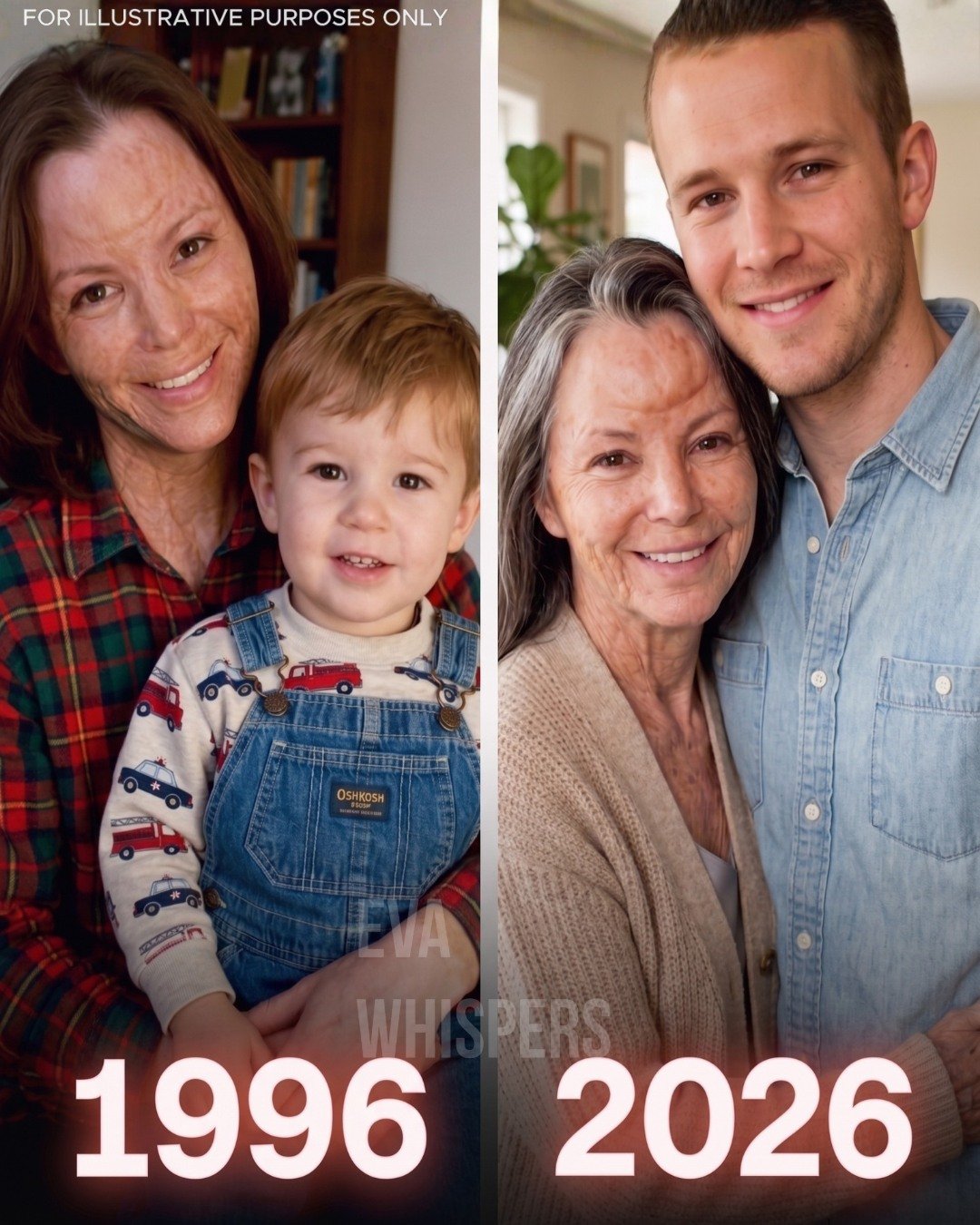
My father walked out on my mother after the worst night of her life, and for 30 years he stayed gone. Then, on my birthday, he showed up at our door asking for help, and I told him I would give it to him on one condition.
I’m 32 now, and the only reason I’m alive is because my mother carried me out of a burning house when I was two years old.
The fire started because of a gas leak in the kitchen. It happened in the middle of the night. My father was away on a work trip, so it was just me and my mom in the house. She woke up to the smell of gas, and then the explosion came. She grabbed me from my crib and ran through the smoke, carrying me outside.
I don’t remember the fire itself.
I remember the scars.
They run along one side of her face, down her neck, and across her shoulder. When I was old enough to ask about them, she told me the truth in the plainest way possible.
“The house caught fire. I got you out. That’s all.”
But that wasn’t all.

When my father came home and saw her after she left the hospital, he didn’t thank her for saving me. He didn’t even try to hide what he was feeling. He said he couldn’t live with the reminder. Later, my mother admitted that he also said he still had time to build a different life with someone he could admire.
Then he left.
There was no custody fight. No birthday cards. No phone calls. Nothing.
My mother never told that story with any drama. She would simply say, “Some people leave when life stops flattering them.”
Then she’d go to work.
She worked double shifts at a diner while enduring skin treatments she could barely afford. She never asked anyone for pity. She never allowed me to feel like I was something she had to survive.
When I was sixteen, I got a job stocking shirts at a department store.
She found out and got mad.
“You should be studying.”
“I am studying.”
“You are not taking a job because of me.”
“I’m taking a job because groceries cost money.”
That got a laugh out of her, and after that she stopped fighting me on it.
I stayed in retail. I learned the business. I saved aggressively. By the time I was twenty-nine, I had opened my own clothing store. It isn’t huge, but it does well—well enough that my mother was finally able to slow down.
Last week was my birthday.
I spent it at her place. We grilled in the backyard. Burgers, corn, lemonade. Quiet. Easy. The kind of evening that feels earned.
Then someone knocked on the front door.
My mother looked up.
“You expecting anyone?”
“No.”
I went inside, wiped my hands, and opened the door.
A man stood there wearing worn clothes and shoes that were nearly split apart. He looked thin, tired, and gray around the mouth.
I knew him immediately.
I had his eyes.
He looked at me and cleared his throat.
“Hey,” he said. “Son.”
By then, my mother had come up behind me. I felt her stop cold.
I said, “Dad?”
He gave a small nod.
“What do you want?”
He looked past me, saw her, and seemed to shrink a little.
“I need to talk to you both.”
My mother said, “You can talk from there.”
So he did.
He had gone bankrupt. His second wife had left him. He had sold what he could, lost the rest, and run out of people willing to help him.
Then he said the part that almost made me laugh.
“I didn’t know where else to go.”
At least that had an explanation.
He had found me through my store. My business is public, and my first name is on the website. One old contact still knew what town my mother had moved to after the fire. He hadn’t kept up with us over the years. He had only tracked us down once he needed something.
My mother turned away before he finished speaking.
“I’m not doing this.”
He spoke faster.
“Please. I just need help getting on my feet.”
I looked at him.
At the shame.
At the nerve.
At the fact that even now, he still knew exactly where to point his need.
And I knew what I was going to do.
Maybe it was because I had driven past that old street more than once over the years. Maybe some part of me had never really left it either.
“I’ll help you,” I said.
My mother turned so fast I thought she might throw her glass at me.
He stared.
“You will?”
“Yes. Money. A place to stay. I’ll help. But I have one condition.”
His relief came too quickly.
“Fine. Anything.”
I said, “Tomorrow morning, you’re getting in the car with us, and you’re coming back to the old property.”
His face changed.
“What for?”
“So you can stand where you left us.”
My mother said, “No.”
I turned to her.
“Mom, I need this.”
“For what?”
“So he doesn’t get to skip straight to the part where we save him.”
She stared at me for a long second. Then she looked at him.
He said quietly, “If that’s what it takes, I’ll go.”

The next morning, we drove out there.
The old house was gone. In its place stood a small rental with a porch that needed work and a fence leaning off to one side. An older man stood out front holding a rake.
I walked over and introduced myself. I explained that my mother had once lived on that lot and that there had been a fire there when I was a baby.
He looked at my mother, then at me.
“I remember hearing about that place when I bought it.”
His name was Walt.
He told us that years ago, during renovations, workers digging near the old kitchen footing found a metal recipe box wrapped in oilcloth and buried intentionally. He had kept it because it seemed personal, and because his late wife always told him not to throw away things people had hidden with care.
My mother’s hand went to her mouth.
“Was it blue?” she asked.
Walt nodded.
“Faded flowers on the lid.”
She closed her eyes.
“I buried that.”
We all fell silent.
She explained everything right there.
After my father left, she had gone back to the lot one last time before demolition. She found the recipe box in the remains because it had been stored in a lower cabinet that partially survived. She put family photos inside, one of my baby pictures, and a letter she wrote to my father but never sent.
Then she buried it.
She couldn’t keep carrying those things, but she couldn’t throw them away either.
Walt brought the box out from his garage.
Inside were scorched recipe cards, a photograph of my mother holding me as a baby, and an envelope with my father’s first name written on it.
I handed it to him.
“Open it.”
He looked at my mother.
She said nothing.
He opened it.
The letter was short.
There was no begging. No pleading.
She wrote that her son was alive because she carried him through fire. She wrote that if he could no longer love her, he still had a duty to love the child whose life she had saved. She wrote that she would not spend the rest of her life asking a coward to become decent.
He read it twice.
Then he sat down on the porch step and covered his face.
“I’m sorry,” he said.
I believed he meant it.
I just didn’t think that mattered enough.
I looked at Walt.
“You still need work done here?”
Walt glanced around.
“Porch boards. Fence. Couple of posts.”
I turned back to my father.
“Good. That’s the condition.”
He frowned.
“What condition?”
“I’ll pay for materials. I’ll help you get on your feet. But first you’re going to fix this place.”
He stared at me.
Then he actually pushed back.
“I came for help, not this.”
I cut him off.
“Exactly.”
For a second, I thought he might walk away. Part of me hoped he would. At least then everything would stay simple.
But he looked at the letter in his hand, then at my mother, then at the porch.
Finally, he said, “Okay.”
So for the next week, he worked.
Not symbolically.
Actually.
I paid for lumber, screws, nails, and paint. Walt lent tools and kept an eye on everything. My father did the labor. He tore out rotten boards. Reset posts. Straightened the fence. Hauled debris. Got blisters. Got sunburned. Got quiet.

On the second day, he muttered, “You planned this fast.”
I handed him a drill.
“No. I just had a long time to think about what a man owes after leaving.”
That shut him up.
My mother refused to come during the first two days.
On the third day, she brought iced tea. She set one cup on the porch rail near him and said, “Check the support beam before you cover it. Rotten wood doesn’t get stronger because you hide it.”
Then she left.
Later that week, Walt pointed out an area near the porch where old fill dirt had shifted. Mixed in with the dirt and debris was a carved wooden block.
My mother recognized it immediately.
It had come from my crib, which her father had made by hand.
After the fire and demolition, pieces of the old house and furniture had been pushed into a side trench before the lot was regraded years later. That was how it ended up there.
She ran her thumb over the carved star and said, “I thought all of it was gone.”
By the end of the week, the porch was solid and the fence stood straight.
My father looked exhausted.
Older too.
He said, “I did what you asked.”
“Yes.”
“So now what?”
“Now you get one month.”
He blinked.
“One month?”
“Room above my store. Food. Time to find work. That’s it.”
“I’m your father.”
“Biologically, yes.”
He nodded slowly.
Then he looked at my mother.
“I know I don’t deserve another chance.”
She answered him plainly.
“No. You don’t.”
A few days later, she went back to the property alone.
When I picked her up afterward, she sat quietly for a while before finally saying, “I’m glad something good finally got built there.”
That was enough.
I took the crib piece to a local woodworker and had it mounted on a simple board.
Under the carved star, I had him carve one line:
Made worthy before the world said otherwise.
Now it hangs near the fitting room in my store.
I asked my mother to come by when I put it up. I didn’t ask him to watch, but he was already downstairs when I carried out the sign. He stood near the register with the same careful silence he’d been carrying all week.
My mother touched the edge with two fingers.
I tightened the last screw and stepped back.
That was when I realized something.
I hadn’t made that condition to humiliate him.
I made it because too many people confuse regret with repair.
They are not the same thing.