
The Man Who Saved My First Day
I was twenty-four years old when I started working at Grayson Financial.
Fresh out of graduate school, nervous and determined to prove myself, I walked into the towering office building carrying a new laptop bag and enough anxiety to fill an entire conference room.
Everyone else seemed confident.
They knew where to go.
They knew who to talk to.
They already belonged.
I didn’t.
My first morning passed in a blur of introductions, passwords, paperwork, and forced smiles.
By lunchtime, I felt exhausted.
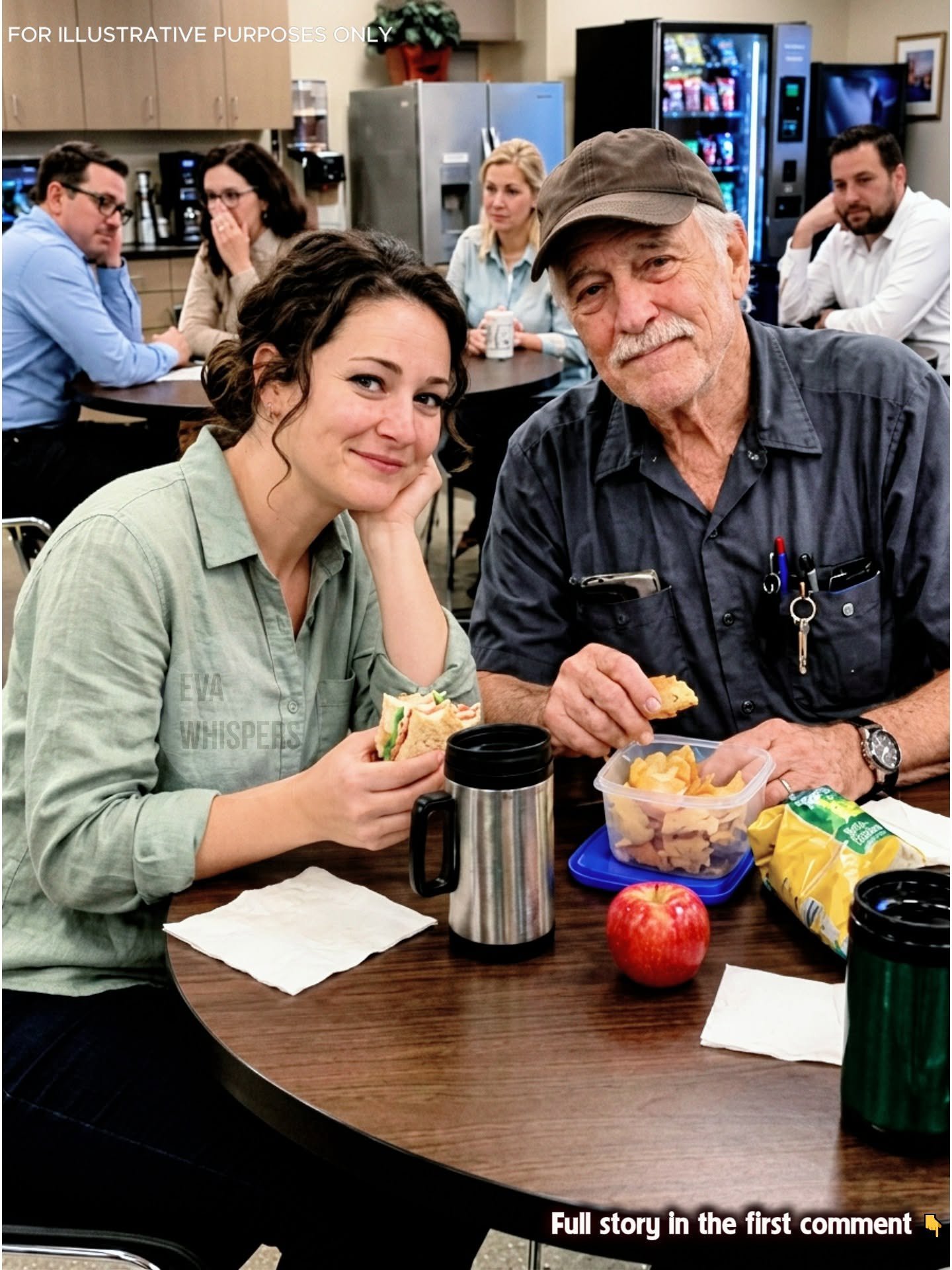
I walked into the employee break room carrying a salad I was too nervous to eat.
Every table appeared full.
Groups of coworkers laughed together. Some discussed projects. Others shared inside jokes that made me feel even more like an outsider.
I stood there awkwardly, searching for an empty seat.
That was when I heard a calm voice.
“You can sit here, if you’d like.”
I looked over.
An older man wearing a gray maintenance uniform sat alone near the window.
His silver hair was neatly combed. His lunch consisted of a simple sandwich wrapped in wax paper.
His smile was warm.
Genuine.
Kind.
I sat down immediately.
“Thank you,” I said.
“No problem,” he replied. “First day?”
“Is it that obvious?”
He chuckled.
“Only because I remember mine.”
That was how I met Charles Wilson.
The company’s janitor.
And the beginning of a friendship that would quietly change my life.
Eleven Years of Lunches
As the months passed, I became part of the company.
I made friends.
Earned promotions.
Learned the culture.
Yet every day at noon, I still sat with Charles.
It wasn’t planned.
It simply became our routine.
Some days we talked about work.
Other days we talked about books.
Sometimes he told stories about growing up in the 1960s.
Other times I told him about my struggles with relationships, family, or career decisions.
Charles was an exceptional listener.
He never interrupted.
Never judged.
Never tried to impress anyone.
He simply listened.
Then he’d offer a few thoughtful words that somehow made everything clearer.
Over time, our lunches became the most peaceful part of my day.
But not everyone understood.

The Office Jokes
At first, the comments seemed harmless.
“Having lunch with your boyfriend again?”
“Tell Charles we’re hiring if he wants a promotion.”
“Careful, Charlotte. You’re spending more time with the janitor than your own department.”
People laughed.
I laughed too.
At least on the outside.
Inside, it stung.
Not because they were mocking me.
Because they were mocking him.
Many of them had never spoken more than three words to Charles.
Yet they acted as though they knew exactly who he was.
One afternoon, after a particularly embarrassing round of jokes, I apologized to him.
“I’m sorry people say things like that.”
Charles smiled.
“Why?”
“Because it’s disrespectful.”
He folded his napkin carefully.
“Charlotte, people often reveal more about themselves than about others.”
I frowned.
“What does that mean?”
“It means kindness doesn’t need approval.”
Then he took another bite of his sandwich.
Conversation over.
That was Charles.
Simple.
Wise.
And completely impossible to offend.
The Lessons He Never Meant to Teach
Over eleven years, our friendship never changed.
I got promoted several times.
Charles remained the janitor.
At least that’s what everyone thought.
When my father died unexpectedly, Charles sat with me during lunch while I cried into my soup.
When my engagement fell apart two years later, he listened without judgment.
When I doubted myself before applying for a management position, he spent weeks encouraging me.
“You’re ready,” he told me.
“What if I fail?”
“Then you’ll learn something useful.”
“What if I succeed?”
He smiled.
“Then you’ll learn something useful.”
I laughed so hard I nearly spilled my coffee.
That was Charles.
Always finding wisdom in the simplest words.
The Empty Chair
One Monday morning, I arrived at work and noticed something unusual.
The hallways weren’t freshly cleaned.
The trash bins hadn’t been emptied.
Charles wasn’t there.
I assumed he was sick.
Tuesday passed.
Still no Charles.
Wednesday morning, I overheard two employees talking.
“Did you hear?”
“Hear what?”
“The janitor died.”
The words hit me like a punch.
Died?
I immediately called Human Resources.
The woman confirmed it gently.
Charles had suffered a heart attack over the weekend.
He was gone.
Just like that.
Gone.
For the first time in eleven years, noon arrived and there was nobody waiting by the window.
Nobody unwrapping a sandwich.
Nobody asking how my day was going.
The chair remained empty.
And somehow the entire building felt colder.
A Funeral Nobody Planned to Attend
The following day, I quietly asked several coworkers whether they planned to attend the funeral.
Most looked surprised.
Others uncomfortable.
A few didn’t even know Charles’s last name.
One person shrugged.
“I didn’t really know him.”
Neither did they.
Not really.
So Saturday morning, I attended alone.
The funeral was held in a small church outside town.
Rain fell softly against the stained-glass windows.
The service was simple.
Respectful.
Peaceful.
I expected only a handful of people.
Instead, the church was packed.
Completely packed.
There were teachers.
Police officers.
Business owners.
Construction workers.
Nurses.
Firefighters.
Young parents holding children.
Elderly couples.
People from every walk of life.
Hundreds of them.
I couldn’t understand it.
Who were all these people?
How had Charles known so many?
As story after story was shared, the answer slowly emerged.
Charles had spent decades quietly helping people.
Paying utility bills for struggling families.
Funding scholarships.
Buying groceries.
Covering medical expenses.
Repairing homes.
Helping strangers.
Never asking for recognition.
Never telling anyone.
Never posting about it.
Never taking credit.
The man my coworkers called “just a janitor” had touched more lives than anyone I’d ever met.
By the end of the service, I was crying openly.
And then something even more surprising happened.

The Attorney
As people began leaving, a tall man in a dark suit approached me.
“Are you Charlotte Harper?”
“Yes.”
He extended his hand.
“My name is Liam Bennett. I was Mr. Wilson’s attorney.”
Attorney?
I blinked.
“Attorney?”
He nodded.
“Mr. Wilson asked me to find you after the funeral.”
Then he handed me an old shoebox.
The cardboard was worn and faded with age.
My name was written on the lid in Charles’s familiar handwriting.
Charlotte.
Nothing else.
Just my name.
My hands trembled.
“What is this?”
Liam smiled.
“Something he wanted you to have.”
Then he added softly:
“And something he wanted you to understand.”
The Contents of the Box
I sat on a nearby bench and slowly lifted the lid.
Inside were dozens of envelopes.
Photographs.
Letters.
Newspaper clippings.
And a journal.
I opened the first envelope.
It contained a photograph of a young Charles standing beside a woman and a little girl.
His family.
Another envelope contained newspaper articles.
The headlines shocked me.
Years earlier, Charles Wilson had been the founder of a successful manufacturing company.
A company worth millions.
I stared in disbelief.
This couldn’t be right.
Charles?
The janitor?
The articles continued.
After selling the business, he had inherited significant wealth.
Enough that he never needed to work another day in his life.
Yet he chose to.
I looked at Liam.
“Why would he become a janitor?”
The attorney smiled knowingly.
“Read the journal.”
So I did.
Charles’s Secret
The first page was dated twenty years earlier.
It described the loss of his wife.
Then his daughter.
Both killed in a tragic accident.
My eyes filled with tears.
Page after page revealed unimaginable grief.
Charles had lost everything.
His business no longer mattered.
His money no longer mattered.
Nothing seemed meaningful anymore.
Until one day he accepted a temporary maintenance position at a local school.
There, he discovered something unexpected.
People treated janitors differently.
Many ignored them.
Some looked down on them.
But a few saw them.
Truly saw them.
And those people revealed extraordinary character.
Charles wrote:
“When people believe you have nothing to offer them, their true nature appears.”
I kept reading.
“The kindest souls are usually the ones who stop to speak with the person everyone else overlooks.”
Then I found the final entry.
The one written shortly before his death.
It was about me.
What He Really Left Me
My heart pounded as I read.
“Charlotte sat beside me on her first day when she had every reason not to.”
“Over eleven years, she never treated me as less important than anyone else in the building.”
“She listened to my stories, respected my opinions, and valued my friendship without expecting anything in return.”
Tears blurred the words.
I continued.
“Many people admired my money when I had it.”
“Charlotte valued me when she believed I had none.”
By then I was openly crying.
Then I reached the last page.
Attached was a letter.
And a document.
The letter read:
“My dear Charlotte,”
“Kindness is one of the rarest investments because people often make it without expecting returns.”
“You never knew who I was, what I owned, or what I could do for you. You were kind anyway.”
“So I leave you something far more valuable than money.”
“The responsibility to continue helping others.”
Beneath the letter was documentation establishing the Charles Wilson Community Foundation.
And beside it—
My name.
As its director.
Continuing His Legacy
Charles had left most of his fortune to charitable causes.
Scholarships.
Medical assistance programs.
Community projects.
Food banks.
Educational grants.
The foundation would oversee all of it.
And he wanted me to lead it.
I sat there speechless.
The attorney explained everything.
Charles had spent years preparing.
Years observing.
Years deciding who he could trust.
Not because I was the smartest person he knew.
Not because I was the most successful.
But because I had treated him like a human being when everyone else saw a uniform.
The Greatest Inheritance
Two years have passed since Charles’s funeral.
Today, the foundation helps thousands of families.
Every scholarship awarded carries his name.
Every family assisted continues his legacy.
And every day, I think about that first lunch.
A frightened young woman.
An empty seat.
A quiet janitor.
Most people spend their lives trying to impress important people.
Charles taught me something different.
The most important people are often the ones nobody notices.
The ones quietly cleaning hallways.
Fixing broken things.
Helping others without recognition.
The world called Charles Wilson a janitor.
But that wasn’t who he was.
He was a teacher.
A mentor.
A friend.
And the greatest man I’ve ever known.
Sometimes I wonder what my life would have become if I hadn’t sat at his table that first day.
Then I remember something he used to say whenever life felt complicated:
“Kindness doesn’t need approval.”
Eleven years later, I finally understand exactly what he meant.