
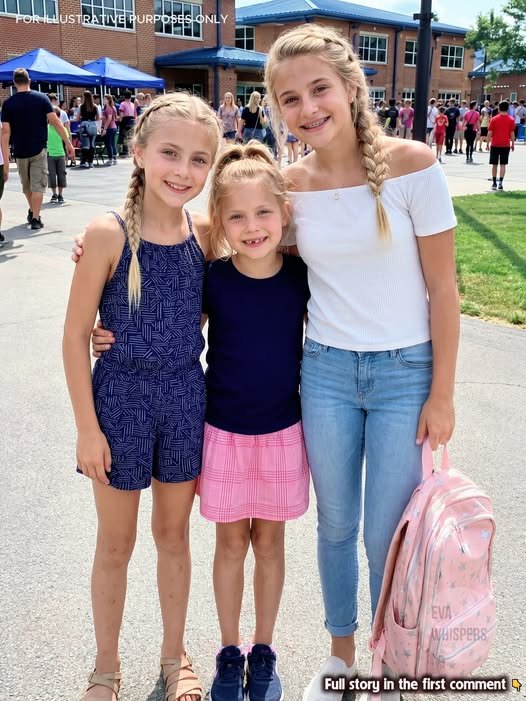
A Normal Afternoon
I slid another tray of cookies onto the rack and listened to my three daughters thunder down the stairs like a small storm.
For a moment, I believed my whole life was exactly where it should be.
Sophie burst into the kitchen first, her ponytail bouncing as she hurried toward me.
“Mom, are you almost done? Everyone is already there,” she asked.
“Ten more minutes, sweetie,” I replied. “You three can walk over without me.”
Mia came in behind her, clutching her backpack tightly against her chest. She kept glancing toward the hallway, where Greta’s voice drifted through the house, low and sharp as she spoke on the phone.
“Mia, honey, where is your sister?”
“She is coming,” Mia whispered. “She said not to bother her.”
I wiped my hands on my apron and stepped into the hall.
Greta was leaning against the wall with her phone pressed to her ear. The second she noticed me, she ended the call.
“Who was that?” I asked.
“Nobody. A girl from school.”
She wouldn’t meet my eyes. Lately, she never did.
I told myself every mother of a teenage daughter watched the same door slowly close.
“Greta, your sisters are waiting.”
“I know, Mom.”
She brushed past me and grabbed her backpack from the bench by the door.
Mia immediately reached for her hand.
“Greta, will you play the ring toss with me?”
“Not today, Mia.”
“You said last time.”
“I said not today.”
Mia’s lip trembled. She let her hand fall and stared down at the floor as though she was already used to disappointment.
I made a mental note to talk to Greta later—gently—about how much her little sister still worshipped her.
But I never got the chance to have that conversation.
“Girls,” I said as I knelt to button Mia’s jacket, “stay together. Ten minutes, that is all. I will bring the cookies.”
“Promise?” Mia asked.
“Promise.”
Sophie was already hopping at the door.
Greta stepped outside without looking back.
Sophie skipped after her.
Mia lingered on the porch for a second, watching Greta’s back.
“Mia? You okay?”
She nodded too quickly.
“Yes, Mom.”
Then she ran after her sisters.
I stood there waving until they disappeared around the corner. Then I went back inside to finish the cookies.
Greta Disappears
An hour later, I hurried up the school steps, balancing a tray of cookies in one hand and a thermos of lemonade in the other.
I waved at a teacher and searched the crowd for three familiar faces.
Sophie spotted me first and came running over with a stuffed pink unicorn tucked under her arm.
“Mom, look what I won! It only took six tries.”
“That’s wonderful, sweetheart. Where’s your sister?”
Mia followed behind her more slowly, her eyes fixed on the ground.
“Sophie, where is Greta?”
“She was with us at the ring toss. Then she said she was going to find her friends.”
“Which friends?”
Sophie shrugged with the careless honesty of an eleven-year-old.
I turned to Mia.
“Mia. Honey. Did you see where Greta went?”
Instead of looking at me, she stared at the cookies.
“I don’t know, Mom.”
Something about her answer unsettled me, but I ignored the feeling.
Greta was fourteen.
Fourteen-year-olds wandered away.
Fourteen-year-olds rolled their eyes when their mothers showed up.
I placed the cookies at the bake-sale table and began checking every booth.
By five o’clock, the sun was sinking behind the bleachers.
Parents were packing up.
I had searched everywhere.
Greta was nowhere.
I drove home with Sophie and Mia in the back seat, convinced Greta would already be there, sitting on the porch and annoyed that I had worried.
She wasn’t.
The Search Begins
I called the police at nine that night.
My voice was steadier than my hands.
“Ma’am, has she ever run away before?”
“Never. Not once. This isn’t like her.”
“Did she take anything with her? A bag, money, a change of clothes?”
I closed my eyes.
“Her backpack. She had her backpack at the fair. I don’t know what was in it.”
Officer Bennett arrived later that night.
He was older, careful, and kind in the way people become kind when they already suspect the worst.
“Ma’am, I have to ask. Was there anything going on at home? Any fights, anything she might have been upset about?”
“No. We’re a close family. I’m a single mom, I work hard, but the girls and I are close.”
“Any contact with her father?”
My jaw tightened instantly.
“Her father passed away years ago. The girls know that.”
He wrote something down without pushing further.
“The missing backpack concerns me. In abduction cases, the victim almost never has time to grab a bag. I’m not saying that’s what happened here. I’m just saying we have to consider she may have left on her own.”
“She wouldn’t.”
“I hope you’re right.”
That night I sat at the kitchen table and prayed to a God I hadn’t spoken to since the divorce.
The next morning, volunteers gathered in the school parking lot.
Sophie clung to my side.
Mia stood near the car with her arms wrapped tightly across her chest, silently watching the searchers disappear into the woods.
Weeks became months.
The flyers faded on telephone poles.
Reporters stopped calling.
Officer Bennett still phoned every few weeks, but his voice grew quieter every time, like a man slowly lowering a casket into the ground.
Sophie cried often, and openly.
I could hold her through her grief.
Mia never cried.
Instead, she seemed to shrink.
She stopped inviting friends over.
She kept her bedroom door closed.
Whenever I asked if she wanted to talk about Greta, she would simply say:
“I’m okay, Mom,”
and disappear behind a book.
Books
I told myself it was grief.
I told myself children handled loss differently.
I told myself many things so I wouldn’t have to look too closely at my youngest daughter.

The Backpack
Two years passed that way—slow, gray, and quiet.
Then, on an ordinary Tuesday afternoon, I carried a basket of laundry into Mia’s room.
I knelt on the rug with a pile of mismatched socks in my lap and opened her closet door.
The same closet I had opened hundreds of times before.
The dusty box of old toys sat in the back exactly where I remembered.
I had promised the church for months that I would donate it.
I began sorting through it.
A stuffed rabbit missing one eye.
A plastic tea set.
A doll whose hair Mia had chopped off when she was seven.
Then I saw it.
A strap.
Faded purple canvas.
A small silver clip I had bought during a back-to-school sale three summers earlier.
My hands instantly went numb.
I pulled harder.
The rest of the bag slid out from beneath the toys.
Greta’s backpack.
The same backpack police had searched two counties for.
I sat frozen on the floor with it in my lap.
I couldn’t make my fingers move.
“Mom?”
I looked up.
Mia stood in the doorway holding a glass of water.
The moment she saw the backpack, all the color drained from her face.
“Mia.”
My voice didn’t sound like my own.
“Why is your sister’s backpack in your closet?”
The glass trembled.
“Mia. Look at me. Why is this in your closet?”
“I, I don’t know.”
“You don’t know?” I lifted the backpack. “You don’t know how it got under your toys?”
Her chin began to shake.
“Greta told me to hide it.”
The room seemed to tilt.
“What did you just say?”
“She told me to hide it from you. And to never, ever show you.”
“Greta told you?” I whispered. “When? When did she tell you?”
Mia stared down at her socks.
“Mia, when did your sister tell you to hide this?”
“Before.”
“Before what?”
“Before she left.”
I stared at her.
Then, with shaking fingers, I unzipped the main compartment.
“Oh my God, I knew this wasn’t an accident. HOW DARE GRETA DO THIS TO ME?!”
Inside was a jacket and two letters.
Both written in Greta’s careful looping handwriting.
One was addressed to me.
The other simply said:
Mia.
I picked up the second envelope.
It looked crisp.
New.
The postmark was recent.
“Mia.”
“Mom, please.”
“All this time?”
“Mom.”
“Answer me.” I looked directly at her. “Have you been in contact with her this entire time? Do you know where she is?”
“Mom, please don’t be mad.”
“Of course I’m mad!” Tears filled my eyes. “I’m heartbroken, and I’m confused because I don’t know how you and Greta could do this to Sophie and me.”
She lowered her head.
“She made me promise.”
“For TWO YEARS, Mia?”
“She’s my sister.”
“I am your mother.”
“She said you’d be angry. She said you’d come and take her back and she didn’t want to come back.”
“Take her back from WHERE?”
Mia pressed both hands over her mouth.
“Mia, take her back from WHERE?”
“I can’t say.”
“You can. You will.”
“She made me promise on her life, Mom. She said if I told you, she’d never write to me again.”
The Truth Comes Out
I sat back on my heels.
The backpack slipped from my lap.
Two years.
Two years of crying on the bathroom floor.
Two years of jumping whenever the phone rang.
Two years of staring at strangers in grocery stores, searching their faces for my daughter.
And all along, my youngest child had known where Greta was.
“How many letters, Mia?”
“What?”
“How many letters has she sent you?”
Mia started shaking.
“A lot.”
“A lot is what?”
“Every month. Sometimes twice.”
I closed my eyes.
“Where are they?”
“In the box. Under the rabbit.”
I reached inside.
Beneath the stuffed animals sat a thick manila envelope.
I pulled it free and dropped it onto the floor.
“Mom, please don’t read them. Please. She trusts me.”
“She trusted you to lie to me, Mia.”
“She trusted me to keep her safe.”
“Safe from whom?”
Mia looked at the floor.
“From you.”
The words struck somewhere deep inside me.
Somewhere I hadn’t known existed.
I picked up the letter addressed to me.
The paper felt older.
“Sit down, Mia.”
“Mom.”
“Sit down on the bed. You are going to be here while I read this.”
She obeyed.
I sat beside her and unfolded the page.
Greta’s letter was short.
Every line hurt.
You told me he was dead, Mom.
He’s not. He’s been looking for me for years.
My hands went numb.
I continued reading.
I found the papers in your drawer last spring.
I wrote to him. He’s kind. He’s real.
And I couldn’t stay in a house built on a lie.
I lowered the paper and stared at Mia.
“She’s with him? Your father?”
Mia nodded.
“Two states away. Mom… why did you tell us he was dead?”
I pressed my hand against my mouth.
The words I had shouted earlier—
“How dare Greta do this to me,”
—changed into something entirely different.
How dare I.
How dare I tell my children their father was dead because I was angry.
How dare I let that lie become their childhood.
The Phone Call
I picked up my phone and dialed the number written in the letter.
It rang twice.
Then:
“Mom?”
Her voice sounded older.
“Greta,” I whispered. “I’m so sorry.”
“You lied to me.”
“I know.”
“For ten years.”
“I know, baby.”
Silence followed.
Then, quietly:
“Will you come? Just to talk?”
“Tomorrow.”
Beginning the Long Road Back
The next morning, all three of us got into the car.
Sophie held Mia’s hand the entire drive.
At a small diner beside the highway, Greta waited in a corner booth.
She didn’t stand.
She didn’t smile.
She simply looked at me.
A stranger.
And my child.
“Sit down, Mom,” she said.
And I sat.
Knowing the road back would be long.
But also knowing that, for the first time in two years, it had finally begun.