
A New House and a Quiet Neighbor
Nine years ago, when I was forty-eight and newly divorced, I moved into a small blue house on Maple Lane with my two children, Emily and Jacob.
It was not the kind of house people dream about when they imagine starting over. The paint was peeling near the porch steps. The kitchen cabinets groaned every time I opened them. The basement smelled faintly of dust and old wood, and in the far corner sat an ancient white freezer that no longer worked.
But it was ours.
After a painful divorce, that mattered more than granite countertops or fresh paint.
Emily was fifteen then, old enough to understand more than I wished she did. Jacob was twelve, still trying to act brave while sleeping with the hallway light on. I was working long shifts at a local clinic, stretching every dollar, and pretending I was not terrified of failing them.
Next door lived an elderly man named Lawrence Whitaker.
His house was small and gray, with neat curtains and a porch swing that never seemed to move. He kept to himself. He rarely had visitors. He walked slowly to his mailbox every morning, always wearing the same brown cardigan, even in weather too warm for it.
When we first met, he gave me a polite nod and said, “Welcome to the neighborhood.”
That was all.
I figured he liked his privacy, and I respected that. At that time, I barely had enough energy to keep my own life together. I did not imagine that the quiet man next door would become one of the most important people our little family would ever know.
The Day Everything Changed
Our friendship began by accident one winter afternoon.
It had snowed for two days straight, turning Maple Lane into a soft white tunnel. I was coming home from work when I noticed Lawrence’s mailbox was overflowing. Envelopes were sticking out, dusted with snow.
Something about it bothered me.
Lawrence was the kind of man who collected his mail at exactly eight every morning. I had watched him do it so many times from my kitchen window that it had become part of the rhythm of my day.
I told myself not to interfere.
Then I imagined him lying helpless inside his house.
So I crossed the yard, climbed his porch steps, and knocked.
No answer.
I knocked again, louder.
After a long moment, I heard shuffling. The door opened just a crack, and Lawrence appeared, pale and unsteady.
“Mrs. Parker,” he said, gripping the doorframe. “Is something wrong?”
“I was going to ask you the same thing,” I said. “Your mail’s been sitting there for days.”
His pride fought him for a second. Then his shoulders dropped.
“I’ve had the flu,” he admitted. “Ran out of medicine yesterday.”
I did not ask permission. I simply said, “Write down what you need.”
He tried to protest, of course. Lawrence protested everything helpful.
But thirty minutes later, I returned from the pharmacy with his medicine, a pack of crackers, ginger tea, and a bottle of orange juice.
He stood in the doorway with his wallet in hand.
“How much do I owe you?”
“Nothing,” I said.
His eyes narrowed. “I don’t take charity.”
“It’s not charity,” I replied. “It’s neighborly behavior.”
For the first time, I saw the smallest smile tug at his mouth.
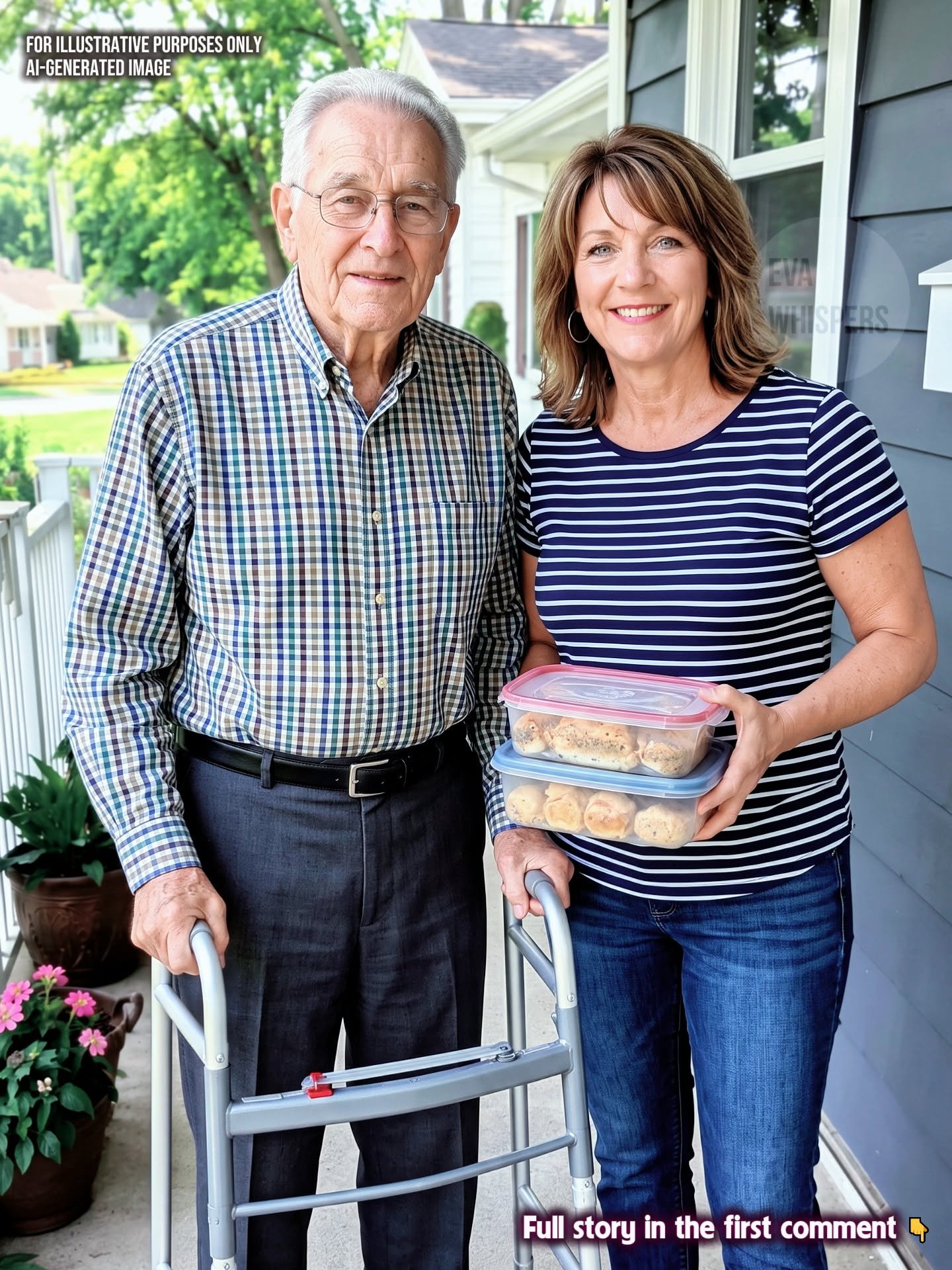
Two days later, I made chicken soup for my children. Without thinking too much about it, I poured an extra serving into a container and walked it over to Lawrence’s porch.
He opened the door and stared at the bowl like I had handed him a treasure.
“You don’t have to keep doing this,” he said.
“I know,” I answered. “That’s why it counts.”

A Routine Made of Small Things
After that, it became a habit.
Whenever I cooked dinner, I made an extra portion for Lawrence. Meatloaf, vegetable stew, roast chicken, pasta with tomato sauce, apple crumble when I had enough apples.
At first, I knocked and handed the food to him directly. Later, when his legs became weaker and winter made the porch steps dangerous, I started leaving the containers on the little wooden table beside his door.
Every evening, I would place the food there, knock twice, and call, “Dinner, Lawrence.”
Sometimes he opened the door. Sometimes he called back, “Thank you, Claire.”
That was my name.
Claire Parker.
For nine years, that small exchange became as familiar to me as breathing.
He still tried to pay me. He left folded bills under the empty containers. I always tucked them back inside his mailbox. Once, he mailed me a check for two hundred dollars with “food expenses” written in the memo line.
I tore it up and told him never to do that again.
“You’re stubborn,” he grumbled.
“So are you,” I said.
Over time, he stopped arguing as much.
My children grew used to him too. Emily helped shovel his walkway in the winter. Jacob carried his grocery bags when I brought them from the store. On Halloween, Lawrence sat by his window and handed out full-sized candy bars, but only because Jacob told him the neighborhood children would “respect him more.”
Lawrence pretended to be annoyed, but I saw him buy three extra boxes the next year.
Slowly, his quiet house became part of our home.
The Man Behind the Curtains
Lawrence was not easy to know at first.
He answered personal questions with short sentences. He did not complain. He never asked for company, even when loneliness sat beside him as visibly as an old dog.
But some evenings, when I brought him dinner, he would invite me in for tea.
His house was spotless but frozen in time. His late wife, Margaret, was everywhere. Her photo stood on the mantel. Her floral apron hung from a hook in the kitchen. Her sewing basket sat beside the armchair, though she had been gone for more than a decade.
“She made this house feel alive,” he told me once, looking around the room. “After she died, I didn’t know what to do with all the silence.”
He told me she had loved roses, old musicals, and lemon cake. He told me she used to dance barefoot in the kitchen while cooking.
And one rainy evening, after a long silence, he told me about his son.
“Daniel,” he said, his voice lower than usual. “He left when he was twenty-three.”
“What happened?”
Lawrence looked into his tea as if the answer was written there.
“Pride. Mine, mostly. Some of his. We said things we shouldn’t have said.”
He explained that Daniel had wanted to become a musician. Lawrence, who had spent his life working as a carpenter, believed steady work mattered more than dreams. The argument grew ugly. Daniel left town. Letters went unanswered. Years passed.
“I thought he’d come home when he needed me,” Lawrence said. “Then I realized maybe he thought I didn’t want him to.”
“Did you look for him?” I asked gently.
“I tried,” he said. “Too late, maybe.”
There was so much regret in his face that I did not know what to say.
So I reached across the table and placed my hand over his.
He did not pull away.
The old freezer in my basement became a family joke.
It had been there when we moved in, pushed against the wall beneath the stairs. It was huge, heavy, and useless. The realtor said the previous owner had not wanted to move it. I had planned to get rid of it, but money was tight, and hiring someone to haul it away never made the top of my list.
So it stayed.
At first, I stored old blankets on top of it. Then boxes of Christmas decorations. Then Jacob’s baseball gear and Emily’s college brochures.
Once, Lawrence came over to help me fix a loose porch rail. I mentioned the freezer and joked that it was probably older than both of us.
He went very still.
“Still in the basement?” he asked.
“Yes,” I said. “Unfortunately.”
He looked away, his expression unreadable.
“Don’t throw it out,” he said.
I laughed. “Why? Is it valuable?”
His eyes softened.
“Old things sometimes hold more than we realize.”
I thought he was being sentimental. Lawrence said things like that sometimes.
I forgot about the conversation.
Years passed. Emily went to college. Jacob grew taller than me. Lawrence’s steps became slower. His hands trembled more. I began checking on him twice a day instead of once. I picked up his prescriptions, made his doctor appointments, and sat with him when the storms rolled in because thunder made his old windows shake.
He never said he loved us.
Lawrence was not that kind of man.
But on my fiftieth birthday, he left a small lemon cake on my porch with a note that said:
“Margaret’s recipe. You have made this street feel less empty.”
I cried over that cake in my kitchen.

His Final Winter
The last winter came quietly.
Lawrence did not collapse dramatically. He did not call for help in the middle of the night. He simply grew tired.
He ate less. Slept more. Stared longer at Margaret’s photograph.
One evening, I brought him beef stew and found him sitting in his armchair, a blanket over his knees.
“Claire,” he said, “do you ever regret moving here?”
The question surprised me.
“No,” I said honestly. “This house saved us.”
He nodded slowly.
“I hoped it would.”
I thought he meant the neighborhood. The peace. The fresh start.
Now I know he meant something more.
A few days later, he passed away peacefully in his sleep.
I found out when his lawyer called me.
Even though Lawrence had been ninety-one, even though I knew his body was tired, grief still hit me like a door slamming shut.
At his funeral, the church was not full. A few neighbors came. His doctor came. The mailman came. Emily drove in from two states away. Jacob stood beside me in a black suit, jaw tight, eyes wet.
There was no son at the front row.
No Daniel.
That hurt more than I expected.
After the service, people drifted toward their cars under a pale gray sky. I was about to leave when a man in a dark coat approached me.
“Mrs. Parker?”
“Yes?”
“My name is Andrew Hale. I was Mr. Whitaker’s attorney.”
He handed me a sealed envelope.
“I was instructed to give you this after the funeral.”
My hands tightened around it.
“What is it?”
“I think Lawrence wanted you to read it at home,” he said gently.
So I did.
The Letter
That evening, I sat at my kitchen table with the envelope in front of me.
Emily and Jacob sat nearby, silent.
For a long moment, I could not open it. Lawrence’s handwriting was on the front, thin and shaky but unmistakable.
Claire.
Finally, I slid my finger beneath the flap.
Inside was a letter.
The first line made my throat close.
“You left food at my door for years.”
I pressed a hand over my mouth.
The second line made my heart stop.
“Now look inside the old freezer in your basement.”
I read the rest with trembling hands.
“Dear Claire,
By the time you read this, I will be with Margaret, or at least I hope I will be close enough to apologize for all the things I was too proud to say.
You must be wondering about the freezer. I know you have wondered why I told you not to throw it away.
That freezer belonged to Margaret and me long before it belonged to your house.
Many years ago, your house and mine were owned by two brothers. Margaret’s parents bought your house first. When they passed, it was sold, but some things remained behind. The freezer was one of them.
Before Daniel left, I hid something inside it. I meant to retrieve it. Then life happened. Pride happened. Grief happened. By the time you moved in, I was too ashamed to ask.
But when I saw you arrive with your children, scared but determined, I felt something I had not felt in years.
Hope.
You gave without asking what you would receive. You fed an old man who had nothing to offer except stories and stubbornness.
So now I am asking you to open the freezer.
The key is taped beneath this letter.
With gratitude beyond words,
Lawrence”
Taped to the back of the page was a small brass key.
For a few seconds, none of us moved.
Then Jacob whispered, “Mom… we need to go to the basement.”
What Was Hidden Inside
The basement light flickered when we pulled the cord.
The old freezer sat in the corner exactly as it always had, buried beneath boxes and dust.
Jacob moved the storage bins. Emily wiped the top with her sleeve. I stood there with the key in my hand, my heart pounding so hard I could hear it.
There was a small lock near the bottom of the freezer, one I had never noticed because an old metal flap covered it.
The key fit.
The lock clicked.
Inside the freezer, there was no ice, no shelves, no forgotten food.
Only a false bottom.
Jacob lifted the panel, and beneath it sat a metal box wrapped in oilcloth.
Emily gasped.
I knelt and pulled it out. My hands were shaking so badly that Jacob had to help me open it.
Inside were bundles of letters tied with blue ribbon, a stack of old photographs, a small velvet pouch, and another envelope with my name on it.
I opened the envelope first.
“Claire,
This box holds the pieces of the life I failed to repair.
The letters are from my son, Daniel. I told myself he never wrote, but that was not true. Margaret kept these hidden because she knew I was too angry to read them. After she died, I found them. By then, Daniel had stopped writing.
I spent years trying to find him. I learned he had a daughter, but I never found where they settled.
The documents in this box may help.
I am leaving my house to you, not as payment for meals, because kindness cannot be bought, but because you made this place a home again.
Sell it, rent it, live in it, or use it however your heart tells you.
But I have one request.
If you can, find Daniel’s family. Tell them an old fool loved them, even when he did not know how to say it.
And one more thing: inside the velvet pouch is Margaret’s wedding ring. She once told me that love is not proven by grand speeches, but by who shows up with soup when the world is cold.
You showed up, Claire.
Thank you.”
I sat back on the basement floor and cried.
Not because of the house.
Not because of the ring.
But because Lawrence had carried all that love and regret in silence for so many years.

Searching for Daniel
The next few weeks were a blur of paperwork, phone calls, and emotion.
Lawrence had indeed left his house to me. Mr. Hale explained that there was no debt, no hidden condition, no trick.
“He was very clear,” the lawyer said. “He said you were the closest thing he had to family.”
I could barely speak.
But what stayed with me most was not the inheritance. It was his request.
Find Daniel’s family.
With Emily’s help, I went through every letter. Daniel had written from different cities over the years. At first, his words were angry. Then sad. Then hopeful.
One letter broke me completely.
“Dad, I know we both said too much. I’m going to be a father soon. I keep thinking about how you taught me to build a chair from nothing but boards and patience. I want my child to know you someday.”
Lawrence had never read that when it mattered.
But maybe it was not too late for someone else.
We searched names, dates, old addresses. Mr. Hale helped legally where he could. Finally, we found a woman named Anna Whitaker living three hours away.
She was Daniel’s daughter.
Lawrence’s granddaughter.
When I called her, my voice shook.
“My name is Claire Parker,” I said. “You don’t know me, but I lived next door to your grandfather.”
There was silence.
Then she said, “My grandfather?”
I told her Lawrence had passed away. I told her I had something that belonged to her father.
Anna cried before I finished.
“My dad died five years ago,” she whispered. “He always wondered if his father hated him.”
“No,” I said, tears running down my face. “He loved him. He just didn’t know how to fix what was broken.”
The Visit
Anna came the following Saturday with her little boy, Samuel.
He was seven, with Daniel’s eyes from the old photographs and Lawrence’s serious expression when he was thinking.
I met them on Lawrence’s porch.
For a moment, Anna simply stood there, staring at the gray house.
“My father described this porch,” she said softly. “He said he used to sit here and play guitar until Grandpa told him the neighbors would complain.”
I laughed through tears.
“Lawrence probably did say that.”
Inside, I gave Anna the letters, the photographs, and Margaret’s ring.
Her hands trembled as she touched them.
“I don’t want to take the ring from you,” she said. “He left it to you.”
“He left it where it needed to go,” I replied.
She looked at me then, really looked at me, and something passed between us that felt like forgiveness, even though neither of us had caused the pain.
Samuel wandered into the living room and stopped before Lawrence’s photo.
“Is that my great-grandpa?” he asked.
Anna nodded.
Samuel studied the picture carefully.
“He looks grumpy.”
We all burst out laughing.
For the first time since the funeral, Lawrence’s house did not feel empty.
What We Did With the House
People asked me what I planned to do with Lawrence’s house.
Some said I should sell it. The money would have changed my life. It could have paid off debts, helped Jacob with school, made retirement less frightening.
For a few days, I considered it.
Then one evening, I stood between my house and Lawrence’s, holding one of my old soup containers, and I remembered every night I had crossed that yard.
I remembered his porch light. His stubborn voice. His stories about Margaret. The way he always pretended not to need anyone, while quietly waiting for the knock.
I knew then what the house should become.
With Anna’s blessing and my children’s help, I turned Lawrence’s home into a small neighborhood meal house for elderly people living alone.
Nothing fancy. Nothing official at first.
Just a warm kitchen, a long table, and volunteers who cooked extra portions the way I once had.
We called it Margaret’s Table.
On the wall, we hung a framed note in Lawrence’s handwriting:
“You left food at my door for years.”
Below it, we added:
“Now we leave the light on for others.”
Anna and Samuel visit often. Samuel likes to sit on the porch swing, the one Lawrence almost never used. Sometimes he brings a small guitar and plays badly but proudly, and every time he does, I imagine Daniel somewhere smiling.
Emily says Lawrence gave us a second family.
Jacob says he gave us a mission.
I think he gave us something even greater.
He reminded us that love is rarely loud.
Sometimes love is a bowl of soup left beside a door.
Sometimes it is medicine picked up on the way home.
Sometimes it is a lonely old man saving his gratitude in a letter because he cannot say it out loud.
And sometimes, hidden inside an old broken freezer, love waits patiently for years—until the right person finally opens it.
The Gift He Really Left Behind
I still live in the little blue house.
The porch has been repainted. The kitchen cabinets still groan, but I have grown fond of the sound. The basement is cleaner now, though the old freezer remains exactly where it was.
I could not bring myself to throw it away.
Every Thanksgiving, we place flowers on Lawrence and Margaret’s graves. Anna brings Samuel. Emily and Jacob come home. Then we return to Margaret’s Table and serve dinner to anyone who needs one.
There are always more people than we expect.
Elderly widowers. Retired teachers. Quiet women whose children live far away. Men like Lawrence, too proud to ask for help but grateful when help arrives without making them feel small.
Sometimes, when I carry a plate to someone sitting alone, I think about the first bowl of soup I brought next door nine years ago.
I did not know I was changing a life.
I did not know Lawrence was changing mine.
That is the thing about kindness. We often think it disappears after the moment passes. A meal is eaten. A prescription is picked up. A porch light goes off.
But kindness does not disappear.
It settles somewhere.
In a house.
In a memory.
In a letter.
In a child who learns to care because he watched his mother do it.
In a granddaughter who finally discovers she was never unloved.
And sometimes, in the quiet corner of a basement, inside an old freezer everyone else thought was useless.
Lawrence once told me old things hold more than we realize.
He was right.
That freezer held letters, photographs, a ring, and a secret.
But more than anything, it held proof that no act of love is ever wasted.
Not even the smallest one.
Not even soup left at a door.