
Three Days Before the Wedding
Three days before I was supposed to walk down the aisle, I found Mason’s grandmother hiding her hairbrush under a towel.
That was the first sign.
Not the curtains still drawn at almost noon.
Not the cup of tea sitting cold beside her favorite chair.
Not the unopened wedding programs stacked neatly on the hallway table, tied with ribbon as if she had wanted to admire them, then suddenly lost the strength.
It was the brush.
An old ivory brush with a handle worn smooth from years of use. I had seen it countless times on Maribel’s dresser, always beside her pearl earrings and a faded photograph of Mason as a little boy, grinning proudly with two missing front teeth.
But that morning, the brush was not on her dresser.
It was half-hidden beneath a folded towel in the bathroom sink.
Not hidden carefully.
Hidden quickly.
A few silver strands of hair still clung to the bristles.
Mason noticed it too.
For a moment, neither of us said anything. We simply stood there, staring at something so ordinary that it should not have hurt.
But it did.
Because sometimes the smallest things tell the truth before people are ready to say it out loud.
Maribel’s Quiet Hiding
Maribel came out of the kitchen wearing a soft blue scarf wrapped around her head.
She had always been petite, but lately she seemed even smaller, as though her illness had folded her inward. Her cardigan hung loosely from her shoulders. Her smile appeared, but only halfway.
“You two shouldn’t be here,” she said, trying to sound cheerful. “You have a wedding in three days. Don’t waste your time fussing over me.”
Mason leaned down and kissed her cheek.
“You are absolutely on our wedding checklist, Nana,” he said. “Very important errand.”
She swatted his arm lightly.
“I don’t want any fuss, boy.”
“You say that every holiday.”
“And every holiday, everyone ignores me.”
For one second, the old Maribel came back. The witty one. The woman who could soften any tense room with a joke and a raised eyebrow.
Then her eyes flicked toward the hallway mirror.
Only for a second.
Then away.
Most people would not have caught it.
Mason did.
So did I.
On the drive home, he barely spoke. One hand stayed on the steering wheel while the other opened and closed against his knee.
Finally, he whispered, “She didn’t look at herself once.”
“I know,” I said.
His face tightened. “She has always been my anchor. My whole life, Cindy. And now she’s disappearing right in front of us.”
I reached for his hand and squeezed it.
“She’s still here,” I said softly.
But even as I said it, I knew what he meant.
Maribel was still alive. Still breathing. Still making jokes. Still pretending she was fine.
But piece by piece, she was beginning to hide herself.

The Little Excuses
The next day, Maribel called and asked if the photographer could avoid taking “too many” pictures of her.
Mason put her on speaker while I sat at the dining table, folding place cards.
“Nana,” he said gently, “there are no important pictures without you.”
She gave a soft laugh.
“Oh, sweet boy. Weddings are for young people. Nobody needs to remember me.”
Mason looked at me.
The place card in my hand bent right down the middle.
Later, she said she might leave the reception early.
“I get tired these days.”
Then she said she could stand in the back for family portraits.
“I don’t want to ruin the pictures.”
Then she told us not to worry if she stayed in a quiet room during the reception.
“Tell people I’m resting.”
Each sentence was small enough to explain away.
Together, they formed something heartbreaking.
A woman who had spent her whole life making space for others was slowly removing herself from the places where she belonged.
And Maribel had always belonged everywhere.
When Mason was a frightened little boy and refused to enter his kindergarten classroom, Maribel walked him there every morning until he no longer needed to clutch her sleeve.
When one of his cousins spilled red punch all over herself at a family reunion, Maribel “accidentally” spilled some on her own dress and announced that red was her favorite color anyway.
When my father’s memory began to fade and he forgot my mother’s name for the first time, Maribel was the first person to take my mother’s hand. She did not gasp. She did not stare. She simply made the moment less lonely.
That was who she was.
She stepped into other people’s embarrassment so they would not have to stand there alone.
And now, when she needed that same kindness, she was trying to slip quietly out of view.
The Photograph That Changed Everything
That night, Mason found an old photograph while sorting through a box his mother had brought for the rehearsal dinner slideshow.
He pulled it out and laughed.
In the picture, Maribel sat on a picnic blanket wearing a bright yellow blouse. One of her eyebrows was penciled in darker than the other. Beside her, six-year-old Mason grinned at the camera with the exact same mismatched eyebrow.
“What happened here?” I asked.
Mason’s smile softened.
“I tried to shave like my dad.”
I looked closer. “And?”
“And I shaved off one eyebrow.”
I laughed before I could stop myself.
Then I noticed his eyes.
They were shining.
“I locked myself in the bathroom,” he said. “I thought everyone was going to laugh at me. I wouldn’t come out.”
I already knew what came next, somehow.
“Mason,” I said softly. “What did she do?”
He looked down at the photo.
“She knocked once, walked in, picked up my dad’s razor, and shaved off one of her own eyebrows.”
My laughter faded.
“She did that before church,” he added. “She sat beside me the whole day with one missing eyebrow. She kept making funny faces until I stopped crying.”
He brushed his thumb across the picture.
“She never let me carry shame alone,” he whispered. “Not once.”
The house went quiet around us.
Outside, a car passed slowly. Somewhere down the street, a dog barked.
But inside that room, something shifted.
Mason did not have to explain what he was thinking.
I already knew.
Our Wedding Morning
On the morning of our wedding, Maribel arrived in a cream dress with pearl earrings and a silk scarf tied perfectly around her head.
Too perfectly.
She hugged me carefully, as if she were afraid part of herself might fall apart if she held on too tightly.
“You look beautiful, Cindy,” she said.
“So do you,” I replied.
She touched my cheek and smiled sadly.
“No lying on your wedding day, sweetheart.”
I took both of her hands in mine. They felt warm but restless.
Before I could say anything else, she glanced toward the mirror near the bridal suite door. Her fingers lifted toward the edge of her scarf, then stopped.
Mason stepped in behind her.
“Nana,” he said, his voice soft, “my beautiful girl.”
She turned.
His whole face changed when he looked at her. I had seen Mason happy, nervous, proud, and overwhelmed. But with Maribel, there was something deeper. Something rooted.
“Walk with me before the ceremony?” he asked.
Maribel blinked.
“Your mother will want to do that.”
“Mom already got me into the right shoes,” Mason said. “You’ve done enough damage for one lifetime.”
Maribel stared at him for half a second.
Then she laughed.
A real laugh.
Small, but real.
And for a moment, I saw the woman Mason had grown up loving.

The Ceremony Everyone Expected
The ceremony looked exactly the way people expect a wedding to look.
White roses.
Crystal lights.
A string quartet playing softly.
Two hundred guests turning in their seats as I walked toward the man I loved.
Mason cried before I even reached him.
I mouthed, “Pull yourself together.”
He mouthed back, “Never.”
Everyone laughed.
We exchanged vows.
We placed rings on each other’s fingers.
We promised forever beneath flowers and light, surrounded by the people who had shaped our lives.
When we walked back down the aisle as husband and wife, the applause was so loud it felt as though the whole room had lifted us.
For the first time all week, I allowed myself to breathe.
I thought maybe the hardest part was over.
But it had not even begun.
The Box Beneath the Table
Just before dinner, Mason took my hand and led me to the center of the ballroom.
The conversations faded little by little.
At the head table, Maribel sat with her hands folded beside a dessert she had not touched. Her scarf was still tied perfectly. Her smile was polite. Her body was present.
But her heart was hiding.
Mason reached beneath the tablecloth and pulled out a small wooden box.
A few guests chuckled, expecting a cute wedding surprise.
Maybe a game.
Maybe a funny dance.
Maybe some sentimental keepsake.
Then Mason opened the box.
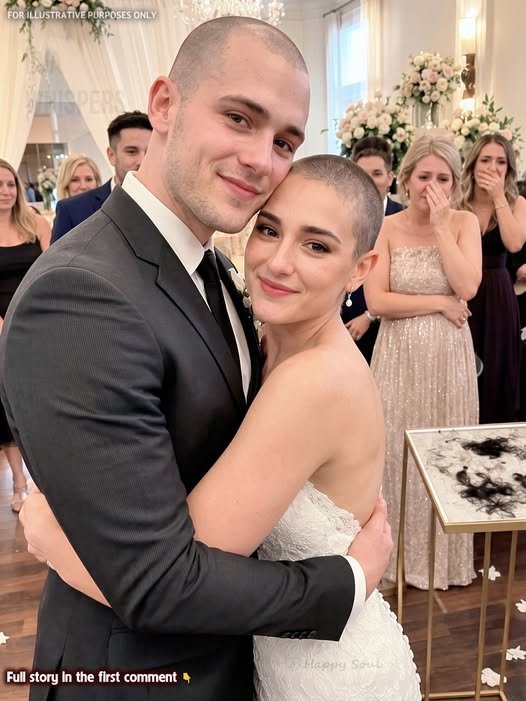
Inside were two electric clippers.
The laughter thinned.
Someone near the back whispered, “What are they doing?”
Mason handed one set of clippers to me.
I took them.
We had practiced this moment once in our bathroom. Not the shaving itself, but the stillness. The breathing. The courage it would take to do something nobody would understand at first.
The clippers buzzed to life.
That sound changed the air in the room.
Mason sat down first.
I placed one hand on his shoulder and brought the clippers to his forehead. Slowly, carefully, I moved them back through his thick brown hair.
A long strip fell into his lap.
Gasps rippled through the ballroom.
Someone gave a nervous laugh near the bar, but it died almost immediately.
Mason looked up at me.
I smiled.
Then he stood.
And I sat.
His hand was gentle at the back of my head.
When the first lock of my hair slid down the front of my wedding dress, I heard Maribel make a sound.
Not quite a sob.
Not quite a gasp.
It was the sound of someone realizing they had been seen.
By the time we finished, the bride and groom from the invitations were gone.
There were no perfect curls.
No polished wedding hairstyle.
No carefully styled groom.
Only two newlyweds with bare heads, joined hands, and nothing left to hide behind.
Then I picked up the microphone.
The Toast No One Expected
For a few seconds, I could hear only the soft hum of the speakers.
Then I looked straight at Maribel.
“Most brides use their wedding toast to thank everyone who made the day beautiful,” I began.
Several guests were already wiping their eyes, though they did not yet know why.
“But today, I need to thank the woman who taught my husband what love looked like long before I ever met him.”
Maribel shook her head once.
It was tiny.
Almost pleading.
But I continued.
“When Mason was six years old, he tried to shave like his father and accidentally shaved off one eyebrow.”
A gentle wave of laughter moved through the room.
“He was so embarrassed that he locked himself in the bathroom. He thought everyone would laugh at him. He thought he had ruined himself in some terrible way.”
Mason reached for my hand.
“Maribel did not stand outside the door and tell him to stop crying. She did not tell him he was being silly. She did not tell him to be brave.”
The room grew still.
“She walked in, picked up the razor, and shaved off one of her own eyebrows.”
The laughter disappeared.
“She refused to let him stand alone in his embarrassment.”
Maribel’s fingers moved to the edge of her scarf.
Then froze.
I swallowed hard and kept my eyes on her.
“That is what you have done your whole life,” I said. “You have stepped into people’s hardest moments and made them less lonely. You laughed first when someone needed mercy. You stood beside people when they felt ashamed. You made everyone feel safe being seen.”
The ballroom was silent now.
No forks.
No glasses.
No whispers.
Only breath.
“Over the last few months,” I continued, “you told us you might skip the pictures. You might leave dinner early. You might stand in the back. You said young people should be the ones everyone remembers.”
Maribel lowered her eyes.
I stepped away from the center of the dance floor, and Mason came with me.
“Today, everyone came here expecting to watch Mason and me promise to stand beside each other for the rest of our lives,” I said. “But before we could make that promise to each other, we wanted to honor the woman who taught us how.”

The Hairbrush
Mason’s mother came forward carrying the ivory hairbrush.
No one else had known I had asked for it.
The brush looked smaller in that grand ballroom than it had in Maribel’s bathroom. So ordinary. So old. So full of years.
A few silver strands still clung to the bristles.
I walked to Maribel and knelt beside her chair.
She stared at the brush.
Then at my bare head.
Then at Mason’s.
I placed the brush gently in her lap.
“You don’t need this to recognize yourself anymore,” I whispered.
Her fingers rested on the handle.
For several seconds, she did not move.
Then, slowly, she set the brush on the table beside her untouched dessert.
She did not adjust her scarf.
Mason knelt on her other side.
“Nana,” he said, rubbing one hand over his newly shaved head, “everything we did today, we learned from you.”
Maribel reached for his face with trembling fingers.
The way grandmothers do.
Her thumb brushed his cheek.
“My beautiful boy,” she whispered.
Then she looked at me.
Her eyes filled.
“My beautiful girl.”
Across the ballroom, someone began crying openly.
Not quietly.
Openly.
And somehow, that gave everyone else permission.
Guests wiped their faces with napkins. Mason’s father turned toward the wall. My mother covered her mouth with both hands. Even the photographer lowered his camera, as if some moments were too sacred to capture immediately.
Then Maribel lifted her hands to her scarf.
No one moved.
No one looked away.
Slowly, she untied it.
The silk slipped from her head and fell into her lap.
And there she sat in the middle of our wedding ballroom, bare and fragile and stronger than anyone in the room.
She looked smaller than before.
But also more herself.
Mason stood and held out his hand.
For one second, she hesitated.
Only one.
Then she took it.
Our First Dance
Our first dance was supposed to belong to Mason and me.
The song had been chosen months earlier. We had practiced in the kitchen. We had joked about stepping on each other’s feet.
But when the music began, Mason did not pull only me onto the dance floor.
He pulled Maribel too.
The three of us stood there beneath the chandeliers, surrounded by flowers, guests, and tears.
Mason held one of her hands.
I held the other.
She was trembling at first.
Then, slowly, she let herself move.
Not perfectly.
Not confidently.
But honestly.
And that was more beautiful than anything we had planned.
People later told me it was the most unforgettable wedding dance they had ever seen.
Not because it was elegant.
Not because it was rehearsed.
But because everyone in that room understood what they were watching.
They were watching a woman who had spent her life helping others feel brave finally accept that same love for herself.
They were watching shame lose its power.
They were watching family become a shelter.
The Photograph That Became Our Favorite
Several months later, we had a family picnic at the park.
Maribel arrived carrying a bowl of potato salad.
No scarf.
No wig.
No announcement.
No apology.
She simply walked across the grass, placed the bowl on the table, and sat down on a blanket beside Mason’s little niece.
For a few minutes, no one said anything about it.
That was the beautiful part.
No dramatic reaction.
No uncomfortable silence.
No pity.
Just Maribel, sitting in the sunlight, laughing when the little girl climbed into her lap.
The child reached up and ran her tiny fingers gently over Maribel’s head.
“It’s soft,” she said.
Maribel laughed.
Not a polite laugh.
Not a careful one.
A full, bright, fearless laugh.
Later, the photographer called everyone together near the oak trees for a family picture.
For the first time since her treatment began, Maribel did not ask to stand in the back.
She did not hide behind someone taller.
She did not reach for a scarf.
She simply sat in front with Mason’s niece in her lap and one arm wrapped around her.
The camera clicked.
That photograph became the family’s favorite.
Not because everyone looked perfect.
But because nobody was hiding.
And every time I look at it, I remember our wedding day.
I remember the sound of the clippers.
I remember the silence in the ballroom.
I remember Maribel’s scarf falling into her lap.
And I remember the lesson she had spent a lifetime teaching us.
Love is not always a grand speech.
Sometimes love is sitting beside someone in their most vulnerable moment.
Sometimes love is giving up your own comfort so someone else feels less alone.
And sometimes, love is two people standing in the middle of their wedding reception, shaving their heads, just to tell one woman:
You are not disappearing.
You are not a burden.
You are not something to hide.
You are still beautiful.
And we will stand with you.