
The Guest I Didn’t Expect
My name is Sarah, and I’m thirty-eight years old.
Every year on the 4th of July, my husband, Mark, and I host a big barbecue in our backyard. It started as a small family tradition when our oldest child was little, but over the years it grew into something everyone looked forward to.
By noon, our backyard is usually full of folding chairs, paper plates, coolers, children running barefoot through the grass, and relatives arguing lovingly over who makes the best potato salad.
Our kids count down to it all year.
Our twelve-year-old daughter, Lily, loves helping me hang little flags along the fence. Our eight-year-old son, Ethan, spends the whole morning asking when the fireworks will start, even though he knows they don’t begin until dark.
That year, everything seemed normal at first.
The grill was ready. The lemonade was chilling in the kitchen. My sister had already called twice to ask if she should bring more ice. Mark had gone to the grocery store for burger buns, charcoal, and the one thing he always forgot until the last minute—mustard.
I was standing at the kitchen counter slicing tomatoes when my phone rang.
It was Mark.
“I hope you don’t mind,” he said.
I paused with the knife in my hand. “That sentence never ends well.”
He gave a nervous little laugh. “I invited someone.”
“Someone?”
“I saw him outside the grocery store,” Mark said quietly. “An older man. He was sitting by the cart return with a backpack. He had an old Army jacket on. Everyone was walking past him like he wasn’t even there.”
I didn’t answer right away.
Mark continued, “I asked if he had somewhere to go today. He said no. I couldn’t just leave him there on the 4th of July, Sarah.”
I looked out the kitchen window at our backyard. My parents were already there. Mark’s brother was setting up the cornhole boards. Kids were everywhere. Neighbors would be arriving soon.
A stranger.
A homeless man.
In our backyard with our children and family.
I am not proud of the first feeling that came over me, but I want to be honest. I was nervous.
“Mark,” I said carefully, “you don’t know him.”
“I know,” he replied. “But I talked to him for a while. His name is Thomas. He’s polite. He’s quiet. He just looked… tired.”
Something in my husband’s voice softened me.
Mark has always had a heart that reacts before fear can stop it. Sometimes that scares me. Sometimes it reminds me why I married him.
I took a breath.
“Okay,” I said. “Bring him.”
A few minutes later, Mark’s truck pulled into the driveway.
And there, sitting quietly in the passenger seat, was a man I would never forget.
Thomas
He looked to be in his late sixties, maybe older.
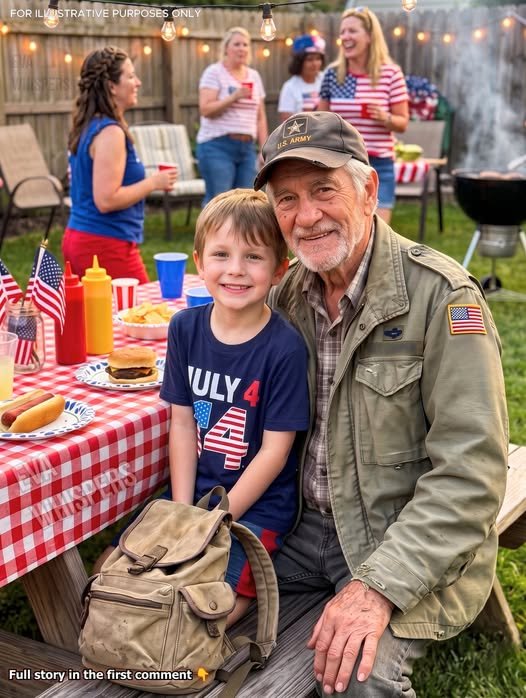
His face was weathered by sun and years, with deep lines around his eyes. He wore a faded Army jacket even though the day was warm, and he held a worn backpack on his lap with both hands, as if it contained everything he had left in the world.
When he stepped out of the truck, he stood very straight.
Not proud exactly.
More like a man trying not to take up too much space.
Mark walked him toward me.
“Sarah,” my husband said gently, “this is Thomas.”
The old man removed his cap.
“Ma’am,” he said, his voice low and respectful. “Thank you for allowing me to be here. I won’t be any trouble.”
His manners caught me off guard.
I smiled, though I still felt unsure. “You’re welcome, Thomas. There’s plenty of food.”
He looked toward the backyard, where laughter and music floated through the air. For a moment, his eyes changed. Something passed over his face so quickly I almost missed it.
Longing.
Like he was looking at something he used to have.
Then he blinked and looked down.
“I appreciate it,” he said.
Before I could say anything else, he noticed Mark’s brother struggling to carry a stack of folding chairs from the garage.
Thomas immediately stepped forward.
“Let me help with those.”
“Oh, you don’t have to,” I said.
But he was already lifting half the chairs, moving with careful strength.
Within fifteen minutes, he had helped set up chairs, carried bags of ice to the cooler, and straightened a tablecloth that kept blowing in the wind.
He thanked me three separate times for one hamburger.
Not in a way that felt dramatic.
In a way that made my throat tighten.
As if a simple hot meal at a family cookout was something precious.
By two o’clock, my fear had started to disappear.
By three o’clock, I was ashamed that I had ever been afraid.

A Place at the Table
At first, some of our relatives stared.
Not openly. Not cruelly. But people noticed. Of course they did.
An elderly homeless veteran in a faded jacket doesn’t blend easily into a backyard full of matching red, white, and blue paper cups.
My mother pulled me aside near the lemonade table.
“Sarah,” she whispered, “who is that man?”
“His name is Thomas,” I said. “Mark invited him.”
My mother glanced at him. He was sitting at the edge of the patio, holding his plate carefully on his knees.
“Is everything all right?”
I looked at Thomas. He had just noticed that Lily had dropped a napkin, and he leaned down to pick it up before the wind carried it away.
“Yes,” I said. “I think everything is all right.”
Ethan, my son, was the first person who treated Thomas as if he belonged there completely.
He marched right over with a football tucked under one arm.
“Did you ever play football?” Ethan asked.
Thomas looked surprised. Then his mouth curved into a smile.
“A little,” he said.
“Can you throw?”
Thomas set his plate down carefully.
“I used to be pretty good.”
That was all Ethan needed to hear.
Five minutes later, they were in the yard tossing the ball back and forth. Thomas moved slower than the younger men, but his throws were perfect. Ethan whooped every time the ball landed in his hands.
Soon, Thomas was telling him stories.
Not sad stories.
Funny ones.
He told Ethan about a cook in the Army who could burn toast but somehow make the best pancakes anyone had ever tasted. He told him about a stray dog that used to follow his unit around and steal socks. He told him about learning to sleep through any sound except someone opening a bag of potato chips.
Ethan laughed so hard he fell backward onto the grass.
Even Mark’s brother joined in.
By late afternoon, Thomas wasn’t sitting alone anymore.
He was part of the circle.
He helped my father fix a wobbly table leg. He complimented my sister’s deviled eggs like they were something from a five-star restaurant. When Lily got shy about serving lemonade, Thomas accepted a cup from her with such gratitude that she stood a little taller afterward.
I watched him from the porch more than once.
There was something about him I couldn’t explain.
He was gentle, but he carried sadness like an old coat he couldn’t take off.
The Fireworks
As the sun went down, everyone gathered on blankets and lawn chairs to watch the fireworks.
Ethan sat beside Thomas on the grass.
I noticed that my son was quieter than usual. Normally, he shouted after every burst of color. That night, he leaned close to Thomas and listened.
I couldn’t hear what they were saying.
Mark slipped his arm around my shoulders.
“You okay?” he asked.
I nodded.
“I’m glad you brought him,” I admitted.
Mark smiled. “Me too.”
When the fireworks began, the sky filled with gold and red sparks. Children clapped. Neighbors cheered. Someone behind us sang off-key and everyone laughed.
Thomas watched silently.
The bright colors reflected in his eyes.
For a moment, I wondered what memories the fireworks brought back to him. But he didn’t look frightened. He looked deeply moved.
When the final burst lit up the whole backyard, everyone applauded.
Thomas slowly stood.
He brushed grass from his pants, picked up his backpack, and walked over to Mark.
“Sir,” he said, holding out his hand, “thank you for today.”
Mark shook his hand firmly.
“You don’t have to leave yet,” Mark said. “We’ve got plenty of dessert.”
Thomas smiled, but shook his head.
“I’ve already received more than enough.”
Then he turned to me.
“Thank you, ma’am,” he said. “I forgot what it feels like to spend the 4th of July with a family.”
That sentence hit me so hard I had to blink back tears.
“You’re welcome here anytime,” I said.
He looked at me as if he wanted to believe that.
Then he crouched beside Ethan.
My son leaned close as Thomas whispered something into his ear.
Ethan grinned.
“What did he say?” I asked after Thomas stood again.
Ethan only shrugged, still smiling. “Nothing.”
Thomas put on his cap, gave one last polite nod, and walked down our driveway into the warm night.
I watched until he disappeared beneath the streetlights.
Then I went inside, never imagining that by the next morning, that quiet old man would turn our whole world upside down.

The Knock
The next morning, I woke up tired but happy.
The backyard looked like every 5th of July backyard in America—paper plates in trash bags, half-melted ice in coolers, lawn chairs folded in crooked stacks, and little bits of firework paper near the driveway.
Mark was outside cleaning the grill.
Lily was still asleep.
Ethan was at the kitchen table eating cereal, turning something small over in his fingers.
“What’s that?” I asked.
His hand closed quickly.
“Nothing.”
I frowned. “Ethan.”
Before he could answer, the doorbell rang.
It was barely eight o’clock.
I wiped my hands on a towel and walked to the front door.
When I opened it, two men stood on our porch.
Both wore dark suits despite the morning heat. One was older, maybe in his sixties, with silver hair and sharp eyes. The younger one stood slightly behind him, holding a leather folder.
The older man lifted an ID badge.
“Ma’am,” he said, “are you Sarah Miller?”
My stomach tightened.
“Yes.”
“We’re looking for a man named Thomas.”
The world seemed to go still around me.
Mark must have seen my face through the window, because he came quickly from the backyard.
“What’s going on?” he asked.
The two men exchanged a long glance.
Then the older one asked the question that made my blood run cold.
“Ma’am… did Thomas leave anything with your little boy?”
I forgot how to breathe.
Slowly, I turned toward Ethan.
His cereal spoon was frozen halfway to his mouth. His face had gone pale.
“Ethan,” I said softly, “what did Thomas give you?”
My son’s eyes filled with worry.
“I didn’t steal it,” he whispered.
The older man’s expression softened immediately.
“No, son,” he said. “Nobody thinks that.”
Ethan reached into his pocket and pulled out a small silver dog tag on a worn chain.
He placed it in my palm.
It was old, scratched, and warm from his hand.
Stamped into the metal was a name.
THOMAS J. CALLAHAN.
Below it was another line.
ALWAYS BRING THEM HOME.
I looked up at the men.
“Who are you?” Mark asked, stepping protectively beside me.
The older man took a breath.
“My name is Richard Graham. I’m an attorney. This is Daniel Reed. He works with a veterans’ outreach organization.” He looked at the dog tag in my hand. “We’ve been trying to find Thomas Callahan for nearly four months.”
The Truth About Thomas
We invited them inside.
I didn’t want to, but I also couldn’t stand there on the porch with my heart pounding and my son scared.
At the kitchen table, Richard Graham opened his folder.
Inside were photographs, documents, and an old newspaper clipping.
The man in the picture was younger, stronger, clean-shaven.
But the eyes were the same.
Thomas.
“Thomas Callahan served as a medic,” Richard explained. “After he came home, he spent most of his life helping other veterans. He volunteered at shelters. Drove men to appointments. Helped people fill out paperwork. He was the kind of man who showed up for everyone.”
Daniel, the younger man, spoke quietly.
“My father was one of the men he helped.”
I looked at him.
He swallowed hard.
“My dad was lost for a long time after he came home. Thomas found him sitting outside a bus station one winter night and refused to leave him there. He helped him get back on his feet. Because of Thomas, my father rebuilt his life, started a company, raised a family.”
Richard placed a document on the table.
“When Daniel’s father passed away last year, he left instructions in his will. He wanted Thomas found. He left him a small house, a living trust, and funding for a program Thomas always dreamed of starting.”
“A program?” I asked.
Daniel nodded. “A place where veterans without families could come for meals, paperwork help, haircuts, rides, and simple companionship. Thomas used to say men didn’t always need charity first. Sometimes they needed a table where someone remembered their name.”
I looked down at the dog tag in my hand.
“Then why was he on the street?” Mark asked.
Richard’s face grew sad.
“Because grief can convince a good man that he deserves nothing.”
The room went quiet.
Richard explained that Thomas had lost his wife several years earlier. They had no living children. After she passed, he slowly drifted away from people. He gave away most of what he had. He stayed in shelters when he had to, slept outside when he didn’t.
Every time someone tried to help him, he disappeared.
“He didn’t think he was worth searching for,” Daniel said.
My eyes stung.
Ethan slid closer to me.
“What did he whisper to you last night?” I asked him gently.
My son looked at the dog tag.
“He said, ‘Keep this for me until I remember where home is.’”
No one spoke.
Then Ethan added, “And he said if kind people ever came looking for him, I should tell them he smiled yesterday.”
Daniel turned away quickly, wiping his eyes.
Richard cleared his throat.
“That dog tag never leaves his neck,” he said. “Not for decades. If he gave it to your son, it means yesterday mattered to him.”
My husband sat back slowly.
“So where is he now?”
“That’s what we’re trying to find out,” Daniel said. “We hoped he told you something. Anything.”
I closed my eyes and replayed the night before.
Thomas standing beneath the porch light.
Thomas thanking us.
Thomas walking down the driveway.
Then I remembered.
“He asked where the nearest bus station was,” I said.
Mark looked at me. “The old Greyhound station?”
I nodded. “I thought he was just making conversation.”
Daniel stood immediately.
“We need to go.”
But Ethan jumped up too.
“I want to come.”
“No,” I said automatically.
“Mom, please.” His voice trembled. “He told me to keep it until he remembered home. What if he needs it back?”
I looked at Mark.
My husband’s face was full of the same emotion I felt.
Fear.
Hope.
Responsibility.
Finally, Mark said, “We’ll all go.”

Finding Thomas
The old bus station sat on the edge of town, half-empty most days except for travelers passing through and people with nowhere else to rest.
We drove there in two cars.
I held the dog tag the entire way.
When we arrived, Daniel went inside first. Mark followed. I kept Ethan beside me.
We searched the benches.
The waiting area.
The vending machines.
Nothing.
My heart sank.
Then Lily, who had insisted on coming once she heard what was happening, pointed across the street.
“There,” she said.
Thomas was sitting beneath a tree near the far sidewalk, his backpack beside his feet.
He looked smaller than he had in our backyard.
As if the night had taken something out of him.
Daniel started forward, but I touched his arm.
“Let Ethan go first.”
My son walked slowly across the grass.
Thomas looked up.
When he saw Ethan, surprise crossed his face.
Then shame.
He stood too quickly, as if he had been caught doing something wrong.
“Son,” he said, “you shouldn’t be here.”
Ethan held out the dog tag.
“You forgot this.”
Thomas stared at it.
His hand shook as he took it.
“I didn’t forget,” he whispered.
“I know,” Ethan said. “But you told me to keep it until you remembered where home is.”
Thomas looked past him at all of us.
At Mark.
At me.
At Daniel and Richard.
His eyes filled with tears.
Daniel stepped forward.
“Mr. Callahan,” he said, voice breaking, “my father looked for you for years. He wanted to thank you. He wanted to give you the home you helped him find.”
Thomas shook his head.
“I don’t need anything.”
“Yes, sir,” Daniel said gently. “You do. And more than that, we need you.”
Thomas looked confused.
Daniel continued, “That program you talked about? The place with meals and rides and people who remember your name? My father funded it. But he said it couldn’t open without you. He said you were the heart of it.”
Thomas lowered himself back onto the bench.
For a long moment, he said nothing.
Then he looked at my husband.
“I was only supposed to eat a hamburger and leave.”
Mark sat beside him.
“You did eat a hamburger,” he said. “You also helped my son laugh harder than he has in months. You made my daughter feel brave. You reminded my whole family what this holiday is supposed to mean.”
Thomas covered his face with one hand.
“I’m tired,” he whispered.
Mark put a hand on his shoulder.
“Then stop walking alone.”
That was the moment Thomas finally broke.
Not loudly.
Not dramatically.
Just a quiet, exhausted sob from a man who had carried too much for too long.
And right there outside an old bus station, surrounded by strangers who had somehow become connected overnight, Thomas Callahan let himself be helped.
One Year Later
A year has passed since that 4th of July.
This year, our backyard was full again.
Same folding chairs.
Same lemonade.
Same kids running barefoot through the grass.
But one thing was different.
Thomas arrived early.
Not from the street.
Not with everything he owned in a backpack.
He came from the small white house Daniel’s father had left for him. He wore a clean blue shirt, polished shoes, and that same old dog tag around his neck.
The veterans’ program opened in spring.
They named it The Home Table.
Three days a week, veterans come there for meals, help, conversation, and company. Thomas works there almost every day. He says he doesn’t run it. He simply “keeps the coffee warm.”
But everyone knows the truth.
He is the soul of the place.
Ethan volunteers there with Mark once a month, setting out napkins and filling water cups. Lily painted a sign for the front wall that says:
Everyone deserves a place at the table.
That second 4th of July, Thomas stood beside our grill and tried to help Mark flip burgers.
“You’re a guest,” I told him.
He smiled. “Family helps.”
I had no argument for that.
When the fireworks began, Thomas sat in the same place on the grass beside Ethan.
This time, he didn’t look like a man remembering what he had lost.
He looked like a man finally accepting what he had found.
After the final firework faded, he turned to me.
“Sarah,” he said, “last year, your family gave me one day of kindness. I thought that was all I deserved.”
I shook my head, already crying.
He smiled gently.
“But one day reminded me how to live the next one.”
I looked around the yard.
At my husband, whose soft heart had changed a life.
At my children, who had learned that kindness is not weakness.
At Thomas, who arrived as a stranger and became family.
And I realized something I will never forget.
Sometimes, the person you welcome into your home is not just someone who needs saving.
Sometimes, they bring something back to you too.
A lesson.
A purpose.
A reminder.
That a full table means nothing if we are too afraid to pull up one more chair.
And every 4th of July now, before we eat, Ethan runs to the gate and looks down the street.
Because in our family, the celebration doesn’t truly begin until Thomas comes home.