
The Heat Wave
Last month, our city was hit by one of the worst heat waves I could remember.
By noon, the air felt heavy enough to press against your chest. The streets shimmered under the sun, and the sidewalks were nearly empty because it was simply too hot to be outside. Even the usual sounds of the city seemed quieter—fewer car horns, fewer footsteps, fewer people rushing from place to place.
Everyone was hiding indoors if they could.
I wished I could have done the same.
That afternoon, I had just finished a long shift at the small bakery where I worked. The ovens had made the heat even worse, and by the time I stepped outside, my shirt was sticking to my back. I carried a half-empty bottle of water in one hand and my canvas work bag over my shoulder, thinking only about getting home, taking a cold shower, and lying under the fan.
My apartment was about twenty minutes away on foot. Usually, I enjoyed the walk. It gave me time to clear my head after work. But that day, every step felt harder than the last. The sunlight bounced off car windows and concrete walls. Even the shade felt warm.
I was passing a bus stop near Maple Avenue when I noticed an elderly man sitting alone on the bench.
At first, I almost walked past him.
Then something about him made me slow down.
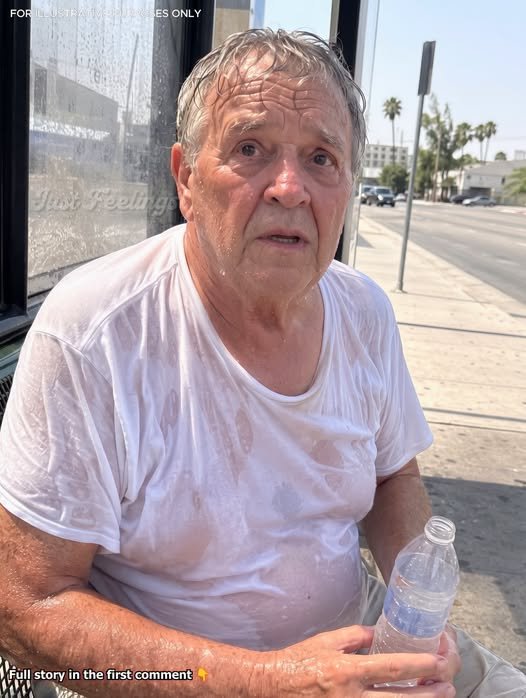
He was wearing a pale blue button-up shirt, dark trousers, and polished brown shoes that looked too formal for such a hot day. His silver hair was neatly combed, but his face was flushed and damp with sweat. He kept wiping his forehead with a handkerchief, then lowering his head as if the simple act of sitting upright was exhausting him.
His hands were trembling.
I stopped walking.
The bus stop had a small roof, but the sun had shifted, leaving most of the bench exposed. The man was sitting right in the heat, blinking slowly, his mouth slightly open like he was trying to breathe through invisible weight.
Something inside me whispered, Go check on him.
The Man at the Bus Stop
I stepped closer and asked gently, “Sir? Are you okay?”
He looked up at me, but his eyes didn’t seem fully focused.
“I’m fine,” he murmured. “Just waiting for the bus.”
His voice was weak.
I glanced down the street. There was no bus in sight.
“Do you have water?” I asked.
He tried to answer, but before he could speak, his hand slipped from his knee. His eyes rolled back, and his body tilted sideways.
He collapsed.
For one terrifying second, I froze.
Then my body moved before my mind could catch up.
I dropped my bag and ran to him. “Sir! Sir, can you hear me?”
He didn’t respond.
A few people were walking on the opposite side of the street. They looked over when they heard my voice, but no one came closer. One woman slowed down, stared for a moment, then kept walking, holding her umbrella over her head.
My heart pounded.
I knelt beside the elderly man and carefully shifted him so he wouldn’t fall off the bench completely. I remembered enough from a first aid poster at work to know I shouldn’t panic. I shaded his face with my body and loosened the top button of his shirt.
“Please wake up,” I whispered.
I took out my phone and called emergency services.
“There’s an elderly man collapsed at the bus stop on Maple Avenue,” I told the operator, my voice shaking. “I think it’s the heat. He’s breathing, but he’s not responding.”
The operator stayed on the line with me and told me what to do. I checked his breathing. I kept him as cool as I could. I didn’t try to move him too much.
After what felt like forever, his eyelids fluttered.
He opened his eyes.
“Where…” he whispered.
“You’re okay,” I said quickly. “You collapsed. I called an ambulance. Just stay with me, all right?”
His face filled with embarrassment, even in his condition.
“I’m sorry,” he murmured. “I’m sorry for causing trouble.”
“You’re not causing trouble,” I said. “Please don’t apologize.”
He tried to sit up, but I gently stopped him. “No, stay still. Help is coming.”
He looked frightened, almost ashamed. That hurt my heart more than I expected. He wasn’t acting like a man who thought he deserved care. He was acting like someone who had spent too long trying not to be a burden.
I opened my water bottle and held it near his mouth.
“Just a tiny sip,” I said.
He drank carefully, his hand trembling around mine.

Waiting for Help
The ambulance took seven minutes to arrive, though it felt much longer.
During that time, I kept talking to him.
“My name is Clara,” I said. “What’s yours?”
He blinked at me, still dazed. “Arthur.”
“That’s a nice name.”
He gave the faintest smile. “My wife used to say that.”
Used to.
The sadness in those two words was quiet but deep.
I didn’t ask more. Instead, I kept my voice steady.
“Arthur, you’re doing great. Just keep looking at me. The ambulance will be here soon.”
He nodded weakly.
Cars passed. People glanced. No one stopped.
I don’t say that to judge them. Maybe they were scared. Maybe they assumed someone else had it handled. Maybe the heat had made everyone desperate to get where they were going.
But kneeling there beside Arthur, I felt strangely alone in the middle of the city.
Then, far down the street, I finally heard the siren.
Arthur heard it too. His eyes filled with panic.
“No hospital,” he whispered. “Please. I can’t afford—”
“Don’t worry about that right now,” I said softly. “Your health matters first.”
He shook his head slightly. “I shouldn’t have come out.”
“Why did you?” I asked before I could stop myself.
His eyes drifted toward the road.
“I had to deliver something,” he said. “Important.”
Before I could ask what he meant, the ambulance pulled up.
The paramedics moved quickly. They checked his pulse, took his temperature, asked him questions, and helped him onto a stretcher. One of them told me I had done the right thing by calling.
I stood back, clutching my bag, suddenly aware of how sweaty and dusty I was.
Just before they closed the ambulance doors, Arthur turned his head toward me.
His hand reached out.
Without thinking, I stepped closer.
He grabbed my wrist—not hard, just enough to make me look at him.
“Thank you,” he said quietly. “I won’t forget this.”
I smiled, though my throat felt tight.
“Everything will be okay,” I said.
The doors closed.
The ambulance drove away.
And I honestly thought that would be the last time I ever saw him.
The Folded Note
When I got home that evening, the apartment was warm and still.
I lived alone in a small place above a laundromat. It wasn’t fancy, but it was mine. The kitchen counter was chipped, the windows were old, and the ceiling fan made a clicking noise if it spun too fast. But after a long day, it always felt like shelter.
That night, though, I couldn’t relax.
I kept thinking about Arthur.
Had he made it to the hospital safely? Did he have family? Was anyone waiting for him? Would he be okay?
I washed my face, changed clothes, and tried to eat something, but my mind kept drifting back to the bus stop.
Finally, I emptied my pockets onto the kitchen counter like I always did after work.
My keys landed first.
Then a receipt.
Then a few coins.
Then a small folded piece of paper.
I stared at it.
I was certain it hadn’t been there that morning.
The paper was folded twice, carefully, almost formally. My name was written on the outside in shaky handwriting.
Clara.
My heart began to beat faster.
I unfolded it slowly.
The note was short.
Dear Clara,
If you are reading this, then I managed to do one brave thing today.
Thank you for stopping when others kept walking.
My name is Arthur Whitman. I am not a rich man anymore, but I once had something very precious. Years ago, my wife and I opened a small community kitchen for people who had nowhere to go. After she passed, I lost the strength to keep it alive.
Today, I was on my way to deliver the last key to the building before it was sold.
But then you stopped.
You reminded me that kindness still exists.
If I make it through today, I want to ask you something.
Please come to 118 Willow Street tomorrow at 10 a.m.
There is a door there that should not close forever.
—Arthur
By the time I finished reading, my hands were shaking.
I read the note again.
Then a third time.
Arthur Whitman.
118 Willow Street.
A door that should not close forever.
I sat down slowly at the kitchen table, the note still in my hand.
I didn’t understand what he wanted from me. I didn’t know why he had slipped the note into my pocket instead of simply telling me. Maybe he had been too weak. Maybe he had only managed it when he grabbed my wrist.
But one thing was clear.
That elderly man had not just been waiting for a bus.
He had been on his way to say goodbye to something important.
And somehow, my small act of kindness had changed his mind.

Willow Street
The next morning, I almost talked myself out of going.
It sounded strange. A note from an elderly stranger. An address I didn’t know. A request I didn’t fully understand.
But the handwriting stayed in my mind.
So did his frightened eyes.
At 9:40, I took a bus to Willow Street.
The heat was still brutal, though not as unbearable as the day before. I carried two bottles of water in my bag this time.
Willow Street was in an older part of town where brick buildings stood close together and trees leaned over cracked sidewalks. At number 118, I found a two-story building with faded green doors and dusty windows. Above the entrance was an old wooden sign.
The Whitman Community Kitchen.
The letters were peeling.
A man in a gray suit stood outside, checking his watch. Beside him was Arthur.
He looked tired but alive.
Relief rushed through me.
“Arthur,” I called.
He turned, and when he saw me, his expression softened.
“You came,” he said.
“Of course I came. Are you okay?”
“I spent the night at the hospital,” he said. “Heat exhaustion. They wanted me to stay longer, but I had unfinished business.”
The man in the suit cleared his throat impatiently.
“Mr. Whitman,” he said, “we really need to finalize this.”
Arthur looked at the building.
Then at me.
“This place belonged to my wife and me,” he said. “For twenty-eight years, we fed people here. Not just the homeless. Anyone. Single parents. Elderly neighbors. Workers between jobs. Children after school. We never asked questions. We just served soup, bread, and dignity.”
His voice trembled.
“After my wife, Eleanor, died, I tried to continue. But the bills piled up. Volunteers moved away. I got older. Eventually, I closed the doors.”
The man in the suit shifted his folder from one hand to the other.
Arthur continued, “Yesterday, I was going to hand over the key. The building was going to be sold and turned into storage offices.”
I looked at the faded sign again.
Something about it felt painfully alive, like a sleeping heart.
Arthur reached into his pocket and took out an old brass key.
“But then I collapsed,” he said. “And a young woman who didn’t know me chose to stop.”
He held the key toward me.
I stepped back. “Arthur, I can’t take that.”
“I’m not giving you the building,” he said gently. “Not like that. I’m asking you to help me decide whether it deserves one more chance.”
The Room Full of Memories
Arthur unlocked the door.
Inside, the building smelled like dust, old wood, and faint traces of spices that seemed to have sunk into the walls. Sunlight poured through tall windows, revealing long tables stacked against one side, metal shelves, a serving counter, and a kitchen in the back.
Everything was old, but not ruined.
On the wall hung framed photos.
Arthur and Eleanor standing beside a huge pot of soup.
Children eating at the tables with paper crowns on their heads.
Volunteers laughing as they packed food boxes.
A handwritten sign near the counter said:
Take what you need. Give what you can. Leave with hope.
I swallowed hard.
Arthur stood quietly beside me.
“My wife wrote that,” he said.
“It’s beautiful.”
“She believed hunger wasn’t only about food,” he whispered. “Sometimes people are starving for kindness.”
I walked slowly around the room.
I thought about my own childhood. My mother had raised me alone after my father left. There were weeks when groceries ran low and she pretended not to be hungry so I could have seconds. I remembered the church pantry bags, the embarrassment in her eyes, and the relief when someone smiled instead of judging.
A place like this would have meant everything to us.
“What happened to the volunteers?” I asked.
“Some are still in town,” Arthur said. “But I stopped calling. I didn’t want them to see how much I was failing.”
“You weren’t failing,” I said. “You were grieving.”
His eyes filled with tears.
For a long moment, he said nothing.
Then he handed me a small notebook.
It was filled with names and phone numbers. Some pages had notes beside them.
Maria — best lentil soup.
Ben — repairs shelves.
Denise — school counselor, knows families in need.
Pastor Allen — bread donations.
At the back of the notebook, tucked between pages, was a photo of Eleanor. She had kind eyes and a smile that seemed to understand sorrow without being swallowed by it.
“She would have liked you,” Arthur said.
I looked up.
“Arthur, I work at a bakery. I’m not someone who knows how to run a community kitchen.”
“No one starts knowing,” he replied. “They start by caring.”
One More Chance
The man in the suit had followed us inside and was waiting near the door.
“Mr. Whitman,” he said carefully, “the buyer won’t wait forever.”
Arthur looked at him.
Then he looked at me.
“Clara,” he said, “yesterday I thought this place had reached its end. But when you stopped for me, you reminded me of Eleanor. Not because you saved my life, though you may have. But because you noticed. That was always her gift. She noticed people.”
I didn’t know what to say.
Arthur turned to the man in the suit.
“I’m not selling today.”
The man frowned. “Mr. Whitman—”
“I said I’m not selling today.”
His voice was quiet, but firm.
Something inside the room changed.
The man sighed, closed his folder, and left.
The sound of the door shutting echoed through the empty kitchen.
Arthur lowered himself into a chair, exhausted but strangely peaceful.
“What now?” I asked.
He smiled faintly.
“Now we see whether kindness can travel.”
I spent the rest of the morning helping him make calls.
At first, my voice shook. I felt awkward calling strangers from an old notebook. But one by one, people answered.
Maria cried when she heard Arthur’s name.
Ben said, “I thought that place was gone.”
Denise paused for a long time, then said, “Tell me what you need.”
By evening, six former volunteers had promised to come by on Saturday.
I called my manager at the bakery and explained the situation. To my surprise, she offered leftover bread at the end of each day.
“Only if someone picks it up,” she said.
“I will,” I replied before I could think twice.
Arthur looked at me with quiet gratitude.
And for the first time, I understood why my hands had shaken when I read his note.
It hadn’t been fear.
It had been the feeling of standing at the beginning of something bigger than myself.

The Day the Doors Opened Again
That Saturday, I arrived at Willow Street expecting a few people.
Instead, there were fourteen.
Maria came with a pot of lentil soup so large it took two people to carry it. Ben brought tools and fixed the loose shelves. Denise arrived with a list of families who could use meals but might be too proud to ask. My bakery manager sent three boxes of bread and pastries that would have otherwise gone to waste.
Even the woman who lived next door came over with a broom and said, “I was wondering when someone would bring this place back.”
Arthur stood in the middle of it all, overwhelmed.
For hours, we cleaned.
We opened windows. We scrubbed tables. We swept dust from corners. We washed pots, sorted plates, and threw away old boxes. Someone found a working radio, and soon music filled the room.
By late afternoon, the Whitman Community Kitchen looked different.
Not new.
Better than new.
It looked remembered.
A week later, we served our first meal.
We didn’t make a big announcement. Denise quietly told a few families. Pastor Allen mentioned it to some elderly residents. My bakery put a small notice near the register.
Still, by six o’clock, nearly every chair was filled.
A tired mother came in with two children and apologized three times before accepting soup.
An older man in a faded jacket sat by the window and ate slowly, as if he wanted the meal to last.
A teenage boy took bread for his little sister and whispered, “Thank you,” without lifting his eyes.
Arthur greeted everyone at the door.
Not as a man giving charity.
As a host welcoming guests.
I worked behind the counter, ladling soup into bowls, my heart aching in the best possible way.
At one point, I turned and saw Arthur standing beneath Eleanor’s sign.
Take what you need. Give what you can. Leave with hope.
His eyes were wet.
“She would be proud,” I said softly.
He nodded.
“No,” he whispered. “She is.”
What the Note Really Meant
Weeks passed.
The heat wave ended. Rain came. The city cooled.
But something warm remained at 118 Willow Street.
The community kitchen opened twice a week at first, then three times. Donations arrived slowly but steadily. People gave what they could—vegetables from backyard gardens, canned goods, old chairs, cleaning supplies, time.
And something unexpected happened.
People who had come for help began helping too.
The tired mother started washing dishes after meals.
The older man by the window repaired the broken sign outside.
The teenage boy painted a mural on the side wall with his little sister. It showed a long table under a bright sky, with people of every age sitting together.
At the bottom, he painted three words:
Kindness travels quietly.
I kept my job at the bakery, but after work, I went to the kitchen as often as I could. I learned how to organize donations, make phone calls, stretch ingredients, and listen without making people feel small.
Arthur became stronger too.
He still moved slowly, but his eyes no longer carried the same loneliness. He had a reason to wake up, people expecting him, and a building once again filled with voices.
One evening, after everyone had gone home, he asked me to sit with him.
The kitchen was quiet except for the hum of the refrigerator.
He placed the original note on the table between us.
“You kept it?” I asked.
He smiled. “I wrote another copy for myself before I slipped that one into your pocket.”
I laughed softly. “Arthur, why did you do that? Why not just ask me directly?”
He looked down at his hands.
“Because I was afraid,” he admitted. “Afraid you would say no. Afraid I would sound foolish. Afraid that if I spoke the words out loud, I would have to believe in them again.”
His voice grew softer.
“But when I woke up and saw you kneeling beside me, I thought of Eleanor. I thought, maybe this is the answer. Not a miracle with thunder and bright lights. Just one person stopping.”
I looked at the note, its shaky handwriting now familiar to me.
“You changed my life too,” I said.
He looked surprised.
I smiled. “Before that day, I thought kindness was something small. Something nice to do when you had extra time or energy. But now I understand. Sometimes kindness is a key. You don’t always know what door it opens.”
Arthur’s eyes shone.
Then he reached into his pocket and placed the brass key on the table.
This time, I didn’t step back.
“This belongs to all of us,” he said. “But I want you to keep it safe.”
I picked up the key and held it in my palm.
It was heavier than I expected.
The Door That Stayed Open
A month ago, I was just walking home from work, tired and overheated, thinking only about myself.
Then I saw an elderly man at a bus stop.
I could have kept walking.
Others did.
And I understand how easy it is. Life is busy. People are tired. The world teaches us not to get involved, not to stop, not to notice too much.
But that day, for reasons I still can’t fully explain, I stopped.
I gave a stranger water.
I called for help.
I stayed until he wasn’t alone.
And that evening, I found a note in my pocket that made my hands shake.
At first, I thought the note was the mystery.
But it wasn’t.
The real mystery was how one small choice could lead to a room full of people being fed. How one moment at a bus stop could reopen a kitchen. How a lonely old man could find his purpose again. How a tired young woman like me could discover that her life had room for something meaningful.
Arthur still thanks me every time he sees me.
But I always tell him the truth.
He gave me something too.
He gave me proof that goodness doesn’t have to be loud to matter. It doesn’t have to be rich, powerful, or perfect. Sometimes it looks like a bottle of water. A phone call. A hand held gently in the heat.
Sometimes it looks like a folded note slipped quietly into a pocket.
And sometimes, if you are brave enough to open it, that note becomes a door.
A door that should not close forever.
A door that, because someone stopped, stayed open.