
The Last Morning of My Old Life
Seven years ago, I lost everything in a single phone call.
My wife, Claire, was eight months pregnant with our first child, a little boy we had already named Noah. We had painted his nursery pale blue, assembled the crib twice because I had done it wrong the first time, and argued lovingly over whether the stuffed elephant should sit on the shelf or beside the rocking chair.
That Saturday, Claire was driving to her parents’ house for her mother’s birthday. I was supposed to go with her, but an elderly customer had a pipe burst beneath her kitchen sink.
Claire stood in the doorway wearing her yellow scarf, one hand supporting her belly.
“You work too much,” she said.
“And you worry too much.”
She smiled, walked back to me, and placed my palm against the place where our son was kicking.
“Don’t let him arrive before I get back.”
I laughed and kissed her forehead.
Those were the last words I heard from her.
An hour later, a state trooper called.
There had been a chain-reaction collision on the interstate. Rain, poor visibility, and a truck that had lost control had turned the road into chaos. Claire’s car had been found near the center of it.
I drove there so fast that I barely remembered the journey.
At the scene, red and blue lights flashed through the rain. Officers kept people behind a line of tape. I shouted Claire’s name until my voice broke.
A trooper finally approached me. His face already carried the answer.
He led me far enough to see a covered form near the wreckage.
“Please,” I said. “Let me see her.”
He gently stopped me.
“Sir, you should remember her as she was.”
I never got to say goodbye.
The House That Stayed Frozen
Claire’s parents arranged the funeral because I could barely form sentences.
The identification had been made through her purse, her necklace, and the registration of the car. The damage was severe, and everyone advised us not to ask for a viewing.
I accepted what the officials told me because grief makes obedience feel easier than doubt.
The nursery stayed untouched.
For years, I could not bring myself to remove the tiny clothes from the drawers. Sometimes, after working late, I sat in the rocking chair in the dark and listened to the silence where my son’s cries should have been.
I had a choice: let grief destroy every part of me, or keep moving.
So I worked.
Twelve-hour days became fourteen. I expanded the business, hired employees, and took every difficult job no one else wanted. People called me dependable. They did not know I was simply afraid to go home.
I never dated again. Every new beginning felt like a betrayal of the family I was supposed to have.
Seven years passed.
Then my boss sent me to the city where Claire and I had met.

The City of Ghosts
By then, I had sold part of my company to a regional contractor and stayed on to manage specialized projects. My boss needed me to inspect the plumbing system in an old hotel being renovated downtown.
I almost refused.
Every street in that city belonged to Claire and me, especially Bellamy Café.
When we were college students, we used to share one pot of tea there because neither of us had enough money for two drinks. Claire always poured mine first. She said it was proof she loved me more.
After the inspection, I walked without thinking until I found myself across the street from the café.
The sign had been repainted, but the front windows were the same.
Then I noticed the woman on the sidewalk.
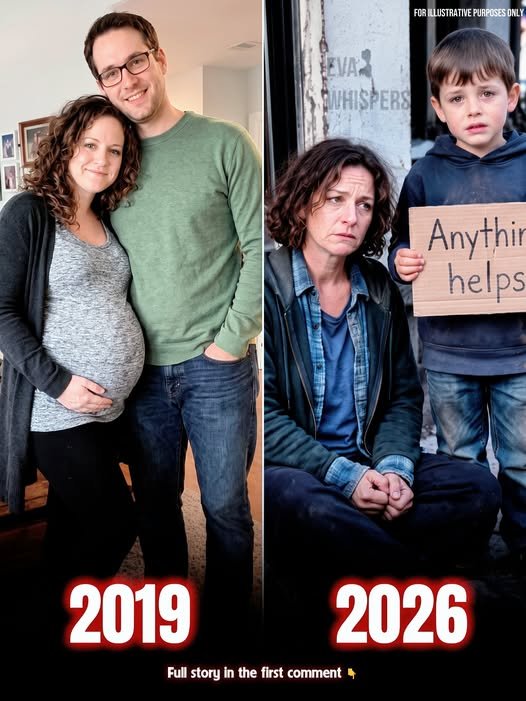
She sat beneath the awning of a closed bookstore with a paper cup in front of her. Her coat was too thin for the cold. Beside her stood a little boy holding a piece of cardboard.
ANYTHING HELPS.
I reached for my wallet.
Then the woman raised her head.
Every muscle in my body locked.
Her hair was shorter. Her face was thinner and lined by years I had not witnessed. But the gray-blue eyes, the small scar near her eyebrow, and the way her lips parted when she was startled—
It was Claire.
My wallet slipped from my hand.
The little boy looked at me. He had dark hair like mine and the same deep dimple in his left cheek that my father had carried all his life.
He tugged gently on the woman’s sleeve.
“Mom,” he whispered, “he found us.”
The Photograph
Claire slowly stood.
For several seconds, neither of us moved. The city continued around us—cars passing, doors opening, people talking—but every sound felt far away.
“Daniel?” she said.
Hearing my name in her voice shattered something inside me.
I crossed the distance between us, then stopped an arm’s length away. I was terrified that touching her would make her disappear.
“You’re dead,” I whispered.
Her eyes filled with tears.
“I know that’s what they told you.”
The boy stepped closer to her. Claire rested a protective hand on his shoulder.
“This is Noah,” she said.
The name struck me harder than anything else.
I looked at him again. Seven years old. The exact age our son would have been.
Claire opened his worn backpack and pulled out a faded photograph protected inside a plastic sleeve. She held it toward me with trembling hands.
“Everything they told you about that day was wrong,” she said. “Look.”
The photograph had been taken at the crash scene.
I recognized the rain, the twisted vehicles, and the line of emergency lights. In the background, standing behind police tape with both hands on my head, was me.
But that was not what made me go pale.
In the foreground, two paramedics were carrying a pregnant woman toward an ambulance. Her face was turned toward the camera.
It was Claire.
She had been alive.
She had been less than a hundred yards away from me while I stood staring at the covered body of a stranger.
On the back of the photograph was a newspaper caption:
UNIDENTIFIED PREGNANT SURVIVOR AIRLIFTED FROM INTERSTATE PILEUP.
The date was the day Claire had “died.”
My knees weakened. I sat on the edge of the sidewalk because I could no longer trust my legs.
“How?” I asked. “How could no one know?”
Claire crouched in front of me.
“It was confusion,” she said. “Then it became years of mistakes.”

What Really Happened
We went inside Bellamy Café.
The owner gave us a booth in the back. Claire spoke slowly, sometimes stopping to steady herself.
A passing nurse had pulled her from the passenger side of the car moments before another vehicle struck it. In the chaos, Claire’s purse and yellow scarf remained near the wreckage. Another woman who had been moved close to Claire’s car was mistakenly linked to those belongings.
Claire, unconscious and without identification, was transported across the county line because the nearest trauma center was full. She was registered as Jane Doe.
That night, doctors delivered Noah by emergency surgery.
Claire survived, but the injury to her head left her with severe memory loss. She knew fragments—a man’s hands, a blue nursery, a café window, the name Noah—but she could not remember her full name, address, or even the city where she lived.
For weeks, she could barely speak.
The pileup had overwhelmed several counties. Records were entered incorrectly, and the missing-person report filed by Claire’s parents was closed after the body near her car was identified as hers.
Everyone was looking for a dead woman, not a living Jane Doe.
After rehabilitation, Claire and the baby were placed in temporary housing run by a small charitable organization. An older volunteer named Ruth became their closest support. Ruth kept the newspaper photograph because she believed someone in the background might recognize Claire.
“She spent years helping me search,” Claire said. “But the picture was from a regional paper, and your face was blurred in the online copy. I only remembered your first name.”
“Why didn’t you go to the police again?”
“I did. But I was listed as deceased under my real identity and alive under no identity at all. Without a last name or family DNA, every path ended.”
Her memory returned in pieces.
She remembered the name Bellamy before she remembered the city. She remembered that I fixed pipes. She remembered our son’s name because we had said it so often before the crash.
Then, three months earlier, Ruth died.
The charity home closed soon afterward. Claire had been cleaning offices at night, but when Noah became ill and she missed several shifts, she lost the job. Their room was rented week to week, and they were forced to leave.
Claire used the little money she had saved to travel to the city from the photograph.
“I knew this café mattered,” she said. “I thought maybe someone here would remember us.”
The café owner had remembered Claire and me as students, but he did not know my last name or where I had gone.
For nine days, Claire and Noah returned to the same block.
They had run out of money that morning.
“I hated holding that sign,” Noah said quietly. “But Mom said sometimes asking for help is how you stay brave.”
I covered my face with both hands.
For seven years, I had lived in a house with an empty bedroom while my wife and son struggled to find their way back to me.
The Boy Who Already Knew Me
When I lowered my hands, Noah was watching me carefully.
“How did you recognize me?” I asked.
He pointed to the photograph.
“I looked at it every night,” he said. “Mom said the man behind the tape might be my dad.”
His voice held hope, but also caution. He had imagined me, but he did not know me.
I wanted to pull him into my arms. Instead, I asked, “May I sit beside you?”
He nodded.
I moved to his side of the booth.
Up close, I saw more familiar details: Claire’s eyes, my eyebrows, and the small habit of rubbing his thumb against his fingertip when nervous. I had done that since childhood.
“Did you really build me a blue room?” he asked.
My throat tightened.
“It’s still there.”
“Mom said there was an elephant.”
I laughed through my tears.
“She wanted it on the shelf. I wanted it by the rocking chair.”
“Where is it now?”
“On the shelf,” I said. “Your mother usually won.”
For the first time, Noah smiled.
That smile felt like sunrise after seven years of night.
The Truth We Needed to Prove
I took them to a hotel that evening. Claire refused at first, worried that I was acting from shock rather than certainty.
“I don’t want Noah hurt if this turns out to be something else,” she said.
“It isn’t something else.”
But I understood her fear.
The next morning, we contacted a lawyer, the hospital, and the state police. We also arranged a DNA test.
Waiting for the result was unbearable, even though my heart had already decided.
During those days, I learned that Noah loved astronomy, disliked peas, and could repair almost any broken toy with tape and patience. He asked endless questions about plumbing while Claire watched us as if she were afraid to blink.
She and I had harder conversations.
We were not the same people who had kissed goodbye seven years earlier. She carried the fear of having no identity and no safe place. I carried years of grief that had hardened into habits.
She apologized for not finding me sooner.
I told her never to apologize for surviving.
I apologized for believing a report without asking more questions.
She took my hand.
“You were grieving,” she said. “You trusted people whose job was to know.”
The DNA result arrived four days later.
Probability of paternity: greater than 99.99 percent.
Noah read the paper twice.
Then he looked at me.
“So it’s official?”
“It’s official.”
He launched himself into my arms.
I held my son for the first time when he was seven years old.
I had missed his first breath, first word, first step, and first day of school. But as he clung to me, I promised myself I would not waste another moment mourning what I could not change.
I would be there for everything that came next.
The state reopened the crash file. The truth was not one grand conspiracy, but a chain of rushed assumptions, incorrect entries, and agencies that failed to communicate.
The woman buried under Claire’s name was eventually identified through updated DNA testing, giving another searching family an answer. Claire’s legal identity was restored, her death certificate was canceled, and the county issued a public apology.
The trooper who had stopped me from seeing the body also apologized. I did not forgive the system in a single day, and neither did Claire. But we refused to let anger take the years we still had.
Our lawyer helped establish a fund for unidentified patients and families affected by emergency-record errors. Claire insisted that part of it support mothers and children leaving temporary housing.
“No one should disappear because databases don’t match,” she said. “And no parent should have to hold a cardboard sign before someone notices they need help.”

The House That Remembered Them
Three weeks after I found them, I brought Claire and Noah home.
I was nervous as I unlocked the door.
The house had changed. The furniture was different, the walls had been repainted, and the kitchen Claire once loved had been remodeled. But the nursery remained almost exactly as she had left it.
Claire stood in the doorway and covered her mouth.
The pale blue walls had faded slightly. The crib was still beneath the window. The stuffed elephant sat on the shelf.
Noah walked in slowly.
“This was mine?”
“It was waiting for you,” I said.
He touched the crib, then looked at the small bed we had bought for him before coming home.
“I’m too big for that baby bed.”
“You are,” I said. “But your mother and I built it for you. Badly.”
Claire laughed.
The sound filled the room, warm and familiar.
That evening, we ate pizza on the floor because the dining table was covered with boxes. It reminded us of our first apartment.
Noah poured my drink before his own.
“Mom says that means I love you more,” he said.
Claire and I looked at each other.
For the first time since finding them, the past did not feel like a door closing. It felt like a road that had somehow led us home.
Learning to Be a Family
Our reunion was not magically easy. Claire sometimes woke frightened, I sometimes stared at her as if she might vanish, and Noah worried one mistake could separate us again.
We met with a family counselor and created routines. Friday became pizza night. I reduced my work hours. Claire began studying social work so she could help people who had fallen through the same cracks.
On Noah’s first day at his new school, I took so many pictures that he said, “Dad, I’m going to school, not the moon.”
It was the first time he called me Dad without hesitating. I cried after he went inside.
We did not try to recreate the marriage we had lost.
We built a new one.
Six months after coming home, Claire and I returned to Bellamy Café. We sat at our old table with Noah between us and ordered one pot of tea.
This time, we could afford three drinks, but Claire said tradition mattered.
She poured mine first.
“I still love you more,” she said.
“No chance,” I replied.
Noah rolled his eyes.
“You both love each other the same. Can we order cake now?”
We laughed until the café owner came over to see what was happening.
Seven Years Later, We Began Again
People often ask whether I am angry about the seven lost years.
I am.
Some losses do not disappear simply because a miracle follows them. I will never see Noah take his first steps. Claire and I will never recover the nights we spent believing the other was gone.
But anger is not the only truth.
The truth is also that my wife survived.
My son grew into a kind, curious boy who kept believing his father might be hidden somewhere in a faded photograph.
The truth is that Claire sat outside the one place her memory refused to surrender.
And on the one afternoon I almost refused to visit that city, I walked down the street where they were waiting.
A year after our reunion, we replaced the cardboard sign Noah had held that day.
We framed it beside the crash photograph, but beneath them we added a new picture: the three of us standing in the blue bedroom, arms around one another, the stuffed elephant balanced on Noah’s head.
Under the frame, Claire placed a small silver plaque.
It reads:
SOMETIMES HOME IS NOT A PLACE YOU NEVER LEAVE.
SOMETIMES HOME IS THE LOVE THAT KEEPS SEARCHING UNTIL YOU RETURN.
For seven years, I thought my life had ended with a phone call.
I was wrong.
It had been delayed, scattered, and hidden behind mistakes—but it had not ended.
My family was still out there.
And somehow, against every impossible odd, we found one another again.