
The Call That Changed Everything
The first sound I remembered after the crash was the violent shriek of twisting metal.
The second was my mother’s voice telling me that her pickleball schedule mattered more than my children.
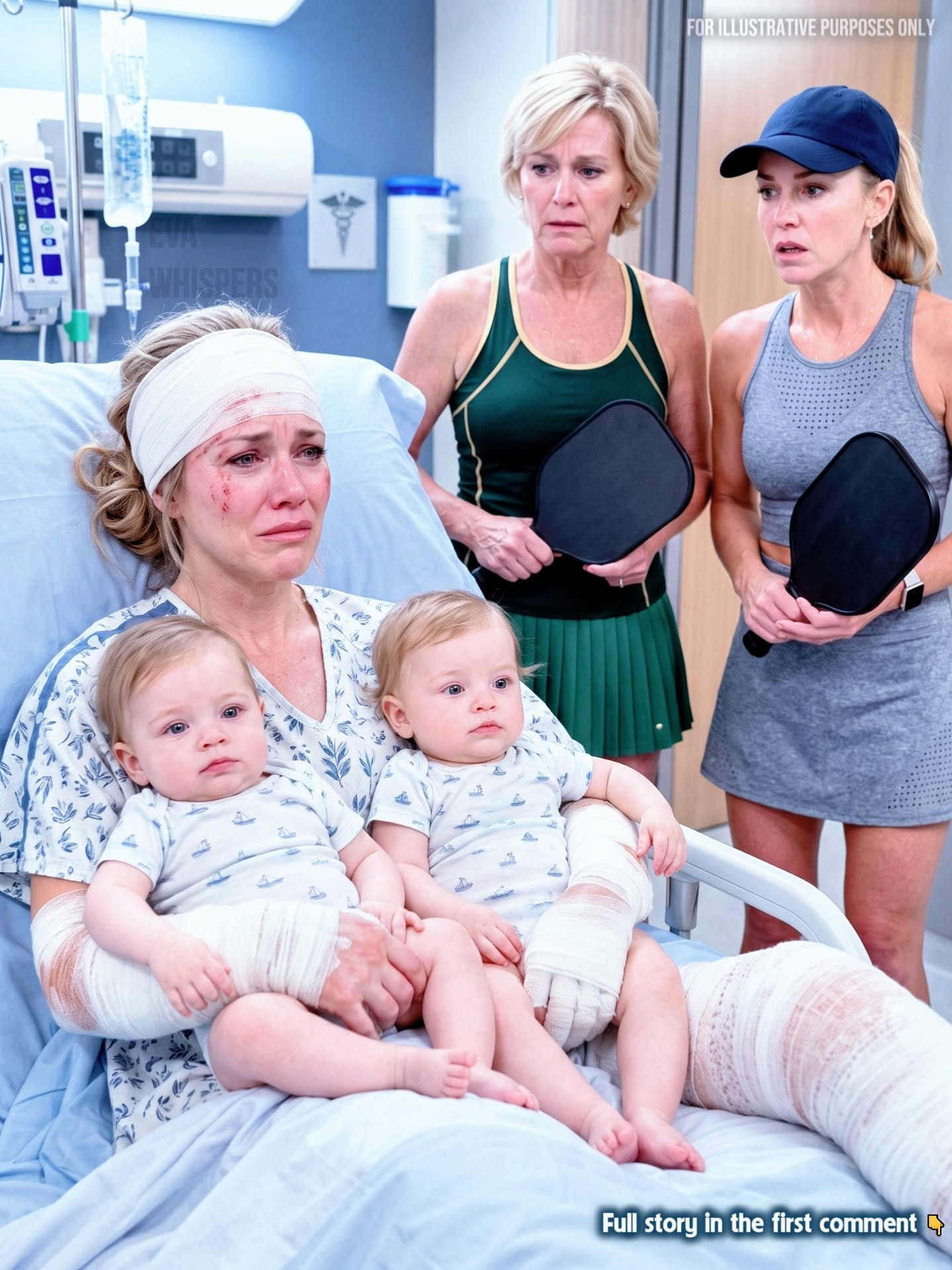
When I opened my eyes, harsh white hospital lights blurred above me. Every breath sent a sharp ache through my ribs, and a heavy, crushing pain spread across my hips whenever I tried to move.
A surgeon stood beside my bed and calmly explained what had happened.
My pelvis was fractured. Two ribs were broken. Several muscles and ligaments had been badly damaged. I would need surgery, months of rehabilitation, and more patience than I could imagine.
“You may walk normally again,” he told me, “but recovery will not be quick.”
At that moment, walking was not my greatest concern.
“My babies,” I whispered. “Where are my babies?”
My one-year-old twins, Noah and Lily, had been strapped into rear-facing car seats in the back. The safety seats had done exactly what they were designed to do.
They had survived with only a few bruises.
A nurse told me they were being watched by an emergency hospital caregiver, but the arrangement could last only twenty-four hours.
After that, someone from my family would need to take them.
The problem was that I no longer had much family left.
My husband, Adam, had passed away unexpectedly the year before. Since then, I had been raising the twins alone while managing the financial consulting company we had built together.
My parents were not simply my first choice.
They were my only choice.
With trembling fingers, I called my mother.
She answered after several rings.
“Mom,” I said, struggling to keep my voice steady. “There’s been an accident.”
She made a small sound of concern, but before she could speak, I continued.
“The twins are safe, but I’m badly hurt. I can’t stand or lift them. The hospital can only keep the emergency sitter until tomorrow.”
There was silence on the other end.
“I need you and Dad to take Noah and Lily for a while,” I said. “Only until I’m strong enough to care for them again. It may be a few weeks.”
My mother released a long, irritated breath.
“Mara, you can’t keep expecting us to rearrange our lives whenever something happens to you.”
For a moment, I thought the medication had made me misunderstand her.
“Mom, I was in a serious crash.”
“And I’m sorry about that,” she replied. “But your father and I have our own commitments. I still need time for pickleball. Your sister never places this kind of pressure on us.”
I stared at the ceiling.
“Claire doesn’t have children.”
“That isn’t the point.”
“What is the point, then?”
“The point is that we are not permanent babysitters. You’re an adult, Mara. You need to make other arrangements.”
My voice cracked.
“I’m not asking you to babysit because I want a vacation. I can’t even sit up without help.”
“I’ve said what I needed to say.”
“Mom—”
“Figure it out.”
Then the call ended.
I continued holding the phone against my ear long after the line went silent.
Outside my room, I heard Lily begin to cry.
Every instinct in me demanded that I get out of bed, pick her up, and comfort her. But when I tried to shift my body, pain tore through my hips so fiercely that I gasped.
I could not reach my daughter.
I could not hold my son.
And the two people who had spent years telling everyone how much family mattered had refused to come because they did not want their recreational schedule interrupted.

Eight Years of Buying Their Comfort
As I lay beneath those hospital lights, memories began returning one after another.
The monthly mortgage payments on my parents’ house.
The luxury SUV my father said he needed because his old vehicle had become “embarrassing.”
Their private medical insurance.
Their country club membership.
Their anniversary trips.
Their restaurant bills.
The emergency roof repair that somehow became my responsibility.
My mother had once laughed while calling it “an early inheritance in reverse.”
I had paid for everything because I believed successful children should care for the parents who raised them.
When my sister Claire opened a clothing boutique and lost money during the first year, I covered the rent.
When she lost more money during the second year, I placed her on my company payroll as a consultant, even though she rarely attended meetings and produced almost no actual work.
Whenever I questioned the arrangement, my mother reminded me that Claire was “still finding herself.”
Apparently, I had spent eight years finding everyone else’s money.
Claire was allowed to remain carefree.
My parents were allowed to live comfortably.
And I was expected to solve every emergency, fund every dream, and absorb every consequence.
Yet when I truly needed them—when I was lying broken in a hospital bed with two frightened babies—they considered me an inconvenience.
A warm hand touched my shoulder.
A nurse named Elena stood beside me. She had gentle brown eyes and the calm manner of someone who knew when not to fill silence with empty reassurance.
My phone was slipping from my fingers. She carefully took it and placed it on the blanket.
“Is there someone else we can contact?” she asked.
Through the glass wall, I could see Noah and Lily asleep in two borrowed cribs. Lily’s tiny hand rested near her cheek. Noah had curled onto his side, clutching the corner of a hospital blanket.
Something inside me changed as I watched them.
It was not rage.
Rage was loud and temporary.
This feeling was quieter.
Colder.
Final.
For years, I had confused financial dependence with closeness. I had kept paying because part of me believed generosity would eventually make my family value me.
But love that disappeared when the money stopped was never love.
I looked at Elena.
“Please call Daniel Cho.”
“Is he a relative?”
“No,” I said. “He’s my attorney.”
The Phone Call at Midnight
Daniel answered immediately.
He had worked with my company for years and had handled everything from contracts to corporate acquisitions. More importantly, he had known Adam and understood how much the business meant to both of us.
“Mara?” he said. “I heard about the collision. How badly are you hurt?”
“Badly enough that I won’t be walking for a while.”
“I’m coming to the hospital.”
“Come tomorrow. Tonight, I need you to do something else.”
There was a pause.
“What do you need?”
“I want every payment connected to my family stopped.”
Daniel did not respond immediately.
I continued before I could lose my nerve.
“Freeze every authorized card. Cancel the club payments, insurance premiums, allowances, subscriptions, and automatic transfers. Remove Claire from payroll. Begin the process of returning Dad’s leased SUV.”
“Mara, are you certain?”
“I’ve never been more certain.”
“Does that include the house?”
I looked toward the cribs again.
My parents called it their house, but legally, it belonged to my holding company.
Years earlier, they had been denied a mortgage because of poor credit and excessive debt. I purchased the property through the company and allowed them to live there rent-free under a renewable occupancy agreement.
They had decorated it, entertained in it, and spoken of it as though they had earned every room.
But the deed had never carried their names.
“Yes,” I said. “That includes the residence.”
Daniel exhaled slowly.
“They are going to panic.”
“They left two babies without care because they thought I would always rescue them. Let them experience one emergency I don’t solve.”
By midnight, the transfers had stopped.
The cards linked to my accounts were deactivated.
Claire’s consulting payment was removed from payroll.
The vehicle lease department scheduled the SUV for return.
At 12:07 a.m., my mother called.
Then again.
And again.
Six calls in less than ten minutes.
I placed the phone facedown.
For the first time in eight years, I allowed my family to deal with the consequences of their own choices.

They Remembered Me When the Money Disappeared
By sunrise, everyone suddenly remembered that I existed.
My father left a voicemail ordering me to “fix whatever banking error had occurred.”
My mother sent several furious messages after her country club payment was declined in front of her friends.
Claire sent a photograph of an overdue rent notice from her boutique.
Her message contained only one sentence:
You’re ruining all of us.
Not one of them asked whether I had slept.
Not one asked about my injuries.
Not one asked whether Noah or Lily had eaten, cried, or needed anything.
They cared about the money because the money had always been my role in the family.
Daniel arrived that morning and immediately began working with my company’s human resources department. Through an emergency family-care program I had created for employees, he arranged a licensed professional nanny.
Elena helped move the twins into a family recovery suite beside my hospital room. It was not home, but it allowed us to stay together.
During the day, therapists taught me how to move from the bed into a wheelchair.
At night, Noah and Lily slept close enough for me to hear their quiet breathing.
I still could not carry them, but the nanny placed them carefully beside me so I could kiss their foreheads, feed them, and read their favorite picture books.
Every small moment reminded me of what truly mattered.
Three days after the accident, Claire arrived.
She entered my room wearing oversized sunglasses, expensive boots, and enough perfume to announce her presence before she spoke.
“Mom is devastated,” she said.
I looked at her.
“I’m improving slowly. Thank you for asking.”
She removed her sunglasses but showed no embarrassment.
“You know what I mean. Her card was rejected at the club. Everyone saw.”
“I’m sure that was difficult.”
“She barely slept.”
“Neither did Lily. She woke up crying because her mother couldn’t pick her up.”
Claire’s mouth tightened.
“You’re twisting everything.”
“Am I?”
“Mom established a boundary. You can’t financially punish the entire family because she refused to become your full-time nanny.”
“She refused to help after I nearly died.”
“She was overwhelmed.”
“I was the one trapped in a hospital bed.”
Claire lowered her voice.
“Restore the payments. After that, we can talk about arranging a childcare schedule.”
I studied her.
“We?”
“You need us now, Mara. Whether you want to admit it or not.”
Then she placed a folder on top of my blanket.
“I brought something that will make this easier.”
The first page was titled Temporary Power of Attorney.
The second document would give Claire control over my voting rights while I was supposedly incapacitated.
The third would authorize her to borrow money against my company shares.
Several signature lines had already been highlighted.
I slowly raised my eyes.
“You came to the hospital to ask me to sign away control of my company?”
“It’s temporary.”
“And you expect me to believe this protects me?”
“It protects the family,” she said. “You are injured, emotional, and taking strong medication. Someone needs to make responsible decisions.”
“Someone like you?”
“I’m your sister.”
“That didn’t answer my question.”
Claire leaned closer.
“Once the documents are signed, Mom has agreed to take the twins tomorrow.”
The cruelty of it left me momentarily speechless.
My children were not being offered help.
They were being used as leverage.
The Trap They Never Saw Coming
I allowed my hand to shake as I lifted the papers.
Claire mistook my pain for weakness.
Her expression softened with triumph.
“This is the right choice,” she whispered. “You’ll see.”
Instead of reaching for the pen, I pressed the nurse-call button.
Elena entered first.
Daniel followed her, accompanied by the hospital’s patient advocate.
The confidence vanished from Claire’s face.
Daniel removed the folder from my hands and studied the documents.
“This is interesting,” he said.
Claire folded her arms.
“What is?”
“The notary listed here died eighteen months ago.”
Claire reached for the folder.
Daniel stepped back.
“It’s just a template,” she said quickly. “It isn’t official.”
“You sent this same document to a lender yesterday.”
Her face became pale.
Daniel opened his tablet.
“You also submitted a letter stating that Mara had appointed you acting president of her company.”
“That’s not what happened.”
“It was sent from your email address.”
“Someone must have accessed my account.”
“Along with a loan request using Mara’s shares as collateral?”
Claire looked at me.
“You knew?”
I had spent more than a decade designing compliance and fraud-prevention systems for financial institutions.
Every official company document contained hidden tracking information. Any alteration, duplication, or unauthorized transmission automatically notified Daniel and our security director.
Claire believed my broken bones had left my entire life unprotected.
She had chosen to commit financial fraud against the one person professionally trained to detect it.
“I knew before you walked into this room,” I said.
Claire lunged toward the folder, but Elena moved between her and the bed.
Hospital security arrived moments later.
As they escorted Claire from the room, she shouted that I had tricked her.
But I had not set the trap.
I had merely allowed her to reveal how far she was willing to go.
Later that afternoon, Daniel showed me something worse.
Claire had failed to return a company laptop months earlier. Our security team remotely recovered a family group chat from the device.
My mother had written:
Keep refusing to take the babies. Once Mara becomes desperate enough, she’ll sign.
Claire had replied:
As soon as she signs, we control the company accounts.
My father responded with a thumbs-up.
I read the exchange twice.
Until that moment, a small part of me had still hoped my mother’s cruelty had been impulsive—that she had spoken carelessly and regretted it later.
But it had not been a careless refusal.
It had been a strategy.
They had left me helpless on purpose.
They had used my injuries and my children as pressure points in an attempt to seize control of everything Adam and I had built.
Daniel closed the tablet.
“We can handle this privately or contact investigators.”
“Contact them.”
“And the house?”
“Schedule a meeting there next week.”
“Should I tell your family that investigators will attend?”
I looked at my sleeping children.
“No.”
Daniel raised an eyebrow.
“Let them come believing they have already won.”

The Family Meeting
One week later, Daniel drove me to the house in a wheelchair-accessible van.
Every movement still hurt. I wore a support brace beneath my coat, and my hands shook slightly from the effort of transferring into the wheelchair.
But emotionally, I felt stronger than I had in years.
Daniel carried three folders.
My parents and Claire were waiting in the living room when we arrived.
A bottle of champagne had already been opened.
Claire smiled as though welcoming a defeated opponent.
“I knew you would finally become reasonable.”
My mother remained beside the fireplace with her arms crossed.
“Before we discuss anything,” she said, “you owe this family an apology.”
I almost laughed.
“For what?”
“For embarrassing us. Your father had to return the SUV. My membership account was suspended. People have been asking questions.”
My father pointed toward my wheelchair.
“We understand that you were upset, Mara, but family members don’t destroy one another over hurt feelings.”
I looked at the three of them.
“Family members also don’t abandon two babies to pressure their injured mother into surrendering her company.”
Claire’s smile disappeared.
Daniel placed the folders on the coffee table.
“The first document formally ends your occupancy agreement,” he said to my parents. “You have thirty days to leave the property.”
My mother stared at him.
“You cannot remove us from our own home.”
“The property belongs to Mara’s holding company.”
“We have lived here for years!”
“Rent-free,” Daniel replied. “Under an agreement that may be terminated according to its terms.”
My father slowly lowered himself onto the sofa.
Daniel opened the second folder.
“This file contains records of unauthorized purchases, false invoices, personal expenses charged to company accounts, and salary payments made to Claire for services she did not perform.”
Claire gripped her champagne glass.
“We are seeking repayment of four hundred and twelve thousand dollars.”
The glass slipped from her fingers and shattered against the floor.
No one moved to clean it.
Daniel touched the third folder.
“This concerns the false power of attorney, the fraudulent loan application, the forged corporate authorization, and the counterfeit notarization.”
Two investigators stepped into the living room from the hallway.
Claire backed away.
“This is insane.”
My mother turned sharply toward her.
“What did you do?”
Claire stared at her.
“You knew! You told me Mara would forgive us once she calmed down!”
“Do not involve me in your mistakes.”
Daniel placed printed copies of the group messages on the table.
“Mrs. Hale, you instructed Claire to refuse childcare until Mara became desperate. You also signed the false witness statement included in the lender submission.”
The color disappeared from my mother’s face.
My father covered his mouth with one hand.
Mother looked at me.
“We were trying to teach you a lesson.”
“A lesson?”
“You had begun taking us for granted.”
I felt something inside me finally break free.
“No. I paid for your home, your car, your insurance, your vacations, your hobbies, and your debts. The one time I needed help, you used my children to try to steal my company.”
“We would never have stolen it,” she insisted. “We were only trying to protect the family.”
“You were trying to protect your access to my money.”
Claire began crying.
“I planned to repay everything.”
“With what?” I asked. “The boutique I funded? The fake salary I gave you? Or the company shares you tried to take from me?”
The investigators asked Claire and my mother to accompany them for formal interviews.
As my mother passed my wheelchair, she reached for my hand.
I pulled away.
“Please, Mara,” she whispered. “We are still your family.”
“So are Noah and Lily,” I said. “You remembered that we shared blood only after the cards stopped working.”
The Cost of Silence
My father remained behind after the others left.
He had not forged the documents himself, but he had known about the plan. His silence had approved it.
For years, he had also remained quiet while my mother favored Claire, demanded more from me, and treated my generosity as an obligation.
I gave him a choice.
He could cooperate with the investigation, provide every financial record he had, and receive limited assistance finding an affordable apartment.
Or he could continue protecting them and face the consequences in court.
He cooperated.
For once, he did not argue.
Claire eventually pleaded guilty to attempted fraud and forgery-related charges. She received probation, restitution requirements, and a prohibition against managing client funds.
Her boutique closed.
My mother avoided jail through a settlement, cooperation, and repayment. She sold most of her jewelry and several expensive possessions to cover part of what she owed.
My parents moved into a modest apartment far from the country club.
Their new life was not cruel or unsafe.
It was simply a life they had to finance themselves.
For the first time, their comfort was no longer built on my exhaustion.

Learning to Walk Forward
Recovery was slow.
There were mornings when standing for ten seconds felt like climbing a mountain. There were nights when pain kept me awake long after the twins had fallen asleep.
I learned to use a wheelchair.
Then a walker.
Then a cane.
I learned how to accept help without feeling weak and how to distinguish genuine kindness from dependence disguised as affection.
Elena remained part of our lives after I left the hospital. Her compassion had carried me through one of the darkest periods I had ever known.
Several months later, I asked her to lead my company’s newly expanded family-care foundation.
The program provided emergency childcare, transportation, temporary housing assistance, and recovery support for employees facing medical crises.
I could not change what my family had done.
But I could make sure other parents never had to lie helpless in a hospital bed wondering who would protect their children.
Eleven months after the crash, I stood in my backyard without a cane.
Noah and Lily chased soap bubbles across the grass, laughing whenever one burst against their tiny hands.
Elena watched from the patio.
I took one careful step.
Then another.
My legs still felt uncertain, but they carried me forward.
My phone vibrated in my pocket.
It was a message from my mother.
We miss you. Can we begin again?
I read it slowly.
For years, I would have answered immediately. I would have softened the truth, accepted excuses, and rushed to restore peace.
But peace purchased through self-betrayal was not peace.
I looked at my children.
Then I typed:
Begin by becoming people they would be safe loving.
I did not promise forgiveness.
I did not promise another chance.
I did not explain myself further.
I placed the phone aside and watched Noah reach for another bubble while Lily clapped beside him.
For a long time, I had believed silence meant loneliness.
Now, for the first time, it felt clean.
It felt honest.
It felt free.
And as my children ran toward me beneath the afternoon sun, I took another steady step forward.