
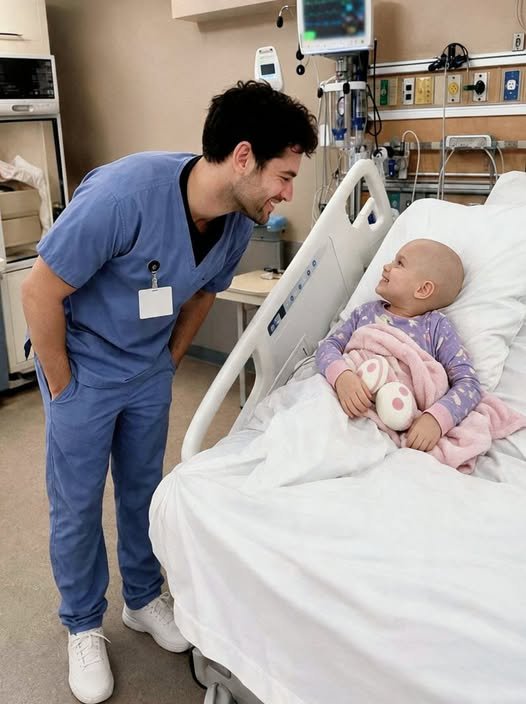
The Hospital Became Our Whole World
Before my daughter became ill, I believed hospitals were temporary places.
You went inside because something hurt, waited beneath fluorescent lights, spoke to a doctor, and eventually returned home with medication and instructions to rest.
I never imagined a hospital would become my four-year-old daughter’s second home.
I never imagined I would memorize the sound of every machine beside her bed, recognize nurses by the rhythm of their footsteps, or learn to distinguish an ordinary alarm from one that required immediate attention.
But after Adeline was admitted to the pediatric oncology ward, our old life seemed to disappear almost overnight.
The world beyond the hospital continued as if nothing had happened. People went to work, bought groceries, complained about traffic, and made weekend plans.
Meanwhile, my world became one small room filled with monitors, medication pumps, plastic tubing, and the sharp scent of disinfectant.
I was raising Adeline alone, and facing her illness without another parent beside me was more frightening than anything I had ever known.
Before her diagnosis, Adeline’s greatest concerns were wonderfully ordinary.
She worried about whether I had cut the crusts off her sandwiches correctly. She spent several minutes every evening deciding which stuffed animal deserved the honor of sleeping beside her. She loved butterflies, glitter-covered crayons, princess dresses, and stories in which kindness always won.
Every fairytale ended happily in Adeline’s world.
Then cancer arrived and stole the simplicity from her childhood.
Instead of preschool, playgrounds, and afternoon naps in her own bed, she had treatments, examinations, and long nights beneath harsh hospital lights.
I slept on a narrow couch beside her bed so often that my apartment began to feel like a place I merely visited. My clothes always carried the faint smell of hand sanitizer, and vending-machine coffee became the closest thing I had to a proper breakfast.
There was no one waiting to take over when I became exhausted.
No one could relieve me for an evening or make the difficult decisions when fear clouded my thoughts. Every medical conversation, every consent form, and every uncertain choice rested on my shoulders.
Still, I tried not to let Adeline see how terrified I was.
She needed my smile, even when I had to force it.
She needed to hear that everything would be all right, even on the nights when I whispered the same promise to myself and wondered whether it was true.
A Place Filled With Sorrow—and Hope
The pediatric oncology floor was unlike anywhere else.
It carried a sadness no child should ever know, yet it was also filled with an extraordinary kind of hope.
Children decorated their IV poles with stickers and ribbons. Parents celebrated improved test results with cupcakes from the cafeteria. Nurses remembered birthdays, favorite television shows, preferred juice flavors, and the names of beloved stuffed animals.
Small victories mattered there.
A finished meal mattered.
A peaceful night mattered.
A child smiling after a difficult treatment mattered more than anyone outside those walls could understand.
Among the nurses caring for the children was a young man named Josh.
He appeared to be around thirty and possessed the kind of patience that could not be taught in a classroom. He never rushed through a conversation, even when the floor was busy. He spoke gently, listened carefully, and somehow remembered something special about every child.
The first time he treated Adeline, she clutched her stuffed rabbit against her chest and refused to let anyone near her IV.
“I don’t like needles,” she whispered.
Josh crouched until they were eye to eye.
“I don’t like them either,” he admitted.
Adeline stared at him suspiciously.
“You don’t?”
“Not at all.”
“But you’re a nurse.”
“I know,” he said with a grin. “That makes it pretty strange, doesn’t it?”
A tiny giggle escaped her.
It was the first real laugh I had heard from my daughter in several days.
That single sound made me want to cry with relief.
From that moment forward, Josh became Adeline’s favorite person on the ward.
We had taped a paper calendar beside her bed, and she insisted on marking the days he was scheduled to work. Whenever I drew a smiling face on one of his shifts, she would point to it proudly.
“Tomorrow is a Josh day!”
If his schedule changed, she would pout dramatically before announcing that she supposed she could survive waiting one more day.
I appreciated him more than I knew how to say.
Before touching Adeline’s arm or checking her IV, he always explained what he was doing. He asked permission instead of treating her as though she had no control over her own body. He praised her when she finished her food, swallowed her medicine, or completed a treatment without crying.
He never looked at her with pity.
He treated her like a child who happened to be sick—not an illness occupying a hospital bed.
The Nurse Who Understood Princesses
One afternoon, Adeline and I were coloring pictures of castles when Josh entered to check her vital signs.
He glanced at the page in front of her.
“What masterpiece are we working on today?”
“A castle,” she answered. “But it needs more sparkles.”
Josh nodded with complete seriousness.
“Every proper castle needs sparkles.”
Adeline looked delighted.
“You understand.”
“I’ve learned never to argue with royalty.”
While he wrapped the blood pressure cuff around her small arm, she studied him closely.
“You’re very nice,” she said.
“Thank you.”
“And you’re handsome.”
The blue crayon slipped from my fingers.
“Adeline!”
She looked at me innocently.
“What?”
“You don’t have to embarrass people.”
“I’m not embarrassed,” Josh said, laughing.
“Well, I am,” I muttered.
He smiled as he entered her numbers into the chart.
At the time, it seemed like nothing more than an amusing conversation between a little girl and the nurse she adored.
Soon, our days returned to their exhausting pattern.
Tests.
Treatments.
Waiting.
Fear.
Hope.
Then more waiting.
Some evenings, after Adeline finally fell asleep, I stood beside the window at the end of the hallway and watched families leave the hospital.
Parents carried sleepy children toward their cars. Teenagers complained about homework. Couples hurried through the rain beneath shared umbrellas.
I watched them and wondered what it felt like to have ordinary worries.
I wanted to be concerned about spilled juice, missing socks, and preschool schedules again.
I wanted a problem that did not involve test results.

The Dream Adeline Feared She Would Never Have
One Monday afternoon, Adeline was especially talkative.
Josh had stopped by to replace the batteries in one of her toys, and she began describing a cartoon she had loved before she became too ill to attend preschool.
“There was a prince,” she explained.
“What happened to him?” Josh asked as he straightened the blanket over her legs.
“He asked the princess to marry him.”
“That sounds important.”
“It was beautiful,” she continued, sighing as though she had personally witnessed the event. “There were flowers everywhere.”
“I’m sure there were.”
“And everyone clapped.”
Josh smiled.
“That sounds like a wonderful celebration.”
Adeline nodded thoughtfully.
“I want something like that someday.”
A soft ache moved through my chest. I assumed she was imagining herself as a grown woman, healthy and happy, wearing a beautiful dress.
Then her expression changed.
“I probably won’t have a husband,” she said quietly.
The room became painfully still.
The monitors continued beeping, but somehow every sound felt distant.
My throat closed.
Four-year-old children were supposed to believe they had endless tomorrows. They were supposed to dream without measuring those dreams against an illness.
I wanted to tell her that she would grow up, fall in love, and have every happiness she could imagine.
But the words would not come.
Josh remained beside her bed.
“Why do you think that?” he asked gently.
“Because I’m sick.”
His face softened.
“You know what I think?”
She looked up at him.
“I think you are one of the bravest people I have ever met.”
Adeline gave a small shrug, unconvinced.
Then she said, “If I got to choose, I’d want my husband to be handsome and kind like Nurse Josh.”
Heat rushed to my face.
“Oh, sweetheart.”
Josh gave a quiet laugh, though his eyes had become suspiciously bright.
“That might be the nicest compliment anyone has ever given me.”
“I mean it,” she insisted.
“I believe you.”
He finished checking her chart and walked toward the door.
Before leaving, he glanced back.
“I’ll see you tomorrow, Princess Adeline.”
She waved happily.
Neither of us understood then how deeply her words had touched him.
The following day, rain covered the hospital windows in silver streaks.
Adeline had endured a difficult treatment and slept through most of the afternoon. When she finally woke, she looked pale and exhausted.
Josh arrived at the beginning of his shift carrying a paper cup filled with crayons from the children’s activity room.
“I heard a famous artist was staying in this room,” he said.
Adeline’s tired face immediately brightened.
“Are those for me?”
“I believe they are.”
She examined each crayon with great care.
“My favorite is purple.”
“I remembered.”
Her eyes widened.
“You really remembered?”
“I try to remember important things.”
She hugged the crayons against her chest.
While I packed a few belongings into my overnight bag, Josh and Adeline talked about dragons, castles, and enchanted forests.
For several minutes, the hospital room no longer felt like a place filled with illness.
Then the head nurse stepped inside to review Adeline’s chart.
Adeline began giggling.
With the dramatic excitement only a four-year-old could manage, she announced, “Nurse Josh made me a secret vow today!”
I stopped packing.
The head nurse looked up.
Josh’s face turned bright red.
Adeline continued proudly, “He said he’s keeping it forever, but I’m not allowed to tell Mommy yet.”
The entire room seemed to freeze.
I looked directly at Josh.
He lowered his gaze, muttered something I could not understand, and quickly stepped into the hallway.
The head nurse forced an uncomfortable smile.
“Well,” she said, “that certainly sounds mysterious.”
Adeline grinned as if she had just been entrusted with the greatest secret in the world.
I sat beside her.
“What did Josh promise you?”
She pressed both hands over her mouth.
“I can’t tell.”
“Was it something about your medicine?”
She shook her head.
“Did he promise you a surprise?”
Her smile grew wider.
“Did he tell you not to tell me?”
“I promised him.”
My stomach tightened.
“What exactly did you promise?”
She hugged her rabbit and refused to answer.
To her, it was harmless magic.
To me, it was an unknown secret involving my vulnerable child and an adult I had trusted.
That evening, I asked again.
She would not tell me.
The next morning, I tried turning the question into a game.
Still nothing.
“It belongs to me and Josh,” she whispered.
Three Days of Growing Fear
For the next two days, everything felt different.
Josh remained kind and professional, but he was quieter around me.
He greeted Adeline, checked her medication, and asked whether she needed anything. Yet whenever our eyes met, he looked away almost immediately.
My exhausted mind began inventing explanations.
Why had he turned so red?
Why had he hurried away?
Why would he ask my daughter to keep something from me?
Part of me felt ashamed for doubting him. He had shown Adeline nothing but kindness. He had comforted her during painful moments and treated her with more patience than many adults had shown me.
But another part of me—the frightened, sleep-deprived mother who had spent months preparing herself for terrible news—could not let the matter go.
Protecting Adeline had to come before politeness.
It had to come before gratitude.
It even had to come before trust.
By the third morning, I was barely functioning.
I had spent another restless night listening to the machines beside her bed and replaying every conversation in my mind.
Before sunrise, I went downstairs to buy the strongest iced coffee available from the hospital café.
I was gone for less than ten minutes.
When the elevator doors opened onto the pediatric floor, the hallway felt strangely silent.
There were no cartoons playing in the family lounge.
No laughter from the nurses’ station.
No voices drifting from the nearby rooms.
Instead, several members of the hospital staff stood outside Adeline’s door.
Some were wiping tears from their faces.
My heart stopped.
The coffee cup began trembling in my hand.
For one horrifying second, I believed I had left my daughter at exactly the wrong moment.
“No,” I whispered.
I rushed toward the room.
No one stopped me.
No one explained.
The only thought in my head was that I was too late.
Not Adeline.
Please, not my little girl.
I pushed through the gathered staff and threw open the door.
“Adeline!”
The coffee slipped from my hand and struck the floor.
The Fairytale Behind the Door
The room I entered looked nothing like the sterile hospital space I had left minutes earlier.
Warm fairy lights glowed across the walls.
Paper flowers hung from the ceiling. Colorful streamers framed the windows, and handmade butterflies appeared to float above the bed.
A large cardboard castle stood in one corner.
Silk petals formed a pathway across the floor toward Adeline’s bed, which had been transformed into a princess’s throne with pastel blankets, ribbons, and sparkling decorations.
Several nurses were wearing tiaras.
A child-life therapist held a toy wand.
Even the IV pole had been wrapped carefully in pink ribbon.
At the center of it all sat my daughter.
A glittering crown rested on her head.
She was not crying.
She was not frightened.
She was smiling more brightly than I had seen her smile in months.
I stood speechless in the doorway.
Then I saw Josh beside her bed, his hands clasped nervously in front of him.
The nurses behind me entered quietly.
Only then did I understand.
Their tears had not come from tragedy.
They had been crying because they knew what was about to happen.
“What is all this?” I asked, pressing a hand against my chest.
Josh met my eyes for the first time in days.
“I’m sorry,” he said. “I know the secret frightened you.”
“You terrified me.”
“I understand. I should have handled it differently.”
I looked around the transformed room.
“I don’t understand what’s happening.”
He took a breath.
“A few days ago, Adeline told me about the cartoon with the prince and princess.”
“There were flowers,” Adeline added.
Josh smiled at her.
“A great many flowers.”
He turned back to me.
“She told me she wanted a moment like that someday. Then she said she didn’t think she would ever have one because she was sick.”
Tears filled my eyes.
“I remember.”
“She also said that if she could choose, she would want someone handsome and kind like Nurse Josh.”
Several nurses laughed softly through their tears.
“I remember wishing the floor would open beneath me,” I admitted.
“So did I,” Josh said, smiling shyly.
Gentle laughter filled the room.
Then his expression became serious.
“But I couldn’t stop thinking about what she said. No child should believe illness has taken every beautiful moment away from her.”
He gestured toward the decorations.
“I spoke with the nurse manager, the administration, and the child-life team. The activity staff built the castle. Maintenance helped hang the decorations. The cafeteria made cupcakes. Volunteers and children from the ward created the flowers and butterflies.”
The head nurse stepped forward.
“Everyone wanted to help,” she said.
I slowly looked around again.
The decorations were not expensive or perfect, but they had been made with extraordinary care.
Some of the paper flowers had uneven petals. Glitter covered the floor. The cardboard castle leaned slightly to one side.
Yet it was the most beautiful room I had ever seen.
An entire community had worked together because my daughter had shared one fragile dream.

Josh Keeps His Vow
Josh reached into his pocket and removed a small velvet box.
My heart jumped.
“It’s only pretend,” he assured me gently.
I nodded, too emotional to speak.
He walked toward Adeline and lowered himself onto one knee.
The room fell silent.
When he opened the box, I saw a sparkling plastic ring shaped like a pink flower.
“Princess Adeline,” he began, “every princess deserves to know that she is courageous, precious, and deeply loved.”
Adeline’s face glowed.
“A few days ago, I made you a promise.”
“You did,” she said eagerly.
“I promised I would help bring your fairytale to life.”
“You kept the secret!”
“I did.”
He carefully slid the toy ring onto her finger.
“This isn’t a real proposal,” he told her. “It’s a reminder that being sick does not mean your dreams stop mattering.”
Adeline stared at the ring for one breathless moment.
Then she threw her arms around his neck.
“I love it!”
The room erupted in applause.
Children from nearby rooms gathered in the doorway with their parents. One little boy raised both arms and shouted, “The princess said yes!”
Everyone laughed.
Fairytale music began playing through a portable speaker. A child-life specialist placed a flower crown on Adeline’s head, and another nurse handed her a bouquet of handmade paper flowers.
Each flower carried a message.
“You are brave.”
“You make us smile.”
“Our favorite princess.”
“Keep believing.”
Then the cupcakes arrived, decorated with pink frosting and tiny stars.
For the next hour, no one spoke about chemotherapy, scans, medication, or blood counts.
Adeline was not a patient.
She was not a diagnosis.
She was simply a happy little girl sitting in the middle of her own fairytale.
And I stood beside her, crying harder than I had cried in months.
The Conversation in the Hallway
After the celebration, Josh stepped into the hallway.
I followed him.
For a moment, neither of us spoke.
Then I wiped my face.
“I owe you an apology.”
He shook his head.
“You don’t.”
“I doubted you.”
“You were protecting your daughter.”
“I imagined terrible things.”
“You have lived with the possibility of terrible things every day since she became ill,” he said quietly. “Your mind was trying to protect her—and you.”
His understanding made my tears return.
“I forgot there were still people capable of doing something this kind.”
“There are more of them than you think.”
“Thank you,” I whispered.
“You don’t need to thank me.”
“Yes,” I said. “I do.”
I looked through the doorway at Adeline, who was showing her ring to another child.
“You gave her something her illness couldn’t take away.”
Josh followed my gaze.
“She gave all of us something too.”
The Ring Beside Her Bed
After that day, life on the oncology ward returned to its familiar rhythm.
The decorations eventually came down.
Treatments continued.
Some test results gave us hope. Others brought new worries.
There were difficult mornings and long nights when Adeline cried because she wanted to sleep in her own room, play outside, or return to preschool.
Whenever she felt discouraged, she opened the small treasure box beside her bed and looked at the plastic flower ring.
“My prince kept his promise,” she would say.
The nurses smiled each time they heard it.
The ring became more than a toy.
It reminded her that she was loved by people beyond her family.
It reminded me that even in a place shaped by illness, kindness could still create something beautiful.
One More Important Question
Several months later, after Adeline completed another successful round of treatment, her doctors told us she could begin spending longer periods at home between appointments.
Packing our belongings should have felt entirely joyful.
Instead, I found myself strangely emotional.
The ward had held some of the most terrifying moments of my life, but it had also introduced us to people who had carried us when I was too exhausted to stand alone.
Josh stopped by before we left.
He spoke with Adeline about her next visit and reminded her to take care of the flower ring.
As I watched him, I thought about everything he had done.
Not only the fairytale celebration.
I remembered every gentle explanation, every encouraging word, every time he had knelt beside her instead of speaking over her.
He had never treated her as weak.
He had made her feel safe, respected, and important.
I reached into my purse and handed him a small envelope.
“I want to ask you something.”
He looked at it cautiously.
“This isn’t another secret, is it?”
I laughed.
“No more secrets.”
He opened the envelope and removed the card inside.
Written across it were the words:
Would you do us the honor of becoming Adeline’s godfather?
Josh stared at the card for several seconds.
When he looked up, his eyes were filled with tears.
“Are you serious?”
I nodded.
“There is no one I trust more to remind her how brave she is.”
He knelt beside Adeline’s wheelchair.
“I would be honored.”
Adeline squealed.
“I knew you would say yes!”
We all began laughing.
The Promise That Changed Everything
Cancer had taken many things from my daughter.
It had taken carefree birthdays, afternoons on the playground, preschool memories, and countless ordinary days no child should ever have to lose.
But it had not taken everything.
Because of one compassionate nurse—and an entire hospital ward that chose to help him—cancer never took away Adeline’s belief in kindness.
It did not take away her imagination.
It did not take away her ability to dream.
Josh’s vow was never really about a toy ring, a cardboard castle, or a pretend fairytale.
It was a promise that Adeline’s life still contained joy.
It was a promise that she was more than her illness.
It was a promise that even during the darkest season of our lives, love could enter a sterile hospital room and transform it into something magical.
And that was a promise worth keeping forever.