
PART 1
The first thing my mother said when I came home from deployment was not welcome back.
It was, “Leave him alone. He needs to learn.”
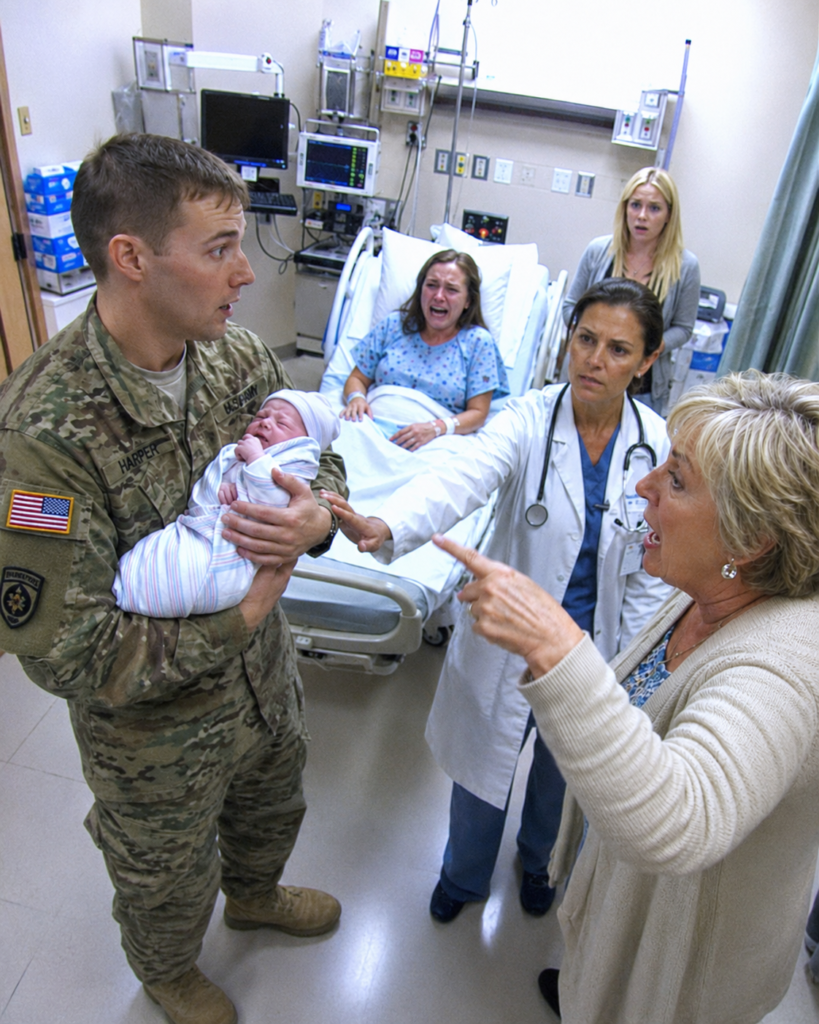
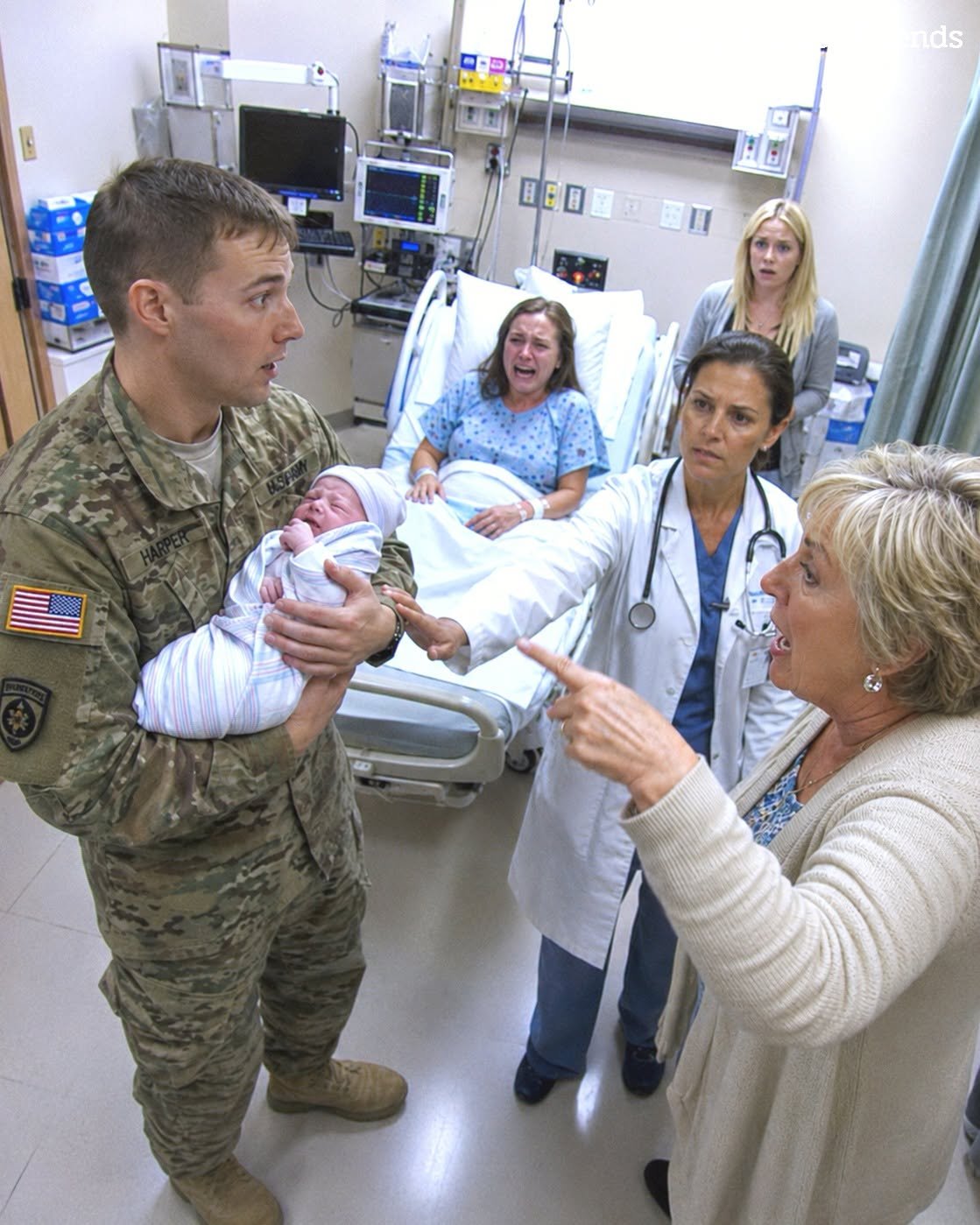
She was talking about my three-week-old son.
His cry came from the nursery in thin, broken sounds, like his little body had already run out of strength and was only crying because something inside him refused to quit.
My duffel bag hit the hardwood floor.
For eight months, I had slept beside sandbags, eaten cold food under red lights, and learned to hear danger before I saw it.
Danger had a smell.
Hot dust.
Metal.
Blood.
Fear.
That night, in my own house in Virginia, danger smelled like sour formula, sweat, and a baby left too long in a room with the heat turned up too high.
“Mom?” I called.
No answer.
Just another weak cry.
I moved down the hallway slowly, not because I was afraid, but because I knew what anger could do to a man’s judgment. I had seen men lose everything in three seconds because they charged before they looked.
So I looked.
The hallway table was covered with mail Sophia never would have left stacked like that. A vase lay cracked beside the wall. One of Leo’s tiny socks was on the floor near the bathroom door. The baby monitor had been turned face down.
Then I saw the nursery door.
Half open.
Light spilling across the carpet.
My son cried again.
Then stopped.
That silence was worse than any scream I had heard overseas.
I pushed the door open.
Sophia was on the floor beside the crib.
My wife.
My calm, stubborn, funny wife who once argued with a pharmacist for twenty minutes over a two-dollar overcharge because “principle still matters, Lucas.”
She was shaking so hard her teeth clicked.
One side of her face was swollen. Her lower lip was split. There were purple marks around both wrists, and one sleeve of her shirt was torn at the shoulder.
She looked at me like I was a ghost.
For one second, fear filled her eyes.
Then she recognized me.
“Lucas?”
Her voice cracked on my name.
I crossed the room and dropped to one knee beside her.
Before I could touch her, my mother appeared behind me.
Eleanor Hayes stood in the doorway wearing Sophia’s pale blue silk robe like she had bought it herself. Her silver hair was pinned neatly at the back of her head. Her lipstick was fresh. Her face was smooth and cold.
Behind her, my younger sister Audrey leaned against the doorframe with a glass of wine in one hand.
Audrey looked bored.
That was what scared me most.
Not guilty.
Not shocked.
Bored.
“What happened?” I asked.
My mother folded her arms.
“She needed discipline.”
Sophia flinched.
My eyes went to the crib.
Leo lay under a thin blanket, face flushed, lips dry, little fists curled against his chest. I touched his forehead with the back of my fingers.
Burning.
Not warm.
Burning.
“How long has he had a fever?” I asked.
Sophia opened her mouth.
My mother answered first.
“Since yesterday.”
“Yesterday?”
“She was making a scene about it.”
Sophia’s hand closed around my sleeve.
“His temperature was 104. I tried to call the doctor. They took my phone. They wouldn’t let me leave.”
Audrey gave a soft laugh.
“Oh, please. She panics if he sneezes.”
I did not look at Audrey.
I kept my eyes on Leo.
“What medicine has he had?”
Sophia whispered, “I gave him what the pediatrician said. Then Eleanor poured it out.”
My mother’s chin lifted.
“I will not have some hysterical girl drugging a baby in my house.”
My house.
There it was.
The sentence she had been waiting to say.
My house.
I picked Leo up carefully and wrapped him against my chest. His body felt too hot through the blanket. His cry came out as a tired little whimper.
Audrey stepped in front of me.
“Where do you think you’re taking him?”
“To the hospital.”
“Lucas,” my mother said, warning in her voice. “You need to calm down and hear our side.”
I looked at my son’s cracked lips.
Then at my wife’s bruised face.
Then at the robe my mother had stolen from her closet.
“I am calm.”
That made Audrey smile.
“You always were dramatic when you came home in uniform.”
I was not in uniform.
I was in jeans, a black T-shirt, and boots dusty from the long drive from base.
But I understood what she meant.
To Audrey, service was a costume.
To my mother, marriage was property.
And to both of them, Sophia had been alone.
That was their mistake.
They thought alone meant unprotected.
They thought quiet meant weak.
They thought distance meant ignorance.
They thought family meant immunity.
They thought my patience was permission.
I looked past them toward the front window.
Headlights swept across the walls.
One car.
Then another.
Then a third.
My mother’s face changed.
Only a little.
But I saw it.
Audrey turned toward the driveway.
“Who is that?”
I shifted Leo higher against my chest.
“The people you should have been afraid of.”
For six weeks, I had known something was wrong.
Sophia’s messages had changed first.
She used to send me pictures of her breakfast, complain about the dishwasher, ask if I remembered where we kept the spare lightbulbs. Then her texts got shorter.
We’re fine.
Busy day.
Baby is fussy.
I’m tired.
Then came messages that did not sound like her at all.
Your mother is helping so much.
Audrey has been great.
I need space.
Don’t call tonight.
Sophia never wrote like that.
My wife used commas when she was angry and full sentences when she was scared.
Those messages had neither.
I called.
No answer.
I called again.
No answer.
Then my mother called me back from Sophia’s phone and sighed like I was bothering her.
“She’s emotional, Lucas. New mothers can be unstable. You need to focus on your duty.”
Duty.
People like my mother loved that word when it benefited them.
So I did focus on my duty.
I asked my commanding officer for help.
I asked a friend in cyber investigations to look at the message headers.
I asked Sophia’s father if she had contacted him.
He sent me six emails she had managed to write from an old tablet before someone found it and smashed it.
Lucas, they won’t let me take Leo to the doctor.
Lucas, your mother says this house is hers now.
Lucas, I think Audrey is sending messages from your account.
Lucas, please come home if you can.
The last email was only five words.
I am scared of them.
That was the day I stopped sleeping.
Now my mother stood in the nursery doorway, still trying to look offended instead of afraid.
“You brought strangers into a private family disagreement?” she asked.
The front door opened.
Boots stepped inside.
Captain Elena Ruiz entered first.
Two military police investigators came behind her.
Then Detective Marcus Harris from county police.
Then a child protective services worker.
Then my attorney, Naomi Price.
Then two paramedics with emergency bags.
My sister’s wineglass tilted in her hand.
My mother said nothing.
For the first time since I had known her, Eleanor Hayes had no ready line.
Detective Harris looked at Sophia on the floor.
His jaw tightened.
“This is not a family disagreement.”
Captain Ruiz looked at me.
“Sergeant Hayes.”
I nodded once.
“My son first.”
The paramedics moved fast.
Audrey stepped back like the medical bags were contagious.
One paramedic took Leo from my arms. The other knelt by Sophia and began checking her eyes, her pulse, the bruises on her ribs.
Sophia grabbed my hand.
“Don’t let them take him.”
“They’re not taking him from us,” I said. “They’re helping him.”
My mother’s voice sharpened.
“This is absurd. That baby has a fever. Babies get fevers.”
The paramedic looked up.
“Not like this without immediate care.”
The room went quiet.
One sentence.
First payoff.
My mother’s face tightened, but she recovered quickly.
“Sophia refused help. She wanted attention.”
Sophia shook her head, crying silently.
Naomi opened her briefcase and placed a thick folder on the changing table.
“That is not what the evidence shows.”
Audrey stared at the folder.
Then at me.
For the first time, she looked less bored.
My mother noticed.
And suddenly, both of them understood the same thing.
I had not come home to ask questions.
I had come home with answers.
PART 2
The ambulance lights painted the nursery walls red and white.
Red across the crib.
White across Sophia’s bruised cheek.
Red across my mother’s stolen robe.
White across Audrey’s empty wineglass.
Nobody moved for a second.
Then the house exploded into motion.
The paramedics carried Leo down the hallway, one of them calling out numbers I did not like. Sophia tried to stand and nearly collapsed. I caught her before she hit the floor.
“I’m sorry,” she whispered.
Those two words almost broke me.
Not because she said them.
Because I knew why.
My wife had been trapped in my house, hurt by my family, watching our son get sicker by the hour, and somehow they had convinced her she needed to apologize.
I helped her onto the stretcher.
“You did nothing wrong.”
My mother made a disgusted sound.
“Oh, for heaven’s sake. She is playing you, Lucas.”
Detective Harris turned.
“Mrs. Hayes, I’d stop talking.”
“I know my rights.”
“Then use the right to remain silent.”
Audrey crossed her arms.
“You can’t just walk in here and threaten us. We live here.”
Naomi looked at her.
“No, you don’t.”
Audrey blinked.
My mother’s mouth flattened.
Naomi pulled out another document and laid it on the dresser.
“Temporary occupancy agreement. Signed by Eleanor Hayes. Permission to reside in the guest suite during Lucas Hayes’s deployment. Revocable immediately upon violence, criminal activity, financial abuse, or endangerment of a child.”
Audrey laughed once.
A sharp, nervous sound.
“That’s not real.”
Naomi slid the page closer.
“It is notarized.”
My mother did not look at it.
That told me she already knew.
Years earlier, after my grandfather died, he left me enough money to buy the house outright through a military family trust. He had not left it to my mother. He had not left it to Audrey.
He had left it to me because he knew exactly what they were.
My grandfather had raised me from the age of twelve.
My mother liked to say she had “gone through a hard season.”
That hard season lasted five years.
Five birthdays.
Five Christmas mornings.
Five school photos where I stood beside Grandpa because my mother was somewhere else with some man who promised her a better life until the money ran out.
When she came back, Grandpa gave her a room.
Not forgiveness.
A room.
That was his way.
He believed mercy should have boundaries.
I was slower to learn.
When I deployed, Sophia was pregnant and anxious. My mother offered to “help.” Audrey said she would stop by.
I wanted to believe people could change.
I wanted to believe Leo might soften them.
I wanted to believe my family could finally act like one.
Instead, they saw a young wife, a newborn baby, and a house they had always believed should have been theirs.
Sophia was loaded into the ambulance. Leo was already inside.
I leaned in through the open doors and kissed her forehead.
“I’m coming.”
Her fingers tightened around mine.
“Lucas.”
“I promise.”
Captain Ruiz touched my shoulder.
“Five minutes.”
I understood.
Sophia and Leo needed the hospital.
But the house needed to be secured.
Naomi stepped beside me as the ambulance doors closed.
“Let’s finish the first layer.”
The first layer.
That was Naomi’s phrase.
There was always what people did.
Then there was why.
Then there was who helped them.
I watched the ambulance pull away.
Then I turned back toward the house.
My mother stood in the foyer like a queen forced to receive peasants.
Audrey stood near the stairs, thumb moving fast over her phone.
Detective Harris noticed.
“Put it down.”
“I’m calling my lawyer.”
“You can call after we preserve the device.”
“You can’t take my phone.”
Harris held out one hand.
“Watch me.”
Audrey looked at my mother.
My mother gave her the tiniest shake of the head.
Too late.
Captain Ruiz saw it.
So did I.
Second payoff.
They were communicating without words because they had practiced this.
The military police investigator beside Ruiz opened a sealed evidence bag.
Inside was a small black memory card.
Audrey went still.
My mother’s eyes moved to the nursery ceiling.
The camera.
Before I deployed, I installed a nursery camera so I could see Leo after he was born. Sophia teased me for being overprotective.
“You’re going to watch him sleep from another continent?”
“Yes.”
“That is ridiculous.”
“Yes.”
But she smiled when she said it.
Two weeks after Leo came home, the live feed went dark.
My mother told me the camera was defective.
Audrey said Sophia had unplugged it because it made her feel watched.
I believed neither of them.
The camera had local storage.
When the internet returned, it uploaded.
Every time.
Captain Ruiz opened a tablet.
“I need everyone to remain where they are.”
Audrey’s voice came out higher than before.
“What is this supposed to prove?”
Ruiz pressed play.
The first clip began in the nursery.
Sophia stood by the crib, exhausted, hair tied back, robe loose over her shoulders. Leo cried in the background.
My mother entered.
No robe then.
Just a cream cardigan and slacks.
Sophia said something the camera did not catch clearly.
My mother slapped her.
The sound filled the room.
My hands curled once.
Then opened.
Calm.
Stay calm.
On the screen, Sophia stumbled back against the dresser.
My mother leaned close and spoke clearly enough for the camera to hear.
“You are a guest in this family.”
Audrey looked away.
My mother did not.
Ruiz played the next clip.
Audrey blocking the front door while Sophia held Leo in a car seat.
Sophia’s voice shook.
“He has a fever. Move.”
Audrey smiled.
“Call Lucas and ask permission.”
“You took my phone.”
“Then I guess you’re stuck.”
Next clip.
My mother taking a bottle of infant medicine from Sophia’s hand.
Sophia begging.
“Please, Eleanor, the doctor said—”
The medicine went down the sink.
Next clip.
Audrey at the kitchen table with Sophia’s phone and laptop.
She was typing.
She was laughing.
She said, “He’s so easy. Just write duty and he folds.”
Detective Harris looked at her.
Audrey said nothing.
Next clip.
My mother dragging Sophia by the hair in the hallway while Leo screamed in the nursery.
That was when Audrey whispered, “Oh my God.”
Not because Sophia had been hurt.
Because they had been seen.
Captain Ruiz stopped the video.
Silence filled the foyer.
My mother adjusted the sleeve of Sophia’s robe.
“You don’t understand the context.”
Naomi’s voice was cold.
“Context does not turn assault into parenting.”
My mother looked at me.
“You were not here. She was lazy. She slept while dishes piled up. She cried all day. She let the baby control the house. I was trying to keep order.”
There it was.
Not a confession.
A justification.
The kind people make when they think cruelty is discipline with better posture.
Audrey found her voice.
“She wanted everything handed to her. Free house. Free money. Your benefits. Your pity.”
Naomi opened the folder.
“Speaking of money.”
Audrey’s eyes dropped to the papers.
Naomi placed three bank statements on the entry table.
“Thirty-eight thousand dollars withdrawn from the household emergency account over four months. Transfers authorized with Sophia Hayes’s digital signature.”
My mother looked bored again, but her left hand moved.
A tiny twitch.
She was scared.
“You gave Sophia access to that account,” she said. “Maybe she spent it.”
“She did not,” Naomi said.
Audrey snapped, “You can’t prove that.”
Naomi turned one page.
“We can.”
She laid out login records.
Device IDs.
IP addresses.
A purchase receipt for a luxury handbag.
A reservation at a spa resort.
A payment to a private storage unit.
All under Audrey’s email.
Audrey took one step backward.
Detective Harris moved with her.
Third payoff.
The stolen money had not vanished.
It had left footprints.
My mother’s voice lowered.
“Lucas, do not do this.”
“Do what?”
“Destroy your family.”
I looked at the tablet still frozen on Sophia being dragged down the hall.
“You did that.”
Something in her face shifted.
Anger, yes.
But under it, resentment.
Old and rotten.
“You have no idea what it is like,” she said. “To watch your own father give everything to your son. To be treated like a visitor in the life you created.”
There was her motive.
Not love.
Not concern.
Ownership.
She believed birthing me meant owning whatever I earned.
She believed my grandfather’s house should have passed through her hands, even after she had disappeared from mine.
Audrey lifted her chin.
“Grandpa hated us.”
“No,” I said. “He knew you.”
Naomi pulled out one more document.
My mother finally looked at it.
Her expression cracked.
“What is that?”
“The trust clause,” I said.
Grandpa had written it in plain language because he knew lawyers could make evil sound complicated.
Any beneficiary who commits financial exploitation, abuse, identity theft, or felony harm against another named beneficiary shall have distributions suspended pending judicial review.
Sophia was a beneficiary.
Leo was a beneficiary.
My mother’s lips parted.
Audrey whispered, “No.”
Fourth payoff.
They had not just lost control of the house.
They had put their inheritance on a blade.
Naomi slid the notice across the table.
“As of tonight, all distributions to Eleanor Hayes and Audrey Hayes are frozen.”
Audrey lunged for the papers.
Detective Harris caught her wrist before she touched them.
Her wineglass slipped from her other hand and shattered across the floor.
My mother looked at me with pure hatred.
“You planned this.”
I stepped closer.
“No. You planned this.”
Then I pointed to the camera memory card.
“I documented it.”
The handcuffs came out then.
Audrey started screaming first.
My mother stayed silent.
That was how I knew she was already thinking about the next move.
PART 3
At the hospital, Leo looked impossibly small under the white blanket.
An IV was taped to his tiny hand. A monitor beeped beside him. His face was still flushed, but the doctor said the fluids were helping.
I stood beside the bassinet with both hands on the rail because I needed something solid to hold.
“Sergeant Hayes?”
I turned.
The pediatric doctor was a woman in navy scrubs with tired eyes and a steady voice.
“I’m Dr. Patel. Your son was dehydrated and running a high fever. We’re treating him aggressively, and he’s responding.”
“Will he be okay?”
“We are optimistic. But I need to be direct with you. Another few hours without treatment could have been catastrophic.”
Another few hours.
I closed my eyes once.
Opened them.
“Thank you.”
Sophia was in the room next door.
Concussion.
Two cracked ribs.
Severe bruising.
Dehydration.
Stress response.
Words that sounded clinical because doctors needed distance to do their jobs.
But I had seen the marks.
There was nothing clinical about a handprint on your wife’s arm.
Naomi arrived at 3:17 in the morning carrying coffee I did not drink.
Captain Ruiz was with her.
Detective Harris had stayed at the house for the search.
“Eleanor and Audrey were booked,” Naomi said. “Assault. Child endangerment. Unlawful imprisonment. Identity theft. Forgery. Financial exploitation. More may come.”
“Protective order?”
“Emergency order granted before midnight. No contact with Sophia, Leo, or you. No access to the property.”
Captain Ruiz added, “The military side is reviewing the cloned communications. If someone used your credentials or impersonated you while you were deployed, that moves beyond county charges.”
I looked at her.
“Someone?”
Ruiz did not answer immediately.
That told me enough to file it away.
Not now.
Leo first.
Sophia first.
Everything else later.
Naomi watched me.
“You need to prepare yourself. Your mother will claim this is a misunderstanding. Audrey will claim she was controlled by Eleanor. They will both say Sophia exaggerated.”
“They can say what they want.”
“They will also try to get public sympathy.”
I looked through the glass at Leo.
“They hurt a newborn.”
“People excuse things when the story is packaged well.”
That was true.
My mother had survived her entire life on packaging.
She could make abandonment sound like sacrifice.
She could make greed sound like fairness.
She could make cruelty sound like tradition.
At 4:02, Sophia woke up.
I was beside her when her eyes opened.
She looked at the ceiling first.
Then at the IV line.
Then at me.
Panic flashed across her face.
“Leo?”
“He’s here. He’s being treated. The doctor says he’s responding.”
Her eyes filled.
“I tried.”
“I know.”
“I tried so many times, Lucas.”
“I know.”
“She said you told her to handle me.”
“I didn’t.”
“She showed me messages.”
“I know. Audrey faked them.”
Sophia closed her eyes, and tears slipped sideways into her hair.
“They made me feel crazy.”
That sentence hurt more than the bruises.
I sat carefully on the edge of the bed.
“You are not crazy.”
“She told the neighbors I had postpartum psychosis. She said if I called police, they would take Leo away from me.”
Naomi stepped closer.
“They won’t.”
Sophia looked at her.
“They said Lucas gave them the house.”
Naomi opened a smaller folder and placed a copy of the deed on Sophia’s blanket.
“No. Lucas owns the home through the Hayes Family Trust. You and Leo are protected beneficiaries. Eleanor had temporary permission to occupy one guest suite. That permission is terminated.”
Sophia stared at the paper.
For a long moment, she did not speak.
Then she whispered, “So I wasn’t in her house.”
“No,” I said.
Her mouth trembled.
“I was in mine.”
That was the fifth payoff.
Not legal.
Not financial.
Human.
For months, they had used the word house like a weapon.
Now it was back where it belonged.
In Sophia’s hands.
The next morning, I went home with Detective Harris, Naomi, and a locksmith.
The house looked different in daylight.
Smaller.
Meaner.
Like secrets had been hiding in corners and the sun had finally caught them.
There was a black smear on the kitchen counter where the baby bottle warmer had overheated. Formula crusted inside three bottles in the sink. Sophia’s prenatal vitamins had been dumped in the trash. One of Leo’s blankets was shoved behind the laundry basket.
In the guest suite, my mother’s clothes were lined up by color.
Cream.
Ivory.
Navy.
Black.
She had taken the largest room in the house after I left.
Not the guest suite.
Our room.
Sophia’s jewelry box sat open on the dresser.
Empty.
I stood there looking at the velvet compartments.
Naomi watched from the doorway.
“You knew?”
“I suspected.”
“Do you want a minute?”
“No.”
I took photos.
Then I opened the closet.
Sophia’s clothes had been pushed to the far end. My mother’s coats hung in front. Audrey’s shopping bags filled the floor.
In one bag, Detective Harris found receipts.
Pawn shop.
Designer boutique.
Wine bar.
Spa resort.
Storage facility.
The receipts were folded inside one of Leo’s burp cloths.
That detail stayed with me.
Not the amount.
Not the brand names.
That.
A burp cloth.
My son’s cloth used to hide theft from his mother.
Harris bagged everything.
In Audrey’s old room, we found the laptop.
She had not had time to wipe it.
Or maybe she thought a deleted folder meant gone.
People like Audrey believed technology worked like apologies.
Say the right word, and the record disappeared.
It did not.
The cloned messages were there.
Drafts.
Screenshots.
A folder labeled L.
Inside were messages written in my voice.
Stop being dramatic.
Mom knows better than you.
Do what she says.
I can’t deal with you right now.
You’re embarrassing me.
Reading them felt like swallowing glass.
Naomi stood beside me.
“Lucas.”
I closed the laptop.
“I’m fine.”
“You do not have to be.”
“I know.”
But I did have to be useful.
There is a difference.
By noon, the locks were changed. The alarm code was reset. The nursery camera was replaced. Every window latch was checked.
At 2:30, a moving company arrived.
Naomi had arranged it.
Everything belonging to Eleanor and Audrey went into labeled boxes under police supervision.
Clothing.
Shoes.
Cosmetics.
Documents.
No furniture.
No family photos.
No jewelry unless proven theirs.
My mother’s portrait from the staircase landing stayed right where it was until I walked over, lifted it off the hook, and set it face down on the floor.
The mark it left on the wall was pale and rectangular.
Like the house itself had been wearing a bandage.
By evening, Sophia and Leo were both stable.
I returned to the hospital with a clean blanket from home.
Sophia touched it and started crying.
“It smells like our laundry.”
I sat beside her.
“I changed the locks.”
She nodded.
“They’re gone?”
“Yes.”
“Your mom will hate me.”
I looked at her.
“My mother hated anyone she could not own.”
Sophia looked down at her hands.
“And Audrey?”
“Audrey hated that you had what she wanted without begging for it.”
“What did she want?”
“The house. The trust. The life. The attention.”
Sophia gave a sad, tired smile.
“I would have given her attention.”
“I know.”
“That’s what makes it worse.”
Leo made a soft sound from the bassinet.
Not a cry.
A living, sleepy sound.
Sophia turned her head toward him.
For the first time since I came home, her face softened without fear.
That night, I slept in a chair between my wife and my son.
At 6:11 the next morning, my phone buzzed.
Unknown number.
I ignored it.
It buzzed again.
Then Naomi’s phone rang.
She answered, listened, and looked at me.
“What?”
She covered the receiver.
“Eleanor is requesting a deal.”
I almost laughed.
“She has been in custody less than eight hours.”
“She says she has information.”
“About what?”
Naomi’s eyes shifted toward the hallway, where Captain Ruiz stood speaking with a nurse.
“About the messages.”
The room felt colder.
I looked at Leo.
Then at Sophia.
Then back at Naomi.
“What kind of information?”
Naomi listened again.
Her face changed.
Not much.
Enough.
“She says Audrey didn’t clone your account alone.”
PART 4
My mother had always treated truth like furniture.
Something to rearrange before guests arrived.
So when Naomi said Eleanor had information, I did not feel relief.
I felt the old familiar caution.
“What does she want?” I asked.
Naomi listened into the phone, then ended the call.
“Reduced charges. Access to personal belongings. Permission to speak to you.”
“No.”
“I told her no.”
“Good.”
“But her attorney claims she can identify a second person involved in impersonating you.”
Captain Ruiz stepped into the room.
“I need to hear this.”
Naomi looked at me.
“Only if you agree.”
Sophia was awake now.
She had heard enough.
Her voice was weak, but clear.
“No.”
Everyone turned to her.
Sophia swallowed.
“She does not get to use another secret to pull Lucas back into her orbit.”
I moved beside her bed.
“You’re right.”
She looked at Ruiz.
“If there is another person, investigate them. But Eleanor does not get him alone.”
Captain Ruiz nodded.
“Agreed.”
Sixth payoff.
Sophia had been silent for months because silence had been forced on her.
Now the room listened when she spoke.
The formal interview happened that afternoon.
Not with me.
With Detective Harris, Captain Ruiz, Naomi, and Eleanor’s public defender present.
I watched later from a recording because Naomi said I needed to see my mother’s face when she said it.
Eleanor sat in a gray interview room, no makeup, hair loose around her face.
Without Sophia’s robe, without the staircase, without the house behind her, she looked smaller.
Angrier.
Not sorry.
Never sorry.
“I want my personal property released,” she said.
Detective Harris leaned back.
“You are not bargaining with a yard sale.”
“I have information.”
“Then give it.”
“My daughter made most of the fake messages.”
“Most?”
Eleanor’s lips pressed together.
“There was another account.”
Captain Ruiz spoke then.
“What account?”
Eleanor looked at her.
“You military people think your systems are so clean.”
Ruiz did not blink.
“What account, Mrs. Hayes?”
Eleanor looked down at her hands.
“A man contacted Audrey. Said he served with Lucas. Said he knew how hard deployments were on marriages. Said Sophia was probably unstable.”
Naomi paused the recording there when she showed me.
“Do you recognize that?”
“No.”
She resumed.
Detective Harris asked, “Name?”
Eleanor shrugged.
“He used Ryan at first. Maybe Bryan. Audrey handled him.”
“Handled him how?”
“They messaged.”
“What did he want?”
“He wanted updates. Screenshots. He helped her make the messages look like they came from Lucas.”
Captain Ruiz leaned forward.
“Was he military?”
“He said he was.”
“Branch?”
“I don’t know.”
“Rank?”
“I don’t know.”
Harris looked unimpressed.
“You expect us to believe a mysterious military man helped your daughter abuse your daughter-in-law for no reason?”
Eleanor’s face hardened.
“I did not say no reason.”
Naomi paused the video again.
I knew before she said it.
Money.
It was always money, power, or revenge.
Sometimes all three.
The recording resumed.
Detective Harris asked, “What reason?”
Eleanor looked at the table.
“He said Lucas was being considered for a trust expansion. Some death benefit structure. He said if Sophia looked unstable, control of the family assets could be challenged.”
That sentence landed like a boot to the chest.
Naomi stopped the video.
“There is no death benefit structure that works that way,” she said.
“I know.”
“But Eleanor may have believed there was.”
I looked at the frozen image of my mother.
“Who told her about the trust expansion?”
Naomi’s silence answered.
Very few people knew.
Me.
Sophia.
Naomi.
The trust accountant.
My commanding officer knew only enough to support the welfare investigation.
Grandpa’s old estate lawyer knew, but he had retired.
Captain Ruiz came to the hospital after the interview.
“This does not mean someone in your unit is involved,” she said.
“But someone knew enough.”
“Yes.”
“Could Audrey have found it in my files?”
“Possibly.”
“Could my mother?”
“Possibly.”
“But you don’t think so.”
Ruiz looked through the glass at Leo.
“I think someone pushed two resentful women toward a target they already wanted.”
That was the cleanest description of evil I had heard all week.
It does not always create the fire.
Sometimes it finds dry wood.
The next three weeks became a war fought with paperwork.
Medical reports.
Police reports.
Protective orders.
Trust filings.
Digital forensics.
Insurance notices.
Statements from neighbors who suddenly remembered hearing things.
A woman across the street named Mrs. Bell admitted she had seen Sophia standing on the porch barefoot one night, crying, while my mother blocked the door.
“Why didn’t you call anyone?” Detective Harris asked her.
Mrs. Bell cried.
“Eleanor said Sophia was having a breakdown. She said calling police would make it worse.”
That was another thing my mother understood.
Most people do not ignore suffering because they are evil.
They ignore it because someone gives them a comfortable excuse.
Sophia came home after six days.
I carried Leo inside first.
Then I helped her across the threshold.
She stopped in the foyer.
The house was clean.
Too clean, maybe.
The carpets had been washed. The broken vase was gone. The nursery had new curtains because Sophia could not look at the old ones without shaking.
On the entry table, I had placed a small framed photo.
Not of my mother.
Not of my grandfather.
A photo of Sophia holding Leo in the hospital, both of them asleep, my hand resting on the blanket.
Sophia stared at it.
Then she touched the frame.
“You put us here.”
“You belong here.”
Her face crumpled.
I held her carefully because of her ribs.
The first night home, she slept with every light on.
The second night, only the hallway light.
By the fifth, she let the nursery door stay halfway open.
Healing did not look like speeches.
It looked like a spoonful of soup finished.
A shower without crying.
A phone left charging in another room.
A laugh that surprised her.
A nap while I held the baby.
I left active deployment rotation and accepted a training command position forty minutes from home. Some men in my unit called it career suicide.
Maybe it was.
I had been overseas when my family became a prison.
I would not let ambition turn me into an absence again.
Eleanor and Audrey were denied bail after prosecutors showed the nursery footage.
My mother stared at the judge like she expected him to apologize.
Audrey cried so hard her mascara ran down her neck.
The judge watched the clip of Leo crying while Audrey blocked the door.
Then he said, “The court has seen enough.”
Seventh payoff.
They had performed power for months.
Now the only audience that mattered did not clap.
The trust hearing happened two months later.
My mother wore navy.
Audrey wore beige.
Both looked like women dressed for church instead of consequences.
Their attorney argued the trust clause was too broad.
Naomi argued it was painfully specific.
Then she played a clip.
Not the worst one.
Not the slap.
Not the medicine.
The clip where Audrey sat at the kitchen table typing fake messages from me while my mother watched over her shoulder.
My mother said on video, “Make him sound disappointed. That hurts more.”
In the courtroom, Sophia took my hand.
Audrey covered her face.
My mother looked straight ahead.
The judge froze all distributions permanently pending the criminal outcome.
He also ordered that any forfeited funds could be redirected to Leo’s education and Sophia’s recovery costs if convictions were entered.
Outside court, reporters waited.
I did not speak.
Sophia did.
She stood beside Naomi, pale but steady.
“My son is alive because evidence survived what I almost didn’t,” she said. “I hope every isolated spouse hears this: if someone takes your phone, your money, your doctor, or your voice, that is not family. That is control.”
She spoke for less than one minute.
It went viral by dinner.
Messages poured in.
Military wives.
New mothers.
Women who had been trapped by in-laws, partners, parents, people who smiled in family photos.
Sophia read every one.
Then she closed the laptop and cried for an hour.
Not because she was weak.
Because being believed can hurt after months of being denied.
Three months after I came home, Eleanor and Audrey accepted plea agreements.
Prison time.
Restitution.
Permanent protective orders.
No contact.
No access to trust property.
No public profit from their story.
Audrey looked at me during sentencing.
“I was your sister.”
I nodded.
“You were.”
My mother said nothing until the bailiff led her away.
Then she turned and mouthed one word.
Ungrateful.
I almost smiled.
Even in chains, she thought motherhood was a loan I had failed to repay.
Sophia squeezed my hand.
I did not answer my mother.
That was the eighth payoff.
Some people spend years training you to respond.
Freedom begins when you stop.
PART 5
Leo’s first real laugh happened on a Tuesday morning.
Not a holiday.
Not a milestone anyone writes in a baby book with gold ink.
Just a Tuesday.
I was making coffee, Sophia was folding tiny pajamas at the kitchen island, and Leo was in his bouncer kicking one socked foot like he had urgent business with the ceiling fan.
I made a ridiculous noise.
He laughed.
A wet, bright, surprised little laugh.
Sophia froze with one pajama shirt in her hands.
I made the noise again.
Leo laughed harder.
Sophia covered her mouth.
Then she laughed too.
For a few seconds, the house held nothing else.
No court dates.
No bruises.
No police reports.
No ghost of my mother in the hallway.
Just coffee.
Laundry.
A baby laughing because his father sounded stupid.
Peace did not arrive all at once.
It came in pieces.
A new lock clicking shut.
A doctor saying Leo was gaining weight.
Sophia sleeping four straight hours.
The prosecutor emailing final documents.
The trust accountant confirming the frozen funds had been redirected.
The day Sophia wore the blue silk robe again.
Not because she forgot.
Because she chose to take it back.
Six months after sentencing, the house looked like ours in a way it never had before.
The guest suite became a small office for Sophia’s nonprofit.
She named it Homefront Safe.
She wanted to help military spouses recognize domestic abuse, financial control, and isolation before it became a locked door.
At first, she answered messages alone.
Then volunteers came.
Then a retired family court advocate offered free consultations twice a month.
Then a local pediatrician asked for pamphlets.
Then a base chaplain called.
Sophia hung up, looked at me, and said, “This is bigger than I thought.”
I kissed Leo’s head.
“It always was.”
On Leo’s first birthday, sunlight poured through the nursery windows.
Blue balloons floated against the ceiling.
A small cake sat on the kitchen table, mostly frosting because Sophia said first birthdays were for pictures, not nutrition.
Naomi came.
Captain Ruiz came.
Detective Harris came off duty and brought a stuffed police dog that Leo immediately tried to chew.
Sophia’s father cried when Leo smeared cake across his own forehead.
I stood in the doorway watching my wife smile without checking the hallway first.
That was the ninth payoff.
Not revenge.
Not prison.
Not money.
That smile.
Late that afternoon, after everyone left, Sophia took Leo upstairs for a nap.
I stayed in the kitchen with a trash bag, collecting paper plates and torn wrapping paper.
My phone buzzed.
Naomi.
I answered.
“Please tell me nobody is appealing anything today.”
“I wish.”
My hand stopped over the trash bag.
“What happened?”
“I need you to come to my office.”
“Now?”
“Yes.”
“Sophia and Leo?”
“They’re not in immediate danger.”
That sentence did not comfort me.
Because lawyers only say immediate when there are other kinds.
“What is it?”
Naomi was quiet for two seconds.
Then she said, “The forensic team recovered Audrey’s deleted cloud archive.”
“We already had enough.”
“Not this part.”
I looked toward the stairs.
Sophia’s voice floated softly from the nursery as she sang Leo down.
“What did they find?”
Naomi exhaled.
“A payment ledger.”
My jaw tightened.
“From who?”
“That’s why I need you here.”
“Naomi.”
Another pause.
Then her voice lowered.
“The account that paid Audrey did not belong to your mother.”
I stepped away from the kitchen window.
Outside, a black SUV sat across the street.
Engine running.
Windows tinted.
I had seen that SUV before.
Not in the neighborhood.
On base.
My pulse slowed.
The way it did when danger stopped hiding.
“Lucas?” Naomi said.
I watched the SUV’s brake lights glow.
Then go dark.
“I’m listening.”
“The ledger shows six payments. All routed through shell accounts. But the recovery team found one attached note Audrey forgot to delete.”
The SUV pulled away from the curb.
Slow.
Patient.
Not fleeing.
Leaving a message.
Naomi said, “It says: Keep the wife isolated until deployment status changes. If the child deteriorates, control of the trust becomes easier.”
The street blurred at the edges.
Not from fear.
From focus.
I looked upstairs.
At my wife.
At my son.
At the life we had barely pulled back from the edge.
Then Naomi said the sentence that turned every victory into the beginning of something worse.
“Lucas, whoever helped them was not trying to steal your house.”
My hand closed around the phone.
“They were trying to make sure you never came home at all.”