
Part 1 — The Promise He Never Forgot
On the night of senior prom, my mother shut my bedroom door behind us and turned the lock.
That was the moment I realized something was wrong.
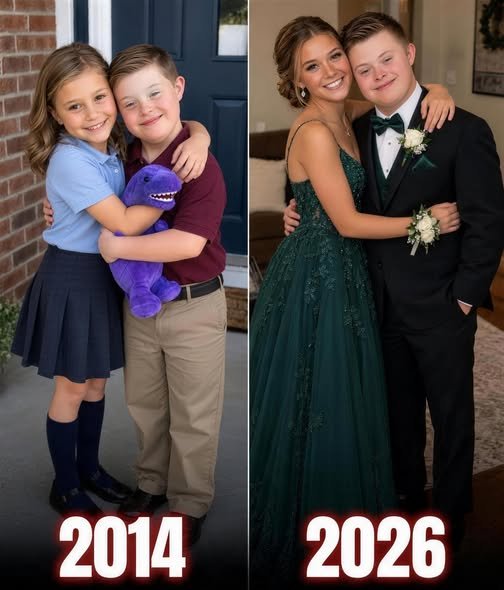
Downstairs, my best friend Noah was waiting in the living room in a navy-blue suit. He was wearing the bow tie he had talked about for months, and I could hear his laughter drifting up through the floor as he chatted with my aunt.
I looked at Mom.
“Why did you lock the door?”
She didn’t answer immediately.
Instead, she took a slow breath and looked at me with an expression I couldn’t read.
“You’re still going to prom with Noah,” she said. “I’m not stopping you.”
“Then what’s going on?”
She hesitated.
“But before you leave, I need you to hear something.”
“About what?”
Her gaze flickered toward the door.
“About Noah.”
My stomach tightened.
Then she added softly,
“And about me.”
I had no idea that the conversation we were about to have had actually begun six years earlier.
And in some ways, twelve years earlier.
Back when Noah and I were six years old and our friendship started over a shared hatred of raisins.
We met in first grade during snack time.
Our teacher passed out little red boxes of raisins to everyone in class. I opened mine, stared at the shriveled things inside, and immediately began trying to hide the box beneath my napkin.
A voice beside me whispered,
“Good idea.”
I turned.
The boy sitting next to me was doing exactly the same thing.
“You don’t like raisins either?”
He shook his head solemnly.
“They’re grapes that got too old.”
I stared at him.
Then I laughed so hard that our teacher told us both to settle down.
That boy was Noah.
By lunchtime, we had decided we were best friends.
At six, I didn’t care that Noah had Down syndrome.
What mattered to me was that he cheated whenever we played dinosaur trivia, told terrible jokes with absolute confidence, and never made fun of my drawings even when my T. rex looked like a potato with teeth.
We were just two children who liked each other.
Then one afternoon, another boy in our class said something cruel.
He told Noah that nobody would ever marry him.
I still remember watching Noah’s smile disappear.
Something hot and angry rose inside me.
“Someone will love him,” I snapped.
The boy laughed.
“Then you marry him.”
Later that day, Noah found me alone near the playground.
He stood beside me for a few seconds before asking quietly,
“Chrissy?”
“Yeah?”
“Would you love me?”
At six years old, I had absolutely no understanding of how big that question was.
So I shrugged.
“Maybe.”
His entire face lit up.
Then I remembered something my older cousin had been talking about for weeks.
Prom.
“But we have to go to prom first,” I said.
Noah frowned.
“What’s prom?”
“A fancy dance you go to when you’re almost an adult.”
He considered that very seriously.
Then he held out his pinkie.
“Promise we’ll go?”
I hooked mine around his.
“Promise.”
Five minutes later, I was probably thinking about crayons or recess.
Noah remembered that promise for twelve years.
Part 2 — The Friend Who Stayed
Growing up didn’t pull us apart the way people often assume childhood friendships will.
We changed.
Our interests changed.
Our schedules changed.
But somehow, Noah and I kept finding our way back to each other.
He became obsessed with baseball statistics.
I became obsessed with art.
He could talk for half an hour about batting averages and pitchers.
I could spend the same amount of time discussing color, brushwork, and paintings he insisted all looked “unfinished.”
He dragged me through baseball conversations.
I dragged him through museums.
Neither of us ever convinced the other that our hobby was better.
When we were twelve, my parents divorced.
That was the first time Noah saw me become someone quieter.
Dad moved out.
Mom tried to hide how much she was hurting, but sometimes I would walk past her room and hear her crying.
At school, I stopped eating much.
I spoke less.
I avoided friends.
Most people asked questions.
Noah didn’t.
He simply started sitting next to me at lunch.
Some days, he talked about baseball.
Some days, he complained about homework.
Other days, he said almost nothing.
He never demanded that I explain why I was sad.
He never tried to convince me everything was fine.
He just made sure I wasn’t sitting alone.
Years later, when I failed my first driving test, Noah showed up at my house holding two ice creams.
I looked at the cups in his hands.
“Why two?”
He handed me one.
“This one is because you tried.”
“And the second?”
He took a bite.
“Because you were terrible.”
I laughed so hard I nearly dropped mine.
Another time, I came close to giving up painting after someone at school laughed at a piece I’d worked on for weeks.
The next morning, I discovered that Noah had taken one of the ugliest dinosaur drawings I’d ever made and taped it inside his locker.
I stared at it.
“Why is that there?”
“So you don’t quit.”
I pointed at the drawing.
“Noah, that dinosaur is awful.”
He nodded thoughtfully.
“Very awful.”
“Then why keep it?”
“Because if you stop drawing now, your dinosaurs will always look like potatoes with arms.”
That was Noah.
He didn’t fix my problems.
He didn’t pretend pain wasn’t real.
He simply refused to disappear when things became difficult.
So by the time senior prom arrived, I didn’t need to think about who I wanted to go with.
Noah still decided to remind me anyway.
One afternoon, he appeared beside my locker with an unusually serious expression.
“Chrissy?”
“Yes?”
“Do you remember first grade?”
I decided to tease him.
“Not really.”
His face fell so quickly that I immediately regretted it.
Then he slowly raised one hand.
His pinkie was extended.
And suddenly everything came rushing back.
The raisin boxes.
The playground.
That boy’s cruel comment.
Our promise.
I stared at his pinkie.
“Prom?”
Noah grinned.
“Prom.”
I hooked my finger around his.
Then he added proudly,
“I already bought my bow tie.”
I blinked.
“When?”
“November.”
I laughed.
“Noah, prom wasn’t even close in November.”
He shrugged.
“Stores run out of things.”
“They weren’t going to run out of bow ties.”
He gave me a suspicious look.
“You don’t know that.”
And just like that, a childhood promise I’d almost forgotten became our actual plan.

Part 3 — Rosemary
Prom night arrived faster than either of us expected.
I was halfway down the staircase when the doorbell rang.
Mom opened the door.
Noah stood on the porch wearing his navy suit and the famous bow tie.
It was perfectly straight.
In one hand, he held a small corsage.
The second I saw him, I smiled.
Then I noticed Mom.
Her expression had changed.
She looked at Noah as though she were seeing him differently for the first time.
I came down another step.
“What’s the flower?”
Noah lifted the corsage proudly.
“Rosemary.”
I laughed.
“That’s not exactly a traditional prom flower.”
“I know.”
“So why rosemary?”
He smiled.
“The florist said rosemary means remembering.”
He paused for dramatic effect.
“And I remember promises.”
Behind me, Mom made a strange, broken little sound.
I turned.
Her eyes were shining.
“Mom?”
She quickly wiped beneath one eye.
“Christina, come upstairs with me.”
I frowned.
“Now?”
“Yes.”
“But Noah’s here.”
“I know.”
Noah looked between us.
“I can wait.”
I gave Mom a confused look but followed her upstairs.
The second we entered my bedroom, she closed the door.
Then she locked it.
My irritation immediately turned to worry.
“Mom, you’re freaking me out.”
“You’re going with Noah.”
“You already said that.”
“I need one promise from you first.”
That made me defensive.
“If this is about him having Down syndrome—”
“It isn’t.”
“Then what is it?”
Mom sat on the edge of my bed.
For several seconds, she simply looked down at her hands.
Then she asked,
“Do you remember what you were like after your father left?”
I stared at her.
“What does Dad have to do with prom?”
“You were twelve.”
“I know.”
“You barely spoke. You weren’t sleeping well.”
She looked at me.
“And you stopped eating lunch.”
I went still.
“How do you know that?”
Her answer came quietly.
“Noah told me.”
I stared at her.
“Noah?”
Mom nodded.
Then she told me something I had never known.
During one of the hardest weeks after the divorce, she had parked outside my school one afternoon and cried in her car.
She thought she was alone.
She wasn’t.
Noah saw her.
“He came over to the car,” Mom said. “He knocked on the window and asked if I was okay.”
I sat beside her.
“What did you say?”
“I lied and told him I was fine.”
Despite everything, I smiled faintly.
“He probably didn’t believe you.”
“He didn’t.”
Mom took my hand.
“Then he asked whether you were broken.”
The word hit me strangely.
“Broken?”
“He’d noticed you weren’t eating. He’d noticed you weren’t laughing. He knew you had started sitting by yourself.”
My throat tightened.
“What did you tell him?”
“I told him you weren’t broken.”
Mom’s eyes filled again.
“And then he said something I’ve remembered ever since.”
“What?”
Her voice trembled.
“He said, ‘Good. Because I don’t know how to fix people. I only know how to stay.’”
I couldn’t say anything.
Suddenly, those lunches came back to me in detail.
Noah dropping into the seat beside me.
Noah talking about baseball when I didn’t feel like talking.
Noah quietly eating when I didn’t want conversation at all.
I had always remembered those moments as friendship.
I had never realized he had made a conscious decision to stay near me because he could see I was hurting.
Mom squeezed my fingers.
“That day, I asked him for something I probably never should have asked a twelve-year-old for.”
I turned toward her.
“What?”
“I asked Noah to look after you.”
I stared at her.
“You did?”
She nodded, ashamed.
“I was falling apart, Christina. Your father was gone. You barely talked to me. I didn’t know how to reach you.”
Her voice broke.
“But Noah could still make you smile.”
I imagined twelve-year-old Noah standing beside my mother’s car.
“What did he say?”
Mom gave a small, teary laugh.
“Just ‘Okay.’”
Of course he did.
Then her expression changed.
“That wasn’t the mistake, though.”
“What was?”
“For years afterward, I watched your friendship through the wrong lens.”
I waited.
“Whenever you changed plans because Noah wasn’t invited somewhere, I worried.”
My shoulders stiffened.
“When you defended him, I worried. When you chose to spend time with him instead of other people, I wondered whether you felt responsible for him.”
I pulled my hand away.
“He’s my best friend.”
“I know.”
“You thought I was taking care of him?”
“Yes.”
Her honesty stung.
She looked toward the floor.
“I kept noticing what I imagined Noah might need from you.”
Then she looked at me again.
“And somehow I failed to see what he was giving you.”
I said nothing.
She continued softly.
“The lunches after your dad left.”
“The ice cream after you failed your driving test.”
“The ridiculous dinosaur taped in his locker.”
“The night of your first heartbreak when he sat with you on the porch until almost midnight.”
I felt tears burning behind my eyes.
Mom whispered,
“Noah was never some responsibility you were carrying.”
She shook her head.
“You were carrying each other.”
And suddenly I understood why she had looked at him that way when he arrived.
Not with worry.
With recognition.
“So what’s your condition?” I asked.
Mom smiled through her tears.
“Don’t walk downstairs and go to prom with Noah because a six-year-old girl made a promise.”
She took both my hands.
“Go because eighteen-year-old Christina still chooses him.”
For several seconds, I simply stared at her.
Then I laughed softly.
“Mom.”
“What?”
“That was already why I was going.”
Her face crumpled.
“I know that now.”
Part 4 — The First Dance
When we came downstairs, Noah looked at us suspiciously.
“You were gone a long time.”
“I know,” I said.
He looked at Mom.
“Did Chrissy get in trouble?”
Mom laughed.
“No.”
Then, to my complete surprise, she walked directly toward him.
“Noah, can I have the first dance?”
His eyes widened.
“Mrs. Jane.”
“Yes?”
“This isn’t prom.”
I burst out laughing.
Mom ignored him.
She turned on music from her phone and held out her hands.
Noah sighed dramatically but accepted.
For the next thirty seconds, he attempted to lead while Mom repeatedly stepped in the wrong direction.
Finally, Noah stopped.
“Mrs. Jane.”
Mom looked at him innocently.
“What?”
“Chrissy dances better.”
Mom nodded.
“That is exactly why she’s your date.”
Then her smile faded into something gentler.
She looked directly at him.
“Thank you for staying.”
Noah blinked.
He looked genuinely confused, as if she’d thanked him for breathing.
Then he glanced at me.
“She stays too.”
Mom closed her eyes for a moment.
I knew immediately what those three words had done to her.
For years, she had believed the friendship moved mostly in one direction.
That Noah needed me.
That I protected him.
That I included him.
But Noah had never seen our friendship that way.
Neither had I.
We stayed for each other.
That was all.

Part 5 — Twelve Years Later
When Noah and I finally arrived at prom, the gym had been transformed with lights, fabric, flowers, and decorations that were clearly trying very hard to make us forget we were still standing inside a school.
Noah approved.
“Very fancy.”
“You’ve been waiting twelve years. Was it worth it?”
He looked around thoughtfully.
“Ask me after food.”
Naturally.
We took photographs.
Talked to friends.
Ate more snacks than we were supposed to.
Noah spent several minutes explaining to someone why his bow tie had been an excellent early purchase.
Then the music slowed.
He turned toward me.
His expression became serious.
He held out his hand.
“Chrissy.”
I smiled.
“Yes?”
“You owe me.”
“For what?”
“Twelve years.”
I laughed.
“Fine.”
I took his hand.
Five seconds later, he stepped directly on my shoe.
“Ow!”
“That was your fault.”
“How?”
“Your dress is badly designed.”
“You stepped on my foot!”
“There is too much fabric.”
I stared at him.
Then both of us started laughing.
People glanced over.
We didn’t care.
And that became my favorite thing about the entire night.
Nothing extraordinary happened.
The music didn’t stop.
Nobody gathered around us.
Nobody applauded because Noah and I were dancing together.
No one turned our friendship into a performance.
We were simply two eighteen-year-olds at senior prom.
Two terrible dancers laughing at each other.
Exactly where we had promised to be when we were six.
And somehow, the ordinariness of it made the moment perfect.
Part 6 — What Mom Finally Understood
By the time Mom arrived to pick us up, my feet were aching.
I took off my heels before we even reached the parking lot.
Noah picked them up.
“You’re carrying my shoes?”
“You’re walking too slowly.”
“You just complained about my dress all night.”
“That doesn’t mean you should walk barefoot in a parking lot.”
He was overheating in his suit, so I carried his jacket.
At the car, he opened my door.
I climbed inside.
Then, before he could walk around to the other side, I leaned across the back seat and opened his door for him.
Noah grinned.
“Thank you.”
“You’re welcome.”
Mom watched us through the rearview mirror.
She didn’t say anything.
She didn’t need to.
For years, she had looked at our friendship and assumed there had to be a caretaker.
A giver.
A receiver.
Someone strong and someone who needed protecting.
That night, she finally saw what had always been obvious to Noah and me.
Nobody was rescuing anybody.
I wasn’t with Noah because I felt sorry for him.
He wasn’t beside me because my mother had asked him to protect me six years earlier.
Neither of us was fulfilling some childhood obligation.
The promise had brought us to prom.
But friendship had kept us together for the twelve years in between.
We had learned something as children that adults sometimes make far more complicated than it needs to be.
When someone matters to you, you show up.
When life becomes difficult, you don’t have to fix everything.
Sometimes you can’t.
Sometimes the person you love doesn’t need answers, advice, or rescuing.
Sometimes they simply need someone willing to sit beside them until the worst part passes.
Someone who remembers.
Someone who chooses them.
Someone who stays.
And if you’re very lucky, somewhere along the way, you realize something even more beautiful.
They’ve been choosing you too.