
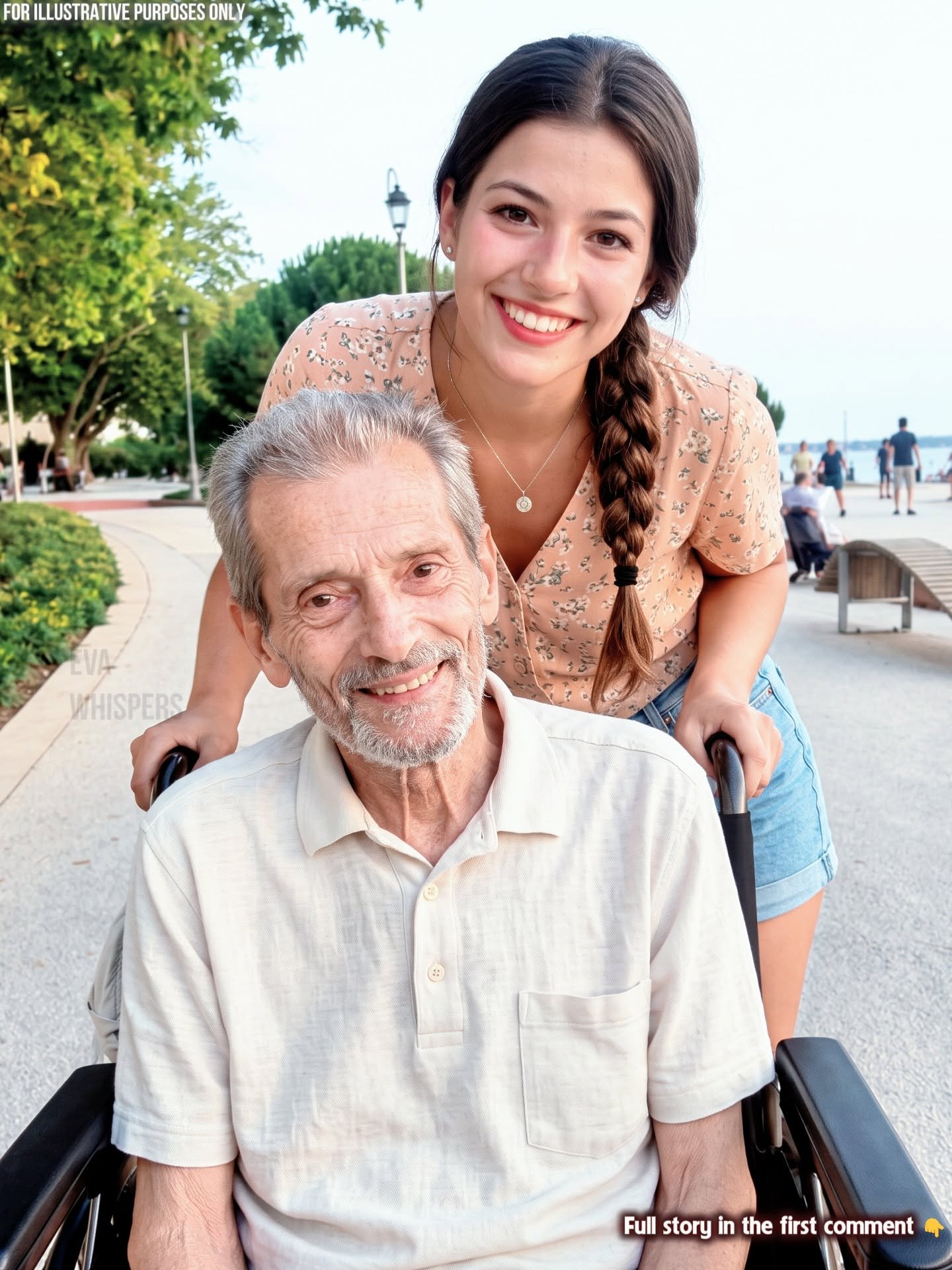
Part 1: The Man With No Visitors
Two years after my mother died, I began volunteering at a small hospice on the outskirts of town.
Whenever people asked why, I gave them the answer they expected.
“I want to help people during a difficult time.”
It sounded generous and admirable. It was also only half true.
The real reason was that I could no longer stand returning to my silent house every evening. My mother’s shoes were still tucked beneath the bench by the door. Her favorite mug remained in the cupboard. Sometimes I caught myself reaching for my phone to call her before remembering there was no one left to answer.
At the hospice, grief did not make people uncomfortable. No one told me to be strong, move forward, or focus on the good memories. Sadness belonged there. It was allowed to sit in the room without explanation.
That was where I met Nathan Cole.
Nathan was fifty-nine, though illness had made him look older. His face was thin, his eyes were alert, and his patience seemed to have disappeared long before his health did.
He disliked almost everything.
He complained about the weak coffee, the lumpy pillows, the curtains, the daytime television programs, and the cheerful tone nurses used when asking about his pain.
Most of all, he hated being called brave.
“I’m not brave,” he told one nurse. “I’m simply not dead yet.”
Most patients had family photographs on their bedside tables. Flowers arrived with handwritten cards. Children and grandchildren came carrying homemade meals, clean clothes, and stories from home.
Nathan had none of those things.
There was one worn leather bag beside his bed and no emergency contact listed in his file.
During my second shift, I crossed the street and bought him coffee from a small café. When I handed it to him, he took a cautious sip.
“You remembered the cream.”
“You complained about the hospice coffee for twenty minutes.”
“Complaining doesn’t mean anyone listens.”
“It does when the person complaining is impossible to ignore.”
For a moment, he simply stared at me.
Then one corner of his mouth lifted.
It was the first time I saw him smile.
Several days later, the volunteer coordinator stopped me in the hallway.
“Nathan asked whether you could visit him.”
“Did he say why?”
“He said you remind him of someone.”
I should have asked who.
Instead, I began stopping by his room before ending each shift.
Nathan revealed his life in fragments. He told me he had washed dishes as a teenager, driven delivery trucks in his twenties, and eventually spent most of his adult life working in a diner.
He spoke about broken refrigerators, impatient customers, and a waitress who once chased a thief down the street while still wearing an apron.
But whenever I asked about family, he redirected the conversation.
“Were you ever married?” I asked one afternoon.
“Pass me the crossword.”
“Do you have children?”
“Nine letters. ‘Unnecessarily complicated.’”
“Nathan.”
“Bureaucracy.”
“That’s eleven letters.”
“Then the puzzle is wrong.”
One afternoon, while I sat beside him working on a crossword, a man in a dark suit appeared in the doorway.
The change in Nathan was immediate.
His shoulders stiffened. The faint warmth in his expression vanished.
“What do you want?” Nathan demanded.
The man raised a folder. “Your signature.”
Nathan accepted the papers without introducing us. The stranger glanced at my coffee cup and then at the puzzle book lying between us.
Something unreadable passed across his face—hurt, perhaps, or resentment.
“This is Eric,” Nathan finally said. “He handles my paperwork.”
Eric gave me a restrained nod.
Nathan signed the documents and held them out.
“You can go now.”
Eric’s jaw tightened, but he said nothing. He took the folder and left.
I remember thinking Nathan treated him like an employee who had overstayed his welcome.
I did not know then how wrong I was.
A week later, rain tapped against Nathan’s window while I adjusted the blanket over his legs.
He reached out and closed his fingers around my hand.
“I have one final request.”
“That sounds ominous.”
“It probably is.”
He looked toward the dark window.
“Pretend you’re my daughter until I’m gone.”
I thought I had misunderstood him.
“What?”
“Life separated me from my little girl before she was born. I never got to hold her. I never watched her grow up. I never heard her call me Dad.”
His voice remained controlled, but his hand trembled around mine.
My mother had raised me alone. She had never told me my father’s name.
Whenever I asked about him, she offered the same answer.
“He chose fear over us.”
After her death, I searched through every drawer, box, envelope, and old photograph she had left behind. I found no name, no address, and no explanation.
Nathan’s request should have frightened me.
Instead, it touched the oldest and deepest wound I carried.
I forced a smile.
“Well, then… hello, Dad.”
Nathan laughed so hard that it turned into a coughing fit.
I reached for the call button, but he caught my wrist.
“Don’t ruin my first minute as a father.”
“You’ve been my father for less than a minute, and you’re already giving orders.”
“I have a lot of lost time to make up for.”
Neither of us understood how true those words were.

Part 2: A Borrowed Family
For the next six weeks, Nathan and I created a small family out of imagination, coffee, and borrowed time.
I brought him coffee from across the street. He saved the most difficult crossword clues for me. I pushed his wheelchair through the hospice garden while he criticized flowers he had never planted.
“That rose bush is leaning.”
“It’s a plant, Nathan. It isn’t required to stand at attention.”
“It has no discipline.”
He complained constantly, but beneath the irritation, I began to notice gentleness.
He remembered which days were hardest for me. He asked about my work. He noticed when I had not slept well, even when I insisted I was fine.
For years, I had been the person who cared for everyone else. During my mother’s illness, I scheduled appointments, managed medications, cooked meals, worked two jobs, and smiled whenever she apologized for needing me.
Nathan was difficult, but he chose me.
I had not realized how badly I needed to be chosen.
The hospice approved two brief outings after Nathan signed the necessary medical forms.
The first was to Millie’s Diner.
The moment we entered, the manager’s face brightened.
“Nate. It’s good to see you.”
Nathan gave a careless shrug when I looked at him.
“I used to work here.”
The way the staff greeted him suggested he had done much more than that.
We sat in a corner booth near the window. A waitress brought him coffee without asking for his order.
Nathan requested two slices of apple pie.
“Are we expecting someone?” I asked.
“No. I simply dislike choosing.”
“Between two identical slices?”
“One could be better.”
The second outing was to the ocean.
Getting him across the sand was exhausting. He refused help until his legs nearly failed him. Finally, he allowed me to support his weight.
At the water’s edge, he removed his shoes and pressed his bare feet into the wet sand.
His eyes closed.
For several minutes, the sharp-tongued man disappeared. He looked peaceful and strangely young.
“Was it worth the trouble?” I asked.
“Ask me when I can no longer stand.”
People often assumed I was his daughter during our outings.
Before I could correct them, Nathan always answered.
“She is.”
Every time he said it, warmth spread through me, quickly followed by guilt.
We were pretending. I knew that.
Yet the affection between us did not feel imaginary.
Sometimes I wondered whether love cared about facts. Perhaps it only cared that two lonely people had found each other when they needed someone most.
Nathan weakened rapidly during the final week.
His sharp voice faded. He slept more often. Some days, he could barely lift his coffee cup.
During my last visit, I sat beside him and held his hand. His fingers felt light and fragile in mine.
He opened his eyes.
“Was I convincing?”
“As a father?”
“As someone worth remembering.”
My throat tightened.
“You were difficult.”
A faint smile appeared.
“That sounds honest.”
“You were demanding, rude, stubborn, and exhausting.”
“Better.”
I leaned closer.
“And I’ll remember you.”
His fingers tightened around mine.
Nathan died the following morning.
At his funeral, I recognized several hospice workers, the manager from the diner, and the silver-haired waitress who had served us without asking Nathan what he wanted.
Eric stood alone near the back.
He watched as I placed a flower on Nathan’s casket.
For a moment, I thought he might approach me.
He did not.
The next afternoon, my phone rang.
“My name is Eric Cole,” the caller said. “I handled Nathan’s estate.”
“I remember you.”
“There’s something you need to know. Something Nathan should have told you himself.”
We arranged to meet at his office.
A small wooden box sat in the center of the conference-room table when I arrived. Eric looked as though he had not slept since the funeral.
He gestured toward the chair across from him.
I remained standing.
“What did Nathan hide from me?”
Eric took a breath.
“Nathan was your biological father.”
The words entered the room but did not reach me.
“No.”
“He was your father.”
“No,” I repeated, louder this time.
Eric opened a file and pushed it across the table.
Inside was a signed acknowledgment of paternity dated before my birth. There were copies of letters addressed to my mother, each marked as returned. Beneath them was a report from an online genealogy service.
Years earlier, while searching for relatives on my mother’s side, I had submitted a DNA sample.
Nathan had found me through that database.
“He confirmed your identity,” Eric said. “Then he learned you were volunteering at the hospice.”
I stared at him.
“He chose that hospice because I worked there?”
“Yes.”
“He arranged our meeting?”
“Yes.”
“You knew?”
Eric’s expression tightened.
“Yes.”
“For the entire six weeks?”
“Yes.”
My chair crashed into the wall as I stood.
“You watched me pretend he was a stranger.”
“I did.”
“You watched me call him Dad without knowing he actually was my father.”
“I did.”
“Why?”
“Nathan believed you would refuse to see him if you knew the truth.”
“That decision belonged to me.”
“I know.”
“Stop saying that!”
Eric lowered his gaze.
“He threatened to refuse treatment and remove me from every medical decision if I told you. I convinced myself that he was dying and that giving him a few peaceful weeks would hurt you less than telling you.”
“You decided his comfort mattered more than my right to choose.”
“Yes,” Eric whispered. “And I was wrong.”

Part 3: The Brother I Never Knew
I wanted Eric to argue with me.
I wanted him to defend what he had done so I could hate him without hesitation.
Instead, he accepted my anger, and somehow that made it worse.
He opened the wooden box.
Inside were two bundles of letters. One had my name written across it. The other was addressed to Eric.
Beneath the letters were legal documents stating that Nathan had left us joint ownership of Millie’s Diner.
I looked from the papers to Eric.
“Who were you to him?”
Eric’s jaw tightened.
“His son.”
The answer struck a different wound.
Nathan had spent six weeks pretending he had never known what it felt like to be a father.
All that time, he had already had a son.
Eric explained that Nathan had married years after leaving my mother. Eric had grown up in Nathan’s house, but he had rarely experienced affection from him.
“He provided everything practical,” Eric said. “Food, school fees, a place to live. He attended parent meetings and checked my grades. But he never asked how I felt unless my feelings were interfering with something measurable.”
“And you still protected him.”
Eric stared through the window.
“When he told me about you, it was the first time he had trusted me with anything personal. I thought he was finally treating me like a son.”
His voice became quieter.
“Then you arrived carrying his coffee, and suddenly he became the father I had spent my whole life waiting for.”
“You resented me.”
“Yes.”
“I didn’t take him away from you.”
“I know.”
I glared at him.
Eric stopped, then corrected himself.
“No. You didn’t.”
Nathan’s letter waited unopened on my kitchen table that night.
I walked past it repeatedly.
Part of me wanted to tear it apart. Another part wanted to press it against my chest and imagine that it contained every answer I had ever wanted.
Eventually, I opened it.
Nathan admitted that he had failed both of his children, though in different ways.
He had abandoned me before I was born.
He had remained in Eric’s life but withheld the tenderness a child deserved.
He wrote that he had panicked when my mother became pregnant. He left town, then returned months later claiming he wanted to help. By then, my mother had refused to see him.
He had sent letters for years. She returned them unopened.
Perhaps he had regretted leaving.
But regret did not erase the moment he chose fear over responsibility.
Nathan confessed that he had arranged our meeting because he wanted to know whether I could care for him before learning what he had done.
He had wanted love without first facing judgment.
Even his regret had become another demand placed upon me.
Near the end of the letter, he mentioned the question he had asked during our final conversation.
Was I convincing?
The truth turned my stomach.
Nathan had never been pretending to be my father.
He had been pretending not to be.
On the final page, he wrote that he hoped Eric and I might someday give each other the family he had denied us.
I called Eric the next morning.
“We are not obligated to become family because Nathan wanted a peaceful ending.”
“I agree.”
“And I haven’t forgiven you.”
“I understand.”
For the next month, we communicated only through separate attorneys.
The diner could not be sold without both signatures. The building was valuable, but the business itself was struggling. It carried unpaid bills, aging equipment, and years of delayed repairs.
Eric wanted to sell the property, clear the debt, and divide what remained.
At first, I agreed.
Then we visited Millie’s.
The silver-haired waitress from Nathan’s funeral approached me.
“You came here with him.”
“Yes.”
“I’m Rosa.”
She led us to the same corner booth where Nathan and I had eaten pie.
“Nathan started here as a dishwasher,” she said. “Years later, he bought the building.”
Her hand rested on the back of the booth.
“Every year on your birthday, he sat here and ordered two slices of apple pie.”
My arms tightened across my chest.
“Missing someone isn’t the same as finding them.”
Rosa held my gaze.
“No. It isn’t.”
Six employees depended on the diner for their income.
Eric remained focused on the numbers.
“We can’t keep every failing business alive because we feel guilty.”
“And selling it fixes everything?”
“It pays the debt.”
“It also takes away six people’s jobs.”
Paul, the manager, overheard us.
“Your father told us he was trying to make things right,” he said.
Eric went completely still.
Then, to my surprise, he faced Paul.
“He lied to her.”
The conversations around us stopped.
Paul frowned. “What?”
“She didn’t know Nathan was her father,” Eric said. “I knew. I helped him hide it from her until he died.”
Rosa stared at him.
Eric’s face reddened, but he did not turn away.
“I chose Nathan’s wishes over her right to know the truth. Whatever happens to this diner, don’t blame her for taking time to decide.”
It was the first time I had seen Eric stop protecting Nathan’s reputation.
Three days later, he sent me a written apology.
He offered to step down as the estate representative. He also offered to pay for independent legal counsel to review every document and every decision he had made.
It was the first apology that cost him something.
That was why I agreed to listen.

Part 4: Learning to Tell the Truth
I agreed to examine the diner’s accounts before making a final decision.
For four months, Eric and I met twice a week.
We argued about nearly everything.
We argued over staff schedules, equipment costs, menu prices, and whether keeping the diner open was an act of loyalty or a form of guilt.
Eric believed numbers told the truth.
I believed numbers often ignored the people hiding behind them.
Eventually, we found a compromise.
An unused section of land behind the diner could be sold. The sale would cover the most urgent debts. We reduced operating hours temporarily, renegotiated supply contracts, and postponed renovations that were not essential.
The diner survived.
But the financial solution was not the most important thing we built during those months.
Eric began telling me about mistakes before I discovered them.
He showed me documents without being asked. When he was uncertain, he said so. When he disagreed with me, he no longer hid behind Nathan’s authority.
And slowly, I stopped seeing every practical suggestion as proof that he was cold.
I learned that Eric had spent most of his savings on Nathan’s treatment.
He learned that I had worked two jobs while caring for my mother.
I discovered that beneath Eric’s controlled voice was a man who had spent his entire childhood trying to earn affection through achievement.
He discovered that beneath my anger was a daughter who had wanted answers long before she understood the questions.
Neither discovery erased his betrayal.
But it changed the shape of my anger.
One afternoon, Paul blamed Eric for the condition of the diner.
“Your father ignored these problems for years,” he said. “You should’ve done something.”
Before I could think, I stepped between them.
“Eric isn’t responsible for every choice Nathan made.”
Eric looked at me with surprise.
Later, as we walked to our cars, he said, “You didn’t have to defend me.”
“I wasn’t defending what you did to me.”
“I know.”
“But I won’t let people punish you for things that weren’t yours.”
He nodded.
This time, the words “I know” did not make me angry.
The hospice eventually formed a partnership with Millie’s.
Once a month, the diner provided free breakfasts to hospice patients and their families.
We did not rename the diner after Nathan.
Neither of us wanted to turn him into a saint.
We left the corner booth untouched, though.
It held too many versions of him to erase.
It was where he had eaten alone on my birthdays. Where he had brought me without confessing the truth. Where Eric had finally admitted what we had done.
Trust did not arrive dramatically.
It grew through small, almost ordinary actions.
Eric called when he promised he would.
I stopped assuming silence meant deception.
We argued, apologized, and returned to the conversation.
Sometimes we spoke about Nathan. Sometimes we deliberately did not.
We did not call each other brother and sister.
Not at first.
Nathan had tried to write our ending for us. We refused to follow his script.
Whatever relationship formed between Eric and me would be built by our choices, not by Nathan’s final request.

Part 5: Three Chairs at the Table
On my birthday, I arrived at Millie’s before opening.
The dining room was still dim. The chairs were upside down on most of the tables, and the kitchen smelled faintly of coffee and warm apples.
Eric was sitting in Nathan’s corner booth.
Two slices of apple pie rested on the table.
“I suppose he finally got his table for two,” Eric said.
I looked at the empty seat across from him.
Nathan had manipulated me.
He had stolen my chance to confront him while he was alive. He had decided that his fear mattered more than my consent. He had wanted forgiveness without doing the painful work of asking for it honestly.
Missing me for years did not repair what he had done.
But the six weeks we spent together had also been real.
The laughter had been real.
The coffee, the crosswords, the ocean, and the quiet conversations beside his bed had been real.
Love did not erase anger.
Anger did not make love false.
I reached for a third chair and pulled it toward the booth.
“No,” I said. “He doesn’t get to decide who belongs at this table.”
Eric stared at the chair for a long moment.
Then he moved over and sat beside me rather than across from me.
Before the doors opened, he reached into his briefcase and placed Nathan’s unopened letter on the table.
“I still haven’t read it,” he said.
“Why not?”
“Because I think I already know what he’ll ask me to forgive.”
I studied the envelope.
“Maybe he won’t.”
“He always wanted the ending before doing the work required to reach it.”
His words sounded so much like my own anger that I nearly laughed.
I pushed the letter gently toward him.
“You don’t have to read it today.”
Eric looked at me.
“Did you read yours all at once?”
“No. I stopped three times.”
“Did it help?”
“It hurt differently each time.”
He nodded.
Instead of returning the letter to his briefcase, he slipped it into the inside pocket of his coat.
It was a small distinction, but I noticed it.
For once, neither of us allowed Nathan to control the pace.
We sat without speaking until Rosa switched on the lights.
The dark windows slowly became mirrors, reflecting the booth, the slices of pie, and three chairs gathered around one table.
Rosa unlocked the front door.
Families from the hospice began walking inside. Some looked exhausted. Others carried the careful expressions of people trying not to fall apart in public.
Eric and I stood to help welcome them.
Nathan’s slice of pie remained in the center of the table.
Rosa noticed the three chairs. Without saying anything, she disappeared into the kitchen and returned carrying another fork.
She placed it beside the untouched slice.
It was not forgiveness.
It was not forgetting.
It was simply an acknowledgment that Nathan had been part of our story, even if he no longer had the right to control how it ended.
Eric looked at me.
For the first time, I did not see Nathan’s lawyer, his accomplice, or the favored child who had received the life I never had.
I saw a man who had been hurt by the same father in a different way.
My brother.
Not because Nathan had ordered us to become family.
Because, little by little, we had chosen it for ourselves.