
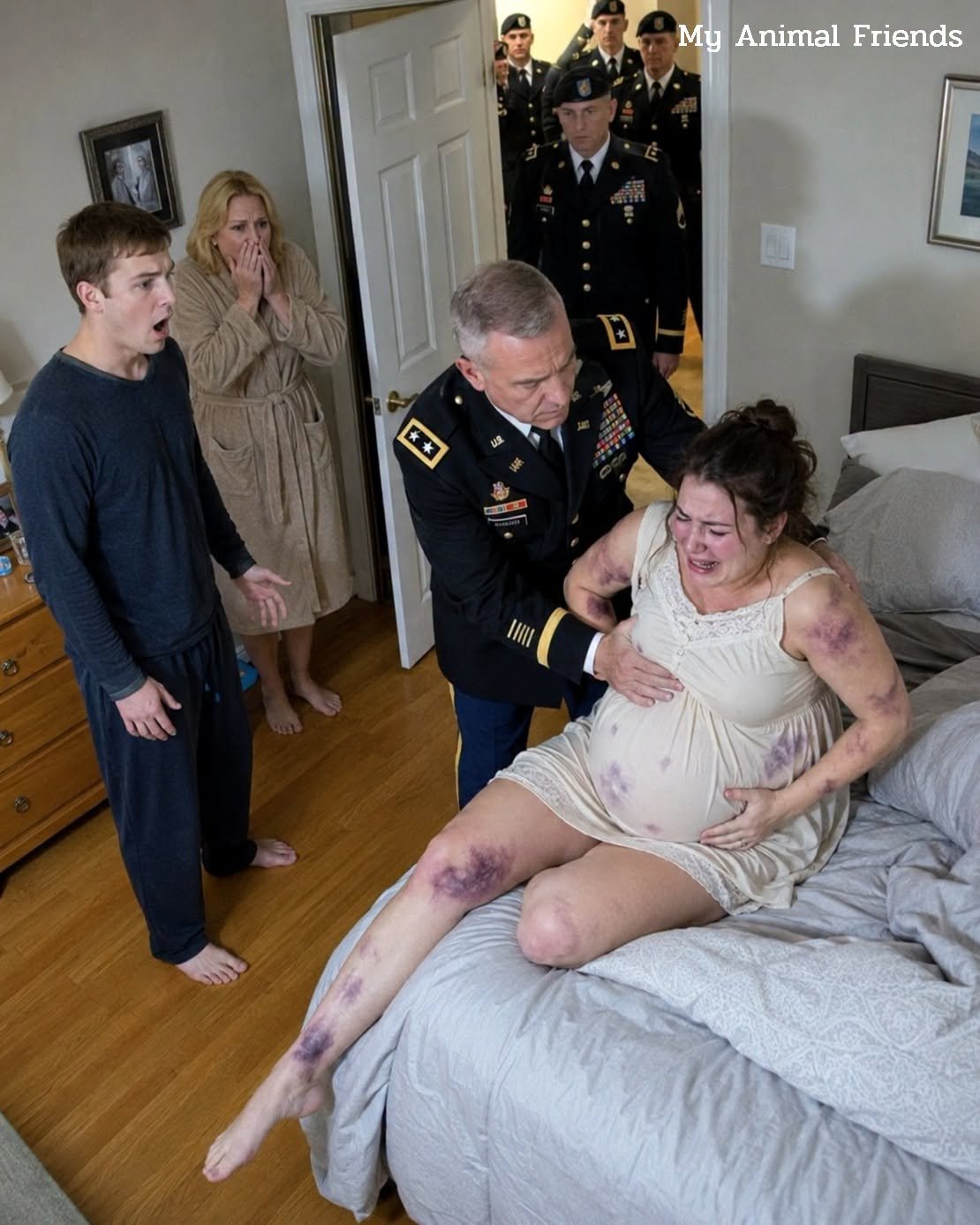
PART 2
The heavy footsteps stopped outside the apartment door.
For one strange second, nobody moved. Ryan stood beside the bed with his face drained of color. Linda’s mouth hung slightly open, as if the sentence she had been preparing had simply disappeared. My father remained where he was, one hand still gripping the blue blanket, his eyes fixed on the dark marks I had spent months hiding.
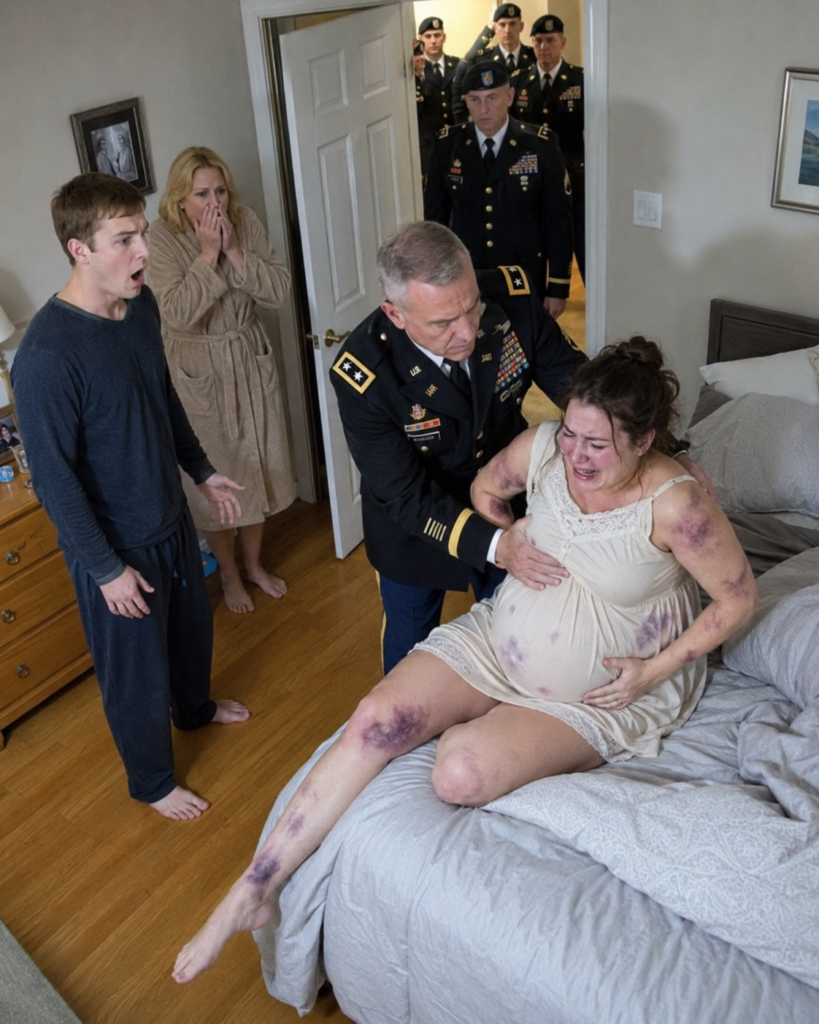
Then someone knocked.
Not a polite knock. Not a neighbor’s uncertain tap.
A firm, official sound.
Dad folded the blanket back over me with a gentleness that made my chest ache. He did not look at Ryan again when he crossed the room. He opened the door to reveal two uniformed officers and a woman in a navy coat with a medical bag hanging from her shoulder.
“Colonel Bennett?” one officer asked.
Dad nodded once. “Thank you for coming.”
Ryan’s head snapped up. “You called the police?”
“I called for help,” Dad said.
The woman stepped inside first. Her eyes moved quickly from me to the room, taking in the untouched food, the dim curtains, the stillness that had swallowed my life. “Emily Bennett?”
I tried to answer, but my throat closed.
Dad returned to my side. “She’s Emily Carter now,” he said quietly, then swallowed. “But she’s my daughter.”
The nurse introduced herself as Mara. Her voice was calm without being soft, steady without being cold. She asked if she could check me. I nodded because I could no longer think of any other way forward.
Ryan began talking at once.
“She’s fragile,” he said. “Pregnancy has been hard on her. She bruises easily. She’s emotional. You can ask anyone.”
Linda stepped beside him, folding her arms. “This is humiliating. Emily has always exaggerated when she doesn’t get her way.”
Dad turned then.
He did not raise his voice. Somehow that made him more frightening.
“Not another word until my daughter has been examined.”
The officers separated Ryan and Linda into the living room. Their voices drifted through the open door, sharp at first, then quieter when they realized no one was accepting easy explanations anymore.
Mara pulled the chair closer to the bed. “Emily, I’m going to ask you some questions. You only answer what you can.”
I stared at her hands as she took my pulse. They were warm, careful, ordinary hands. I had forgotten ordinary kindness could feel so startling.
“How far along are you?”
“Twenty-nine weeks,” I whispered.
“Any pain today?”
I hesitated.
Dad noticed.
“Sweetheart,” he said, kneeling beside me, “you don’t have to protect anyone here.”
The words loosened something inside me. I looked at him, at the face that had taught me how to ride a bike, change a tire, stand straight when life felt heavy. For months, shame had convinced me silence was easier than truth.
But silence had become a cage.
“My side hurts,” I said. “And my back. Sometimes when I breathe.”
Mara’s expression changed only slightly, but I saw it. Concern had weight. “We need to get you checked at the hospital.”
Ryan appeared in the doorway. “Hospital? That’s unnecessary.”
One officer placed a hand near his shoulder. “Sir, stay where you are.”
“I’m her husband.”
Dad’s eyes lifted. “Then start acting like someone worthy of that word.”
The sentence landed quietly, but Ryan flinched as if it had struck the part of him that still cared what others thought.
Mara helped me sit. The room tilted. My father’s hand immediately steadied my shoulder. I hated how weak I felt. I hated that he could feel me shaking.
“I’m sorry,” I whispered.
He looked stunned. “For what?”
“For lying.”
His mouth tightened, not in anger, but pain. “You survived the only way you knew how.”
On the way out, I saw the apartment as if I were visiting it for the first time. The framed wedding photo on the shelf. The baby blanket Linda had chosen and then complained was too expensive. The calendar with doctor appointments Ryan had crossed out and rescheduled without asking me. A stack of unopened mail sat near the door.
Dad noticed the mail too.
He paused.
Linda followed his gaze and moved too quickly. “That’s nothing.”
Dad picked up the stack before she could reach it.
Ryan’s voice sharpened. “Those are private.”
Dad handed the envelopes to one of the officers. “Then they can be reviewed properly.”
I did not understand why such a small thing made Ryan look so frightened.
At the hospital, the world became bright lights, white walls, gentle questions, and machines that measured the baby’s heartbeat. That sound filled the room like a tiny drum refusing to surrender.
Thump, thump, thump.
I cried when I heard it.
Dad stood beside the bed, one hand pressed to his mouth. He looked older beneath the fluorescent lights. Older than he had that morning. Older than he had when Mom died.
“The baby’s heartbeat is strong,” the doctor said. “But you’re dehydrated, undernourished, and there are injuries we need to document carefully.”
The word document made everything real.
A social worker named Priya arrived after sunset. She had kind eyes and a clipboard she barely looked at. She asked where I felt safe going after discharge.
I looked at Dad.
He answered before I could. “Home with me.”
Priya nodded. “Is that what you want, Emily?”
The question was simple. Still, it felt enormous. For months, every decision had been taken from me, disguised as concern or convenience. What I ate. Who I called. Which appointments I attended. Whether I was too tired to leave the bed.
“Yes,” I said. “I want to go with my father.”
Dad closed his eyes briefly.
Later, when the nurses dimmed the lights and left us alone, he sat beside me without speaking. Outside the window, Chicago glowed in the distance, its lights blurred by winter mist.
“I should have known,” he said.
“No.”
“I heard it in your voice.”
“Dad, please.”
He leaned forward, elbows on his knees. “I trained soldiers to recognize fear. I taught men and women to read silence, hesitation, the thing a person says when they can’t say what they mean.” His voice broke. “And I missed it in my own daughter.”
I reached for his hand. “You didn’t miss me. You came.”
He looked at our joined hands for a long time. “I almost didn’t.”
That confession surprised me.
“I told myself not to interfere,” he continued. “I told myself you were grown, married, building your own family. I didn’t want to be the father who barges in and treats his daughter like she can’t make her own choices.”
“You never made me feel that way.”
“I was afraid Ryan would say I was controlling.” A bitter smile crossed his face. “So I tried to be respectful. I gave him room. I gave him the benefit of the doubt.”
We both knew what that room had cost.
A nurse came in near midnight to adjust the monitor. After she left, Dad unfolded the small blanket from the hospital chair and covered himself without leaving my side.
“You should go home,” I said.
“I am home.”
I stared at him.
He nodded toward me and my belly. “Wherever you two are.”
For the first time in months, I slept without listening for footsteps in the hallway.
The next morning, the police officer returned with questions. Dad stepped out when I asked him to, though I saw how hard it was for him. Priya stayed with me.
I told the story slowly.
Not all of it. Not every word Linda had used to make me feel small. Not every time Ryan had apologized and then repeated the same pattern. Not every morning I had stood in front of the mirror telling myself it wasn’t as bad as I thought.
But enough.
When I finished, Priya handed me tissues. The officer’s face remained professional, but his voice softened.
“You did the right thing telling us.”
I almost laughed. The right thing had taken me seven months.
By afternoon, Dad returned with a duffel bag of clothes, my old gray sweatshirt from college, and a phone charger. He placed the charger on the bedside table as if it were treasure.
“Your phone has been ringing,” he said.
I tensed. “Ryan?”
“Mostly his mother. I turned it off after the sixth call.”
“What did she say?”
“I didn’t answer.”
That almost made me smile. My father, who would face a room of generals without blinking, had chosen the greatest insult of all for Linda Carter: silence.
Then he hesitated.
“What?”
He reached into his coat pocket and removed one envelope from the stack he had taken from the apartment. “The officer said this one was addressed directly to you. He allowed me to bring it.”
The envelope was cream-colored, with my name written in careful blue ink.
Emily Bennett.
Not Carter.
Bennett.
My heart gave a strange little kick.
“Who’s it from?” Dad asked.
I turned it over. No return address.
“I don’t know.”
My fingers trembled as I opened it. Inside was a single folded page and a small ultrasound image.
At first, I thought it was mine.
Then I saw the date.
Three years earlier.
The letter was short.
Emily, if you are reading this, then maybe you have finally started asking questions. I should have told you sooner, but I was afraid. Ryan and Linda are not who they pretend to be. Please be careful with anything they ask you to sign. Please find me before the baby comes. There are things you deserve to know. —Claire
I read it twice.
The room seemed to narrow.
“Emily?” Dad asked.
I handed him the paper.
His eyes moved across the lines. When he reached the signature, his expression hardened in a different way. Not the frozen anger from the apartment. This was focus. The colonel part of him had stepped forward.
“Who is Claire?”
“I don’t know.”
“Ryan never mentioned her?”
“No.”
Dad studied the ultrasound. “This says Baby Carter.”
My stomach turned cold. “Ryan told me he’d never been engaged before me.”
Dad folded the letter carefully. “Then we find Claire.”
For two days, the hospital became a strange island between my old life and the one waiting beyond the doors. Nurses came and went. Doctors checked the baby. Priya helped me make a safety plan, a phrase that sounded too practical for something that felt like rebuilding my soul.
Ryan was not allowed to visit.
He called anyway.
At first, I refused to listen to the voicemails. On the third day, I asked Dad to play one on speaker.
Ryan’s voice filled the room, gentle and wounded.
“Emily, this has gotten out of hand. I know you’re scared. Your father is making everything worse. We can fix this privately. Think about our baby. Think about what people will say.”
I stared at the phone.
There it was. Not I’m sorry. Not Are you safe?
What people will say.
Dad ended the message before it finished.
“Do you want to hear the others?”
“No.”
He deleted nothing. Priya had told us to save everything.
On the fourth morning, I was discharged.
Dad’s house sat in a quiet suburb with maple trees lining the street and a porch Mom had painted yellow years before she died. I had grown up in that house. I knew which floorboard creaked near the stairs, which kitchen drawer stuck in humid weather, which window caught the best afternoon sun.
Still, when Dad helped me inside, I felt like a guest in my own childhood.
He had prepared the downstairs bedroom so I would not have to climb stairs. Fresh sheets. A pitcher of water. My prenatal vitamins lined neatly beside a notebook where he had written my medication schedule in military-perfect handwriting.
On the dresser sat a small framed photo of Mom holding me as a newborn.
I picked it up.
“She would be furious,” I said.
Dad set down the duffel bag. “At me?”
“At everyone.”
His smile was sad. “She was small, but she could terrify a room.”
“She would know what to say.”
“She would start by feeding you.”
That made me cry again, but this time it was different. Not the helpless crying from the apartment. This was grief returning to a place where it belonged.
Over the next week, life became quiet in careful ways. Dad made oatmeal with too much cinnamon. I sat in the backyard wrapped in blankets, feeling the baby shift beneath my hands. Priya called every other day. My doctor adjusted my diet and rest schedule.
At night, though, the fear returned.
I dreamed of the blue blanket. Of Linda’s voice outside the bedroom door. Of Ryan telling people I was confused.
One evening, Dad found me awake at the kitchen table at 2:00 a.m., staring at the cream-colored letter from Claire.
He poured two cups of chamomile tea and sat across from me.
“Can’t sleep?”
“I keep wondering who mailed this.”
“The postmark was from Milwaukee.”
I looked up. “You checked?”
“I notice things.”
Of course he did.
“Maybe Claire lives there,” I said.
“Maybe.”
“You found something.”
Dad’s silence answered before he did.
He opened his notebook and turned it toward me. Written on the page were three names.
Claire Whitman.
Ryan Carter.
Lakeside Women’s Clinic.
My eyes settled on the clinic name. “That’s where Ryan wanted me to transfer my prenatal care.”
“But you didn’t.”
“No. I wanted to stay with Dr. Patel. Ryan was angry for days.”
Dad tapped the paper gently. “Claire Whitman was once listed as an emergency contact for Ryan Carter on an old rental application.”
“How did you get that?”
“Legally,” he said, before I could ask. “A friend connected me with a private investigator. Retired police. Very careful.”
I exhaled.
Dad leaned back. “Claire rented an apartment with Ryan four years ago. They separated less than a year later. After that, she seems to have disappeared from most public records.”
“Disappeared?”
“Changed addresses several times. No social media. No current phone listing.”
The baby moved, a slow roll under my palm.
“Dad,” I whispered, “what happened to her baby?”
His face softened. “I don’t know.”
For the first time, I realized Claire’s letter was not only a warning. It was a plea from someone who had been afraid long before I was.
The next morning, I made a decision.
“I want to find her.”
Dad looked up from the sink, hands covered in dish soap. “Emily—”
“I know you want to protect me. But this is part of my life now. Ryan lied about her. He lied about everything. If Claire knows something about him, about Linda, about the clinic, I need to understand it before my baby is born.”
He dried his hands slowly. “We do it carefully.”
“We?”
“You didn’t think I was letting my seven-months-pregnant daughter chase a mystery alone, did you?”
I almost smiled. “There’s the commanding officer.”
“There’s the father.”
The investigator, a woman named Ruth Alvarez, came to the house two days later. She was in her sixties, with silver hair cut to her jaw and reading glasses on a chain around her neck. She carried a leather folder and spoke like someone who disliked wasting words.
“I found Claire,” she said.
My hands tightened around my mug.
“She lives under her middle name now. Anna Claire Whitman. Works part-time at a library outside Milwaukee.”
Dad sat straighter. “Is she safe to contact?”
“I believe so. But she has gone to some trouble to remain hard to find.”
“Because of Ryan?” I asked.
Ruth looked at me carefully. “That is what we need to ask her.”
She slid a photograph across the table. It showed a woman in a green coat leaving a library, her hair tucked beneath a knit hat. She looked ordinary. Tired, maybe. Human.
Nothing like the ghost I had imagined.
“There’s something else,” Ruth said.
Dad’s jaw tightened. “What?”
“Claire has a child.”
The kitchen clock ticked once. Twice.
“A little boy,” Ruth continued. “About three.”
My vision blurred. Three years earlier. The ultrasound. Baby Carter.
Ryan’s child.
My baby’s half brother.
Dad reached for my hand, but I was already standing, one palm pressed against my belly.
“I need air.”
He followed me to the porch but gave me space. The cold wind touched my face, carrying the scent of damp leaves and distant woodsmoke. Across the street, a neighbor’s dog barked. Somewhere, life continued as if revelations were not quietly rearranging the ground beneath me.
A little boy.
I wondered if he had Ryan’s eyes. I wondered if Claire watched him sleep the way I already imagined watching my own child. I wondered what she had escaped with him in her arms.
And I wondered why Ryan had pretended they did not exist.
That night, I called Claire.
My father sat beside me, not close enough to crowd me, not far enough for me to feel alone. Ruth had provided a number and warned that Claire might hang up.
The phone rang four times.
“Hello?” a woman answered.
I closed my eyes.
“Claire? My name is Emily. Emily Bennett. I’m married to Ryan Carter.”
The silence on the other end was so complete I thought the call had dropped.
Then I heard her breathe.
“Are you safe?” she asked.
Those were her first words.
Not who gave you this number. Not why are you calling. Not how dare you.
Are you safe?
I started crying.
“I am now.”
Claire’s voice changed. “You’re pregnant.”
“Yes.”
“How far?”
“Thirty weeks tomorrow.”
She whispered something I couldn’t hear.
“I got your letter,” I said. “I don’t know how. It came to the apartment.”
“I mailed it months ago,” she said. “I thought Linda intercepted it.”
“She may have. My father found it in a stack of mail.”
“Your father?”
“Colonel James Bennett.”
Another silence.
Then Claire gave a fragile laugh. “That explains why you’re safe.”
We spoke for twelve minutes. She did not tell me everything. Not yet. She said trust was hard for her, and I understood that better than I wished to. But she confirmed the little boy was Ryan’s son. His name was Noah.
Ryan had never met him.
“He knows about him,” Claire said. “Linda knows too. They wanted me to sign papers before he was born. Medical releases, financial forms, things they said were routine. I refused after a nurse pulled me aside and told me not to sign anything I didn’t understand.”
“Lakeside Women’s Clinic?” I asked.
Claire went quiet again. “Stay away from that clinic.”
A chill spread through me.
“Why?”
“I don’t have proof,” she said. “Not enough. But Linda has a cousin who works in administration there. When I refused to transfer my care, everything got worse. Ryan became obsessed with control. Appointments. Documents. Insurance. Then Linda started talking about what was best for the family.”
I looked at Dad.
His expression had gone still.
“What documents?” I asked.
“I kept copies,” Claire said. “Hidden. I was afraid to use them, but I kept them.”
“Claire, what were they trying to do?”
Her voice dropped. “I think they were trying to make sure Ryan had legal control if anything happened during the birth. Over decisions. Over the baby. Maybe over money too.”
My mind flashed to the forms Ryan had brought home two months earlier, the ones he had said were hospital paperwork. I had signed some. Not all. I had been tired. He had been impatient.
The room seemed to tilt again.
“Emily?” Claire said.
“I signed papers.”
Dad stood.
“What kind?” Claire asked.
“I don’t know.”
“Find out,” she said. “Find out immediately.”
After the call ended, Dad did not speak for a long moment. Then he walked to the small desk in the living room and opened the folder where he had placed every document from my apartment.
“We’re going through everything,” he said.
We worked until dawn.
There were insurance forms, billing statements, appointment reminders, and copies of documents I barely remembered seeing. Most were harmless.
One was not.
It looked ordinary at first. A medical authorization form. My signature sat at the bottom, shaky but unmistakably mine. Ryan’s name appeared in a section marked authorized representative.
Dad read it twice.
“This gives him access to medical information,” he said.
“That’s bad?”
“Not unusual for spouses. But this attachment…”
He lifted the second page.
I had no memory of signing it.
The language was dense, legal, and carefully phrased. It mentioned decision-making authority in the event I was incapacitated. It mentioned neonatal care. It mentioned temporary guardianship.
Temporary guardianship.
My hands went cold.
“I didn’t know,” I whispered.
Dad’s face had turned pale with controlled anger. “This needs an attorney.”
By breakfast, Ruth had contacted one.
By noon, we were in the office of Margaret Ellis, a family law attorney with sharp eyes and a voice that made panic feel less useful. She reviewed the forms while I sat across from her, one hand on my belly, the other gripping Dad’s sleeve like I was five years old again.
Finally, Margaret removed her glasses.
“This attachment is questionable,” she said. “Possibly invalid, depending on how it was presented and witnessed. But I do not like it.”
“What does it mean?” I asked.
“It means someone was preparing for a situation where your husband could speak for you and the child under very specific conditions.”
Dad’s voice was low. “Can we revoke it?”
“Yes. Today.”
I exhaled so hard my shoulders shook.
Margaret’s expression softened. “Emily, listen to me carefully. Paper can be challenged. Fear can be challenged. You are not without options.”
I wanted to believe her. For the first time, I almost did.
When we returned home, a car was parked across the street.
A silver sedan.
Dad noticed it before I did. His posture changed, just slightly.
“Inside,” he said.
“Is it Ryan?”
“I don’t know.”
But as we walked toward the porch, the driver’s door opened.
Linda stepped out.
She looked immaculate, as always. Beige coat. Pearl earrings. Hair pinned neatly back. She held a covered casserole dish in both hands like she had come to offer comfort instead of confusion.
“Emily,” she called. “We need to talk.”
Dad moved in front of me. “No.”
Linda’s eyes flickered toward the house. “Colonel Bennett, I understand you’re upset. But this family matter has been blown terribly out of proportion.”
“Leave.”
“I brought food.”
“No.”
Her pleasant mask cracked. “You can’t keep her from her husband forever.”
I stepped from behind Dad before fear could stop me.
“No,” I said. “I’m keeping myself away.”
Linda’s gaze shifted to me. For a moment, I saw something raw beneath her expression. Not guilt. Not exactly anger. Panic.
“You don’t understand what you’re doing,” she said.
“I’m starting to.”
Her fingers tightened around the dish. “That baby is a Carter.”
Dad’s voice cut in. “That baby is Emily’s child.”
Linda looked at him then, and the panic sharpened. “You think this is only about Ryan.”
The porch went still.
“What does that mean?” I asked.
Linda’s lips parted. For one strange second, I thought she might tell the truth.
Then a phone rang inside her coat pocket.
She flinched.
Not annoyed. Afraid.
She set the casserole dish on the porch step with unnatural care. “Ask your father what he knows about Fort Sheridan,” she said.
Dad froze.
I turned to him. “What is she talking about?”
Linda walked back to her car without another word.
Dad did not chase her. He did not call after her. He stood motionless, staring at the silver sedan until it disappeared around the corner.
“Dad?”
He looked at the casserole dish.
Then at me.
Fort Sheridan was an old name from his military past, one he had rarely spoken aloud. I had heard it only once, years ago, whispered during an argument between him and my mother when they thought I was asleep.
His face had gone gray.
“Emily,” he said carefully, “don’t touch that dish.”
The baby moved beneath my hand as a cold certainty settled over me.
“What happened at Fort Sheridan?”
Dad opened his mouth, but before he could answer, his phone buzzed.
A message appeared from an unknown number.
It contained a photograph.
My mother, alive, standing beside Linda Carter twenty-eight years ago.
PART 3 – END
For a moment, the world went quiet enough for Emily to hear the maple leaves scraping against the porch.
Her father stood beside her, one hand wrapped around his phone, the other slightly raised as if he meant to shield her from the picture on the screen. But there was no shielding her from it now.
The photograph was old, faded at the edges, its colors softened by time. Her mother stood in front of a brick building, young and bright-eyed, her dark hair pulled over one shoulder. Beside her stood Linda Carter, not yet the polished woman who had appeared on the porch with pearls and a casserole dish, but unmistakably her—same narrow mouth, same lifted chin, same careful smile.
They looked like friends.
No.
They looked like two women keeping a secret together.
Emily reached for the phone, but her father pulled it back.
“Dad,” she said.
His jaw tightened. “Inside first.”
“Don’t do that.”
“Emily.”
“Don’t start protecting me by hiding things. Not now.”
The words shook slightly, but she did not take them back. Her whole life, her father’s protection had felt like shelter. Recently, it had begun to feel like a door he might close before she could see what waited beyond it.
Colonel James Bennett looked at his daughter, truly looked at her. The bruises had faded along her arms, but the memory of them had not. Her face was pale from exhaustion, her body heavy with pregnancy, yet her eyes held a steadiness that had not been there a week ago.
He lowered the phone.
Emily took it gently.
The photo blurred as tears filled her eyes. Her mother, Caroline Bennett, had been gone for nearly seventeen years. Emily remembered her in pieces: perfume and flour on her hands, a laugh that always arrived before the punchline, a voice singing softly while folding laundry. She did not remember this woman in the picture—standing beside Linda Carter, smiling as though the future were harmless.
“Who sent this?” Emily whispered.
“I don’t know.”
The message had no text. Only the photograph.
Emily looked at the number. Unknown. Blocked.
The casserole dish sat on the porch step between them, silver foil stretched tight over the top. It looked absurdly ordinary. Something a neighbor might bring after a baby was born or a family had suffered a loss. But Linda had left it like a warning.
Ask your father what he knows about Fort Sheridan.
Emily turned to him. “What happened there?”
Her father’s shoulders rose with a long breath.
“Not on the porch,” he said. “And not with that dish sitting there.”
This time Emily let him guide her inside.
He locked the door, then drew the curtains halfway closed—not in panic, but with the quiet precision of a man returning to old habits. He placed the casserole dish in a cardboard box without touching it directly, set it near the back door, and washed his hands twice.
Emily watched from the kitchen table, one palm resting against her belly. The baby shifted as if responding to her racing heart.
“Dad.”
He dried his hands, folded the towel carefully, and stood by the sink.
“Fort Sheridan was where I was stationed before you were born,” he said at last. “Your mother and I lived near the base for a short time. It was early in my career. I was young. Too proud. Too sure that following orders meant understanding them.”
Emily waited.
“Linda was there,” he continued. “Not as family. Not as anyone important to me. She worked in an administrative office connected to base housing. Her name then was Linda Whitaker.”
Whitaker.
Emily’s breath caught. “Claire Whitman.”
He looked at her sharply.
“Claire’s last name,” Emily said. “Whitman. Could that be connected?”
“I don’t know.”
But his face said he had wondered the same thing.
He walked to the living room and sat in the armchair he had used every Sunday morning when Emily was growing up. She remembered climbing onto its arm to steal the sports section from him. Now he looked too large for it and too small at the same time.
“Your mother met Linda through a volunteer program for military spouses,” he said. “Caroline was lonely. We moved often, and she tried to make friends wherever we landed. Linda was charming when she wanted to be. Helpful. Organized. She made people feel as though she had all the answers.”
Emily’s throat tightened. “That sounds familiar.”
Dad closed his eyes briefly. “Yes.”
“What happened?”
“There was an incident involving medical paperwork. A young wife on base had complications late in pregnancy. She was new, far from home, and someone mishandled documents that should never have been touched. Decisions were delayed. People blamed the system. Some blamed the doctors. Your mother believed Linda had pressured the woman into signing forms she didn’t understand.”
Emily’s fingers curled against the table.
“Was the woman okay?”
“She survived,” Dad said. “So did the baby. But barely. And the family left soon afterward.”
Emily swallowed. “Did Mom report Linda?”
“She tried. But she had no proof. Only suspicions and one file she wasn’t supposed to see.”
“What file?”
He looked toward the hallway, toward the framed photographs of the life they had built after leaving Fort Sheridan.
“I never knew exactly,” he said. “Caroline told me she had found a pattern. Not just one family. Several. Vulnerable women. Young couples. Transfers. Insurance changes. Medical permissions. Guardianship language hidden in routine forms.”
Emily felt cold despite the warm house. “Like mine.”
Her father nodded once.
“Why didn’t you tell me?”
“Because I didn’t connect it to Ryan until now. Linda Carter was Linda Whitaker. Ryan’s mother. I never knew she had remarried or changed her name. When you introduced us, she looked older, of course, but people change. Names change. And I had only met her a few times decades ago.” His voice roughened. “Your mother recognized danger faster than I did. She always did.”
Emily looked back at the phone. The picture of Caroline and Linda seemed to glow from the screen, a window into a room everyone had locked and abandoned.
“Did Mom’s death have anything to do with this?”
The question landed between them with a force neither expected.
Dad’s face changed.
Emily stood slowly. “Dad?”
“No,” he said, but there was no confidence in it. Only pain. “Your mother died in a car accident. The roads were icy. The investigation was clear.”
“Was it?”
He looked at her as though she had opened a door he had spent years pretending was a wall.
Before he could answer, his phone buzzed again.
Emily startled.
Another message appeared from the unknown number.
This time, it was a line of text.
CHECK THE YELLOW RECIPE BOX.
Emily lifted her eyes.
The yellow recipe box had belonged to her mother.
It sat on the top shelf of the pantry, untouched for years except when Emily wanted to make her mother’s lemon cake. The paint was chipped near one corner. A tiny sunflower decal curled at the edge. Caroline had written recipes on index cards in loopy blue ink, with notes in the margins like James likes extra pepper or Emily steals the frosting.
Dad rose before Emily did. “Stay seated.”
“No.”
She moved with careful determination, one hand braced against the table. He hovered, ready to catch her, but did not stop her.
Together they opened the pantry.
The recipe box waited on the top shelf beneath a bag of flour and beside a tin of old birthday candles. Dad reached for it and set it on the counter.
For several seconds neither touched it.
Then Emily lifted the lid.
The smell of paper and vanilla seemed to drift out, or perhaps memory created it. Cards were arranged by category: soups, breads, cakes, holiday meals. Emily’s eyes blurred when she saw her mother’s handwriting.
Dad turned away for a moment, pressing a fist against his mouth.
Emily removed the cards slowly.
Halfway through desserts, beneath the lemon cake recipe, she found a white envelope folded tightly and taped to the bottom of the box.
Her name was written on it.
For Emily, when truth becomes safer than silence.
Dad made a sound, low and broken.
Emily opened the envelope with trembling hands.
Inside was a letter.
My darling Emily,
If you are reading this, then either I became braver than I was when I wrote it, or the past finally found its way back to our door.
I hope it is the first. I fear it may be the second.
There are people in this world who do not begin as monsters. Sometimes they begin as frightened people who learn that control feels safer than honesty. Sometimes they wrap their fear in polite words, paperwork, concern, and tradition. They learn to smile while taking choices away from others.
If Linda Whitaker ever appears in your life again under any name, do not ignore the chill in your heart. I once ignored mine because I wanted to believe kindness could fix what truth revealed.
I gathered copies of documents from Fort Sheridan. I believed Linda was helping certain families sign medical and legal forms without properly explaining them. I believed there were financial motives, but also something deeper: a desire to control where children went, who made decisions, and which mothers were believed.
I hid what I found because I was afraid. Not for myself at first. For your father’s career. For the young families involved. For you.
James knows some of this, but not all. I was angry with him for trusting the wrong people, and he was angry with me for carrying danger alone. We were young enough to think love meant sparing each other worry. We were wrong.
Emily, trust your father. But also make him tell you the truth.
And trust yourself most of all.
Love,
Mom
Under the letter were photocopied documents, brittle with age. Names were blacked out in some places. Signatures circled. Dates highlighted. A handwritten note was clipped to one page.
L.W. transferred to private medical network after inquiry dropped.
Emily stared at the initials.
L.W.
Linda Whitaker.
Her father had sunk into the kitchen chair. Both hands covered his face.
“Dad,” Emily whispered.
“I failed her.”
“No.”
“I told her to let it go.” His voice cracked under the weight of seventeen years. “I told her we didn’t have enough proof. I told her making accusations could destroy families, careers, our future. She kept saying something was wrong. I kept saying we needed to be careful.”
Emily lowered herself into the chair beside him. “You were trying to protect your family.”
“I was trying to protect the life I understood.” He looked at her then, eyes wet. “Your mother was trying to protect people.”
The old anger Emily had carried after her mother’s death softened into something more complicated. As a child, she had been angry at the icy road, at the doctors who could not save her, at God, at her father for surviving when her mother did not. As an adult, she had folded that anger into silence.
Now she saw her parents not as mythic figures—one brave, one broken—but as two people who had loved each other imperfectly in the middle of fear.
“She wanted me to trust you,” Emily said.
He looked down.
“And she wanted you to tell me the truth.”
He nodded slowly. “Then I will.”
That afternoon, they called Margaret Ellis and Ruth Alvarez. Ruth arrived first, her silver hair windblown, her leather folder tucked under one arm. Margaret joined by video call from her office, glasses low on her nose as she examined scanned copies of Caroline’s documents.
“This is old,” Margaret said. “But patterns matter. Especially if similar language appears in Emily’s recent paperwork.”
Ruth laid the Fort Sheridan copies beside Emily’s forms from Ryan.
The resemblance was not identical, but it was close enough to make the kitchen feel colder.
Same phrases.
Same structure.
Same careful placement of frightening authority beneath harmless headings.
Ruth tapped the table. “This didn’t begin with Ryan.”
“No,” Dad said. “It began before him.”
“Or before Linda,” Ruth said quietly.
Everyone looked at her.
Ruth opened her folder and removed another page. “Linda Whitaker had an aunt. Marjorie Whitaker. She worked in legal administration for several hospitals across Illinois and Wisconsin in the seventies and eighties. Guardianship disputes. Medical consent forms. Estate transitions.”
Emily stared at the documents. “So this is a family pattern?”
“Maybe,” Ruth said. “Or Linda learned from someone who knew exactly how to hide control inside bureaucracy.”
Margaret’s voice came through the laptop. “Emily, our immediate priority remains your safety and the baby. But these documents may help challenge anything Ryan attempts. We can also notify your medical provider, update your records, revoke authorizations, and ensure only you and your chosen representative make decisions.”
“My father,” Emily said immediately.
Dad looked at her, startled.
Emily met his eyes. “If something happens, I want you there. But you don’t decide instead of me unless you have to. You help make sure my voice is heard.”
His expression softened with pride and grief together. “Always.”
For the first time since the apartment, Emily felt something inside her unclench.
Not because the danger had vanished.
Because she was no longer surrounded by people explaining her life to her.
She was speaking for herself.
That evening, Claire called.
Emily sat in her mother’s old bedroom, now hers again, with a notebook open on her lap. Outside, sunset painted the windows gold. Dad stood in the doorway at first, then left when Emily gave him a small nod.
“Are you still safe?” Claire asked.
“Yes. Are you?”
There was a pause, then a soft laugh. “That’s new.”
“What?”
“Someone asking me that like they really want the answer.”
Emily’s heart squeezed. “I do.”
Claire exhaled. In the background, a child laughed, then made an engine sound. Noah. Emily pictured a little boy pushing a toy truck across a carpet, unaware of the long shadow his family name cast over two women who had never met.
“I found my mother’s letter,” Emily said. “She knew Linda years ago.”
“I wondered,” Claire replied.
Emily sat straighter. “You wondered?”
“When Ryan saw an old photo once, he reacted strangely. I thought it was just because Linda hated being reminded of the past. But later he said something about the Bennetts. Not your name specifically. Just that Linda had once known a Bennett woman who caused trouble.”
Emily’s fingers tightened around the notebook. “Caused trouble by telling the truth.”
“Usually the same thing to people like Linda.”
A silence opened between them, but it was not empty. It was the silence of two women standing on opposite sides of the same bridge.
“Claire,” Emily said, “why did you leave?”
Claire was quiet so long Emily thought she had asked too much.
“When Noah was born,” Claire said finally, “Ryan wasn’t there. He had told me I was making everything difficult by refusing his help. Linda came to the hospital anyway. She brought papers. She said Ryan had rights and I was being selfish.”
Emily closed her eyes.
“A nurse noticed I was scared,” Claire continued. “Her name was Denise. She told Linda visiting hours were over, even though they weren’t. Then she whispered that my discharge papers were being delayed because someone had called pretending to be my medical proxy.”
“Ryan?”
“I never proved it. But Denise helped me call my sister. I left the hospital through a staff exit with Noah wrapped in a blanket. I stayed in three places before I stopped being afraid of every car outside.”
Emily pressed a hand to her belly. The baby moved beneath her palm, a gentle push.
“I’m sorry,” she said.
“Me too,” Claire whispered. “But Noah is happy. He thinks pancakes are a food group and that every dog is personally waiting to be his friend. We have a small life, but it’s ours.”
Emily smiled through tears.
“Would you ever let me meet him?” she asked.
Claire’s breath caught.
“Not because of Ryan,” Emily added quickly. “Not because anyone has a right. I just… our children are connected. And maybe we are too.”
This time, Claire cried.
“I’d like that,” she said. “Slowly.”
“Slowly is good.”
After the call ended, Emily remained by the window until the sky deepened into blue. For the first time, the future did not appear as a single locked door. It looked like a hallway with many rooms. Some dark. Some lit. Some waiting.
The next few days moved with purpose.
Margaret filed paperwork revoking Ryan’s authorizations. Emily’s doctor updated her chart with strict privacy instructions. Ruth began tracing the connection between Linda Whitaker, Lakeside Women’s Clinic, and the older Fort Sheridan documents. Dad installed a new lock, not because Emily wanted to live in fear, but because she wanted to sleep.
Ryan continued calling.
Emily did not answer.
Then, one Friday morning, a letter arrived from his attorney.
It was formal, cold, and full of concern.
Ryan Carter wished to resolve matters peacefully. Ryan Carter remained committed to his marriage. Ryan Carter was worried about his unborn child. Ryan Carter requested supervised communication and access to medical updates.
Emily read it at the kitchen table, her oatmeal cooling beside her.
Dad watched her carefully. “You don’t have to respond today.”
“I know.”
“What are you thinking?”
She folded the letter once. “I’m thinking how strange it is that he sounds most loving through a lawyer.”
Dad’s mouth tightened. “That is not love.”
“No.” She looked toward the window, where sunlight rested on the bare branches. “But I don’t want to spend the rest of my life proving what it isn’t.”
He waited.
“I want to build something different. For the baby. For me.” Her voice wavered, then steadied. “And maybe even for the little boy in Milwaukee who deserves to know he isn’t a secret.”
Dad reached across the table and covered her hand with his.
“You sound like your mother.”
Emily smiled faintly. “I hope so.”
That afternoon, Priya visited with a list of support groups and resources. Emily had expected pamphlets and careful sympathy. Instead, Priya brought muffins and sat on the floor beside a stack of baby clothes, helping sort them by size.
“This one is impossibly tiny,” Priya said, holding up a yellow sleeper.
“My dad bought that,” Emily said. “He pretended he didn’t know it had ducks on the feet.”
From the doorway, Dad said, “Those are tactical ducks.”
Priya laughed. Emily did too.
The sound surprised her. It filled the room awkwardly at first, then naturally, as if laughter had been waiting nearby for permission to return.
Later, while folding a soft green blanket, Emily found herself crying again.
Priya did not rush to comfort her. She simply placed another blanket in Emily’s lap.
“I hate that happy things make me sad,” Emily said.
“They don’t,” Priya replied. “They remind you what you almost forgot you deserved.”
Emily held the blanket to her chest.
That evening, Dad made pasta badly. The noodles stuck together, the sauce was too thick, and he burned the garlic. Emily ate two bowls anyway. After dinner, they sat in the living room with Caroline’s recipe box between them.
“I want to know more about Mom,” Emily said.
Dad leaned back, studying the box. “What do you want to know?”
“Not the perfect version.”
He nodded.
So he told her.
He told her Caroline hated folding fitted sheets and once threw one over his head during an argument. He told her Caroline had been terrified of becoming a mother until the day Emily was born, then terrified every day afterward for entirely new reasons. He told her she sang off-key on purpose when she wanted to make him laugh. He told her she had a temper, a stubborn streak, and a habit of underlining sentences in library books even though she knew it was wrong.
Emily laughed and cried until both felt like the same healing.
Then Dad grew quiet.
“She left one more thing,” he said.
Emily looked at him.
He went to the hallway closet and returned with a small wooden box she had never seen. It was dark walnut, with a brass latch and a scratch across the lid.
“I found this after she died,” he said. “I never opened it.”
Emily stared. “Why?”
“Because it had my name on it.” He swallowed. “And I was afraid of what she might have needed to say.”
Emily did not scold him. She understood too well how fear could turn even love into a locked box.
“Do you want to open it now?” she asked.
He sat beside her.
Together, they lifted the latch.
Inside were photographs, a pressed yellow flower, an old hospital bracelet from Emily’s birth, and a cassette tape labeled in Caroline’s handwriting.
For James and Emily, if the past returns.
Emily’s heart began to pound.
Dad stared at the tape as if it might speak before he was ready.
“We need a player,” Emily whispered.
“In the basement,” he said. “Maybe.”
He returned ten minutes later with an old portable cassette recorder, dusty but intact. His hands shook as he inserted the tape.
For several seconds there was only static.
Then Caroline’s voice filled the room.
Soft.
Warm.
Alive.
“James, if you are hearing this, I’m sorry I wasn’t brave enough to say it plainly while sitting across from you. And Emily, my sweet girl, if you’re with him, then I need you both to listen carefully.”
Emily pressed both hands over her mouth.
Dad bent forward, elbows on knees, tears falling silently.
“I found something at Fort Sheridan,” Caroline’s recording continued. “Not just paperwork. A name. A child’s name. I don’t know what it means yet, but Linda reacted as though I had uncovered a grave. She told me some families are chosen to carry burdens, and some children are born owing debts they never agreed to.”
Emily looked at Dad, confused.
The tape crackled.
“I followed the trail to a private adoption and guardianship network. It may be nothing illegal. It may be everything wrong wearing legal clothing. I hid copies where I knew no one would look. James, forgive me. I should have trusted you sooner. But someone close to the inquiry warned me that if I kept asking questions, they would make me look unstable. They already started.”
Dad whispered, “Caroline.”
“And Emily,” her mother said, voice breaking now, “if Linda is near you, look for the Whitaker file. That is where the answer begins. Not with Ryan. Not even with Linda.”
The tape hissed.
Then Caroline spoke one final sentence, so quietly that Emily almost missed it.
“The child listed in that file was born under the name Bennett.”
The tape clicked off.
For several seconds, neither Emily nor her father breathed.
Born under the name Bennett.
Emily’s hand moved slowly to her belly.
Dad’s face had gone utterly still, the way it had on the porch when Linda mentioned Fort Sheridan. But beneath the stillness was something Emily had never seen in him before.
Not anger.
Recognition.
“Dad,” she whispered, “what child?”
Before he could answer, the doorbell rang.
Once.
Then again.
Ruth stood on the porch when Dad opened the door, rain shining on her coat, a sealed folder clutched against her chest.
“I found the Whitaker file,” she said, breathless from urgency rather than exertion. “And Colonel Bennett… you need to sit down before you read it.”
Emily rose from the couch, the baby turning beneath her heart.
Ruth looked past Dad and met Emily’s eyes.
“The file says Caroline Bennett gave birth to twins.”
👉 Follow the page and turn on notifications so you won’t miss the next chapter. The story continues in the next post.