
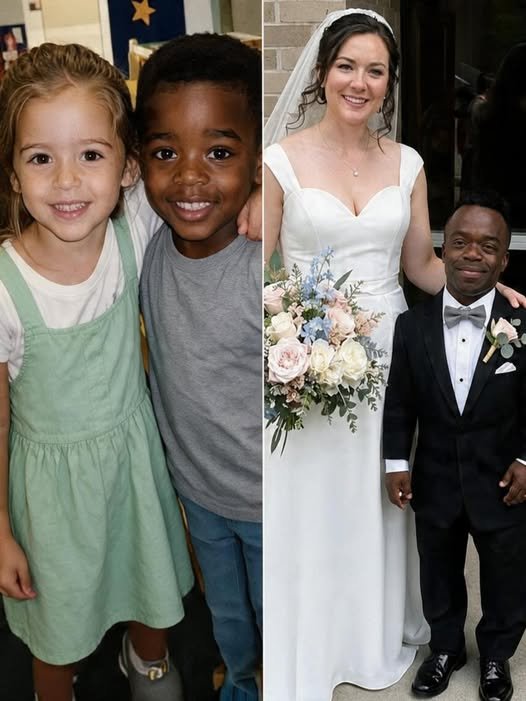
Part One: A Promise Written in Purple Crayon
Noah and I were six years old when we decided we would marry each other.
The agreement happened behind the monkey bars during recess, far away from the teachers and the other children. I tore a page from my spelling notebook and wrote our promise in purple crayon.
“If neither of us is married by the time we turn thirty,” I announced, trying to sound official, “we will marry each other.”
Noah leaned closer and studied the paper.
“You spelled ‘promise’ wrong.”
“I did not.”
“You added an extra letter.”
“You still understand what it says.”
He released a long sigh, as though he had already spent years dealing with my stubbornness.
“Fine.”
He signed his name beneath mine.
Later that afternoon, we bought two plastic rings from a vending machine outside the grocery store. Mine had a scratched purple stone, while his had a crooked silver star.
We pushed the rings onto our little fingers and linked pinkies.
“Thirty is incredibly old,” I whispered.
“Ancient,” Noah agreed. “We probably won’t even remember this.”
Then we raced each other back to school.
For a while, he was right.
The paper disappeared into childhood clutter, and the promise became one of countless things we had said without understanding what they meant.
But two years later, our world began to change.
Noah stopped growing.
At first, the difference was barely noticeable. He had always been smaller than most children our age. Our parents assumed he would eventually catch up.
He never did.
By fourth grade, the boys who had once stood shoulder to shoulder with him were several inches taller. Their arms and legs lengthened. Their faces began losing their childish softness.
Noah remained almost exactly the same size.
Doctors ordered one examination after another. He was measured, scanned, questioned, and studied until hospitals became as familiar to him as classrooms.
Eventually, his family received an explanation.
Noah had an extremely rare condition that affected the development of his bones and the way his body responded to growth hormones. His mind would continue maturing normally, but physically, he would remain close to the size of an eight-year-old child.
The diagnosis explained what was happening.
It did not prepare him for the way people would treat him.
By middle school, strangers assumed he was a lost elementary student.
By high school, people regularly asked whether I was babysitting him.
By adulthood, most people placed him into one of two categories: child or tragedy.
Noah despised both.
He was intelligent, sarcastic, impatient, and fiercely independent. He learned to build websites before most of us understood what a domain name was. He repaired electronics for neighbors and read biographies for entertainment.
He also cheated shamelessly at card games.
Whenever I accused him, he would grin and say, “Winning is not cheating.”
“It is when you hide cards under the table.”
“That sounds like poor observation on your part.”
Noah refused to behave as though the world’s cruelty had broken him.
Still, I noticed the moments when it came close.
Teenagers pointed at him in shopping centers. Adults stared openly in restaurants. Cashiers handed him children’s menus even after he showed them his identification.
Security guards questioned him.
Servers spoke to me instead of him.
Some people became overly sweet, as though he were fragile. Others acted uncomfortable, as though his appearance were something they should not acknowledge.
Dating was even worse.
Some women treated him like a joke. Others approached him out of curiosity and then disappeared when they realized he expected to be treated like an adult.
A few insisted they were interested in his personality, yet still spoke to him in the soft, artificial voice people often used around children.
Noah rarely complained.
When he was hurt, he usually covered it with humor.
For years, we remained inseparable. Then adulthood pulled us in different directions.
I left our hometown for college. Noah stayed behind, completed a computer science degree online, and began working for a software company.
At first, we talked almost every day.
Then our calls became weekly.
Eventually, weeks sometimes passed without either of us noticing.
I dated several men. Noah went on dates too, although none of his relationships lasted very long.
When I was twenty-six, I became engaged to a man named Evan.
Noah congratulated me immediately.
He never mentioned the purple-crayon agreement.
Neither did I.
By then, our childhood promise seemed like nothing more than a sweet memory.
I had no idea Noah had kept it.
Part Two: The Life I Thought I Was Losing
Evan and I planned to marry in early June.
Three weeks before the wedding, I was struck by a car.
I had been crossing the road at a marked intersection when a driver ignored a red light.
I remember hearing a horn.
I remember turning my head.
Then there was a violent impact, followed by the strange sight of the sky spinning above me.
When I opened my eyes again, I was lying in a hospital bed.
My pelvis had been shattered. One of my legs was fractured, and nerve damage had left my left foot partially numb.
The doctors chose their words carefully.
They believed I would walk again.
They could not tell me how long it would take or whether I would ever move without pain.
Evan visited twice.
During his first visit, he brought flowers and placed them beside the bed. He barely looked at me. His attention kept drifting toward the monitors, braces, and metal frame surrounding my injured leg.
The second time, he asked how long rehabilitation would take.
“Several months,” I answered.
He became unusually quiet.
One week later, he called me.
I could hear him breathing, but he said nothing for so long that I finally asked what was wrong.
“I don’t think I can do this,” he said.
I stared at the ceiling.
“Do what?”
“The recovery. The appointments. All of it.”
“You mean our marriage?”
“I’m not strong enough.”
Metal pins were holding part of my pelvis together, and the man I had planned to marry was explaining that my future had become too inconvenient for him.
“Are you leaving because I might need a cane?” I asked.
“It isn’t just the cane.”
“What else?”
“Everything will be different now.”
He continued apologizing, but his apologies sounded distant and empty.
I ended the call before he finished.
Afterward, I lay perfectly still.
The physical pain was unbearable, but it was not the pain I remember most clearly.
What hurt most was realizing Evan had loved the version of me who required nothing from him.
The moment that version disappeared, so did he.
I called Noah that evening.
My voice broke while I told him what had happened.
He did not insult Evan. He did not give me false encouragement or promise that everything would return to normal.
The following morning, Noah walked into my hospital room.
We had not seen each other in almost a year.
For several seconds, neither of us spoke.
Then he pulled a chair beside my bed and placed his hand over mine.
“You won’t face this by yourself,” he said.
That was all it took.
I began crying so hard I could barely breathe.
Noah did not attempt to stop me.
He simply stayed.
And then he kept staying.

Part Three: Learning How to Stand Again
For the next seven months, Noah reorganized nearly every part of his life around my recovery.
He arranged his work schedule so he could drive me to physical therapy three times a week. Because ordinary vehicle controls were difficult for him to use, he had modified his car years earlier with adjustable supports and specialized hand controls.
He made additional changes so I could enter and leave the car safely.
At my apartment, he installed rails in the bathroom and lowered several kitchen shelves so I could reach them from my wheelchair.
He cooked when standing caused too much pain.
He picked up prescriptions and attended appointments.
Most importantly, he learned when to help and when to step away.
Whenever I snapped, “I can manage it myself,” he usually raised his hands and replied, “Then manage it.”
If I failed, he did not rush forward with a satisfied expression.
He waited until I was ready.
“Would you like help now?” he would ask.
Some days, his patience made me furious.
Other days, my pride drove him to the edge of his own patience.
We argued about medication, missed appointments, and my habit of refusing assistance until I was trembling from exhaustion.
One night, I attempted to reach the shower without calling him.
My weakened leg gave way, and I fell onto the bathroom floor.
Noah found me sitting against the bathtub, half dressed, humiliated, and crying with anger.
He lowered himself onto the floor beside me.
For a while, he said nothing.
Then he looked at me.
“You don’t receive an award for suffering alone.”
“I don’t want to become someone else’s responsibility.”
His expression changed instantly.
“Don’t call yourself that.”
“You don’t understand.”
“I understand more than you think.”
I wiped my face.
“No, you don’t.”
Noah’s voice softened.
“I know what it feels like when people decide that your body makes your existence inconvenient.”
His words silenced me.
For years, I had defended Noah whenever strangers underestimated him. I had lectured people for confusing physical appearance with ability.
But the moment my own body changed, I began judging myself by the same cruel standard.
I had started believing that needing help made me less worthy.
Noah recognized that contradiction before I did.
He never tried to rescue me from every difficult moment. Instead, he remained close enough to help while allowing me to choose what happened next.
That night on the bathroom floor, I began to understand something about him that I had overlooked for years.
Noah did not make people feel strong by pretending they were never vulnerable.
He made them feel strong by refusing to treat vulnerability as shameful.
Several weeks later, I attempted to cross the rehabilitation room without assistance.
My physical therapist stood nearby.
“Take your time,” she instructed. “One careful step after another.”
The distance was barely twenty feet.
To me, it felt endless.
My left leg trembled the moment I placed weight on it. Sweat formed along my spine, and every muscle in my body begged me to stop.
Noah waited at the opposite end of the room.
Halfway across, I froze.
He lifted both hands.
“Come on, Christine,” he said. “You’re almost there.”
I took another step.
Then another.
When I finally reached him, Noah’s eyes were wet.
He immediately adjusted his glasses, attempting to hide the tears.
“You’re awful at pretending you aren’t crying,” I said.
“You’re awful at walking.”
I laughed, despite the exhaustion.
Then Noah reached inside his jacket and removed a folded piece of paper.
The edges had softened with age.
Faded purple crayon covered the center.
My breath caught.
“You didn’t.”
He carefully unfolded the page.
Our childhood marriage agreement was still there, complete with misspelled words, crooked signatures, and two badly drawn rings.
“You kept this?”
“For twenty-three years.”
I laughed until I began crying too.
Noah stared at the paper, but his usual smile disappeared.
“There’s something I need to tell you.”
My heart began beating faster.
“I don’t want you choosing me because Evan abandoned you,” he said. “And I don’t want gratitude confused with love.”
“Noah—”
“Please let me finish.”
I nodded.
“I love you,” he said. “I’ve loved you for a long time. But I only want a life with you if you understand the difference between needing someone and freely choosing them.”
For months, I had tried to convince myself that my growing feelings were simply gratitude.
Noah had come when Evan had left.
He had rearranged his work, repaired my apartment, driven me to appointments, and sat with me through my worst nights.
But gratitude did not explain why I recognized the sound of his footsteps in the hallway.
It did not explain why hearing him laugh made difficult days feel survivable.
And it certainly did not explain why the thought of him falling in love with someone else made my chest ache.
“I know the difference,” I whispered.
Noah looked terrified.
“I love you too.”
He closed his eyes.
“Are you certain?”
“No.”
His face fell.
I smiled through my tears.
“I’m certain that I love you. I’m not certain how to become your girlfriend without destroying twenty-three years of friendship.”
“That is an entirely different problem.”
“So we take our time.”
“A ridiculous amount of time,” he agreed.
Part Four: Choosing Each Other
Our first official date took place at a restaurant we had visited countless times as friends.
I changed clothes four times before leaving home.
Noah arrived carrying flowers, then complained that buying them had made him feel like an awkward teenager.
For the first thirty minutes, we debated whether calling the evening a date had ruined our ability to have a normal conversation.
Eventually, our nervousness faded.
Dating Noah was not dramatically different from being his best friend.
It was quieter than that.
The change existed in lingering looks, hands brushing across tables, and the knowledge that every goodbye now meant something it had not meant before.
The outside world continued staring.
Some people assumed I was his caregiver.
Others looked visibly unsettled when they realized we were romantically involved.
Noah worried I would eventually become exhausted from defending our relationship.
I worried he would never trust that I had chosen him without obligation.
Six months later, those fears nearly broke us.
By then, I had returned to work part-time and was walking with a cane.
Noah offered to drive me to an event, and I accused him of hovering.
“You’re starting to act like my nurse,” I said.
His expression hardened.
“I have never treated you like a patient.”
“You remind me about my medication.”
“Because you regularly forget it.”
“I don’t need you managing my life.”
“And I don’t need you rejecting every act of care just to prove you’re independent.”
We did not speak for two days.
On the third evening, I went to his apartment.
“I don’t want to love you simply because you helped me,” I said.
Noah studied me for a moment.
“Then don’t.”
“That isn’t what I meant.”
“I know.”
I sat beside him.
“I love you because you’re you. But sometimes I’m afraid that accepting your help means I’m depending on you for the wrong reasons.”
Noah reached for my hand.
“Then stop confusing care with pity.”
That conversation changed our relationship.
He began asking before helping.
I stopped treating every offer as an attack on my independence.
We learned that love was not one person carrying another.
It was two people paying attention to where the other needed space and where they needed support.
One year after my accident, Noah proposed.
He chose the small footbridge in the park where we had ridden bicycles as children.
He had barely begun speaking when I said yes.
“You haven’t heard the proposal yet,” he protested.
“I’ve heard you talk for twenty-four years. I understand the general idea.”
We were both twenty-nine.
The childhood deadline was approaching.
But neither of us believed the purple-crayon promise had decided our future.
We were not marrying because we had failed to find anyone else.
We were marrying because, after everything life had taken apart, we had found our way back to each other.
Unfortunately, our families did not see it that way.
Part Five: The Words That Almost Destroyed Us
Noah’s parents cared deeply for me, but they were cautious.
They worried I had mistaken loyalty for romance. They were afraid I saw marriage as a way of repaying Noah for helping me recover.
My mother was less careful with her doubts.
During our engagement dinner, she pulled me into the kitchen and closed the door.
“You cannot truly be planning to marry him,” she said.
“I am.”
“This began with a childhood promise.”
“It has nothing to do with that paper.”
“You were going to marry Evan.”
“Yes, and then I discovered what kind of man Evan was.”
“You were injured. Noah took care of you. Now you believe you owe him your life.”
“I don’t owe Noah anything.”
My mother’s eyes filled with frustrated tears.
“What kind of future can he give you?”
Her question turned something inside me cold.
“A future built on respect.”
“You will spend your entire life explaining your relationship.”
“He isn’t a complicated idea.”
“You know exactly what I mean.”
“No,” I said. “Say it honestly.”
She hesitated, then lowered her voice.
“He looks like a child.”
A chair scraped across the floor in the next room.
I opened the kitchen door.
Noah was already heading toward the porch.
He had heard everything.
I followed him outside, but he asked to be left alone.
After that evening, the comments became increasingly difficult to ignore.
One cousin asked whether we had considered “the practical challenges.”
A former friend joked that our wedding photographs might confuse people.
Someone told Noah he was fortunate to find a woman willing to overlook his condition.
Every remark took something from him.
He stopped discussing wedding plans.
During suit fittings, he avoided mirrors.
Whenever I asked what was wrong, he claimed he was tired.
I believed I understood how deeply the cruelty affected him.
I did not understand until our wedding day.

Part Six: The Moment He Tried to Let Me Go
Zahara, my maid of honor, entered the bridal room while the stylist was pinning my hair.
She looked frightened.
“Noah has locked himself in the dressing room.”
I stood so quickly that the stylist nearly dropped the curling iron.
At the dressing-room door, I knocked.
“Noah?”
There was no reply.
I knocked again.
“Open the door.”
“I need a moment.”
“You’ve already had several.”
Zahara found the venue manager, who brought a key.
When the door opened, Noah was sitting on the floor in his wedding suit.
The old purple-crayon promise rested in his hands.
His eyes were red.
“I’m releasing you from it,” he said.
For a moment, I could not understand what he meant.
“Releasing me from what?”
“The promise.”
I knelt in front of him.
“Noah, we are not standing here because of that paper.”
“You don’t have to keep protecting me.”
“I’m not protecting you.”
“You have done it since we were children.”
“I spent most of my childhood punching boys who deserved to be punched.”
“I’m serious, Christine.”
“So am I.”
He looked toward the open doorway.
“Your mother was right about one thing. You will always have to explain us.”
“Noah—”
“People will stare at you. They’ll question you. They’ll insult you and assume something is wrong with you for choosing me.”
“They already do.”
“I can make it stop.”
“By leaving me on our wedding day?”
His face crumpled.
“I’m trying to save you.”
“From what?”
“From waking up ten years from now and realizing that pity became your entire life.”
I took the paper from his hands.
“There is something I never told you.”
He became still.
“I knew I loved you before I crossed that rehabilitation room.”
“Christine…”
“I knew the night I fell in the bathroom.”
“That was one of the worst nights of your recovery.”
“It was. I was furious, embarrassed, barely dressed, and crying on the floor.”
I touched the faded purple letters on the paper.
“You could have rushed in and taken control. You could have made me feel helpless. Instead, you sat beside me until I decided what kind of help I wanted.”
Noah lowered his eyes.
“Evan saw my injured body and decided my life had become too difficult. You saw me at my weakest and never made me feel like I had become less of a person.”
I placed my hand against his cheek.
“You didn’t carry me until I could walk again. You stood beside me until I remembered that I was still myself.”
His eyes filled with tears.
“I still don’t want your gratitude.”
“Good, because gratitude is not why I become jealous when women flirt with you.”
A surprised laugh escaped him.
“Gratitude is not why I know exactly how you take your coffee. It isn’t why I miss you after one night apart. And it certainly isn’t why I want to spend the next fifty years arguing with you.”
“Only fifty?”
“Let’s see how well you behave.”
I rose slowly and extended my hand.
Noah stared at it.
Then he placed his hand in mine.
Instead of returning to our separate rooms, I led him directly into the ceremony hall.
The guests had not yet taken their seats.
My mother looked up in surprise.
I faced the room.
“Before this ceremony begins, I need everyone to understand something.”
The conversations stopped.
“Noah is not a child. He is not a charity project, and he is not an obligation created by a promise we made in kindergarten.”
My mother’s face lost its color.
“I am marrying him because I love him. Anyone who believes his body makes him less intelligent, less capable, or less of a man is free to leave.”
Silence filled the room.
Then Zahara stepped beside us.
“You heard her,” she said firmly.
One guest picked up her purse and quietly walked out.
My mother remained seated.
She lowered her eyes.
Ten minutes later, the ceremony began.
Part Seven: The Promise We Chose to Keep
When it was time to exchange rings, Noah opened the small box in his hands.
Our wedding bands rested inside.
Beneath them were two tiny plastic rings.
Mine still held its scratched purple stone.
His still had the crooked silver star.
I laughed through my tears.
“You kept those too?”
“For twenty-three years.”
We exchanged the real wedding bands first.
After the officiant pronounced us married, Noah carefully placed the old plastic ring onto the tip of my little finger.
I did the same for him.
The promise we had written at six years old was not the reason we stood at the altar.
It had not survived because we were lonely.
It had not survived because Noah was incapable of finding love or because I felt responsible for protecting him.
It survived because two children had somehow recognized where they felt safest long before they understood the meaning of love.
Noah’s body stopped growing when he was eight.
His intelligence did not.
His humor did not.
His courage did not.
And his heart never stopped expanding.
I did not marry Noah because the world said no one else would love him.
I married him because, after years of searching for the life I believed I wanted, I realized my greatest love had been beside me all along.